

Hoi An Travel Tips
Sa Huynh Culture Museum Hoi An 2026: Jar Burials, Ticket and Hours
Sa Huynh Culture Museum Hoi An 2026: Jar Burials, Two-Headed Earrings and the Ticket Square Worth Spending
The Sa Huynh Culture Museum sits beside the Japanese Covered Bridge and holds over 1,000 objects dug out of Hoi An itself — from the people who lived here 1,600 years before the bridge was built.
Two thousand years before there was an Old Town, there were people at the mouth of the Thu Bon. They made pottery, worked iron early, wore stone earrings carved with two animal heads, traded with India and Han China — and buried their dead in ceramic jars as tall as a child. This small yellow museum next to the bridge is where you meet them, and almost every object in it came out of the ground within a few kilometres of where you are standing.
- What the museum is
- Where it is and walking there
- Ticket, hours and the evening move
- Who the Sa Huynh people were
- The building and how the two floors work
- Seven objects worth stopping for
- The eight dig sites around Hoi An
- Best hour, manners and photographs
- What to pair it with
- Is it better than the Hoi An Museum?
- Frequently asked questions
The Sa Huynh Culture Museum: what it is
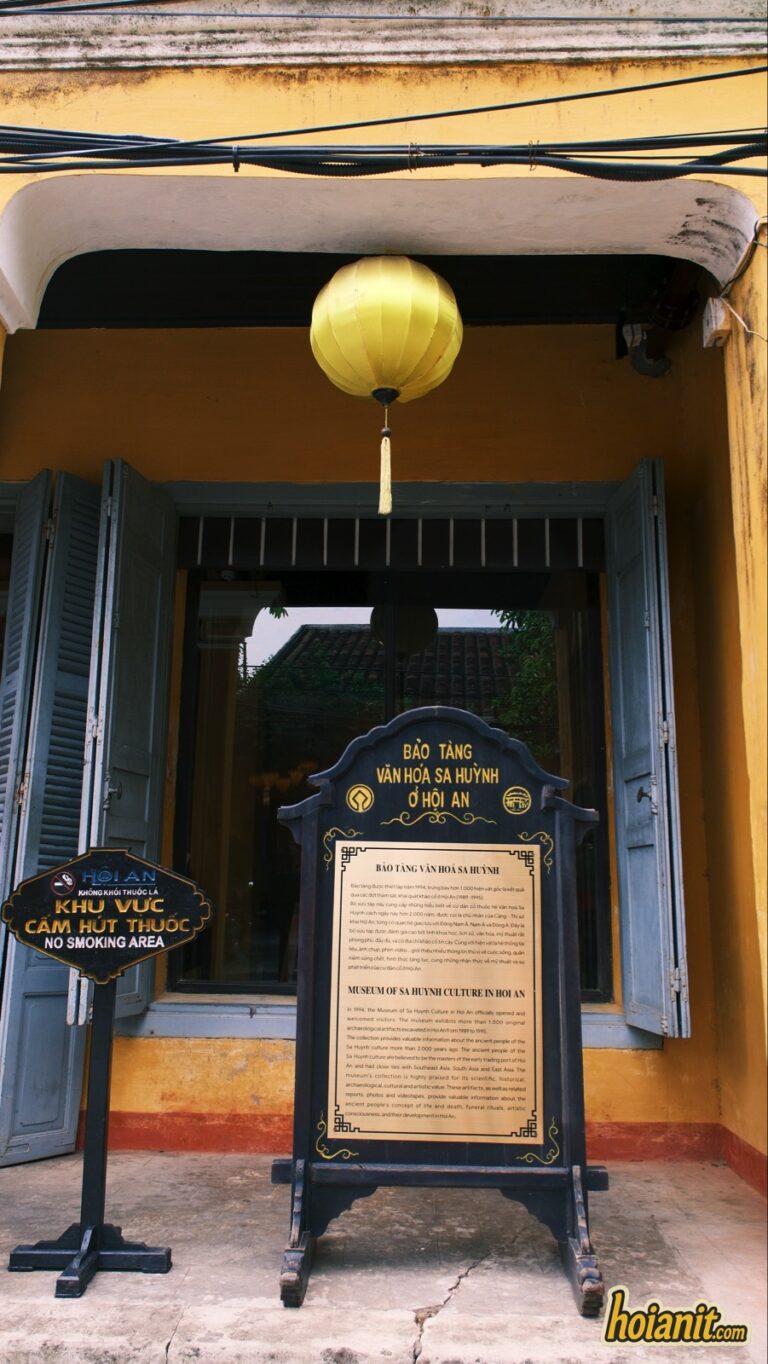
The museum opened in 1994, five years before the Old Town went on the UNESCO list, to show what Hoi An’s own archaeologists had been pulling out of the sand dunes through the late 1980s and early 1990s. That origin matters: this is not a travelling collection or a set of loans. Everything here was excavated locally.
The holdings run to more than 1,000 original objects — jar burials, pottery, iron tools, stone and glass ornaments, bronze, and coins — dating from roughly the 2nd century BC to the 2nd century AD. It is one of the twenty-one sites on the Old Town ticket, run by the Hoi An Centre for Cultural Heritage Management and Preservation, and if you count only objects dug up on site it is the fullest Sa Huynh collection in central Vietnam.

Where it is and walking there
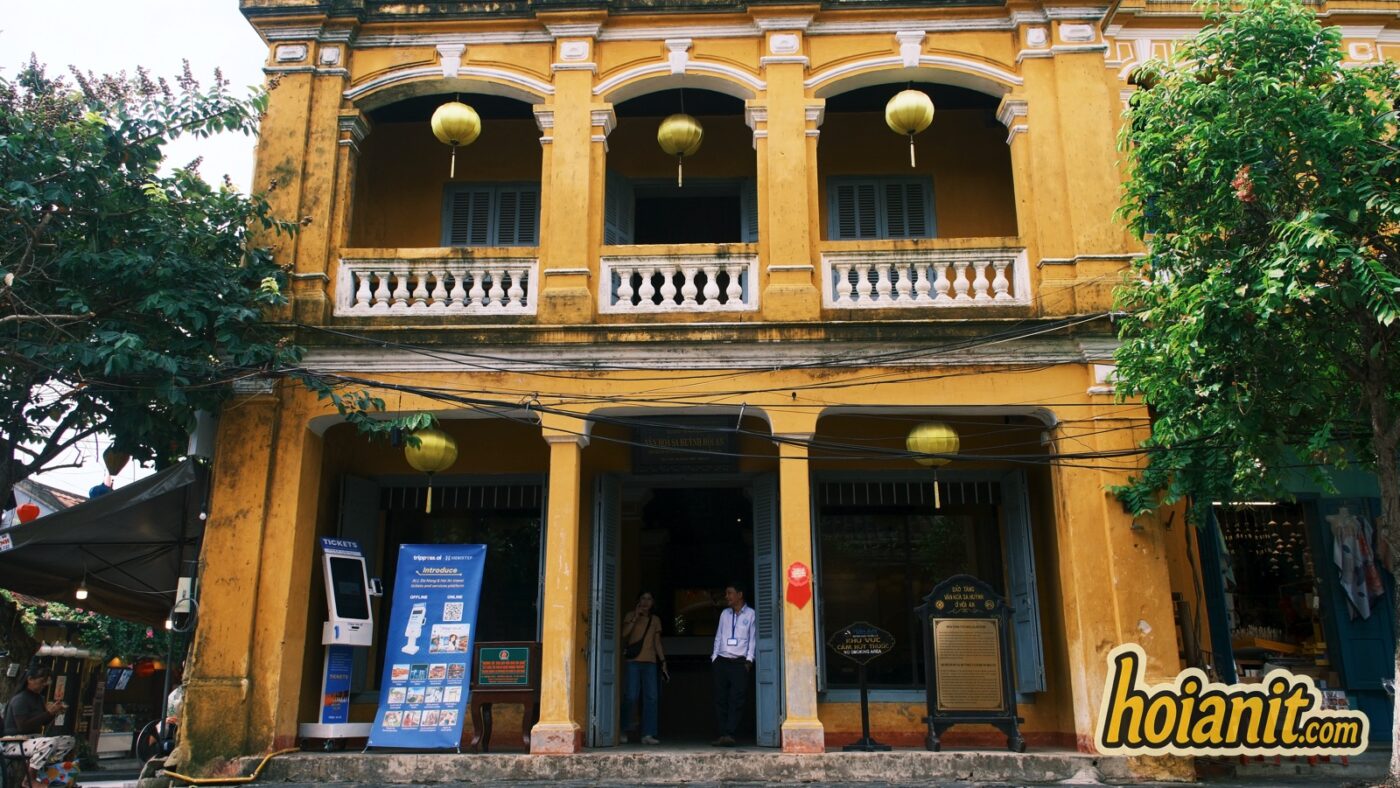
Address 149 Tran Phu, at the western end of the street, a few steps from the Japanese Covered Bridge. From our shop at 84 Phan Chau Trinh it is 220 m, about 3 minutes on foot, measured on Google Maps — which makes it the closest ticketed site in the Old Town to our door. Look for the two-storey yellow colonial building with a balcony and lanterns, on the right as you walk towards the bridge.
- You walk. Tran Phu closes to motorbikes 9:00–11:00 and 15:00–21:30 — see the Old Town vehicle-free hours. Leave the bike with us for free and walk down; it is quicker than finding parking.
- From the bridge: one minute. Step off the bridge, and it is right there.
- From the market: the far end of Tran Phu, about ten minutes east to west.
Ticket, hours and the evening move
| Item | Detail |
|---|---|
| Vietnamese visitors | 80,000₫ |
| International visitors | 120,000₫ |
| Children 1–1.4 m | 40,000₫ / 50,000₫; under 1 m free |
| Covers | 3 of the 21 ticketed sites, valid 24 hours |
| Hours | 7:00 to 21:00 daily; closed on the 10th of every month for maintenance |
| Time needed | 20–30 minutes; 45 if you read every panel |
Two things about those hours are worth planning around.
First, the museum is open until 21:00 while the ancient houses and assembly halls shut at 17:00 or 18:00. If you arrive in Hoi An in the afternoon, spend two stubs in daylight on buildings that close early and keep the third for here after dinner. Lantern-lit street outside, two-thousand-year-old burial jars inside, and usually nobody else in the room.
Second, it closes on the 10th of every month. That catches people out. If your one full day in Hoi An falls on a 10th, swap in the Museum of Trade Ceramics four minutes away. Full mechanics of the ticket are in our guide to the Hoi An entrance ticket, and the machines in the smart ticket kiosks.
Who the Sa Huynh people were
The culture takes its name from a site found at Sa Huynh in Quang Ngai in 1909, and it stretched along the central coast from Quang Binh down towards Dong Nai. It is contemporary with Dong Son in the north and Oc Eo in the south — Vietnam’s three early-iron-age worlds, running in parallel.
These were people of the river mouths and coastal dunes. They farmed, fished, worked iron unusually early, and — the part that changes how you read the whole town — they traded a very long way. Glass and carnelian beads from India and bronze coins from Han China turn up inside graves here. Which means the Thu Bon estuary was already a trading landfall centuries before Christ. The famous sixteenth-century port did not start from nothing; it was the same river mouth doing the same job, fifteen hundred years later.
The signature practice is the jar burial: the dead, or their ashes, placed inside a large ceramic jar with a conical lid and buried with ornaments, tools and small pots. Because those grave goods sat undisturbed, archaeologists have been able to reconstruct almost the whole of daily life from them. The Sa Huynh are generally regarded as ancestors of the Cham — who were the next owners of this coast, long before the Vietnamese arrived.
The bridge outside is four hundred years old. The people in the cases lived here sixteen hundred years before the bridge.
The building and how the two floors work
- The building itself. An early-twentieth-century French two-storey house — yellow walls, turned balcony rail, green shutters. It is one of the few colonial buildings left intact on Tran Phu, and it is worth photographing from the street before you go in.
- Ground floor: the digs. A map marking the eight excavation sites around Hoi An, photographs of the trenches, a reconstructed grave pit with a jar set as it was found, and then the cases of jars themselves — egg-shaped, cylindrical, spherical.
- Upper floor: what went in with the body. Ornaments, iron tools, small pots, coins, plus comparison panels setting Sa Huynh against Dong Son and against the Cham culture that followed. The balcony here looks straight out at Tran Phu and the roof of the bridge.
Read the excavation map before you look at anything else. The objects mean twice as much once you know they came from a dune three kilometres away that is now a pottery village.

Seven objects worth stopping for
- An egg-shaped burial jar with its lid. Close to a metre tall, truncated conical lid. The signature object of the whole culture.
- The two-headed animal earring. Stone or glass, carved with an animal head facing out at each end — usually described as a goat or a saola. This is the emblem of Sa Huynh, and versions of it have been found as far away as the Philippines and Thailand, which tells you how far these people’s contacts reached.
- The three-pointed earring. A ring with three projecting points, often in green nephrite, worn through the earlobe.
- Carnelian and coloured glass beads. Trade with India and island Southeast Asia, sitting in a grave in Hoi An.
- Wu Zhu and Wang Mang coins. Han Chinese bronze coins from around the 1st century BC to 1st century AD, found in local burials — direct evidence of trade with China.
- Iron tools. Axes, knives, spearheads, hoes. Early ironworking is one of the things that distinguishes this culture.
- Painted and incised pottery. Bowls, jars and cooking pots decorated with shell-edge impressions and red ochre, which can be traced forward into later Cham ceramics.

The eight dig sites around Hoi An
The map on the ground floor marks where all this came from: Hau Xa I and Hau Xa II in Thanh Ha, three kilometres from the Old Town and the source of the most jar burials; An Bang, directly behind the beach of the same name; Cam Pho; Trang Soi; Lang Ba; Thanh Chiem in Dien Ban; and Bai Ong on Cham Island, which has the oldest occupation traces of the lot at over 3,000 years.
Look at that list against a modern map and something clicks. The Sa Huynh chose the high sand ridges by the river and the sea — and those exact places are today the Thanh Ha pottery village, An Bang beach and Cham Island. The places you would ride out to this afternoon are the places they chose to live. The dunes were dry, defensible and next to the water; that has not changed in two thousand years.
Best hour, manners and photographs
| When | What it is like | Verdict |
|---|---|---|
| 7:00–8:30 | Empty and cool, before the bridge crowd | Best in daylight |
| 9:00–11:00 | Groups arrive from the bridge; rooms are small | Cramped |
| 19:00–21:00 | Street packed outside, museum almost private | The one nobody thinks of |
| The 10th | Closed all day | Go to the Museum of Trade Ceramics instead |
- Manners: do not touch the cases and do not lean on the reconstructed grave pit. The rooms are small and echo, so keep your voice down.
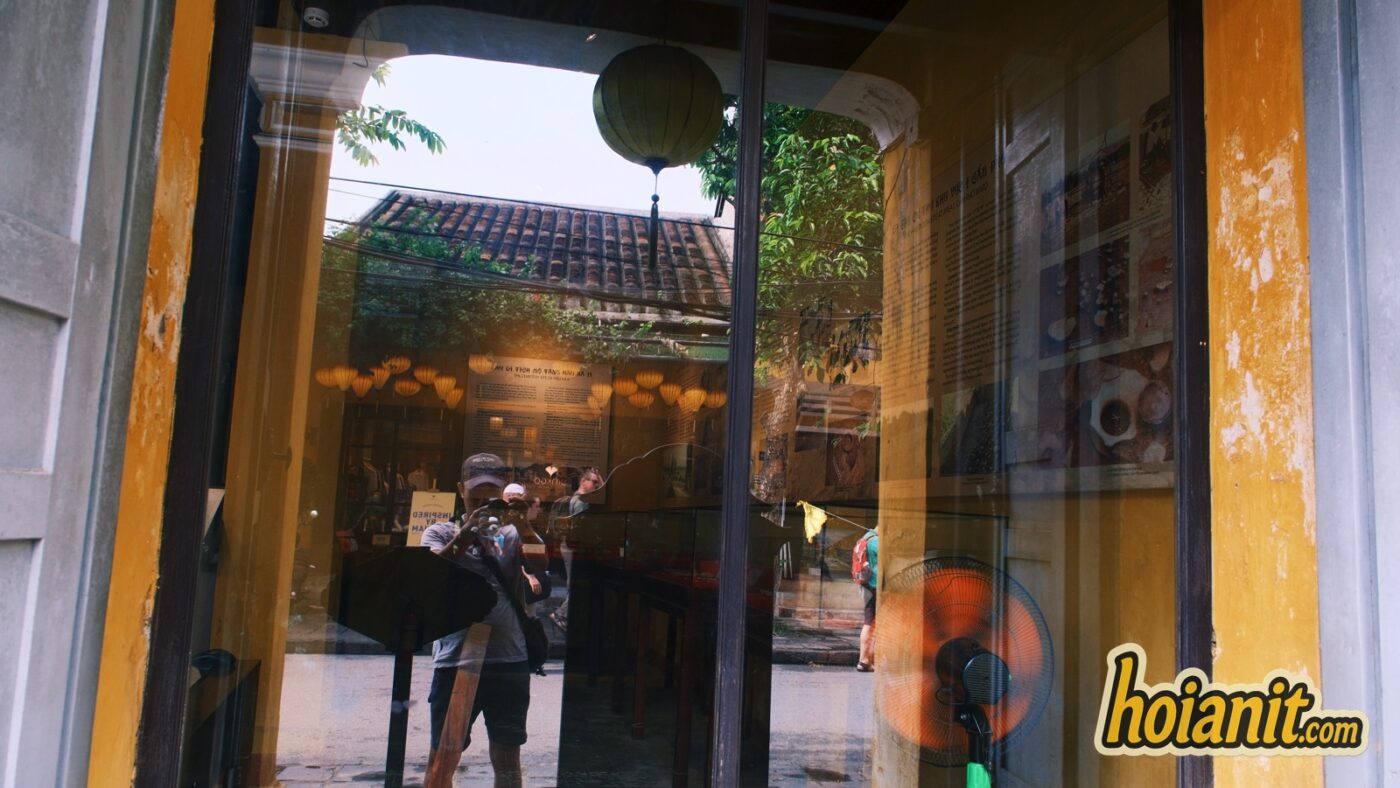
- Photography: allowed without flash. The two shots are a lit jar in its case, and the upper balcony looking out over Tran Phu.
- With children: the grave pit and the two-headed earrings are what they remember. Twenty minutes is about right.
- Accessibility: the upper floor is reached by stairs and there is no lift, so the ornament rooms are not step-free.
What to pair it with
- The Japanese Covered Bridge — one minute. Walk out of the door and it is in front of you.
- Phung Hung Ancient House — two minutes, on the far side of the bridge, with the balcony that looks back down on it.
- The Museum of Trade Ceramics — four minutes east, and the logical next chapter: the trading pottery of the 15th to 18th centuries.
- The Hoi An Museum — ten minutes, the general history museum, which has its own Sa Huynh and Cham room.
- The Cantonese Assembly Hall — also by the bridge, and the best courtyard of the five halls.
Is it better than the Hoi An Museum?
They answer different questions, and choosing badly wastes a stub.
| Sa Huynh Culture Museum | Hoi An Museum | |
|---|---|---|
| Covers | One culture, 2,000 years ago, in depth | The whole story from Sa Huynh to today |
| Objects | 1,000+, all locally excavated | Broader, more mixed, more reproductions |
| Where | 149 Tran Phu, beside the bridge | 10B Tran Hung Dao, 10 min away |
| Time | 20–30 min | 45–60 min |
| Choose it if | You like archaeology and are short of time | You want the full chronology in one building |
Short version: archaeology and thirty minutes, come here. Whole history and an hour, go to the other one. Both on the same ticket, so it is a question of which stub you would rather spend.
Ride out to where the jars came from
We are 220 m from the museum door at 84 Phan Chau Trinh. See the jars in the morning, then take a bike out to Thanh Ha, An Bang or the boat to Cham Island in the afternoon — the same dunes the Sa Huynh chose. Scooters, semi-automatics, electric bikes and bicycles, with helmets, raincoats and a map showing the vehicle-free hours. Want something lighter? You can rent a scooter in Hoi An from 110,000₫ a day.
Sa Huynh Culture Museum: frequently asked questions
Where is the Sa Huynh Culture Museum?
At 149 Tran Phu, at the western end of the street beside the Japanese Covered Bridge. From our shop at 84 Phan Chau Trinh it is 220 m, about 3 minutes on foot — the closest ticketed site in the Old Town to our door.
Do I need a ticket?
Yes. It is one of the 21 ticketed sites, so entry uses one of the three stubs on the Old Town ticket — 80,000₫ for Vietnamese visitors, 120,000₫ for international visitors, valid 24 hours. There is no separate admission.
What are the opening hours?
7:00 to 21:00 daily, and closed on the 10th of every month for maintenance. It is one of the few Old Town museums open in the evening; the quietest windows are 7:00–8:30 and after 19:00.
What is on display?
More than 1,000 original Sa Huynh objects dating from roughly the 2nd century BC to the 2nd century AD, excavated at eight sites around Hoi An: jar burials, two-headed animal earrings, three-pointed earrings, carnelian and glass beads, iron tools, pottery and Han Chinese bronze coins.
What was the Sa Huynh culture?
An early iron-age culture of Vietnam’s central coast, roughly 2,000 years ago, contemporary with Dong Son in the north. It is known for burying the dead in large ceramic jars and for the two-headed animal earring, and is generally regarded as ancestral to the Cham.
How long does a visit take?
Twenty to thirty minutes for both floors, or about forty-five if you read every panel. It pairs naturally with the Japanese Covered Bridge one minute away and the Museum of Trade Ceramics four minutes east.
Is it suitable for children?
Yes, for about twenty minutes. The reconstructed grave pit and the two-headed earrings hold their attention. Note that the upper floor is up stairs with no lift.
Should I choose this or the Hoi An Museum?
Choose the Sa Huynh Culture Museum if you like archaeology and have half an hour — it is beside the bridge and goes deep on one culture. Choose the Hoi An Museum at 10B Tran Hung Dao, ten minutes away, if you want the whole history of the town in one building.








Pick your ride in Hoi AnChọn xe cho chuyến đi Hội An
Scooters, electric bikes and bicycles from one shop in the Old Town — delivered to your hotel, helmets and roadside help included.Xe máy, xe điện và xe đạp — giao tận khách sạn, kèm hai nón bảo hiểm và hỗ trợ dọc đường.
Not sure which one fits? Message us on WhatsApp and we’ll recommend a bike for your plans.
Chưa biết chọn xe nào? Nhắn Zalo 0935 439 306, tụi mình tư vấn theo lịch trình của bạn.