

Hoi An Travel Tips
Phung Hung Ancient House Hoi An 2026: Ticket, 80 Columns and the Flood Trapdoor
Phung Hung Ancient House Hoi An 2026: The Ticket, the 80 Ironwood Columns and the Trapdoor in the Floor
Phung Hung Ancient House stands at the west end of the Japanese Covered Bridge, built in 1780 and lived in by the same family for eight generations. The best thing in it is a hole in the ceiling.
Cross the Japanese Covered Bridge heading west and the two-storey timber house on your right is Phung Hung. It is the largest of the four ancient houses open to visitors in Hoi An, and the only one with a real balcony — but the thing worth walking in for is not the furniture. It is a square hatch cut through the upstairs floor, and the pencil marks on the columns below it.
- What the house is, and why it is the big one
- Walking there from the bridge
- Ticket, hours and how long to stay
- 1780, eight generations, and a name that means prosper
- Three architectures in one room
- The trapdoor, the pulley and the flood marks
- What to see, in order
- Best hour, manners and the balcony shot
- Four ancient houses: which one to choose
- What to pair it with
- Frequently asked questions
Phung Hung Ancient House: what you are walking into
Four houses in the Old Town are open as ticketed sites: Tan Ky, Quan Thang, Duc An and this one. They were all merchant houses — shop at the front, storage above, family behind — and structurally they are cousins. What makes Phung Hung Ancient House the odd one out is height and width. It is two full storeys with a wide frontage and a timber balcony running the length of the upper floor, which is why it feels like a building rather than a corridor.
It was listed as a national historic-cultural monument in 1993, six years before the Old Town as a whole went onto the UNESCO World Heritage list, and it is one of the twenty-one sites your Old Town ticket admits you to. The family who own it still live in the back while the front is open to visitors — which means somebody in the room usually knows the answer if you ask.
Walking there from the bridge
Address 4 Nguyen Thi Minh Khai, immediately at the western end of the Japanese Covered Bridge. From our shop at 84 Phan Chau Trinh it is 200 m, about 3 minutes on foot, measured on Google Maps: along Tran Phu, over the bridge, house on your right as you step off it.
- Ticket gate warning. If you approach from Tran Phu you cross the bridge, and there is a ticket check at the bridge end. Coming around the lane by the creek instead avoids it — worth knowing if you only want to look at the outside.
- You walk. This is deep inside the pedestrian core, closed to motorbikes 9:00–11:00 and 15:00–21:30. See our guide to the Old Town vehicle-free hours, or just leave the bike with us for free and walk in.
- Parking: the western end of Nguyen Thi Minh Khai has paid parking outside the zone.
Ticket, hours and how long to stay
There is no separate admission. Since 10 August 2026 each of the twenty-one ticketed sites costs 20,000₫ per person, and a family member checks your ticket at the door here, usually with a short explanation in Vietnamese or English thrown in.
| Item | Detail |
|---|---|
| Adults, any nationality | 20,000₫ per site, since 10 August 2026 |
| Children under 16 | Free |
| Covers | This site only; each of the 21 ticketed sites is charged separately |
| Hours | 8:00 to 18:00 daily; short lunch break possible, closed in the evening |
| Time needed | 20–30 minutes |
How the whole system works is in our guide to the Hoi An entrance ticket, and the machines that have replaced some of the booths in the smart ticket kiosks.
1780, eight generations, and a name that means prosper
The house went up in 1780, when Hoi An was still the busiest port in central Vietnam. The first owner was a Vietnamese merchant dealing in cinnamon, pepper, salt, silk and ceramics — exactly the cargo that Japanese, Chinese and Portuguese ships came here to buy. The building did three jobs at once: shopfront downstairs, warehouse on the upper floor, family quarters at the back.
Phung Hung translates roughly as prosper or flourish, which is what the merchant was asking for when he named it. Whether or not the name did the work, the family is still here eight generations later, having sat out two wars and several dozen serious floods in the same rooms.
A house built for two seasons: the trading season downstairs and the flood season upstairs.
Three architectures in one room
Guides describe Phung Hung Ancient House as Vietnamese, Chinese and Japanese all at once, which sounds like a brochure line until somebody shows you where to look. Here is where.
- Vietnamese — the skeleton. A post-and-beam frame of 80 ironwood columns, each standing on its own stone base to keep damp and termites out of the timber. The roof is yin-yang tiling, laid in alternating cupped and covering courses so heavy rain drains off fast. This is the local building system, unchanged for centuries.
- Chinese — the face. The timber shopfront, the turned balcony rail, and the pair of round door eyes carved above the main entrance with bagua and chrysanthemum motifs. Those eyes are on almost every old house in Hoi An and they come from Chinese house-protection belief.
- Japanese — the top. The wide four-sided upper roof and the galleried loft running round the interior belong to the Japanese building tradition that was in town when the Japanese quarter stood on the other side of the bridge.
- What is missing: metal. The frame is timber, tile, brick and lime, joined by carpentry rather than fasteners.
Stand in the middle of the front room and look up. You get all three at once — the local frame carrying a Japanese roof over a Chinese shopfront — and that single view is a better summary of what Hoi An was than any museum panel in town.
The trapdoor, the pulley and the flood marks
This is the part almost every visitor walks under without noticing. The house sits beside the creek that runs into the Thu Bon, which makes it one of the first buildings in the Old Town to take water when the river rises. The people who built it in 1780 knew that, and they designed for it.
Cut into the upstairs floor is a square trapdoor opening directly over the front room. When the flood came, the family hauled stock, furniture and eventually themselves up through that hatch on a pulley, then lived on the upper floor for as long as the water stayed. Not an emergency measure — a routine, repeated most autumns for two and a half centuries.
Look at the columns and the walls while you are down there and you will find pencil and paint marks recording the flood levels of particular years. Ask whoever is at the door and they will point out 1964 and 1999, the two that everybody in Hoi An still measures against. The 1999 mark in particular is higher than most visitors expect, and it changes how the whole street looks on the walk back.
Once you have seen the hatch here, you start noticing that nearly every old house in Hoi An has a timber loft. They were not built as bedrooms. They were built as the place you go when the water arrives — which is also why the town’s furniture is lighter than it looks and why nothing valuable was ever kept on the ground.
What to see, in order
- The door eyes, before you go in. Two carved discs above the main door. Look at them from the street; inside you cannot.
- The front room. The former shop floor, now furnished with old tables, an altar cabinet and household pieces. Look up for the roof frame and the trapdoor; look down for the stone column bases.
- The stairs. Steep, narrow and original. Take them slowly, and give way to people coming down — there is no passing space.
- The ancestral loft. Upstairs is the family altar and a shrine to Thien Hau Thanh Mau, the sea goddess — the merchant’s insurance policy on cargo that had to cross open water. Hats off, voices down.
- The balcony. The reason to come. It looks straight down onto the Japanese Covered Bridge and along Nguyen Thi Minh Khai, and it is the only legal elevated view of the bridge in town.
- The embroidery counter. The family sell embroidery and small lanterns near the exit, and on some days somebody is working a frame. No pressure to buy.
Best hour, manners and the balcony shot
| When | What it is like | Verdict |
|---|---|---|
| 8:00–9:00 | Just open, empty, early sun into the front room | The hour to aim for |
| 9:00–11:00 | The bridge crowd arrives; the staircase becomes a queue | Avoid |
| 15:30–17:30 | Afternoon light on the balcony, groups thinning | Good, and you catch the bridge at dusk after |
| October–December | May shut for a few days when the water is up | Ask at the bridge ticket booth first |
- Dress: ordinary clothes are fine, but the upper floor is a family altar. Hat off, and do not sit on the antique furniture.
- Photography: no flash indoors — the timber eats it and the gilding goes flat. The two shots worth taking are the balcony looking down at the bridge, and standing in the middle of the front room looking up at the frame.
- The stairs: not suitable for anyone unsteady on their feet, and there is no alternative route to the upper floor.
Four ancient houses: which one to choose
| House | Address | What it does best |
|---|---|---|
| Phung Hung | 4 Nguyen Thi Minh Khai | Space, the balcony over the bridge, the flood story |
| Tan Ky | 101 Nguyen Thai Hoc | Antiques, inlaid poem panels, the river-back entrance |
| Duc An | 129 Tran Phu | A bookshop and a genuine revolutionary history |
| Quan Thang | 77 Tran Phu | The smallest and quietest; fine Chaozhou carving |

If you want one house and one house only, take this one for the volume and the balcony, or Tan Ky if you would rather see objects than architecture. Doing two in a row is the classic first-timer mistake: the second one feels like a repeat because structurally it is one.
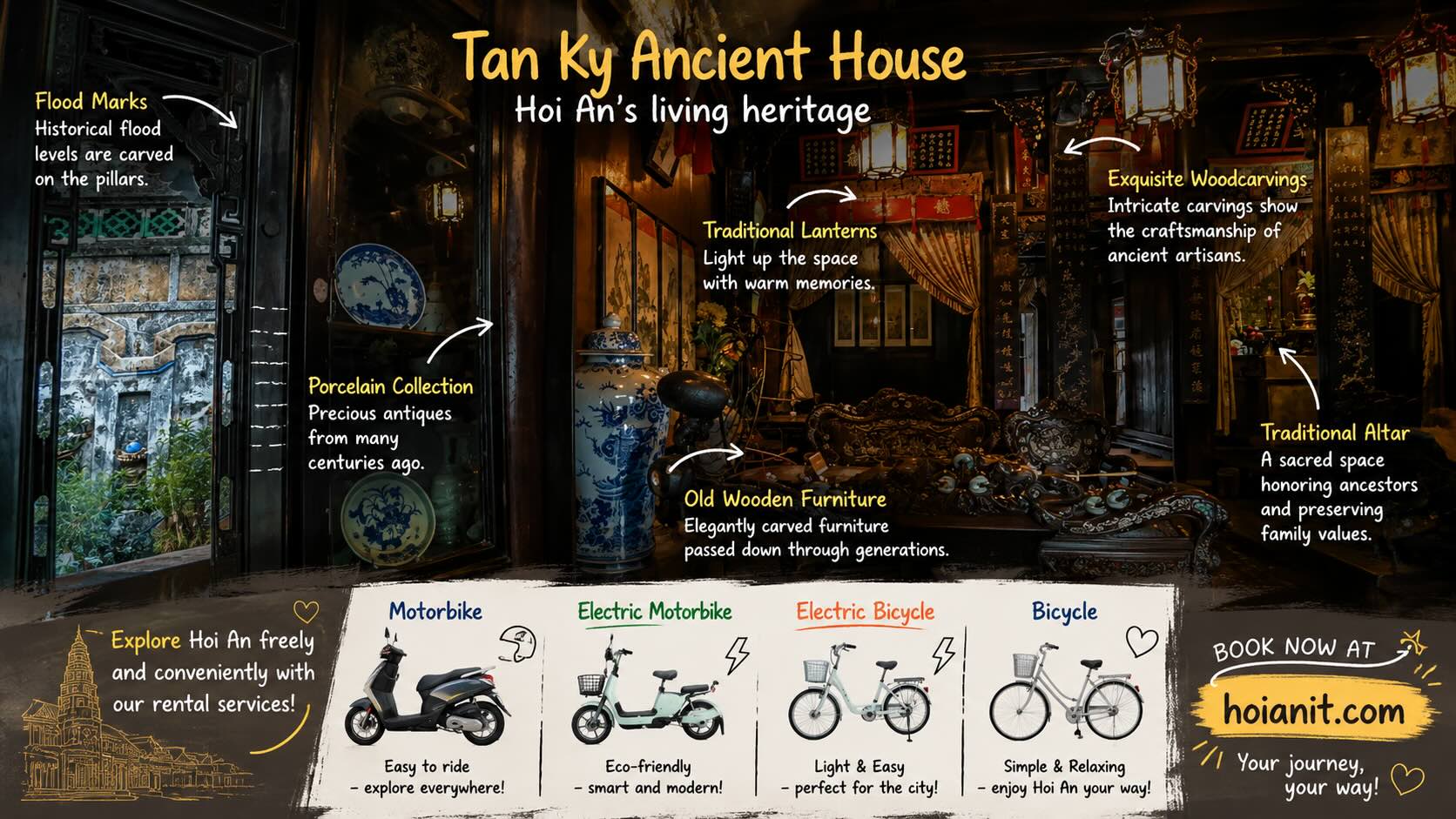
What to pair it with
- The Japanese Covered Bridge — literally outside the door, and you have just photographed it from above.
- The Cantonese Assembly Hall — two minutes back across the bridge, with the best courtyard in town.
- The Fukien Assembly Hall — seven or eight minutes east along Tran Phu, the grandest of the five halls.
- Hoi An Market — the far end of the same street, and the cheaper lunch.
Old Town on foot, everything else on two wheels
We are 200 m away at 84 Phan Chau Trinh. Leave the bike with us for free while you walk the ticket circuit, then ride out to An Bang, Cua Dai or the Bay Mau coconut forest when the afternoon cools. Scooters, semi-automatics, electric bikes and bicycles, with helmets, raincoats and a map marked with the vehicle-free hours. For the full automatic range, start with Hoi An scooter rental — from 110,000₫ a day.
Phung Hung Ancient House: frequently asked questions
Where is Phung Hung Ancient House?
At 4 Nguyen Thi Minh Khai, immediately at the western end of the Japanese Covered Bridge. From our shop at 84 Phan Chau Trinh it is 200 m, about 3 minutes on foot.
Do I need a ticket to go inside?
Yes. It is one of the 21 ticketed sites in the Old Town, so entry costs 20,000₫ per person, the same for Vietnamese and foreign visitors since 10 August 2026; children under 16 go free. A member of the family checks tickets at the door.
What time does it open?
8:00 to 18:00 daily, with a possible short lunch break, and closed in the evening. The quietest window is 8:00 to 9:00, before the crowd crosses over from the bridge.
How old is the house?
It was built in 1780 by a Vietnamese merchant trading cinnamon, silk and ceramics, and the same family has occupied it for eight generations. It was listed as a national historic-cultural monument in 1993.
What is the trapdoor in the ceiling for?
Floods. When the river rises the family hauls goods, furniture and people up through the hatch on a pulley and lives on the upper floor until the water drops. Marks on the columns record the levels reached in 1964 and 1999.
What makes the architecture of Phung Hung Ancient House unusual?
Three traditions in one building: a Vietnamese post-and-beam frame of 80 ironwood columns on stone bases, a Chinese shopfront with carved door eyes, and a wide Japanese-style upper roof with a galleried loft. Almost no metal is used in the frame.
How long does a visit take?
Twenty to thirty minutes: front room, roof frame and trapdoor, the stairs, the ancestral loft with its Thien Hau altar, and the balcony over the bridge.
Is it worth it if I have already seen Tan Ky?
Only for the balcony and the flood story. Structurally the two houses are close relatives, and most people find the second ancient house of the day much less interesting than the first.








Pick your ride in Hoi AnChọn xe cho chuyến đi Hội An
Scooters, electric bikes and bicycles from one shop in the Old Town — delivered to your hotel, helmets and roadside help included.Xe máy, xe điện và xe đạp — giao tận khách sạn, kèm hai nón bảo hiểm và hỗ trợ dọc đường.
Not sure which one fits? Message us on WhatsApp and we’ll recommend a bike for your plans.
Chưa biết chọn xe nào? Nhắn Zalo 0935 439 306, tụi mình tư vấn theo lịch trình của bạn.