

Hoi An Travel Tips
Hoi An Smart Ticket Kiosks: How They Work, and the 2026 Fee Change Most Guides Missed
Hoi An Smart Ticket Kiosks: How They Work, and the 2026 Fee Change Most Guides Missed
The Hoi An smart ticket kiosks sell Old Town entry and an AI audio guide in nearly 20 languages. Since 10 August 2026 the fee behind them is 20,000₫ per site, not 120,000₫.
On 9 February 2026, Hoi An switched on twelve self-service ticket machines around the Old Town. You pick a language, pay with a foreign card, and the machine prints your entry ticket plus a QR code that opens an AI-narrated audio guide on your phone. For a town where the paper ticket book barely changed between 1995 and 2023, that is a big jump.
Six months later, the fee those Hoi An smart ticket kiosks collect changed too. Most English-language guides — including the first version of this page — still quote the old 120,000₫ ticket book. Since 10 August 2026 the charge is 20,000₫ per person, per heritage site, the same for Vietnamese and foreign visitors, and children under 16 go free. Below: how the machines work, what they cost now, where the booths are, and when a human counter is still the better choice.
We run a rental shop at 84 Phan Chau Trinh, two or three minutes on foot from the ticket booth at the Tran Phu end of the Old Town, so we hear the ticket questions every morning. This guide answers the ones we get most.
- What the Hoi An smart ticket kiosks are
- The fee changed on 10 August 2026
- Using a kiosk, step by step
- Where the kiosks and booths are, and their hours
- Card payment and the AI audio guide
- Kiosk or counter: which to use
- From paper ticket books to QR codes
- Which sites to spend your money on
- Parking, car-free hours and riding on
- FAQ
What the Hoi An smart ticket kiosks are
The Hoi An smart ticket kiosks are touch-screen machines installed by the Hoi An Centre for Cultural Heritage Conservation — the body that runs the Old Town’s ticketed houses, halls and museums — together with a Vietnamese technology partner, Vietnam Artificial Intelligence JSC (AIAVN). Twelve went live on 9 February 2026, just before the Lunar New Year rush.
According to the launch reports in Tuoi Tre and Bao Van Hoa, each kiosk does four things:
- Speaks your language. The interface covers nearly 20 languages, so you are not decoding a Vietnamese price board.
- Takes international payment. Foreign bank cards work, which matters if you have just arrived and have no dong.
- Prints the ticket on the spot. No queue, no waiting for a cashier to tear coupons.
- Sells an automated narration ticket. You scan a QR code with your own phone and an AI-generated guide talks you through the sites in your language, with a suggested route.
At launch the kiosks sold only two products: Old Town heritage entry and the narration service. The conservation centre has said it plans to add tickets for nearby attractions later. As of October 2026 we have not seen that rolled out, so for craft villages and the Coconut Forest you still pay at the gate.
The traditional staffed booths did not close. The machines were brought in to take pressure off them at peak hours, not to replace them, and the AIAVN chairman said as much at the launch.
The fee changed on 10 August 2026
When the Hoi An smart ticket kiosks opened in February, they were selling the ticket Hoi An had used for years: one book of coupons, 120,000₫ for foreign visitors and 80,000₫ for Vietnamese, good for a handful of sites within 24 hours. A coupon was torn at each door.
That system ended in two steps after Quang Nam province merged into Da Nang City on 1 July 2025 and the new city council had to reissue every fee:
- February 2026 — Resolution 02/2026/NQ-HDND: heritage sites in the Old Town set at 20,000–30,000₫ per person per building, applied uniformly to Vietnamese and foreign visitors.
- July 2026 — Resolution 98/2026/NQ-HDND, in force 10 August 2026: one flat rate of 20,000₫ per person per site in the Old Town. My Son Sanctuary is 40,000₫ per visit; the Bang An, Chien Dan and Khuong My Cham towers 20,000₫.
| Before 10 Aug 2026 | From 10 Aug 2026 | |
|---|---|---|
| How you pay | One ticket book, coupon torn per site | Per site you actually enter |
| Foreign adult | 120,000₫ per book | 20,000₫ per site |
| Vietnamese adult | 80,000₫ per book | 20,000₫ per site |
| Children | Charged by height (1–1.4 m paid) | Under 16 free |
| Three sites, one adult | 120,000₫ | 60,000₫ |
| Walking the streets | Free | Free |
For a foreign couple who visit three sites, the new rate halves the bill: 120,000₫ instead of 240,000₫. Families gain most, because children under 16 no longer need a ticket at all.
The machines arrived to make the old ticket faster. Then the old ticket disappeared, and the real saving turned out to be the price, not the queue.
Using a Hoi An smart ticket kiosk, step by step
The whole purchase takes a minute or two if you know what you want. The order on screen follows the launch description:
- Choose your language. English, Korean, Japanese, Chinese, French and German are all among the roughly 20 on offer.
- Choose what you are buying. Old Town heritage entry, and if you want it, the automated narration.
- Pay. Insert or tap an international card. Have a backup card — some foreign banks block the first payment in a new country.
- Take the printed ticket. Keep it in your hand, not your bag; staff check it at each building.
- Scan the narration QR with your phone camera and let the page load before you walk into an old house, where the signal can be weak.
Decide your sites before you reach the screen. With the per-site fee, knowing whether you want two buildings or five is the only real decision, and section 8 below will help you pick.
Where the kiosks and booths are, and their hours
The city has not published a map of the twelve kiosk positions. They were installed in the Old Town heritage area, and the natural place to look is where tickets have always been sold: the staffed booths at the entrances to the pedestrian zone. If you cannot see a machine, the booth sells the same entry.
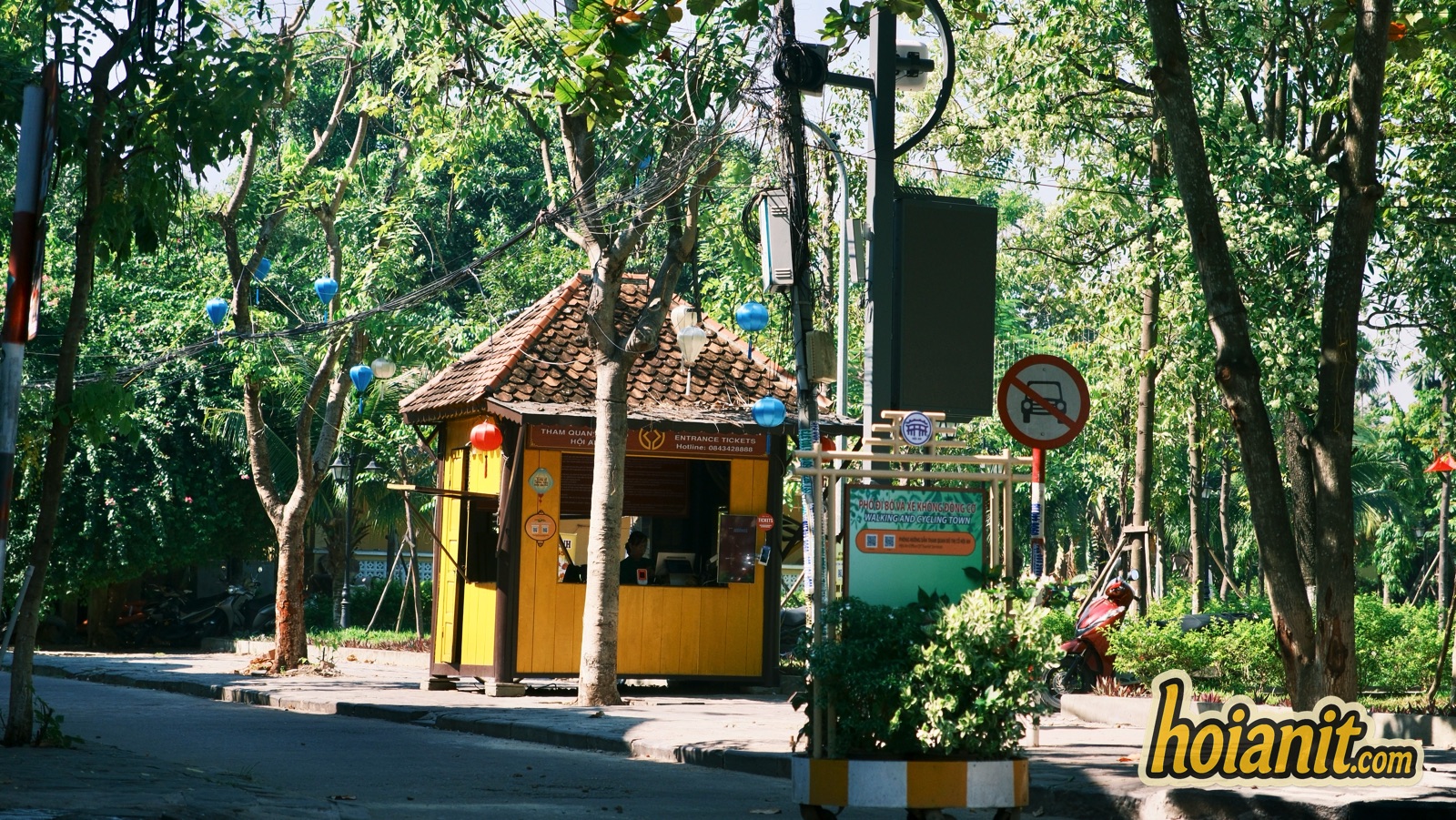
The booths are easy to spot: small kiosks with tiled roofs and yellow walls, usually next to a sign for the pedestrian and non-motorised zone. The ones visitors use most:
- Tran Phu, near the Japanese Covered Bridge — the busiest; two or three minutes’ walk from our shop.
- An Hoi Bridge — for anyone coming from the night market side of the river.
- Hai Ba Trung Street — handy if you arrive from the north, from An Bang or Tra Que.
- Le Loi Street — in the middle of the Old Town grid.

Booths are open from around 7:30 to 21:30. The heritage buildings themselves keep shorter, daytime hours, and a few have their own closed days: the Museum of Folk Culture rests on the 20th of each month and the Sa Huynh Culture Museum on the 10th.
For the full list of what the ticket covers and how the booths work, see our Hoi An entrance ticket guide; this page sticks to the machines.
Card payment and the AI audio guide
Two features are why the Hoi An smart ticket kiosks matter to international visitors.
Payment. Vietnam is still a cash-and-QR country. Local QR transfers need a Vietnamese bank account, and many small booths prefer dong. A machine that accepts a foreign card means you can buy entry the morning you arrive, before you have found an ATM. With per-site fees now only 20,000₫, a small cash float works just as well at the booths.
The narration. The audio guide is built on generative AI from AIAVN. You scan a QR code, choose your language, and the commentary follows your position through the Old Town, suggesting a route and explaining the buildings as you reach them. It runs in your phone’s browser, so you need data and a charged battery.
An AI guide is good at dates and architecture. It is weaker on the stories families tell about their own houses. If you would rather walk with a person who can answer follow-up questions, licensed local guides lead Old Town walks every morning; compare Hoi An walking tours on GetYourGuide and sort by reviews rather than price.
Kiosk or counter: which to use
For most visitors the kiosk is faster. The counter still wins in a few situations.
| Situation | Better choice | Why |
|---|---|---|
| Paying by foreign card | Kiosk | Built for international cards |
| Want the AI audio guide | Kiosk | Narration is sold through the machine |
| Paying cash in dong | Counter | Staff take cash |
| Claiming free entry (student, senior, disability) | Counter | A person has to see your ID or card |
| Not sure which sites to choose | Counter | Staff know what is open today |
| Busy morning, long queue | Kiosk | That is what the machines are for |
Children under 16 do not need a ticket at all under the 2026 rules, so a family of two adults and two children only needs to buy for the adults. Some exemptions in the resolution are written for Vietnamese citizens — for example seniors and visitors with a disability — so foreign travellers in those groups should ask at a counter rather than assume.
From paper ticket books to QR codes
The kiosks are the last step of a longer change. Hoi An sold its Old Town tickets by hand from 1995: a paper book, a coupon torn at each door, records kept on paper. The Saigon Times reported the weak points that system had for decades — books reused and passed on by some tour groups, slow manual checks, and boxes of paper to store.
Digitisation began in January 2023. The town spent more than 8 billion dong on 11 smart ticket counters, a dedicated data centre and printers, with sales through counters, SmartPOS machines, online travel agencies and booking systems, and payment by cash, bank transfer, QR, e-wallet and PayPal. The network was kept separate from social apps so its bandwidth went only to ticketing.
The twelve self-service kiosks of February 2026 sit on top of that system. Then, in August, the fee itself moved to a per-site charge, which suits a digital system far better than a torn paper book ever did. If you visited Hoi An before 2023 and remember a cashier with a stack of books, this is the same office — just with a screen in front.
Which sites to spend your money on
Twenty-one buildings in the Old Town are ticketed sites. At 20,000₫ each you can afford more than the old three, but time, not money, is now the limit: each one takes 20 to 45 minutes, and they close in the late afternoon. Three or four is a comfortable morning.
Pick different kinds of building rather than three of the same:
- The Japanese Covered Bridge — the town’s symbol, with a small shrine inside. Photographing it from the street is free; walking onto it is a ticketed site.
- One Chinese assembly hall — the Fukien hall is the largest and most complete.
- One merchant house — Tan Ky or Phung Hung, where descendants still live and work.
- One museum — the Museum of History and Culture explains everything else, and the Museum of Trade Ceramics is the best rainy-day choice.

If you have an afternoon free, the Hoi An Handicraft Workshop shows twelve crafts under one roof. For a hands-on evening, a lantern-making class with a boat ride is the most popular add-on we get asked about; note that our shop does not run lantern classes itself.
Parking, car-free hours and riding on
The Old Town core is closed to motorbikes and e-bikes from 9:00 to 11:00 and 15:00 to 21:30 (until 21:00 in winter). Outside those hours you can ride through, but in practice it is easier to park at the edge and walk to the booth — the details are in our guide to the Old Town vehicle-free hours.
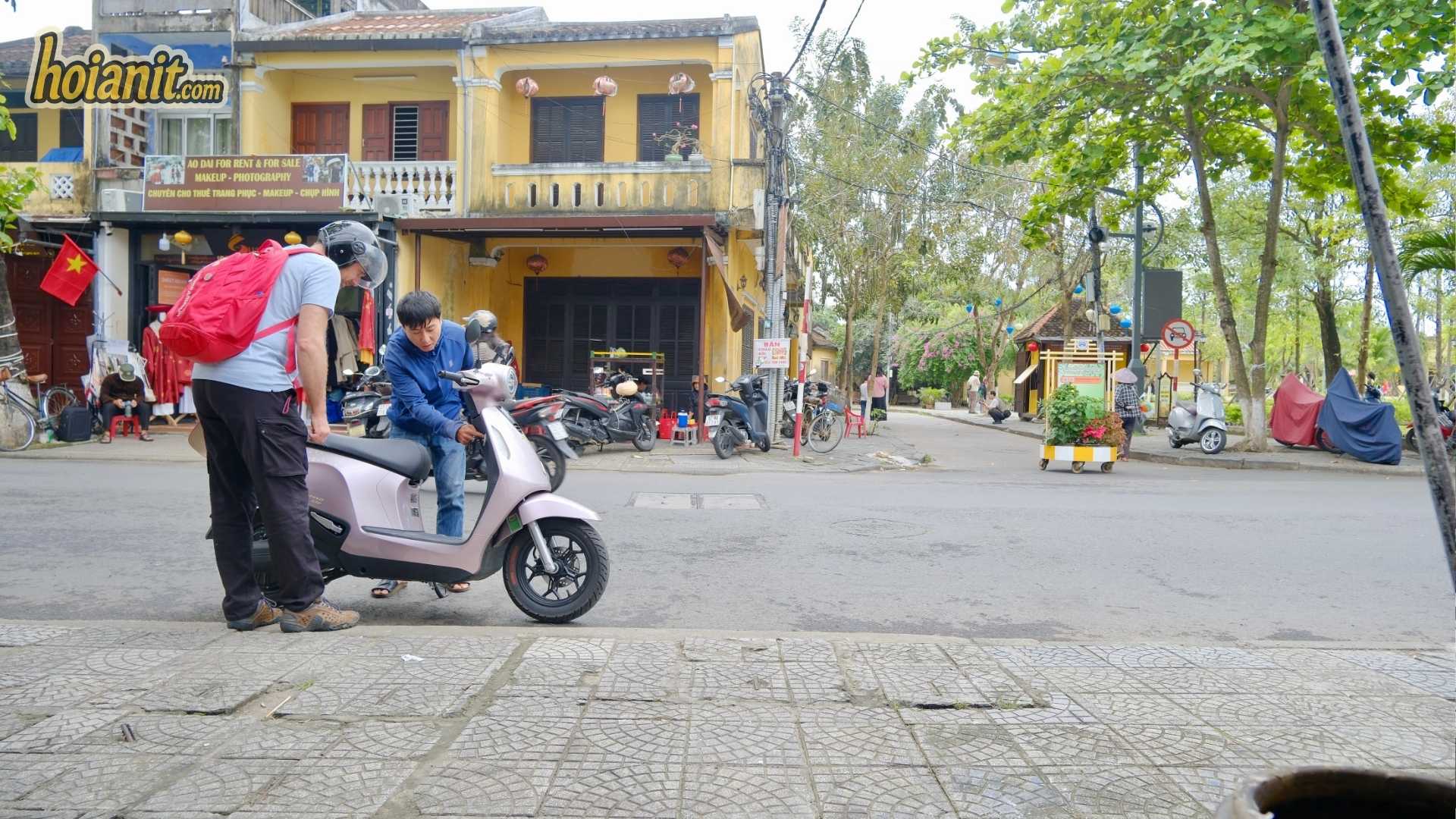
If you rent from us, leave the bike at the shop at 84 Phan Chau Trinh while you explore; the Tran Phu booth is a short walk away. When the heritage houses close in the late afternoon, ride out to An Bang beach, Tra Que vegetable village or Thanh Ha pottery village — all within 3 to 6 km and outside the Old Town ticket.
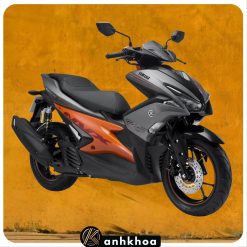
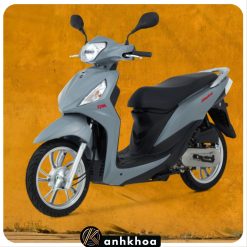
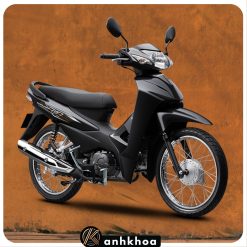
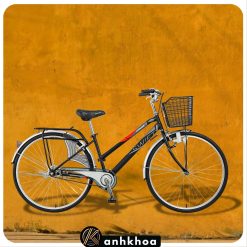
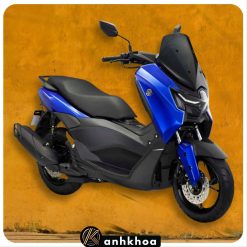
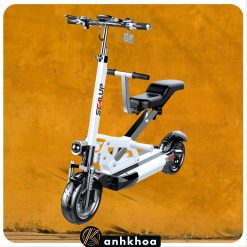
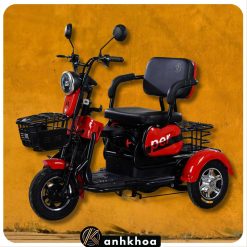
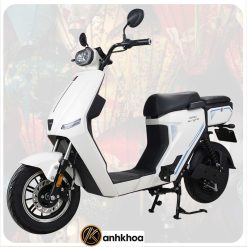
We deliver scooters, e-bikes and bicycles to hotels around Hoi An; delivery has a fee starting from 30,000₫, set out on our delivery fee page. Browse the bikes on motorbike rental in Hoi An.
Ticket sorted? Now the wheels.
Anh Khoa Hoi An is at 84 Phan Chau Trinh, a short walk from the Tran Phu ticket booth. Scooters, e-bikes and bicycles, with helmets and a raincoat, at the shop or delivered to your hotel.
FAQ
What are the Hoi An smart ticket kiosks?
They are 12 self-service ticket machines installed in Hoi An Old Town on 9 February 2026 by the Hoi An Centre for Cultural Heritage Conservation and Vietnam Artificial Intelligence JSC. They work in nearly 20 languages, accept international cards, print your entry ticket and sell an AI-narrated audio guide.
How much is the Hoi An Old Town ticket in 2026?
Since 10 August 2026 the fee is 20,000₫ per person for each heritage site you enter, the same for Vietnamese and foreign visitors, under Da Nang City Council Resolution 98/2026. The old 120,000₫ ticket book for foreigners no longer applies.
Can I pay by card at the kiosks?
Yes. The kiosks were built to accept international bank cards, which is their main advantage over the staffed booths for visitors who have no Vietnamese dong yet. Carry a second card in case your bank blocks the first payment abroad.
Do children need a ticket?
No. Under the 2026 fee rules, children under 16 and school pupils are exempt from the heritage site fee, so a family only pays for the adults. Other exemptions, such as for seniors, are worded for Vietnamese citizens, so ask at a counter.
Do I need a ticket just to walk around the Old Town?
No. Walking the streets, seeing the lanterns, eating and shopping are free. You pay only when you step inside a ticketed building such as an assembly hall, merchant house, museum or the Japanese Covered Bridge.
Where are the kiosks?
No official map of the 12 kiosks has been published. Look for them at the Old Town ticket booths, for example on Tran Phu near the Japanese Covered Bridge, at An Hoi Bridge, on Hai Ba Trung and on Le Loi. The booths sell the same entry if no machine is free.
What time are the heritage sites open?
Most ticketed houses, halls and museums open in daylight only, roughly 7:30 to 17:30, while the booths sell tickets until about 21:30. Buy in the morning if you want to go inside the buildings.
Đọc bằng tiếng Việt: vé tham quan Hội An 2026.
Updated 7 October 2026 by Anh Khoa Hoi An, 84 Phan Chau Trinh. Kiosk launch details from Tuoi Tre News and Bao Van Hoa; the 2023 digitisation figures from the Saigon Times; fees from Da Nang City Council Resolutions 02/2026 and 98/2026 (in force 10 August 2026), as reported by Bao Van Hoa and the Da Nang city portal. How tickets are packaged at the booth can change; always check the screen or ask staff before paying. Links marked to GetYourGuide and Klook are affiliate links: we may earn a small commission at no extra cost to you. WhatsApp +84 935 206 306 · Zalo 0935 439 306.

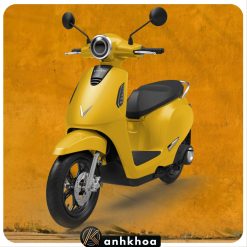
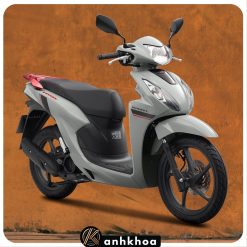









Bikes Rental


More Bike Options in Hoi An
E-Bike · No license









Pick your ride in Hoi AnChọn xe cho chuyến đi Hội An
Scooters, electric bikes and bicycles from one shop in the Old Town — delivered to your hotel, helmets and roadside help included.Xe máy, xe điện và xe đạp — giao tận khách sạn, kèm hai nón bảo hiểm và hỗ trợ dọc đường.
Not sure which one fits? Message us on WhatsApp and we’ll recommend a bike for your plans.
Chưa biết chọn xe nào? Nhắn Zalo 0935 439 306, tụi mình tư vấn theo lịch trình của bạn.