Hoi An Travel Tips
Hainan Assembly Hall Hoi An: The Hall Built for 108 Wronged Men
Hainan Assembly Hall Hoi An: The Hall Built for 108 Wronged Men
The Hainan Assembly Hall at 10 Tran Phu is the one Chinese hall in Hoi An that was not built for a sea goddess. It is a memorial to 108 Hainanese men killed in 1851 and cleared by the emperor afterwards.
Most visitors walk Tran Phu Street from the Japanese Bridge end, run out of ticket coupons at the Fujian hall and turn back. The Hainan hall sits at the far eastern end of the same street, past the market, where the crowds thin out. That is one reason it is quiet. The other is that it only opened to visitors in November 2016, so plenty of older guidebooks do not list it at all.
We walked over from our shop with a camera to check what is there now. This guide covers the story behind the hall, what each part of the building is, and the practical details: ticket, hours and how to reach it. Where our sources disagree, and on this hall they disagree a lot, we say so instead of picking a number.
- Hainan Assembly Hall: quick facts
- The 108 men this hall was built for
- 1851, 1875 or 1883: which date is right
- Reading the facade from the street
- Inside: courtyard, galleries and altars
- Five details worth slowing down for
- Ticket, hours and the best time to go
- Getting to the Hainan Assembly Hall
- Frequently asked questions
Hainan Assembly Hall: quick facts
| What | Detail |
|---|---|
| Names | Hoi Quan Hai Nam in Vietnamese. The plaque over the door reads 瓊府會館, Quynh Phu Hoi Quan. Quynh (Qiong) is the old name for Hainan island |
| Address | 10 Tran Phu, Hoi An Ward, Da Nang City (the east end of the Old Town) |
| Built by | The Hainanese community of Hoi An, on land granted by Emperor Tu Duc |
| Date | Disputed: 1851, 1875 or 1883 to 1891 depending on the source. See section 3 |
| Worships | 108 Hainanese men titled Nghia Liet Chieu Ung, plus the God of Wealth and the community founders |
| Ticket | One coupon from the Old Town ticket. There is a ticket-check sign at the entrance |
| Hours | Google Maps: 09:00 to 21:00 daily. Travel guides: 08:00 to 17:00 |
| Open to visitors since | November 2016 |
| Ceremonies | 2nd day of the 1st lunar month and 15th day of the 6th lunar month |
The 108 men this hall was built for
The other Chinese halls in Hoi An follow one pattern. Merchants from a province settle, prosper and build a hall to the goddess who got their ships across the sea. The Fujian hall and the shared Chinese Assembly Hall both centre on Thien Hau. The Hainan hall is different. Its main altar holds no goddess. It holds the spirit tablets of 108 ordinary men.
The story, as the Hainanese communities in central Vietnam tell it, runs like this. In 1851 a Hainanese trading ship was sailing off the Quang Nam coast. It was taken for a pirate vessel, and the 108 men aboard were killed. They were traders, not pirates. The case went up to Emperor Tu Duc, who cleared their names, gave them the posthumous title Nghia Liet Chieu Ung and granted land for a shrine where they could be worshipped.
The same men are honoured in Hue, where the Hainanese built a temple named Chieu Ung after that title. A photo study of the Hue halls records the 1851 incident and adds that the number may once have been read as 180, so even the famous figure is not beyond question. In Hoi An the count on the altar is 108.
Every other hall on Tran Phu thanks a goddess for a safe crossing. This one remembers the men who did not get one.
That changes how the visit feels. You are not looking at a guild hall that happens to have an altar. You are standing in a memorial, and the Hainanese families of Hoi An still treat it as one.
1851, 1875 or 1883: which date is right
Look up the Hainan Assembly Hall and you will find three different building dates, each stated with total confidence. We could not settle it, so here is what each source says.
| Date | Who gives it | What it probably refers to |
|---|---|---|
| 1851 | The Google Maps description of the hall | The year the 108 men died |
| 1875 | Most Vietnamese and English travel guides | The year usually given for the founding of the hall. One guide ties it to a royal decree honouring the 108 |
| 1883 to 1891 | One detailed English guide | The construction of the present building |
The three dates do not have to contradict each other. A killing in 1851, an imperial decision some years later and a building finished after that is a believable sequence. But we have not seen the stele or the hall records ourselves, so we are not going to tell you one of them is the answer. If a date matters to you, ask the caretaker to point out the inscription inside.
The Vietnam News Agency report on the reopening, dated 23 November 2016, avoids the question completely. It says only that the hall, formerly called Quynh Phu Hoi Quan, was built in the old Chinese style and that Tu Duc granted the land.
Reading the facade from the street
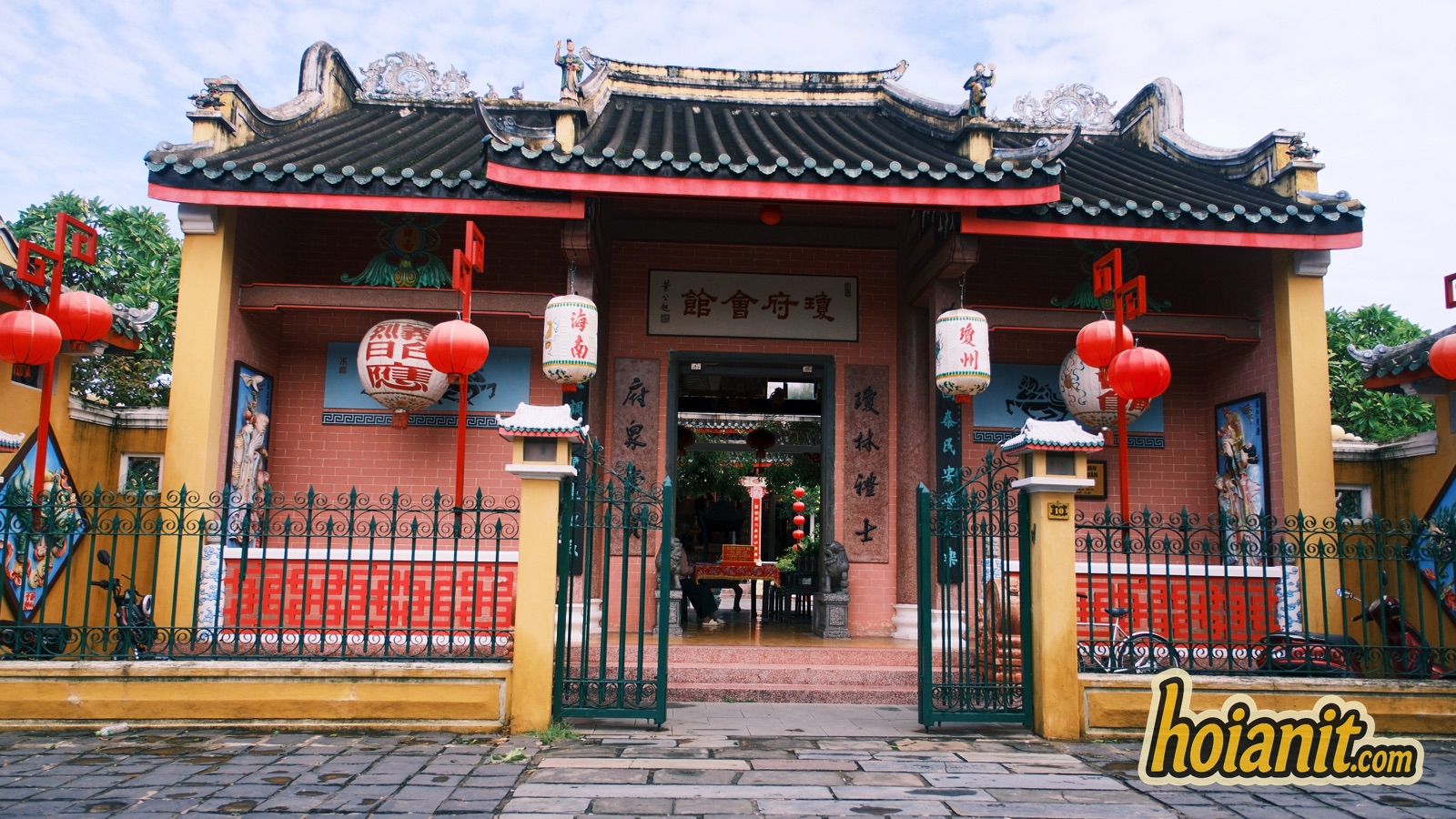
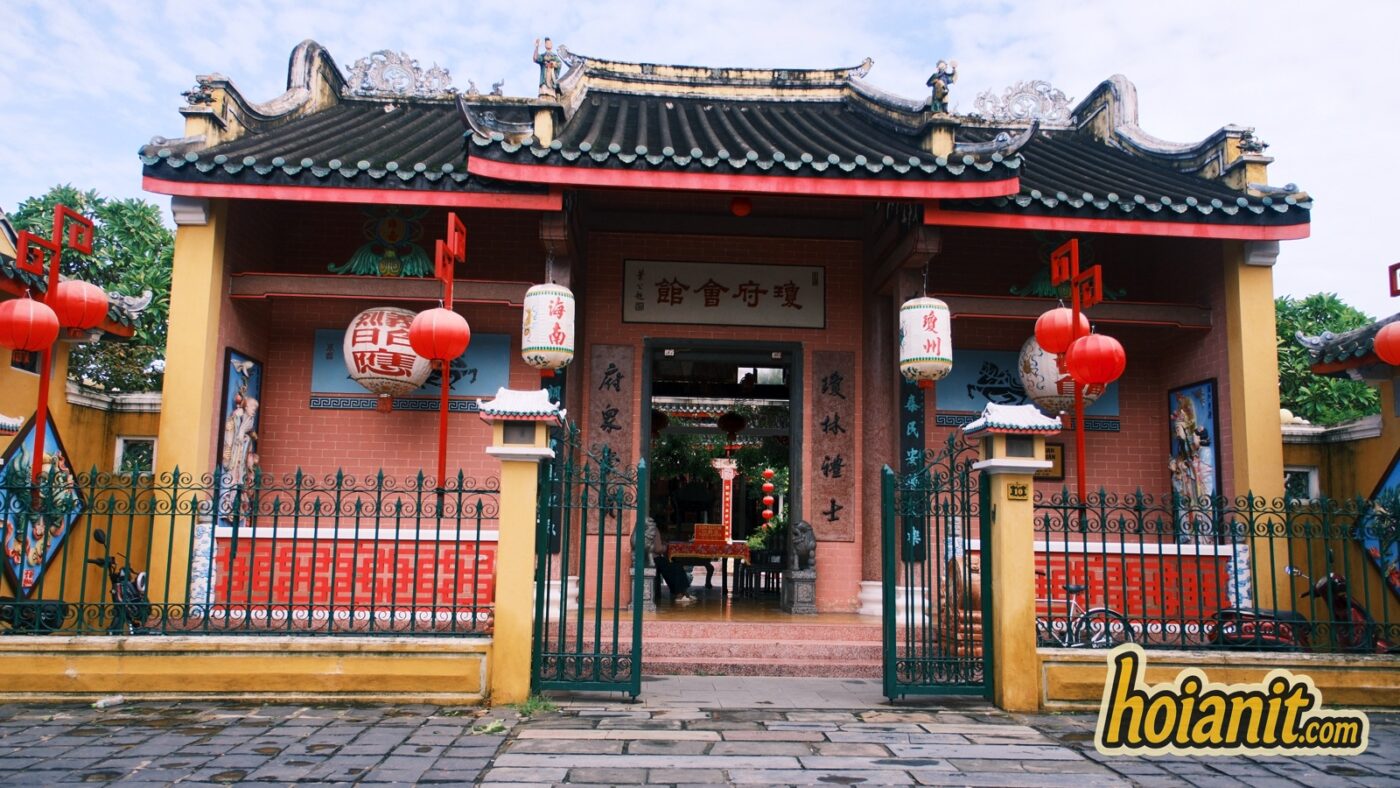
The front building is a three-bay gate house under a dark tiled roof with green glazed tile ends and red eaves. A green iron fence with two small roofed gate posts separates it from the pavement. Compared with the dragon-covered gate of the Fujian hall up the street, it is restrained. Pink brick, yellow plaster, a few lanterns.
The white paper lanterns are worth a second look. They are painted with the characters 海南, Hainan, and with the name of the hall. The red silk lanterns are the ordinary Hoi An kind.
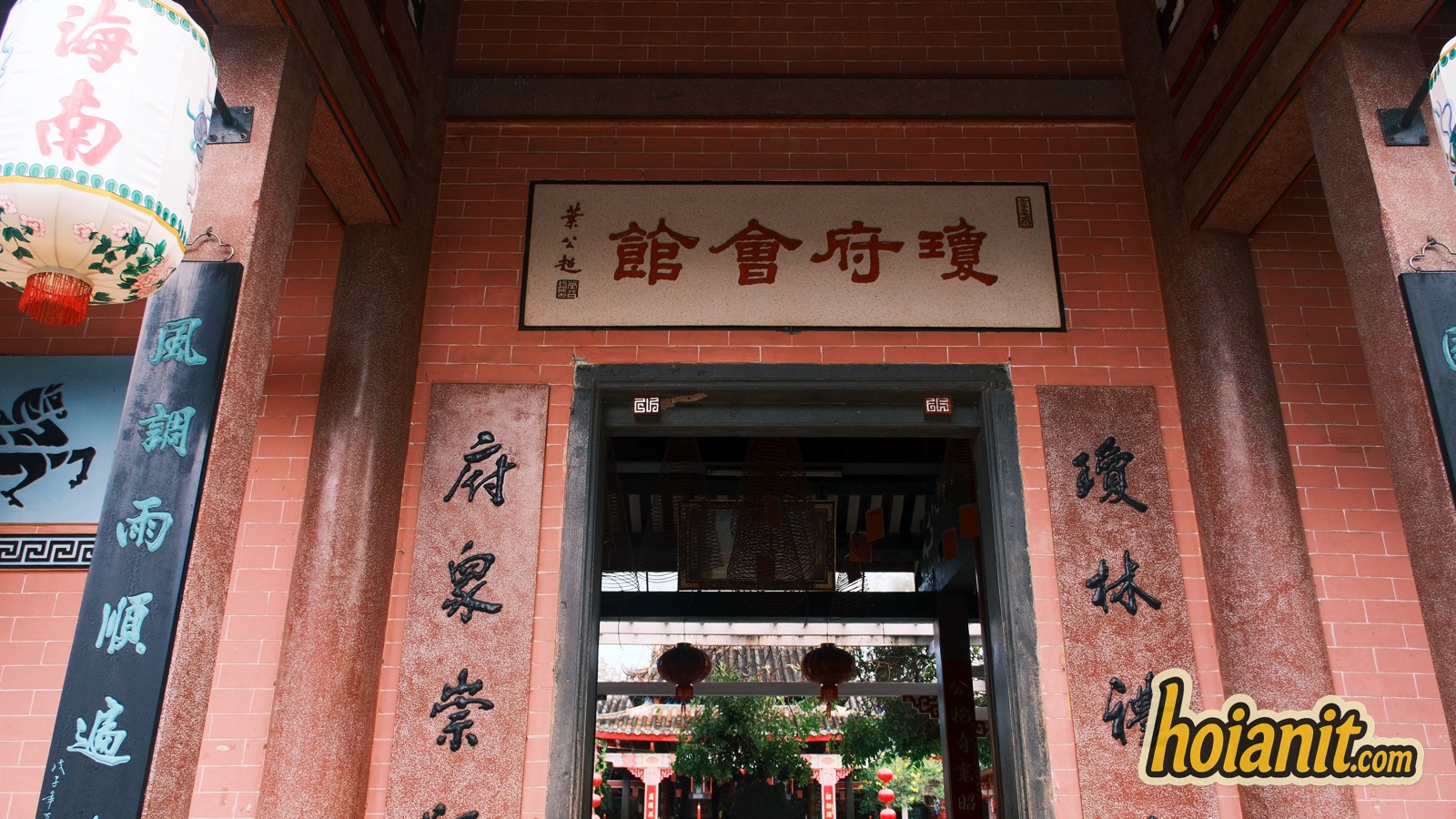
Above the door is the name board, 瓊府會館, read from right to left. Carved stone panels with paired couplets flank the doorway, and two tall dark boards with blue-green characters hang on the front pillars. The one on the left begins with 風調雨順, a stock phrase wishing for wind and rain in their proper season. For a community of sailors and traders that was not decoration. It was the thing they needed most.
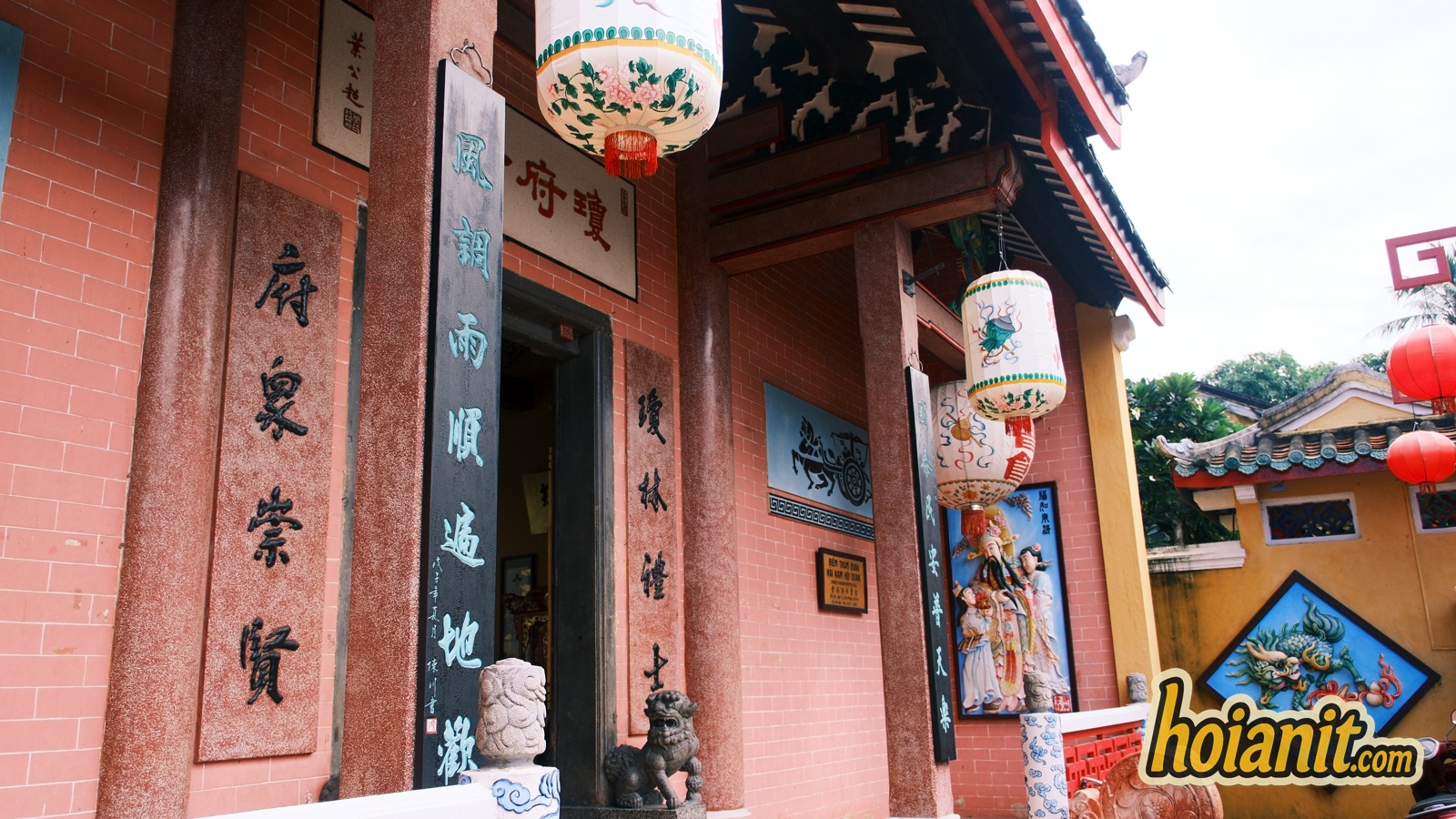
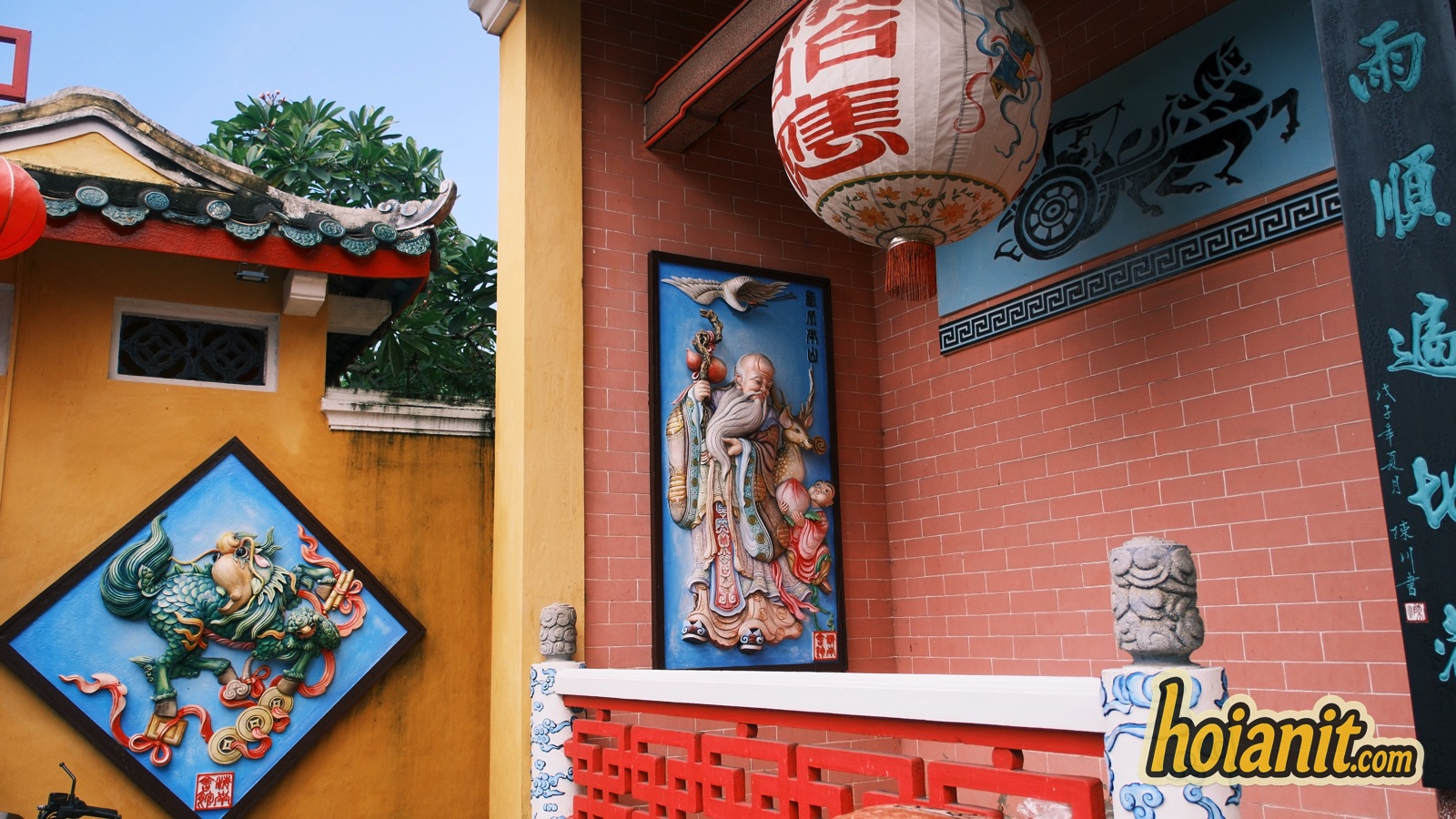
Two small stone lions guard the foot of the door. On the walls at either end of the porch are coloured relief panels. The one on the right shows the God of Longevity, an old man with a high forehead and a white beard, with a deer at his side, a peach branch and a crane overhead. Above him is a black painting of a horse and chariot on a blue ground.
Inside: courtyard, galleries and altars
The plan is simple and symmetrical. Behind the gate house is a front courtyard. An east wing and a west wing run down either side, the main hall closes the far end, and there is a second, smaller yard at the back. Vietnamese sources describe it in exactly those terms: main hall, east house, west house, front yard, rear yard.

Coils of incense hang from the rafters of the gate house, each with a yellow or orange slip of paper carrying the name of the family that paid for it. A coil burns for weeks. If you have seen them at the Cantonese Assembly Hall, these are the same thing on a smaller scale.
The main hall is where the hall earns its ticket. In the centre is a red lacquered and gilded wooden altar front, carved in deep relief with scenes of the three realms: heaven, earth and the water palace under the sea. Behind it stand the tablets of the 108 men. Looking out from the main hall, the altar on the left is for the God of Wealth and the one on the right is for the Tien Hien, the founders of the Hainanese community in Hoi An.
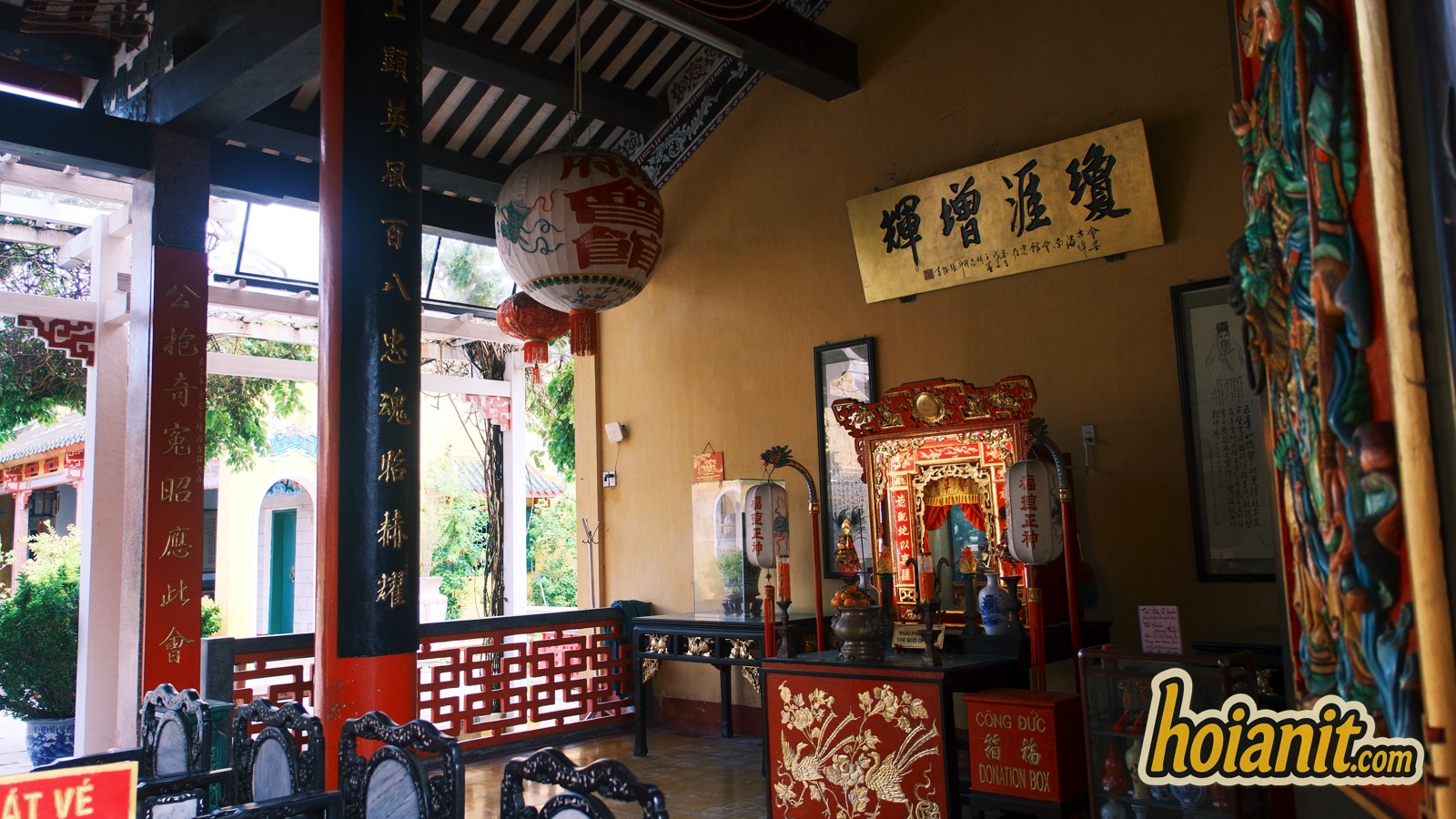
The galleries are open on the courtyard side, with red lattice railings and carved blackwood chairs set out as if a meeting were about to start. The gilded board in our photo reads 瓊涯增輝, roughly “adding glory to Hainan”. Boards like this were gifts, usually from members who had done well and wanted it recorded.
Five details worth slowing down for
- The name over the door is not “Hainan”. It says Quynh Phu. If you are matching the building to a map and expect 海南, look at the paper lanterns instead.
- The carved altar front. Stand close and read it in three bands: sky at the top, human world in the middle, sea creatures and the water palace at the bottom. It is the best piece of woodwork in the building.
- No sea goddess. If you have visited the other halls first, notice what is missing. The centre of this hall belongs to the 108.
- The God of Longevity on the porch. Deer, peach, crane: three symbols of long life in one panel, on the wall of a hall built for men who died young.
- The donation box. It is marked Cong Duc, merit. Nobody will ask you for money. A small note is welcome and goes to upkeep.
This is a working shrine. Cover shoulders and knees, keep your voice down in the main hall and do not touch the tablets or the altar carvings. Photos are fine in the courtyard and galleries. If someone is praying at the main altar, wait until they have finished.
Ticket, hours and the best time to go
Ticket. The Hainan Assembly Hall is one of the sites on the Hoi An Old Town ticket, and there is a ticket-check sign at the door. The published price of the Old Town ticket is 120,000₫ for international visitors and 80,000₫ for Vietnamese visitors, and it comes with a strip of coupons, one per site. Buy it at any of the yellow booths at the edge of the Old Town. Prices and the number of coupons have changed before, so check the board at the booth.
Hours. Google Maps lists 09:00 to 21:00 every day. Most travel guides say 08:00 to 17:00. We would plan around the overlap, 09:00 to 17:00, and treat an evening visit as a bonus if the door is open when you pass.
Best time. Early morning, before 10:00. The hall faces roughly south onto Tran Phu, so the facade is evenly lit in the morning and the courtyard is still cool. Tour groups rarely come this far east, so even at midday you will often have the place to yourself.
Ceremonies. The Hainanese of Hoi An hold their two main ceremonies on the 2nd day of the 1st lunar month, just after Tet, and on the 15th day of the 6th lunar month, the memorial for the 108. On those days the hall is full of families and offerings. Visitors can watch from the courtyard, but stay out of the way.
Getting to the Hainan Assembly Hall
From our shop at 84 Phan Chau Trinh it is 750 m, about 10 minutes on foot, measured on Google Maps: walk east along Phan Chau Trinh, drop down to Tran Phu and keep going until the numbers fall to 10. The hall is on your left. Coordinates: 15.87764, 108.33201.
Tran Phu is inside the Old Town walking zone, which is closed to motorbikes for part of the day. If you are on a rented scooter, park outside the zone and walk the last stretch. Our one-day plan for Hoi An explains how the barriers work. A bicycle is the easy option here, because bicycles are allowed in.
The hall makes a good first stop for a walk west along Tran Phu, because you start at the quiet end and finish at the Japanese Bridge:
- Hainan Assembly Hall, 10 Tran PhuStart here while it is cool. Allow 20 to 30 minutes.
- Quan Cong Temple, 24 Tran PhuA few doors along, opposite the market.
- Fujian Assembly Hall, 46 Tran PhuThe largest and busiest of the halls.
- Chinese Assembly Hall, 64 Tran PhuThe shared hall of the five communities, and free to enter.
- Cantonese Assembly Hall, 176 Tran PhuThe dragon courtyard, a short walk before the Japanese Bridge.
The fifth community hall, the Teochew one, is not on Tran Phu. It is at 157 Nguyen Duy Hieu, further east. For how the whole district fits together, see our introduction to Hoi An Ancient Town.
Exploring the Old Town?
Bicycles from 50,000₫ a day, scooters from 110,000₫. Collect free at 84 Phan Chau Trinh, or have it delivered to your hotel from 30,000₫.
Zalo 0935 439 306Frequently asked questions
Where is the Hainan Assembly Hall in Hoi An?
It is at 10 Tran Phu, at the eastern end of the Old Town, in Hoi An Ward, Da Nang City. It is about 750 m, or 10 minutes on foot, from 84 Phan Chau Trinh.
Do you need a ticket for the Hainan Assembly Hall?
Yes. The hall is one of the sites covered by the Hoi An Old Town ticket and uses one coupon. The published ticket price is 120,000₫ for international visitors and 80,000₫ for Vietnamese visitors.
What are the opening hours?
Google Maps lists 09:00 to 21:00 daily, while most travel guides say 08:00 to 17:00. Visiting between 09:00 and 17:00 is the safe choice.
Who is worshipped at the Hainan Assembly Hall?
The main altar holds the tablets of 108 Hainanese men killed in 1851 and later given the title Nghia Liet Chieu Ung by Emperor Tu Duc. The side altars are for the God of Wealth and for the founders of the Hainanese community.
When was the Hainan Assembly Hall built?
Sources disagree. Google Maps says 1851, most travel guides say 1875, and one detailed guide dates the present building to 1883 to 1891. The year 1851 is when the 108 men died.
How long does a visit take?
Allow 20 to 30 minutes. The hall is smaller and quieter than the Fujian and Cantonese halls on the same street.
What does Quynh Phu Hoi Quan mean?
It is the name written over the door, 瓊府會館. Quynh, or Qiong, is the old name for Hainan island, so the name means the assembly hall of Hainan prefecture.
Đọc bản tiếng Việt: Hội quán Hải Nam Hội An.
Distance measured on Google Maps from 84 Phan Chau Trinh to the hall entrance. Rating, review count and opening hours read from Google Maps in November 2026. History from the Vietnam News Agency report of 23 November 2016 and published guides; where they disagree we give each version. Photos by hoianit.com. We do not run tours of the hall and nothing here is sponsored.
Keep reading Hoi An Travel Tips