

Hoi An Travel Tips
Fukien Assembly Hall Hoi An 2026: Ticket, History and What the Altars Mean
Fukien Assembly Hall Hoi An 2026: The Ticket, the History and What the Altars Actually Mean
Fukien Assembly Hall is the grandest of the Chinese halls on Tran Phu, and it stands on the ground of an older Vietnamese pagoda. Here is what you are looking at, and what it costs.
Most people walk into the Phuc Kien hall, photograph the pink gate, look at the incense coils hanging in the courtyard and walk out again in eight minutes. That is a shame, because almost everything inside is a specific object with a specific reason for being there — a boat in trouble, six men who never went home, twelve women who each look after one part of a baby’s first year. This guide is what we tell riders who leave their bike with us and walk in with a ticket in hand.
- What you are actually looking at
- Walking there, and where to leave the bike
- Tickets: the 2026 fee
- From a washed-up Buddha to a Fujian hall
- Thien Hau and the boat in trouble
- The six who never went home
- The fertility altar and the twelve midwives
- Details worth stopping for
- The other assembly halls on Tran Phu
- Hours, dress and the best time to go
- Frequently asked questions
Fukien Assembly Hall: what you are actually looking at
An assembly hall in Hoi An is not a temple in the ordinary sense. It is a clubhouse — a place where merchants from one Chinese province met, settled disputes, ran a mutual-aid fund, held funerals for men who died far from home, and worshipped the deity who had kept them alive on the crossing. Hoi An has five of them. The Fukien Assembly Hall, built by traders from Fujian province, is the largest and the most decorated, which is why it is the one on every itinerary.
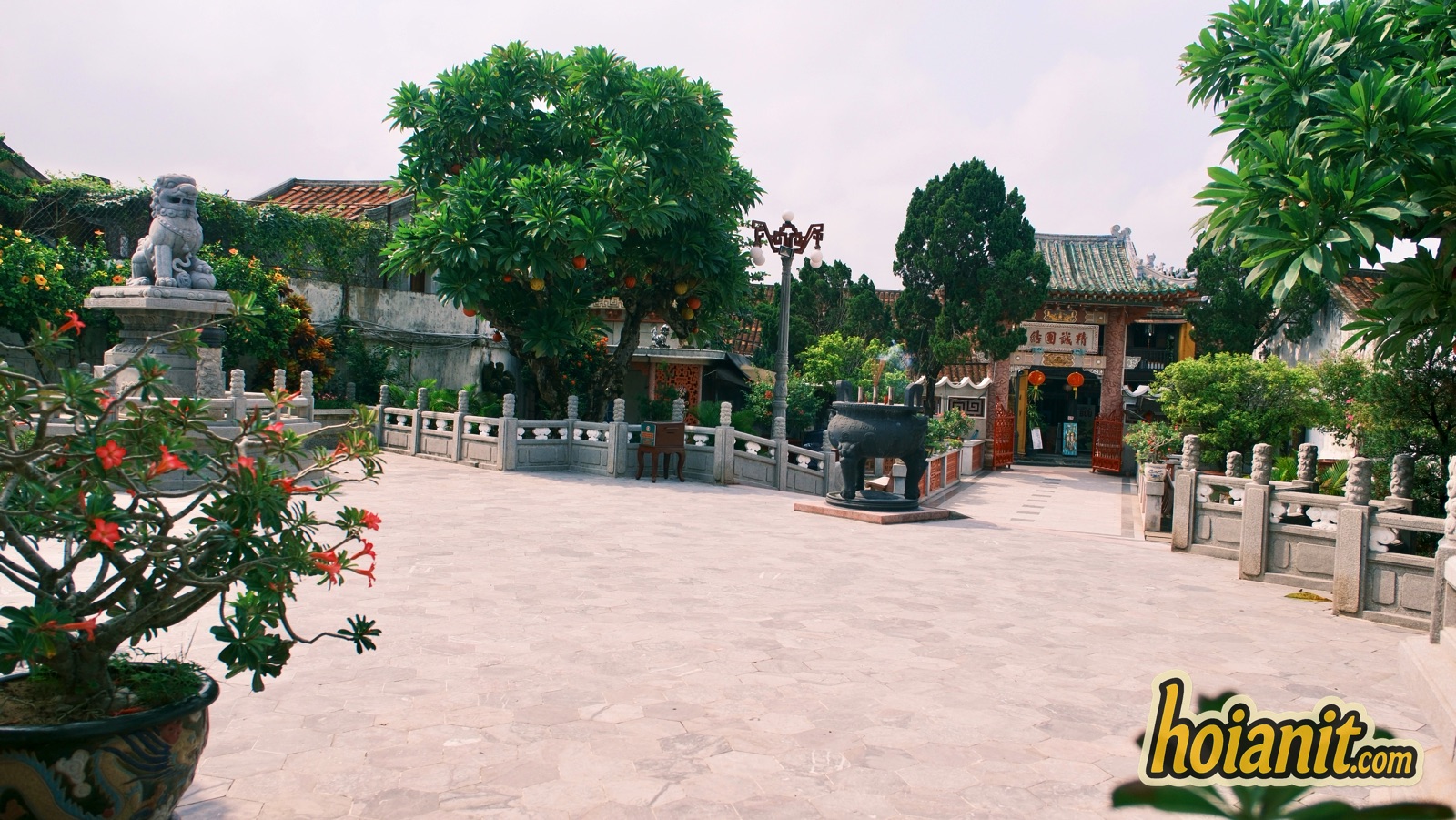
The layout runs deep rather than wide: a triple gate on Tran Phu, a forecourt, a front hall, an open courtyard, the main hall with Thien Hau’s altar, then a rear hall and garden. You walk it in one straight line, and the building gets quieter and darker as you go. The gaudy part is the front. The interesting part is the back.
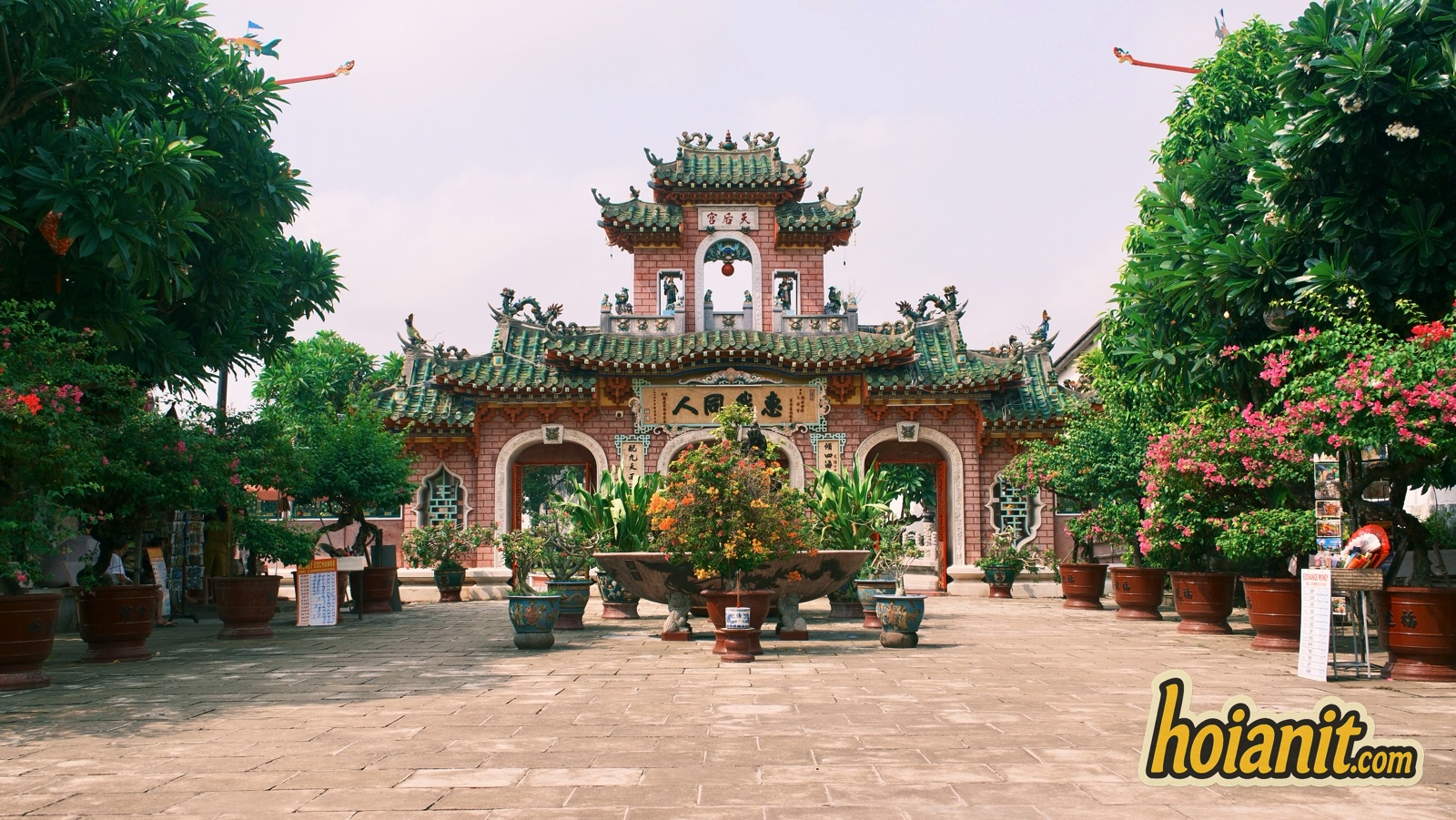
One thing to fix in your head before you go in: the Chinese did not build on empty ground here. The hall sits on a plot that was already a Vietnamese place of worship, and that is the detail almost every guide skips.
Walking there, and where to leave the bike
From our shop at 84 Phan Chau Trinh it is 650 m, about 9 minutes on foot, measured on Google Maps: down Phan Chau Trinh and right onto Tran Phu, or straight along Tran Phu the whole way. You do not ride there. Tran Phu is inside the protected zone, and the Old Town closes to motorbikes from 9:00 to 11:00 and again from 15:00 to 21:30, which covers most of the hours you would want to visit.
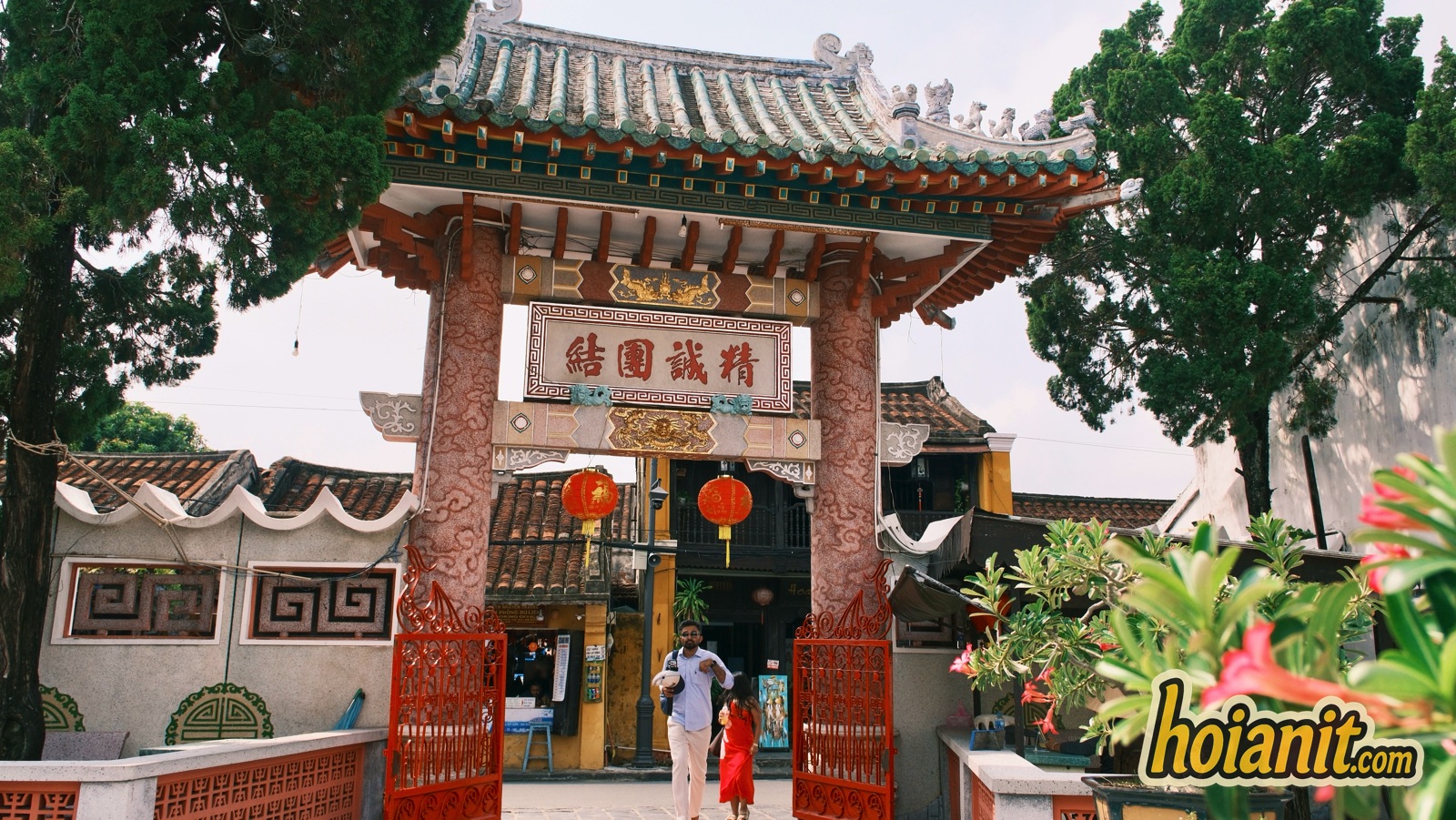
That is the practical reason riders end up walking anyway, and it is why we let customers leave the bike with us for free while they do the Old Town on foot. Park once, walk the whole ticket circuit, come back for the bike when you want the beach or the coconut forest.
- Coming from outside town: park at one of the paid lots on the edge of the pedestrian zone, or leave the bike with us and walk in.
- Coordinates: 15.8775, 108.3307 — useful, because street numbering on Tran Phu is not always obvious.
- Bicycle: fine outside the closed hours, but you will still be pushing it once you are on Tran Phu at peak times.
Tickets: the 2026 fee, and where the Fukien Assembly Hall fits
Until August 2026 Hoi An sold one ticket book for the whole Old Town. Since 10 August 2026 the fee is charged per site: 20,000₫ per person, the same for Vietnamese and foreign visitors, with children under 16 free. You pay at a booth or a kiosk; this hall is one of the twenty-one ticketed sites.
| Item | Price |
|---|---|
| Adults, any nationality | 20,000₫ per site, since 10 August 2026 |
| Children under 16 | Free |
| What it covers | This hall only; each ticketed site is charged separately |
At 20,000₫ a site, money is no longer the limit — time is, and the honest advice is to pick three or four different kinds of building rather than three assembly halls. Our usual suggestion: the Fukien Assembly Hall for the Chinese merchant world, one of the ancient houses for how a trading family actually lived, and one museum. If you only enter one hall in Hoi An, make it this one — it is the biggest, the most complete and the one where the objects still have their original job.
Walking the streets, crossing the Japanese Covered Bridge area, eating and shopping do not need a ticket. Full detail on how the system works is in our guide to the Hoi An entrance ticket, and the newer machines are covered in the smart ticket kiosks.
From a washed-up Buddha to the Fukien Assembly Hall
The ground came first. Before any of this was Chinese, there was a small Vietnamese temple here called Kim Son Tu, built — according to the heritage records kept by the town — to house a Buddha statue that had washed ashore. Merchants from Fujian took over the site in 1697 and put up a hall in timber.
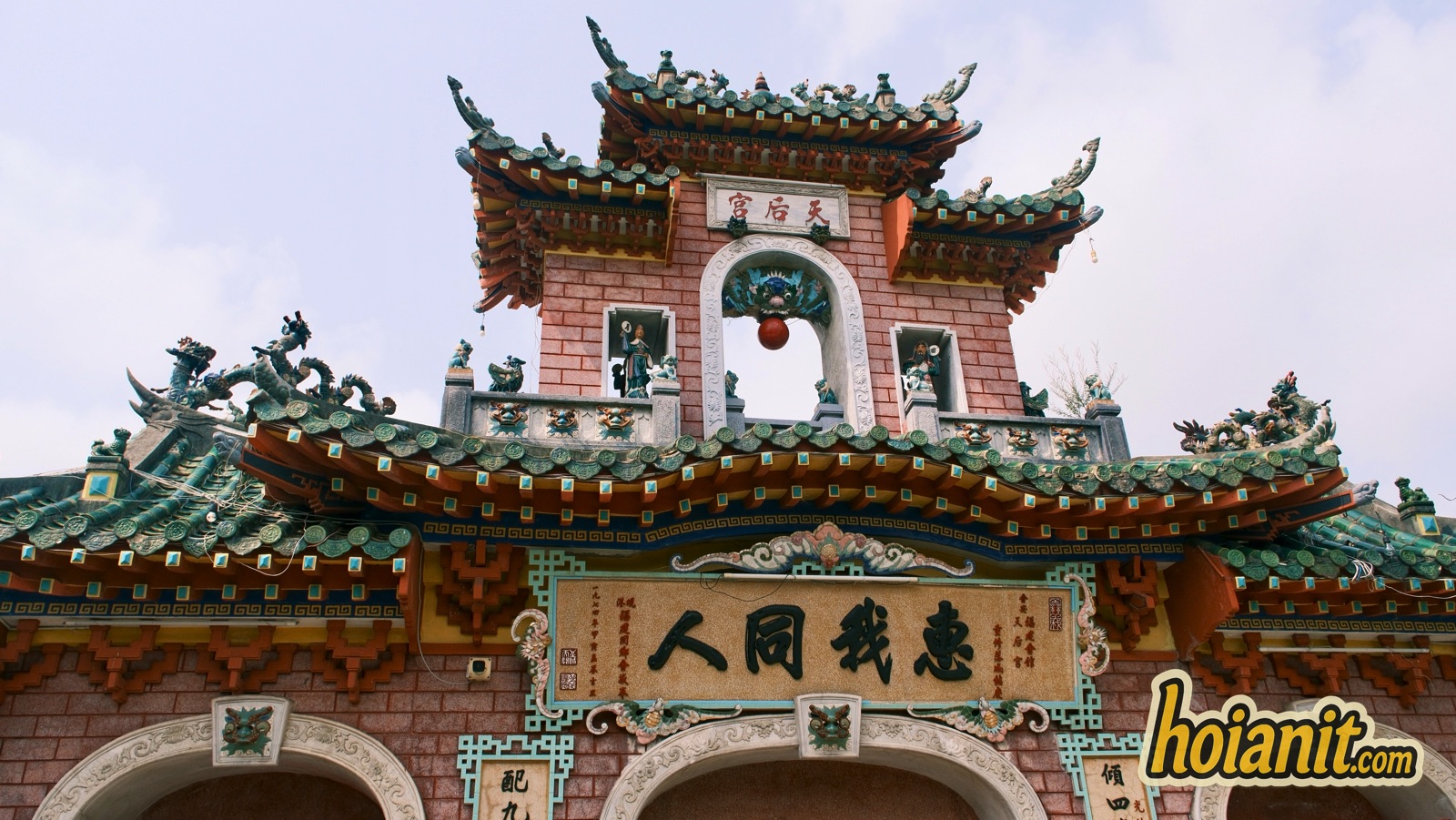
Sixty years later they rebuilt it properly. In 1757 the timber hall came down and a brick-and-tile complex went up in its place, and the name Phuc Kien hoi quan — the Fukien Assembly Hall — became official. Almost everything a visitor sees today belongs to that rebuild and to the restorations that followed it, the largest of which ran from 1970 to 1974 and produced the outer gate. The gate everyone photographs is from 1975, which makes it younger than most of the people photographing it.
The hall was listed as a national historic-cultural monument by the Ministry of Culture in 1990, by a decision dated 17 February; some heritage summaries date the listing to November 1989 instead, and we have not found a source that reconciles the two.
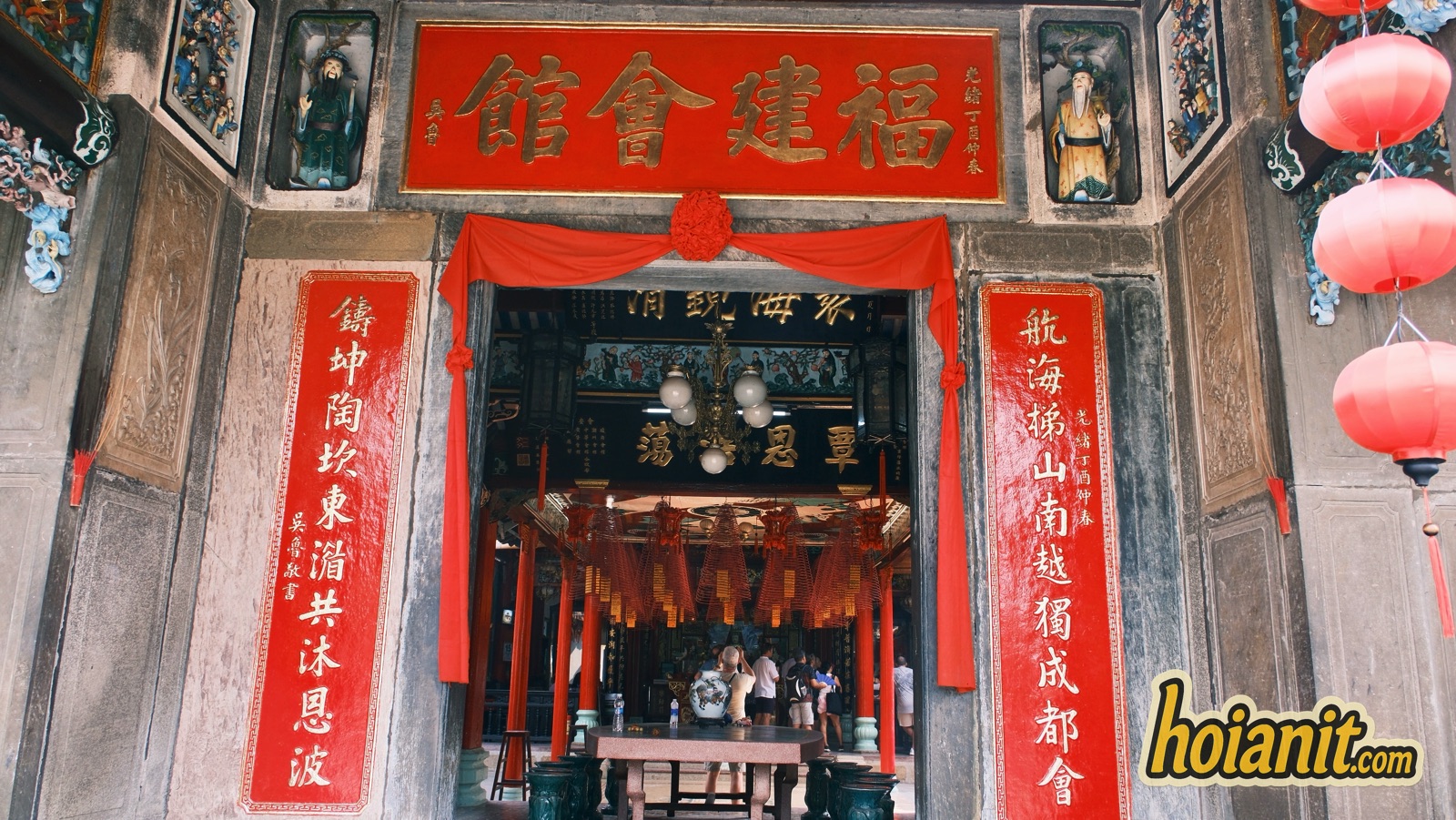
A Vietnamese temple, a Fujian clubhouse and a UNESCO ticket office have all stood on the same forty metres of Tran Phu.
Why Fujian in particular? Because the men who ended up here were not only traders. Many were Ming loyalists who left China after the Qing took power in the mid-1600s, and Hoi An — then one of the busiest ports in Southeast Asia — took them in. That history is not decoration on the wall; it is the reason for the altar in the rear hall, which we will get to.
Thien Hau and the boat in trouble
The main altar belongs to Thien Hau Thanh Mau — Mazu, the sea goddess. She was a real woman from Fujian, by tradition a fisherman’s daughter who could sense storms, and she became the patron of everyone who had to cross open water for a living. For men whose entire fortune sat in a wooden hull between Fujian and Hoi An, she was not a symbol. She was insurance.
She stands with two attendants, and their names tell you the job description. Thien Ly Nhan — Thousand-Mile Eyes — sees ships in trouble at any distance. Thuan Phong Nhi — Wind-Following Ears — hears them calling. Look for the pair flanking her: one shading his eyes, one cupping his ear.
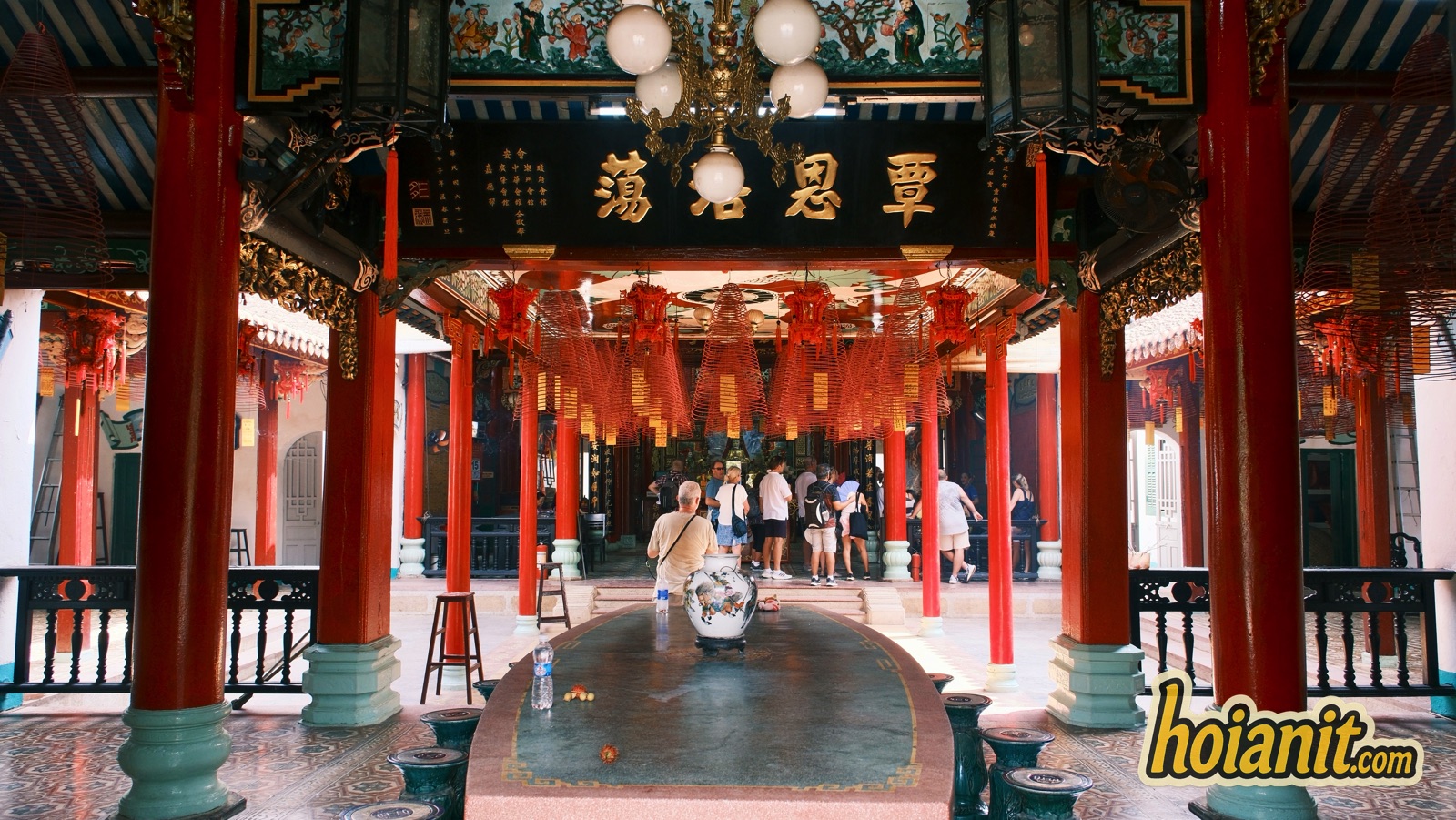
The object most visitors walk past is the model ship. It is a trading junk in distress, dated 1875, complete with painted eyes on the bow so the boat can see its way. It is not a display piece; it is a votive offering, put there by people who had survived a crossing or wanted to. Once you know that, the hall reads differently: it is a room full of thank-you notes from men who made it home.
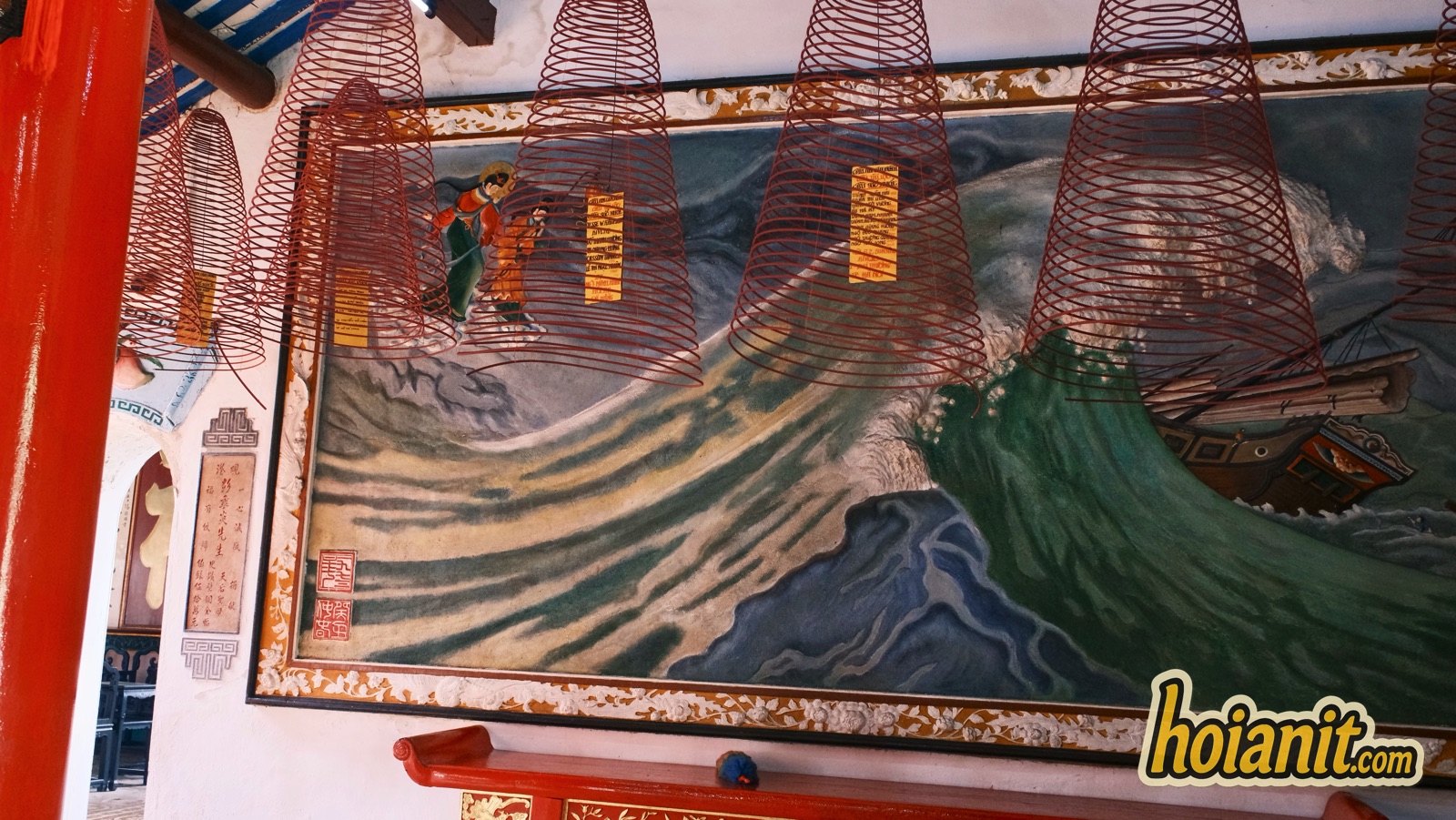
Luc Tanh Vuong Gia: the six who never went home
Keep walking past Thien Hau into the rear hall and you reach the altar of the Luc Tanh Vuong Gia — six deified Fujian ancestors, honoured together. In the community’s own telling these were leaders among the Ming loyalists who fled south rather than submit to the Qing, and who died in exile. Fujian families in Hoi An have kept their memorial day on the 16th of the second lunar month ever since.
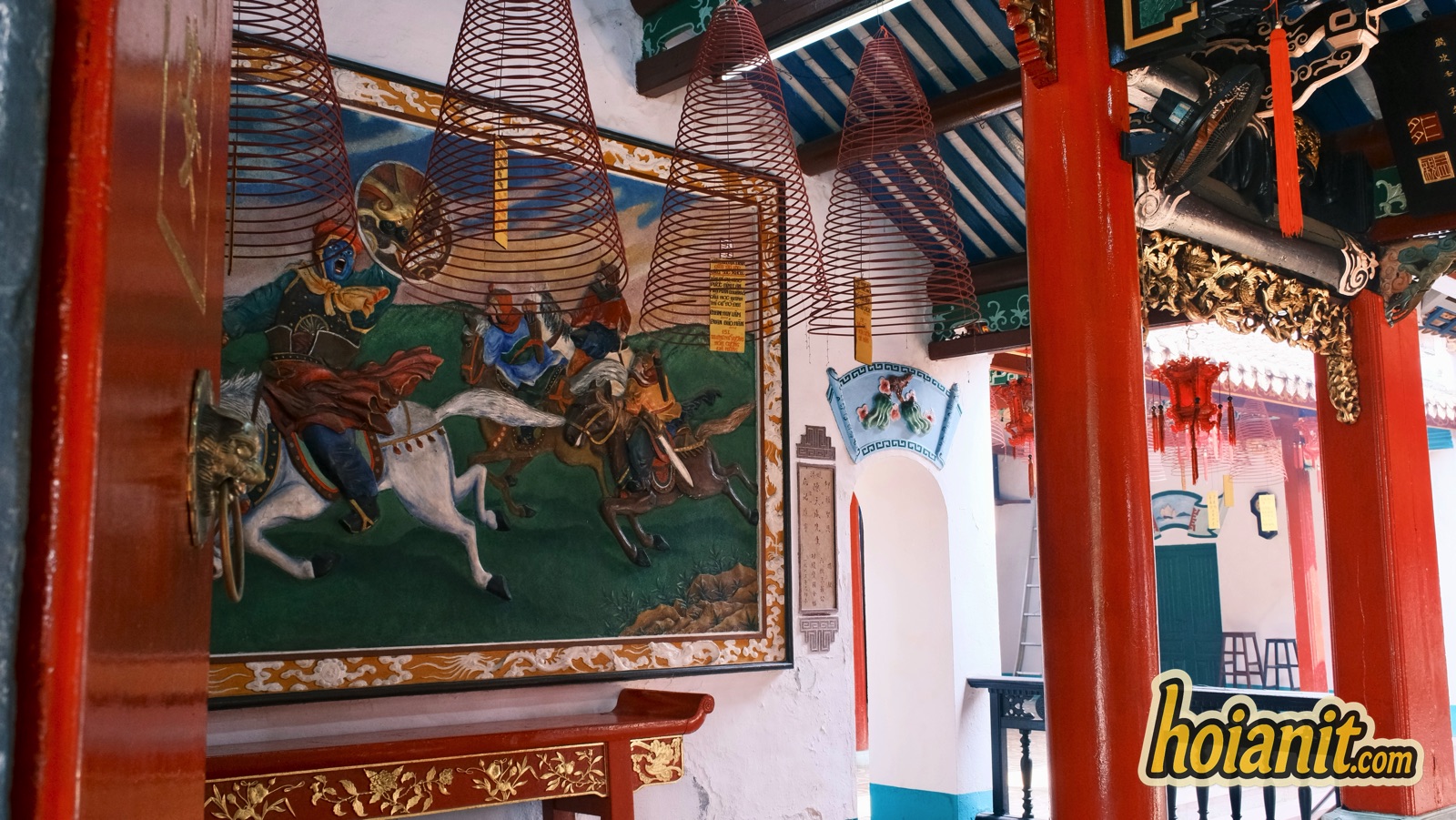
This is the part of the hall that is genuinely a community’s own history rather than shared Chinese folk religion, and it is why the hall matters more to Hoi An’s Fujian-descended families than the photogenic gate out front. If you visit around Tet Nguyen Tieu — the fifteenth of the first lunar month — you may find the hall full of people who are not tourists.
| Occasion | Lunar date | What happens |
|---|---|---|
| Tet Nguyen Tieu | 15th of 1st month | The big community day; the hall fills, offerings everywhere |
| Luc Tanh Vuong Gia | 16th of 2nd month | Memorial for the six; a family occasion more than a spectacle |
| Via Ba Thien Hau | 23rd of 3rd month | The sea goddess’s own day |
Those are lunar dates, so they move every year against the Western calendar. If your trip is anywhere near them, it is worth checking — the hall on a festival day is a different building.
The fertility altar and the twelve midwives
To one side you will find an altar with a row of small female figures. This is the one part of the complex that still gets used, daily, by people asking for something specific.
The figures are the Thap nhi Ba Mu — the twelve midwives — alongside the birth goddesses (Tam vi Chua Sanh Thai). The idea is that a child’s first year is divided into tasks, and each of the twelve is responsible for one of them: one teaches the baby to smile, one to sit up, one to walk, one to speak. Couples who want a child, and parents whose child is unwell, come here and leave offerings. You will see fresh fruit, and often paper slips with names on them.
Vietnamese families keep the same twelve midwives at home — the “cung day thang” ceremony at a baby’s first month is an offering to exactly this group. It is one of those places where Chinese and Vietnamese practice have run together for so long that separating them is pointless.
Details worth stopping for
Give the hall twenty-five minutes instead of eight and there is a lot to find.
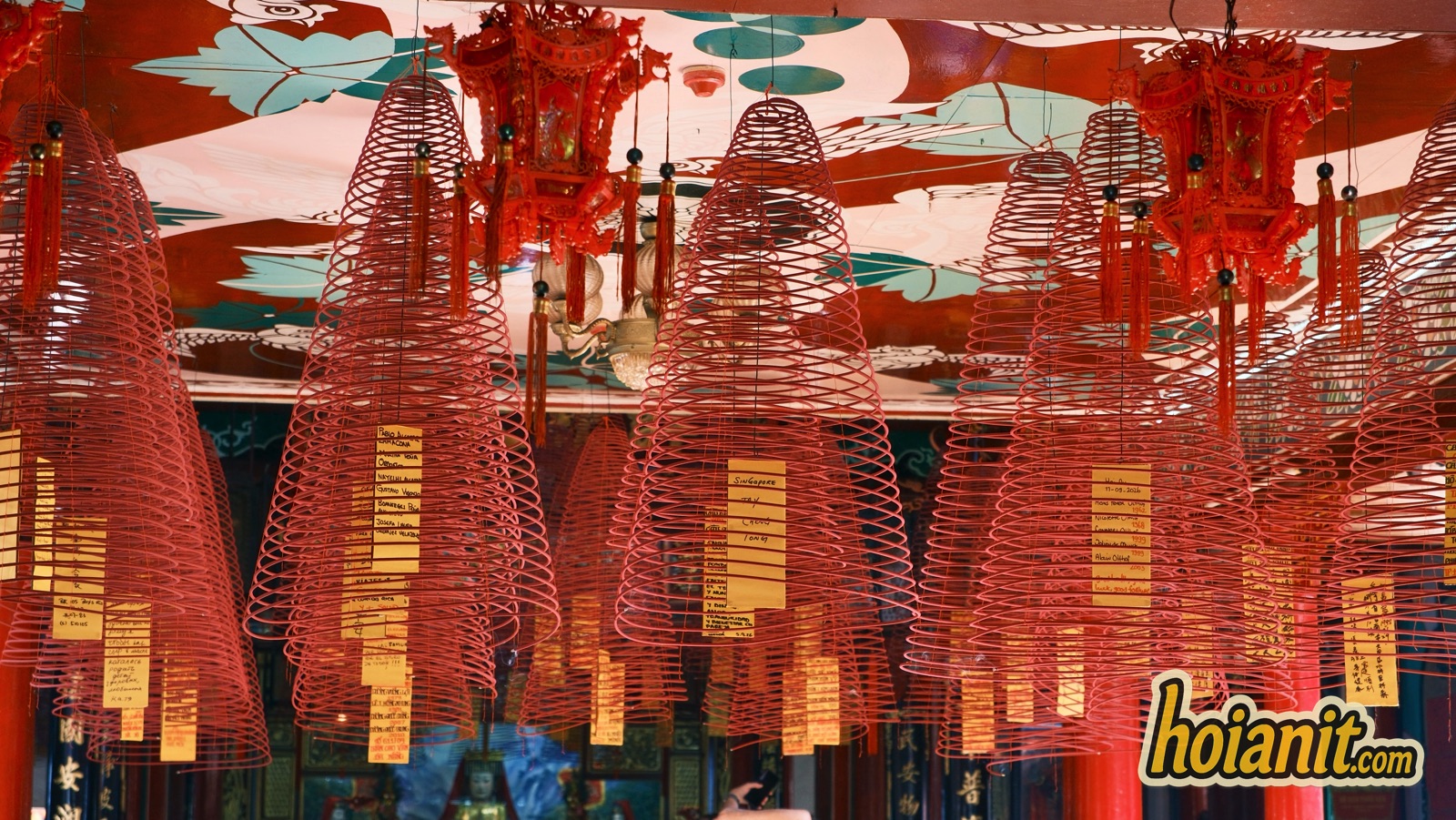
- The incense coils. The spirals hanging in the courtyard burn for weeks. The red paper tags on them are wishes, with the name of the person who paid for the coil. They are the reason the whole complex smells the way it does.
- The bronze bell. A large bell cast in 1790 survives in the hall — older than the gate, older than most of the woodwork.
- The carved panels. Ranks of gilded wooden boards carry the donor names and dedications. Fourteen of the most ornate are singled out in the heritage inventory.
- The carp. Look for fish motifs in the ceramic and the woodwork. The carp that leaps the dragon gate and becomes a dragon is the standard image for a merchant’s son passing the imperial exams — the whole point of getting rich abroad.
- The roof ridge. Fujian roofs curve up harder at the ends than Vietnamese ones, and the ridge is built up with ceramic-shard mosaic. Compare it with a Vietnamese communal house and the difference is instant.
- The mid-air dragons. The pair curling round the front columns are made from broken porcelain set in mortar, not carved — worth getting close to.
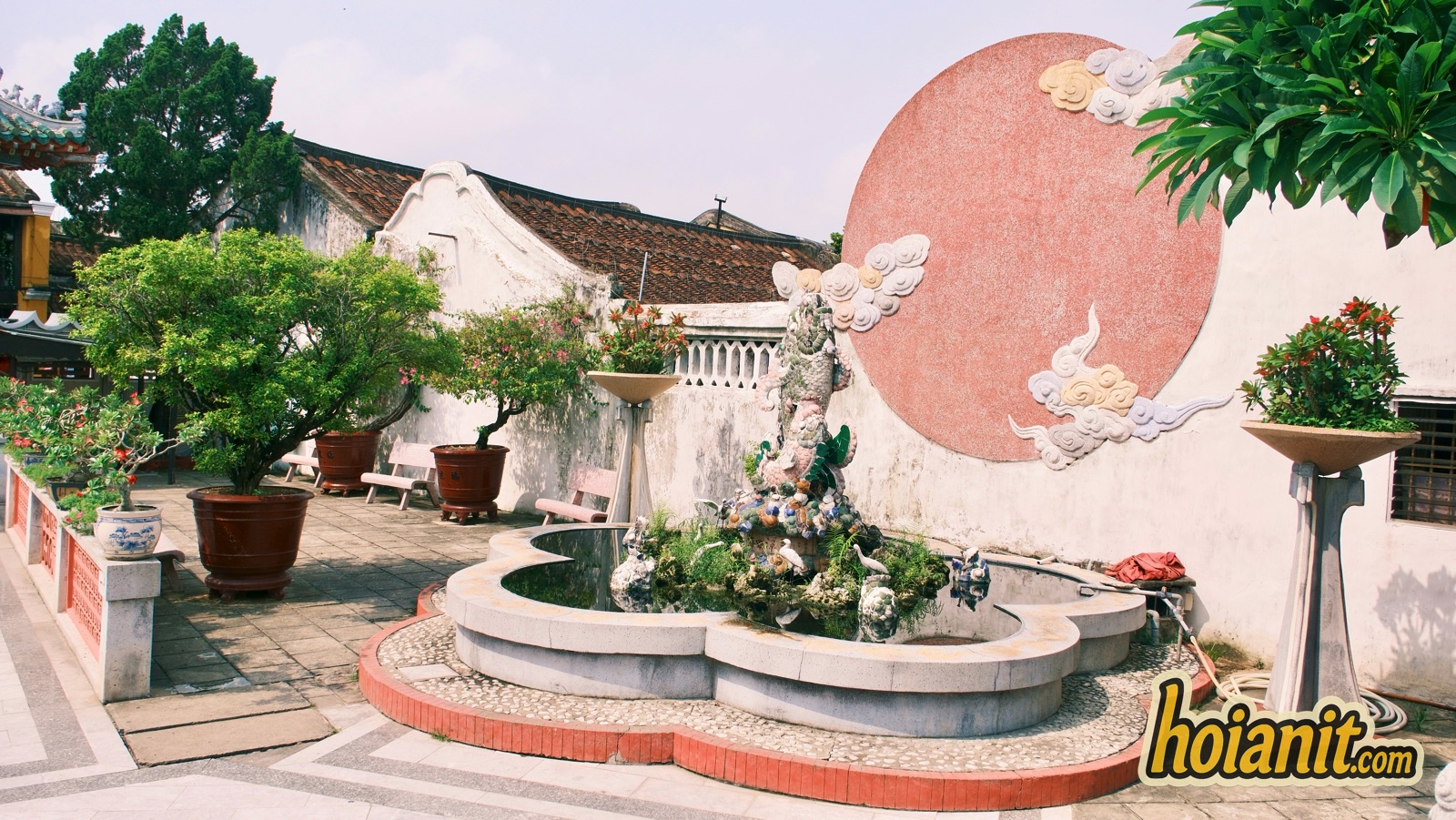
Three of these — the coils, the bell and the panels — are things you can only appreciate standing still. There is a bench in the courtyard. Use it.
The other assembly halls on Tran Phu
Hoi An has five Chinese assembly halls and four of them are on or just off Tran Phu, within a few hundred metres of each other. Knowing which is which stops you paying twice for buildings that do the same job.
| Hall | Community | Ticket? | Go if… |
|---|---|---|---|
| Fukien (Phuc Kien) | Fujian | Yes — 20,000₫ | You only enter one. Biggest, most complete |
| Cantonese (Quang Dong) | Guangdong | Yes — 20,000₫ | You like courtyards and dragon-and-carp fountains |
| Trieu Chau (Chaozhou) | Chaozhou | Yes — 20,000₫ | Woodcarving is your thing — the finest carving of the five |
| Hainan (Quynh Phu) | Hainan | Free | You want the quietest one, and a grim story behind it |
| Chinese All-Community | All five groups | Free | You are walking past anyway |

Two of the five are free, which is worth knowing if you are counting your fees. Our companion guide to the Cantonese Assembly Hall covers the closest alternative if this one is packed when you arrive.

Hours, dress and the best time to go
Published hours vary by source — most list roughly 8:00 to 18:00, some list 7:00 to 17:30, and in practice the doors follow the ticket booths on Tran Phu rather than a printed sign. If you are cutting it fine, ask at the booth when you buy; they know that day’s closing time.
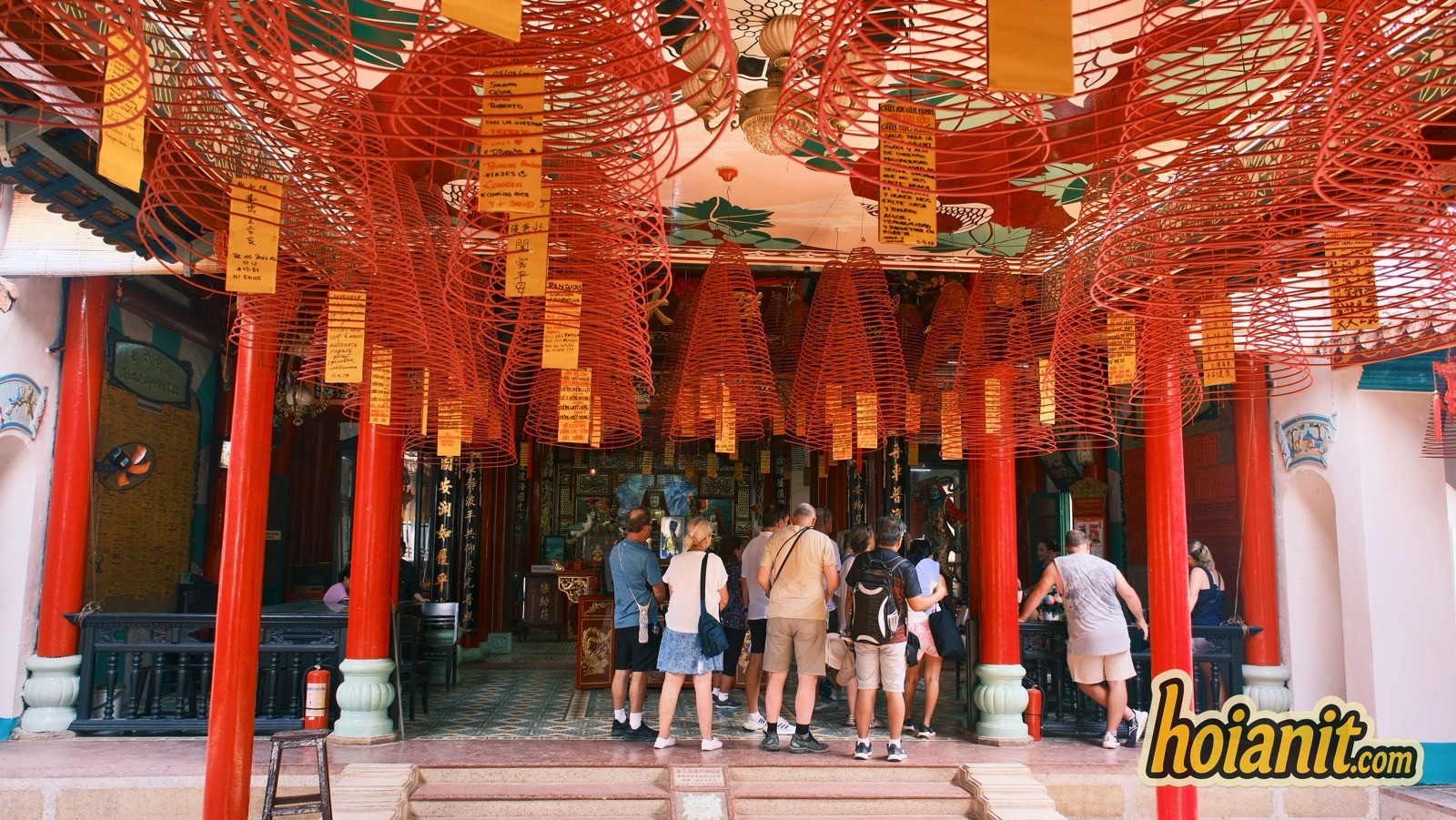
- Best hour: right at opening. By 9:00 the tour groups arrive and the courtyard becomes a queue for the same three photo spots.
- Second best: late afternoon after 16:00, when the light comes in low through the courtyard and the groups have moved to the riverfront.
- Dress: it is a working place of worship. Shoulders and knees covered; nobody will turn you away for a vest top, but you will feel it.
- Shoes: stay on, except where a sign says otherwise.
- Rain: the courtyard is open to the sky, so a wet day means a wet middle section. October to December is the rainy stretch here.
Give it 25 to 40 minutes. Eight minutes gets you the gate and nothing else; an hour is more than the building holds unless you are drawing it.
Bike for the rest of the day?
Park with us for free while you walk the Old Town, then take the bike out to the beach or the coconut forest when the heat drops. Scooters, semi-automatics, electric bikes and bicycles at 84 Phan Chau Trinh, or delivered to your hotel. Automatic scooters start at 110,000₫ a day — see our scooter rental in Hoi An page for the full fleet.
Fukien Assembly Hall: frequently asked questions
Where is the Fukien Assembly Hall and how far is it from the Old Town centre?
It is at 46 Tran Phu, in the middle of the Old Town. From our shop at 84 Phan Chau Trinh it is about 650 m, roughly 9 minutes on foot. You walk rather than ride, because Tran Phu is closed to motorbikes from 9:00 to 11:00 and from 15:00 to 21:30.
Do I need a ticket for the Fukien Assembly Hall?
Yes. It is one of the 21 ticketed sites in the Old Town, so entering costs 20,000₫ per person, the same for Vietnamese and foreign visitors since 10 August 2026. Children under 16 go free.
How old is the Fukien Assembly Hall?
Fujian merchants took over the site in 1697, when it held a small Vietnamese temple called Kim Son Tu, and rebuilt the hall in brick and tile in 1757. The complex was restored several times after that; the outer gate people photograph dates from 1975.
Who is worshipped inside?
The main altar belongs to Thien Hau Thanh Mau, the sea goddess, flanked by Thien Ly Nhan and Thuan Phong Nhi. The rear hall honours the Luc Tanh Vuong Gia, six Fujian ancestors. There is also an altar to the twelve midwives and the birth goddesses, and a god-of-wealth altar.
What is the model boat in the hall?
It is a trading junk shown in distress at sea, dated 1875, with eyes painted on the bow. It is a votive offering rather than a museum display — the kind of thing a merchant left after surviving a crossing.
How long should I spend there?
Twenty-five to forty minutes. Most visitors give it under ten and see only the gate and the courtyard, which misses the rear hall, the fertility altar and the 1790 bronze bell.
Which assembly hall should I choose if I only have time for one?
The Fukien Assembly Hall. It is the largest and most complete of the five. The Trieu Chau hall has better woodcarving and the Cantonese hall has the nicer courtyard, but if you enter only one, this is the one that shows you the whole idea.
Is there a dress code?
It is an active place of worship, so cover shoulders and knees. Nobody is turned away at the gate, but people are praying at the fertility altar and it is their building, not a museum.








Pick your ride in Hoi AnChọn xe cho chuyến đi Hội An
Scooters, electric bikes and bicycles from one shop in the Old Town — delivered to your hotel, helmets and roadside help included.Xe máy, xe điện và xe đạp — giao tận khách sạn, kèm hai nón bảo hiểm và hỗ trợ dọc đường.
Not sure which one fits? Message us on WhatsApp and we’ll recommend a bike for your plans.
Chưa biết chọn xe nào? Nhắn Zalo 0935 439 306, tụi mình tư vấn theo lịch trình của bạn.