

Hoi An Travel Tips, Useful Information
Hoi An Flood Season 2026: What Actually Happens, and Should You Come
Hoi An Flood Season 2026: What Actually Happens, and Should You Come
Hoi An floods most years between late October and mid-December. Here is which streets go under, what still works, what the 2026 forecast says, and the honest answer on cancelling.
- When Hoi An floods, and how often
- What the 2026 season is forecast to look like
- Flood season 2026 so far, and the dates to watch
- What a flood day actually looks like
- Which streets go under first
- Where to stay, and where not to
- Riding a motorbike in flood season
- What still works when the town is under water
- What to do on a flood day
- Should you cancel? The honest answer
- FAQ
When Hoi An floods, and how often
Hoi An sits on a river delta a couple of metres above sea level, at the point where the Thu Bon river meets the sea. It has flooded for four hundred years. The old houses have trapdoors in their upper floors and pulley systems for lifting furniture, because this is not a disaster here — it is a season.
The window runs from late October to mid-December, with October and November the peak. In a typical year the town goes under two or three times; in a bad year more. The trigger is heavy rain upriver in the mountains rather than rain in Hoi An itself, which is why the town can flood on a day that looks merely grey from your window.
What the 2026 season is forecast to look like
2025 was an extreme year, and it is the wrong baseline for planning a 2026 trip. Vietnam’s National Centre for Hydro-Meteorological Forecasting expects this season to be quieter than average:
| Forecast for 2026 | Figure |
|---|---|
| Storms and tropical depressions in the East Sea | 8–10 |
| Of those, reaching the mainland | 3–5 |
| Widespread heavy-rain episodes nationally | 16–19 — fewer than the long-term average |
| When storms concentrate on Central Vietnam | October and November |
| ENSO state | El Nino, with a 63% chance of a very strong El Nino from November |
El Nino years in central Vietnam tend to bring less total rainfall than La Nina years. That is genuinely good news if you are booked for November — but it is a seasonal average, not a promise about your week. Fewer rain episodes does not mean none, and a single storm landing on a high tide still floods the Old Town.
One caveat from the same forecasters in May 2026: they expect fewer widespread rain episodes but more short, very intense local downpours, and called 2026 a year of more extreme, harder-to-predict weather. For Hoi An that means sudden street flooding from rain alone is as likely a nuisance as a classic river flood.
Hoi An flood season 2026 so far, and the dates to watch
Here is what has actually happened this season up to 4 November 2026, and the nights in November and December when a flood is most likely to coincide with the full-moon lantern evening.
| Date (2026) | What happened / what to watch |
|---|---|
| 12 Sep | A tropical depression dumped 70–150 mm on Da Nang (307 mm at Cau Lau). Tran Hung Dao, the main road into the Old Town, flooded about 0.5 m deep for a few hours and scooters stalled; the riverside walking streets stayed dry (VnExpress) |
| 5–11 Oct | Heavy rain centred on Hue and Da Nang, with risk level 2 declared for both; no Old Town river flood was reported |
| 23–24 Oct | Lantern night (14th lunar day) and full moon; no flood reported in the press |
| 26 Oct | The press flagged the coastal road from Da Nang into Hoi An: it floods at several points whenever heavy rain comes, worst outside The Pearl Hoi An resort and near Malibu resort, and cars and scooters stall there. Contractors were digging temporary culverts (Tien Phong) |
| 28–29 Oct | Peak of a heavy-rain spell from Ha Tinh to Da Nang: 50–120 mm in general, locally over 250 mm, easing from the night of 29 Oct (Tien Phong). No Old Town river flood was reported |
| 4 Nov | Da Nang city said the big reservoirs on the Vu Gia–Thu Bon basin hold only 15–22% of their design volume, and river flows for the rest of 2026 are forecast at 20–40% below average. The dams have been told to store water for an El Niño dry season (Znews). Big dam releases helped push up the 2025 floods, so this lowers the odds of a repeat, but a burst of heavy rain can still put the low streets under water |
| 9–12 Nov | Forecast: widespread heavy rain across central Vietnam, Da Nang included, as strong cold air meets an easterly disturbance. From the night of 8 Nov to 12 Nov the sea from southern Quang Tri to Quang Ngai is forecast at wind force 6–7, gusting 8–9, with 2–4 m waves (Tien Phong). Check before booking a Cham Islands boat trip on those days |
| 22–23 Nov | Lantern night on Sunday 22 Nov, full moon on Monday 23 Nov — the highest-risk window of the year if heavy rain comes that week |
| 22 Dec | Lantern night, usually after the main flood window has closed |
If your trip overlaps 20–25 November, keep the plan loose for those days and book a room off the riverfront. We will update this table if the river comes up.
What a flood day actually looks like
It is less dramatic and more inconvenient than the photographs suggest. The water usually arrives overnight. You wake up, the lane outside the hotel is a canal, and someone is paddling a metal boat down it past the shopfronts.
2025 showed the top end. The river at Hoi An read 1.78 m at 4am on 27 October and kept climbing for three more days; by the early hours of 30 October it was around 3.4 m, level with the great flood of 1964, and the gauge downstream at Cau Lau beat the 1964 record by 0.12 m (Tuoi Tre). Low streets by the Hoai river sat under 2–2.5 m, the water at the Japanese Covered Bridge was 15–20 cm higher than in the 1999 and 2007 floods, and the Old Town was closed to tourism from 27 October until visitors started coming back on 1 November. The town then flooded again on 17 November, with Bach Dang more than a metre deep. That is a once-in-sixty-years event, not the norm: a more ordinary flood puts thirty to sixty centimetres through the riverside streets and leaves everything two blocks back dry.

The 2025 floods in photos
These are our own photos from the October and November 2025 floods, the worst Hoi An has seen since 1964. Tap any photo to open it full size.
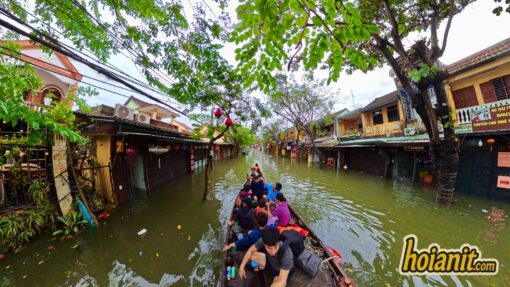
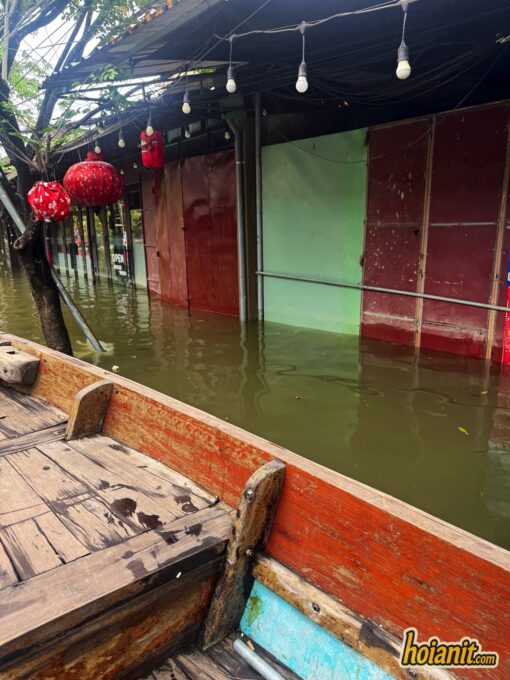
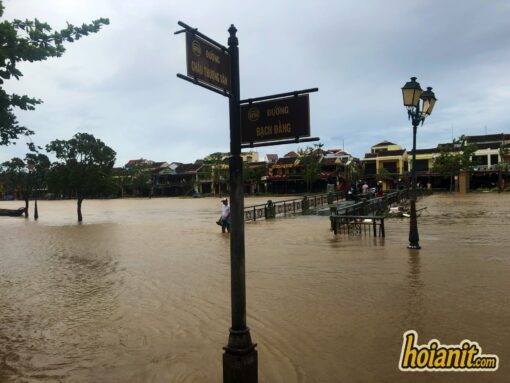

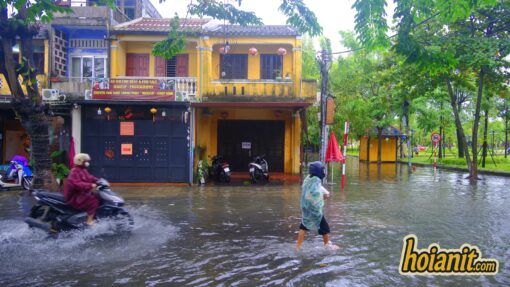
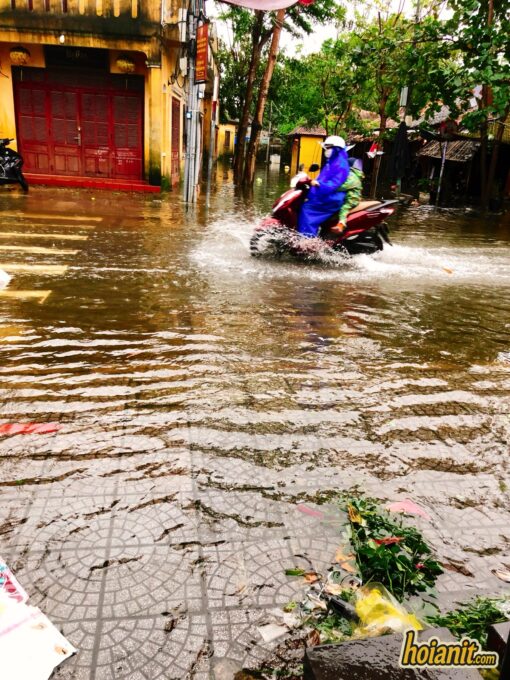
In the Old Town: boats in the lanes, the Hoai river over Bach Dang street and right up to the An Hoi footbridge, and scooters pushing through the shallower streets.

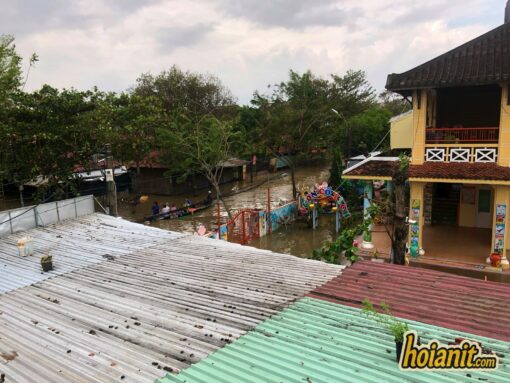
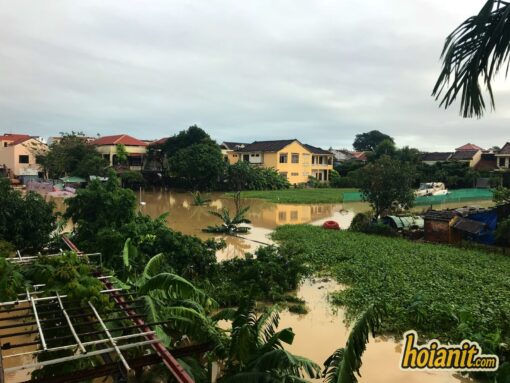
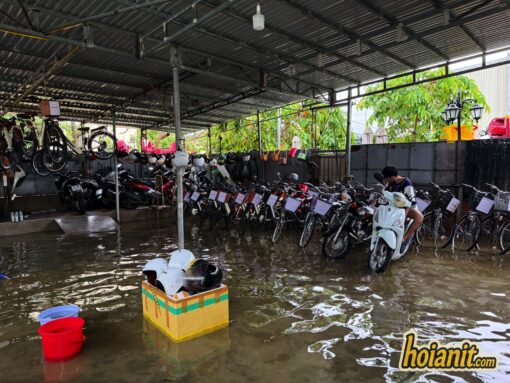


Around town: a school yard under water, floodwater across the fields, bikes standing in a flooded garage, and neighbours keeping life going on boards above the water.

Then it goes. The water falls almost as fast as it rises — usually within a day or two of the rain stopping upriver. Shopkeepers sweep the mud out, the chairs come back down off the tables, and the town reopens with remarkable speed. What takes months rather than days is the drying-out: riverside hotels can need two or three months to get the damp out of ground-floor rooms.
Which streets go under first
Flooding in Hoi An is very predictable, because it is simply a matter of height above the river. Learn this and you can judge a hotel’s address before you book.
| Area | What happens |
|---|---|
| Bach Dang (the riverfront) | First to go, every time, and the last to clear. Effectively underwater whenever the river rises at all |
| Nguyen Thai Hoc, Tran Phu | The heart of the Old Town — goes in any moderate flood |
| Nguyen Phuc Chu (An Hoi side) | The riverside strip opposite the Old Town; floods with Bach Dang |
| Cong Nu Ngoc Hoa, Nguyen Hoang, La Hoi | The night-market and An Hoi area; goes in a bigger flood |
| Tran Quy Cap, Hoi An market | Half a metre in a serious flood |
| Ly Thuong Kiet | Noticeably higher ground — usually stays dry and passable |
| Tran Hung Dao (towards the Hai Ba Trung junction) | Not a river flood but a rain trap: on 12 September 2026, 200–500 m of it sat under about half a metre of rainwater and bikes stalled |
| Cam Chau, Cam Thanh, An Bang | Away from the river; the beach road generally stays open |
Where to stay, and where not to
If your dates fall in the window, this is the single decision that determines whether a flood is an anecdote or a ruined trip.
- Avoid ground-floor rooms on or near Bach Dang and the An Hoi riverside. The views are the reason those rooms exist and the reason they flood.
- Look at Cam Chau, Cam Thanh, Tan An or the An Bang beach road — all a short ride out, all higher or better drained, all still ten minutes from the Old Town.
- A first-floor room beats a ground-floor one anywhere in the centre, even in a hotel that has never flooded.
- Check the hotel has a generator. Power cuts are common during storms; the better places run generators and keep the water hot.
- Book flexible rates for late October and November. The premium is small and the option is worth having.
Our guide to where to stay in Hoi An breaks the areas down in more detail.

Riding a motorbike in flood season
This is the part we know best, and the part where a bad decision costs real money.
Never ride into standing water you cannot see the bottom of. On a scooter the air intake sits low; once water reaches it, the engine draws water instead of air and stops — and if it stops that way, the damage is usually terminal. Vietnamese riders will tell you a bike can wade, and a local on a Wave who knows exactly how deep that particular lane gets probably can. On a rented automatic, in water of unknown depth, over a road surface you cannot see, you cannot.
Practical points for the season:
- Park high, overnight, every night. If the forecast is bad, leave the bike where the hotel staff tell you to — they know which corner of the yard stays dry.
- Electric bikes and floodwater do not mix. A soaked battery pack is both a repair bill and a fire risk. If you have an e-bike and the water is coming, park it high and leave it.
- If the bike does go under, do not try to start it. Starting a flooded engine is what turns a cleanable problem into a rebuild. Call us and leave it alone.
- Ride the beach road, not the river road. The route out to An Bang and Cam Thanh usually stays open long after the Old Town lanes are impassable.
- Rain gear beats a poncho on a bike in November. A poncho catches the wind and the sleeves fill.
Riding in from Da Nang when it is pouring
After the 12 September flooding, Hoi An ward advised riders coming from Da Nang to stay on Le Van Hien, Tran Thu Do and Nguyen Tat Thanh, then turn straight into Ly Thuong Kiet, and to avoid Tran Hung Dao and Hai Ba Trung. That is the route we give our own customers on a wet day. On the coast road, expect standing water outside The Pearl Hoi An resort and near Malibu resort after heavy rain; wait for it to drain or ride round it, and only cross if you can see the road surface and the water is below the wheel hub.
If you are renting from us in flood season
Roadside help is free within 10 km of Hoi An, so if a bike stalls in water, leave it switched off, push it to the kerb and call the roadside line (+84 766 766 087) rather than trying to restart it. Delivery anywhere in central Hoi An is from 30,000₫; on a day when the Old Town is under water, message us on WhatsApp before booking a drop-off at a riverside hotel so we can agree a dry meeting point.
Our guide to riding in the rain in Hoi An covers the technique side, our Hai Van Pass weather tips cover the passes, and what insurance does and does not cover is worth reading before the season rather than during it.
What still works when the town is under water
More than you would expect, and this is the part that surprises people.
Getting in and out of Hoi An is usually fine. The road to Da Nang and the airport runs on higher ground and stays open unless a typhoon is actually crossing the coast. Flights, trains and buses carry on. It is the last two kilometres into the Old Town that stop, not the region.
Hotels keep running. The good ones have generators, so power and hot water continue even when the grid goes down. WiFi is the thing that tends to fail.
Restaurants and cafés outside the flood zone stay open, and much of Cam Chau, Tan An and the beach road carries on as normal. The Old Town shops shut for a day or two and then reopen.
What to do on a flood day
A flood day is a lost day only if your whole plan was the Old Town.
Go inland or up. My Son is on high ground and often perfectly dry when Hoi An is not. Marble Mountains and Da Nang are usually unaffected. The Hai Van Pass is a bad idea in heavy rain, but the run to Da Nang along the coast road is normally fine. If you would rather not ride in the wet, GetYourGuide lists guided My Son trips from Hoi An that you can book the evening before, once you have seen the forecast.
Do the indoor list. A cooking class booked that morning, the museums, a long lunch, a tailor fitting, a massage. Our rainy day in Hoi An guide is the full version of this list.
Or lean into it. Hiring a boat to be paddled down Bach Dang while the shopfronts drift past at eye level is a genuinely extraordinary hour, and it is a thing almost no visitor gets to see. Agree the price first, wear something you do not mind losing, and do not get in a boat that looks overloaded.
Should you cancel? The honest answer
No — not on the basis of the season alone. Here is how we would actually think about it.
| Your situation | What we would do |
|---|---|
| Booked for late Oct or Nov, flexible dates | Shift to December or later if you can. The window narrows sharply after mid-December |
| Booked for late Oct or Nov, fixed dates | Come. Move your hotel away from the river, keep the plan loose, and accept you may lose a day |
| A storm is forecast to cross within 48 hours | Watch it properly. A typhoon landfall is a different event from a flood — follow local advice, stay inside |
| Travelling with small children or limited mobility | Genuinely consider a different month. Wading is not workable and boats are not accessible |
| Already here and the water is rising | Move to a higher room, park the bike high, buy water and snacks, stay off the roads at night |
The wider point is that Hoi An in November is cheap, empty and green, and most visitors get a few grey days and no flood at all. Our month-by-month weather guide sets the season in context if you are still choosing dates.
Riding here in the wet season?
Automatic scooters, semi-automatics, e-bikes and bicycles delivered to any hotel in Hoi An from 30,000₫ — with rain gear, and free roadside help within 10 km of Hoi An if the weather turns.
84 Phan Chau Trinh, Hoi An · Zalo 0935 439 306 · roadside line +84 766 766 087 (24/7)FAQ
When is flood season in Hoi An?
Late October to mid-December, with October and November the peak. The town typically floods two or three times in a season. The trigger is heavy rain upriver in the mountains rather than rain in Hoi An itself, so it can flood on a day that only looks grey.
How deep does Hoi An flood?
An ordinary flood puts thirty to sixty centimetres through the riverside streets. The record flood of late October 2025 was far worse: the river at Hoi An peaked around 3.4 m in the early hours of 30 October, past the 1964 record, and low streets beside the Hoai river sat under 2–2.5 m of water. That was a once-in-sixty-years event.
Which streets in Hoi An flood first?
Bach Dang, the riverfront, goes first every time and clears last. Then Nguyen Thai Hoc and Tran Phu in the Old Town, and Nguyen Phuc Chu on the An Hoi side. Tran Hung Dao near the Hai Ba Trung junction is a separate problem: it is a natural dip that floods from heavy rain alone, as it did on 12 September 2026. Ly Thuong Kiet is on higher ground and usually stays passable.
Will 2026 be as bad as 2025?
It is forecast to be milder. Vietnam’s National Centre for Hydro-Meteorological Forecasting expects 8 to 10 storms in the East Sea with 3 to 5 reaching land, and 16 to 19 widespread heavy-rain episodes nationally, fewer than the long-term average. Storms still concentrate on Central Vietnam in October and November. By 4 November 2026 the press had not reported the river flooding the Old Town this season; the main rain spells so far were 5–11 October and 28–29 October around Hue and Da Nang.
How long does a flood in Hoi An last?
The water usually falls within a day or two of the rain stopping upriver, and the town reopens quickly. What takes longer is drying out — riverside hotels can need two or three months to clear the damp from ground-floor rooms.
Can I still ride a motorbike during flood season?
Yes, on the roads that stay open, but never into standing water you cannot see the bottom of. Once water reaches the air intake the engine draws water and usually destroys itself. Turn round when the water is above the wheel hub, park high overnight, and if a bike does go under, do not try to start it.
Should I cancel my trip to Hoi An because of flooding?
Not on the season alone. If your dates are flexible, shift to mid-December or later. If they are not, come, book a hotel away from the river and above the ground floor, keep the plan loose and accept you may lose a day. Most visitors in November get grey days and no flood at all.
Can you still get to Hoi An during a flood?
Usually yes. The road to Da Nang and the airport runs on higher ground and stays open unless a typhoon is crossing the coast, and flights, trains and buses continue. It is the last two kilometres into the Old Town that stop, not the region.
When is the full moon in November 2026, and does it matter for flooding?
The Hoi An lantern night falls on Sunday 22 November 2026 and the full moon on Monday 23 November. Full-moon spring tides make it harder for floodwater to drain to the sea, so if heavy rain hits the mountains that week, 20–25 November is the window when the Old Town is most likely to flood.
Đọc bản tiếng Việt: Hội An mùa lũ 2026: phố nào ngập trước, có nên đi.
Flood depths, river-gauge readings and affected streets follow Vietnamese press reporting (Tuoi Tre, VnExpress, VietNamNet, Nguoi Lao Dong) of the record 2025 season and the 12 September 2026 rain; 2025 was a once-in-sixty-years flood rather than a typical one. Lunar dates are from the Vietnamese lunar calendar for 2026; the 2026 season table was last updated on 4 November 2026. This page contains an affiliate link (GetYourGuide). The 2026 outlook follows the National Centre for Hydro-Meteorological Forecasting and is a seasonal forecast, not a prediction for any given week — check current warnings before and during your trip. Anh Khoa rents motorbikes, e-bikes and bicycles in Hoi An; the riding advice here is general and does not replace local instructions on the day.
Keep reading Hoi An Travel Tips
 Billiards in Hoi An: 7 Pool Halls Checked on Google Maps, with Hours and Directions (2026)










Pick your ride in Hoi AnChọn xe cho chuyến đi Hội An
Scooters, electric bikes and bicycles from one shop in the Old Town — delivered to your hotel with helmets, plus free roadside help within 10 km of Hoi An.Xe máy, xe điện và xe đạp — giao tận khách sạn, kèm hai nón bảo hiểm, cứu hộ miễn phí trong bán kính 10 km.
Not sure which one fits? Message us on WhatsApp and we’ll recommend a bike for your plans.
Chưa biết chọn xe nào? Nhắn Zalo 0935 439 306, tụi mình tư vấn theo lịch trình của bạn.