

Hoi An Travel Tips
Tran Family Chapel Hoi An 2026: Which of the Three Doors Is Yours
Built in 1802 · grounds of 1,500 m² · open 07:00 – 21:00 · with the rule of the three doors, the doorsill that makes you bow, and how not to waste a square on your Old Town ticket.
Tran Family Chapel Hoi An 2026: Which of the Three Doors Is Yours
The Tran Family Chapel has three front doors and most visitors walk through the wrong one. It is not an old house that sells tickets — it is a working chapel a family still uses.
Almost every visitor walks through the wrong door here. The main hall has three of them, and they are not there for symmetry — each one belongs to a different category of person, and the middle one stays shut most of the year. That single detail tells you what this place actually is: not an old house that sells tickets, but the chapel of a family that still burns incense here. This guide covers the whole story — why Tran Tu Nhac built it in 1802 before sailing off on a diplomatic mission, which door you should use, and how to spend your Old Town ticket without wasting a square.
- The chapel is not an old house
- Where it is, and the address that changed
- Tran Tu Nhac and the mission of 1802
- The three doors: which one is yours
- Inside the hall and the display room
- The rear garden and the star-fruit tree
- Tickets and the 2026 fee
- When to go, and how to behave
- Getting there and parking
- Frequently asked questions
The Tran Family Chapel is not an old house
On the Old Town monument list, the Tran family chapel in Hoi An sits alongside Tan Ky House and Phung Hung House. All three are two-hundred-year-old timber buildings with yin-yang roof tiles, and all three take the same ticket. But they belong to two entirely different categories of building, and mixing them up is why some visitors come out feeling underwhelmed.
| Merchant house (Tan Ky, Phung Hung) | Family chapel (Tran) | |
|---|---|---|
| Original purpose | Home and trading shop combined | A place to worship one family’s ancestors |
| Layout | Narrow street frontage, running back to the river | Walled garden house: forecourt, hall, rear garden |
| Heart of the building | The shop floor and the light well | The altar hall, with lacquered boards and genealogies |
| What you learn | How Hoi An merchants traded and lived | How a Vietnamese lineage organises its worship |
| Atmosphere | Living museum, busy | Solemn, incense burning year-round |
Put simply: the merchant houses tell you about business; the family chapel tells you about lineage. If you have three hours in the Old Town and want to see how a wealthy trader lived, Tan Ky is the better call. If you are curious about ancestor worship — something most foreign visitors hear described but never actually see practised — this is the place.
Where it is, and the address that changed
The chapel stands at 21 Le Loi Street, inside the protected core of the Old Town. Every older article gives an address that no longer exists administratively: since 1 July 2025, under Resolution 1659/NQ-UBTVQH15, Minh An ward was merged with Cam Pho, Son Phong, Cam Nam and Cam Kim into a single ward now called Hoi An ward; and under Resolution 202/2025/QH15, Quang Nam province was merged into Da Nang city.
| Version | Address |
|---|---|
| Oldstill on most blogs and maps | 21 Le Loi, Minh An ward, Hoi An City, Quang Nam Province |
| Correct since 1 July 2025 | 21 Le Loi, Hoi An ward, Da Nang City |
| Asking for directions | Say “nha tho toc Tran, Le Loi” — anyone in the Old Town will point you there |
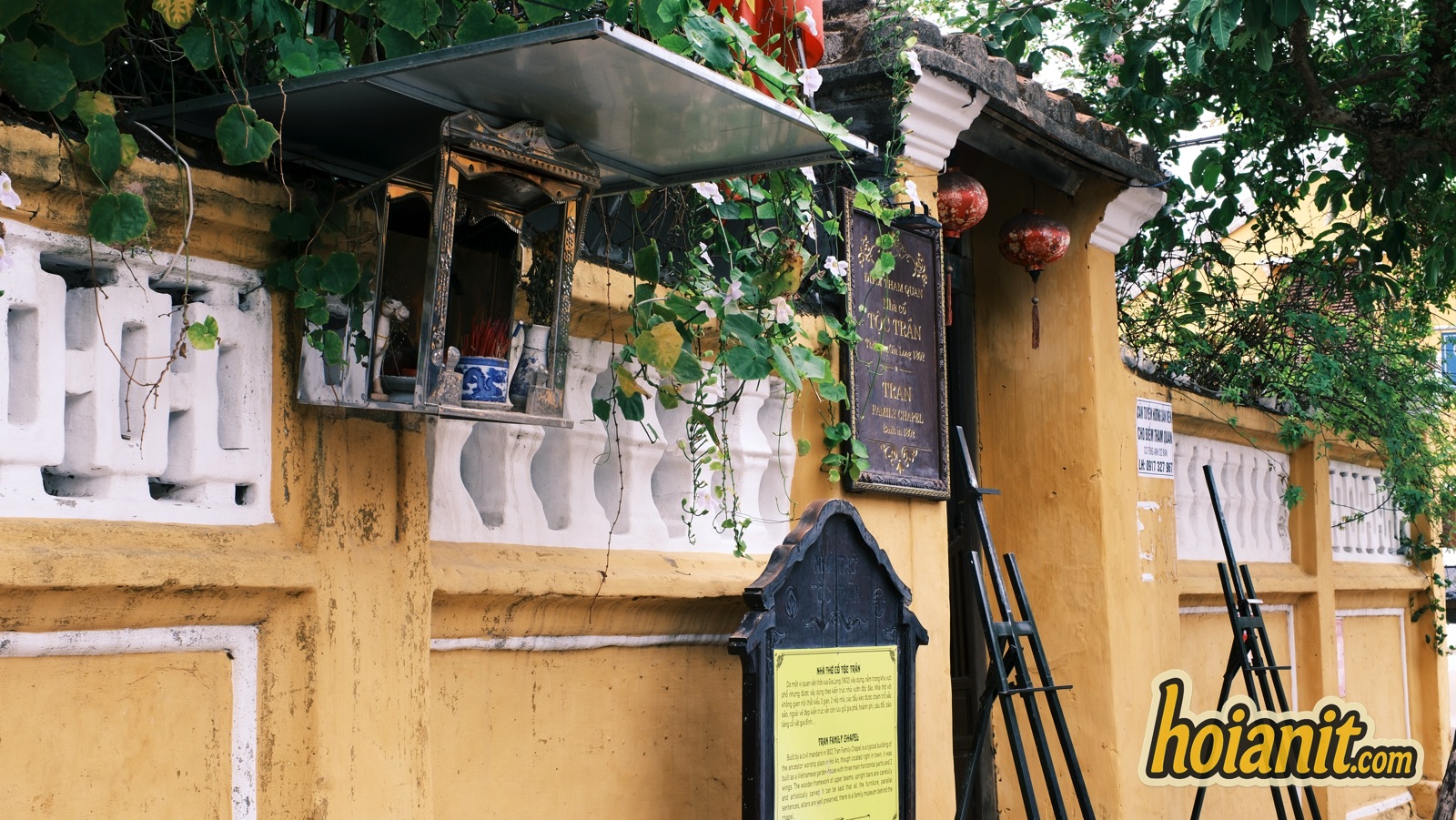
On the ground: Le Loi is the cross street connecting Tran Phu with Phan Chau Trinh. From the Japanese Covered Bridge, walk east along Tran Phu for about five minutes to the Le Loi junction, then turn in — the Tran Family Chapel is on your left, behind a low whitewashed wall and a modest wooden gate. Be warned: the frontage is far more understated than the other monuments, with no large sign, so plenty of people walk straight past it.
Within easy walking distance sit Tan Ky House, the Fujian Assembly Hall and the Japanese Covered Bridge. All four take the same Old Town ticket, so doing them in one go is the most efficient way to use it — see section № 07.
Tran Tu Nhac and the mission of 1802
1802 is the year Nguyen Anh took the throne as Emperor Gia Long, founding the dynasty that would rule Vietnam until 1945. In that same year Tran Tu Nhac — a mandarin from Hoi An and the founding ancestor of the local Tran lineage — was sent as an envoy to China.
An envoy’s journey was not a business trip. The overland route north and across the border took months; diplomatic business could drag on for a year or more; and nobody could promise a return. Before he left, Tran Tu Nhac had this chapel built — so that if he did not come back, his descendants would still have somewhere to gather, burn incense and remember where they came from.
A building put up for people who did not exist yet
This is what sets the Tran chapel apart from almost every other monument in Hoi An. The Japanese Bridge was built to cross a stream. The assembly halls were built so people from the same province could meet. The merchant houses were built to live and trade in. This one was built because a man about to travel a very long way wanted to leave a room for grandchildren he had never met.
Two centuries later it is still doing exactly that. Tran descendants return for death anniversaries and at Lunar New Year. The chapel has never stopped performing its original function — genuinely rare for a monument that also opens its doors to ticket holders.
The walled grounds cover roughly 1,500 m², laid out in the traditional garden-house pattern: a wall around the perimeter, a forecourt, the Tran Family Chapel in the middle, a garden behind. The architecture blends the influences that all happened to be present in the trading port at the time — a Vietnamese timber frame and altar arrangement, yin-yang roof tiles and horizontal lacquered boards in the Chinese manner, and proportions that echo Japanese work. The building has three bays and two roof sections; every column, beam and bracket is timber, with fine carving on the beam ends and pillars.
The Tran Family Chapel doors: which one is yours
Most write-ups mention the three doors in a single sentence and move on. In practice it is the first thing you have to deal with, about thirty seconds after you walk in.
The main hall has three doorways, and the division is anything but arbitrary:
- Centre — the principal doorReserved for the eldest members of the lineage and for people holding rank. It is normally opened only for festivals, Lunar New Year and death anniversaries. On an ordinary day you will find it closed.
- Left as you face the building — the men’s doorFor male members of the family. In the traditional scheme the left side is the yang, or male, side.
- Right — the women’s doorFor female members. The right side is the yin, or female, side.
Use either of the two side doors — it does not matter which. You are not a member of the lineage, so the left–right rule does not bind you, but taking a side door shows you understand that the centre one is not yours. If the middle door happens to be open because a ceremony is on, that is all the more reason to stay clear of it: it is being used for its actual purpose.
In practice the caretaker will steer you the right way. Follow their lead, and please do not step into the middle doorway just to get a symmetrical photograph.
The doorsill that makes you bow
Crossing into the hall you will meet a raised timber beam across the threshold — a doorsill. It is set just high enough that you cannot step over it while still looking straight ahead; to get across you have to glance down at your feet, and that glance downward is a bow.
This is not a construction quirk. The sill exists so that everyone entering the altar hall — family members and strangers alike — performs one small act of respect towards the ancestors, whether or not they realise they are doing it. Of everything you will see on an Old Town ticket, this may be the cleverest piece of architecture: a rule of conduct written directly into timber, needing no sign, no explanation and no ability to read the Chinese characters on the boards above.
A merchant house teaches you how Hoi An made its money. A family chapel teaches you how it says thank you. One raised piece of wood says more than any interpretation panel.— Anh Khoa, born and raised in Hoi An
Inside the hall and the display room
The interior divides clearly in two: the main section for worship, and a side section that was historically where the clan head and family members rested.
What to look at closely
A high, airy ceiling, with a large bronze incense burner at the centre that is alight for most of the year. Around it hang lacquered horizontal boards, parallel verse panels and a carved altar screen — all done by hand.
The timber frame. Look up at the beam ends and pillars; several carry dragon carvings. This is where the skill of the Kim Bong carpenters is most visible, and it is also what phone cameras usually miss, because the hall is dark.
The furniture and verse panels in the outer section, worn in a way only two centuries of use can produce.
Antiques and genealogies
Behind the hall the family displays its heirlooms, including pieces dating from the reigns of Emperor Minh Mang and Emperor Tu Duc — the second and third generations after the Tran Family Chapel went up. A few of the more valuable items are kept in glass cases.
The genealogy books are the real draw. For Vietnamese families a genealogy is how a lineage writes its own history; for most foreign visitors this is the first time they see an actual one rather than hearing it described.
Tran descendants still care for the building and keep the incense burning. A few rules worth remembering: do not place anything on the altar, do not touch the artefacts, ask before taking close-up photos of the altar or of family members, and keep your voice down. If your visit happens to fall on a death anniversary, access to the altar hall may be restricted — that is normal, not a closure.
The rear garden and the star-fruit tree
Right at the back is the rear garden: broad, shaded and almost always quieter than the front of the building. Plenty of people skip it entirely, having taken their photographs in the forecourt and turned around.
Its centrepiece is an old star-fruit tree. According to the family, the tree is as old as the chapel itself — planted when the building went up in 1802. It is tall, wide-crowned and fruits sweetly for most of the year, and its canopy is the most photographed corner of the grounds.
Light. The forecourt and rear garden are bright; the altar hall is very dark. Do not shoot from inside the hall out towards the courtyard — stand in the courtyard and shoot in, or move close and photograph timber details instead.
The best frame is usually taken from the forecourt looking at the three doors, with the yin-yang roof tiles included above.
Best hour: roughly 08:00 – 09:30, when the light still comes in at an angle and the tour groups have not arrived. Early afternoon is harsh and blows out the courtyard.


Tap an image to enlarge. Photographs taken in the grounds at 21 Le Loi.
Tickets and the 2026 fee
The chapel does not sell its own ticket. It is one of the ticketed Old Town monuments, alongside the Japanese Covered Bridge, Tan Ky House, the assembly halls and the museums — and since 10 August 2026 each of them is charged separately at a flat rate.
| Visitor | Price | How it works |
|---|---|---|
| Adults, any nationality | 20,000₫ per person | Per monument you enter (Resolution 98/2026) |
| Children under 16 | Free | No ticket needed |
| Where to buy | Ticket booths around the edge of the Old Town, including one at the Hoai River Square | |
Many travel sites still quote the old ticket book — 120,000₫ for foreigners, 80,000₫ for Vietnamese, covering three, four or five monuments. That system ended on 10 August 2026. The fee is now 20,000₫ per monument, the same for everyone.
The safe move: check the price on the booth or kiosk screen before you pay. How tickets are packaged can still change; the price per monument should not be more than 20,000₫.
Plan the route, not the squares
Under the old ticket book the usual mistake was running out of squares. With the per-monument fee that trap is gone, and the one that remains is time: most monuments close in the late afternoon.
- Make your list before you buy. Decide which monuments you want, pay for those, then do them in a single session.
- Group by geography. The Tran chapel, Tan Ky House, the Fujian Assembly Hall and the Japanese Bridge are all within a few minutes’ walk of each other.
- Keep the ticket safe. Staff check it at the door of each monument.
- Do not buy a ticket just to walk around. Strolling, eating and photographing in the streets of the Old Town needs no ticket — it only covers entry inside the ticketed monuments.
- Where the money goes. Ticket revenue funds the restoration and repair of the Old Town buildings themselves. In other words, the timber doorsill you just stepped over is partly still there because of tickets like yours.
When to go, and how to behave
The chapel opens 07:00 – 21:00, every day. That is a long window, but the hours are not equal.
- 07:00 – 09:30 · The best windowQuiet, cool, and the light still comes in at an angle. It is also when you have the best chance of a real conversation with the caretaker, before any groups arrive.
- 09:30 – 11:30 · Tour groupsOld Town walking tours tend to run through here in this slot. The altar hall is small; a single group of twenty fills it.
- 11:30 – 14:00 · Harsh sunThere is little shade in the forecourt or rear garden. If you come now, spend your time on the interior.
- 14:00 – 17:00 · Good againCrowds thin out. Late afternoon light rakes across the courtyard and the roof tiles photograph beautifully.
- After 18:00 · Quietest, but darkThe hall is dim to begin with and harder to read in the evening. In exchange, the solemn atmosphere is much stronger.
1. Dress modestly. This is a place of worship. Skip the vest tops and very short shorts — the same standard as visiting a pagoda.
2. Remove your hat in the altar hall. Sunglasses too.
3. Ask before photographing. Architecture is fine; close-ups of the altar or of family members deserve a quick word first.
4. Do not lean on or place anything on the furnishings. The columns and altar here are more than two hundred years old.
5. Keep your voice down. The grounds are enclosed and sound carries further than you would expect.
If you want more context on the wider monument system, we have a guide to the Hoai River Square, where one of the main visitor reception points sits, and a piece on the Trieu Chau Assembly Hall if you want to compare a family chapel with a community place of worship built by the Chinese congregations.
The chapel has no guide and no interpretation panels in English — you get a caretaker, a ticket square and whatever you already know. If you would rather have the Old Town explained as you walk it, a half-day guided walking tour covers this cluster of monuments with someone who can read the boards above the altar. Have a look at guided walks and day tours in Hoi An on GetYourGuide.
That is an affiliate link: booking through it costs you nothing extra and helps keep this guide updated.
Getting to the Tran Family Chapel, and parking
The chapel sits deep inside the protected core, so getting there depends entirely on the vehicle curfew rather than on distance.
- Before 16:00. You can ride close to Le Loi, park at one of the lots nearby and walk the last few dozen metres.
- From around 16:00. Streets in the Old Town close to traffic. Park at a lot on the outer edge and walk in — usually 5 to 10 minutes extra.
- Parking for a motorbike is typically 5,000₫ – 10,000₫ per visit. If you are given a tag, keep it.
- Bicycles and e-bikes are more flexible: they get further in and are easier to leave somewhere sensible.
- Do not leave a bike anywhere convenient inside the restricted zone — wardens patrol, and during festivals vehicles do get towed.
If you are staying at An Bang, Cua Dai or Cam Thanh, the ride into the Old Town is three to five kilometres. Taking a taxi each way over several days works out considerably more expensive than renting for the day.
| Vehicle | Per day | Best for |
|---|---|---|
| Bicyclecity bike | 50K | Staying central, Old Town only |
| E-bike / electric scooterno licence needed | from 100K | The most flexible option inside the Old Town |
| Semi-automaticWave, Jupiter | 120K | Staying out of town, riding all day |
| Automatic scooterVision, NVX, Scoopy | 200K – 250K | Two people, with storage under the seat |
Prices include two helmets, rain ponchos and delivery from 30,000₫ to your hotel within Hoi An. Note that anything above 50cc legally requires a valid licence plus a 1968 Convention International Driving Permit — see our guide on whether you need an IDP to ride in Vietnam. E-bikes and 50cc scooters need neither.
Rent a bike and do the whole monument cluster in one afternoon
Our shop is at 84 Phan Chau Trinh, a few minutes on foot from the Tran family chapel. Hotel delivery from 30,000₫, helmets and rain ponchos included, 24/7 roadside support. Prefer twist-and-go? Automatic scooter rental in Hoi An starts at 110,000₫ a day.
Hotline / WhatsApp: +84 935 206 306 · Zalo: 0935 439 306 · 84 Phan Chau Trinh, Hoi AnTran Family Chapel: frequently asked questions
Where is the Tran family chapel in Hoi An?
The chapel stands at 21 Le Loi Street, inside the protected core of Hoi An Ancient Town. The old administrative address was Minh An ward, Hoi An City, Quang Nam Province. Since 1 July 2025 Minh An has been merged into a larger Hoi An ward and Quang Nam has been merged into Da Nang city, so the correct address today is 21 Le Loi, Hoi An ward, Da Nang City. From the Japanese Covered Bridge walk east along Tran Phu for about five minutes to the Le Loi junction.
When was the Tran family chapel built and by whom?
It was built in 1802, during the reign of Emperor Gia Long, by Tran Tu Nhac, the founding ancestor of the Tran lineage in Hoi An. He had it built shortly before departing as an envoy to China, so that if he did not return his descendants would still have a place to gather and worship their ancestors. Tran descendants still return for death anniversaries and Lunar New Year today.
Do you need a ticket to enter the Tran family chapel and how much is it?
The chapel does not sell its own ticket. It is one of the ticketed Old Town monuments, and since 10 August 2026 entry costs 20,000 VND per person, the same for Vietnamese and foreign visitors. Children under 16 go free. Older guides quoting 80,000 or 120,000 VND describe the previous ticket book.
What are the opening hours of the Tran family chapel?
The chapel is open from 07:00 to 21:00 every day. The best window is 07:00 to 09:30, when it is quiet and cool and the light is still angled for photographs. Old Town walking tours tend to pass through between 09:30 and 11:30, when the small altar hall can get crowded.
The altar hall has three doors, so which one should a visitor use?
The centre door is the principal one, reserved for the eldest members of the lineage and people holding rank, and it is normally opened only for festivals and death anniversaries. The two side doors are for the men and women of the family, following the traditional left for male and right for female arrangement. Visitors should use either side door and avoid the centre one. In practice the caretaker will guide you the right way.
Why is there a raised timber beam across the threshold of the altar hall?
That beam is a doorsill, set just high enough that you cannot step over it while looking straight ahead. To cross it you have to glance down at your feet, and that glance is a bow. It was designed so that everyone entering the altar hall, family and strangers alike, performs one act of respect towards the ancestors. It is a rule of conduct built directly into the architecture, needing no sign at all.
How is the Tran family chapel different from Tan Ky or Phung Hung House?
Tan Ky and Phung Hung were merchant homes that doubled as trading shops, with narrow street frontages running back towards the river, and they tell the story of commerce in old Hoi An. The Tran chapel is a place of ancestor worship for a single lineage, built as a walled garden house with a forecourt, an altar hall and a rear garden, centred on lacquered boards, verse panels and family genealogies. In short, the merchant houses are about business and the Tran Family Chapel is about lineage.
What else is there to see besides the altar hall?
Behind the hall is a display room holding the family heirlooms, including lacquered boards, verse panels, old genealogy books and antiques dating from the reigns of Emperor Minh Mang and Emperor Tu Duc, some kept in glass cases. Beyond that lies the rear garden with an old star-fruit tree which, according to the family, was planted when the chapel was built and is therefore as old as the building. It is the most photographed corner of the grounds.
Updated August 2026. Details on the date of construction, Tran Tu Nhac, the architecture and the heirlooms have been cross-checked against several public sources on the monument. Old Town ticket prices and the number of monuments per ticket may change and are currently reported inconsistently — confirm at the booth when you buy. New ward names follow Resolution 1659/NQ-UBTVQH15 of 16 June 2025 and Resolution 202/2025/QH15. Old Town vehicle curfew hours vary with events. Spotted something wrong? Message us on WhatsApp +84 935 206 306 or email info@hoianit.com. Bản tiếng Việt: Nhà thờ tộc Trần Hội An.
More Bike Options in Hoi An


E-Bike · No license










Pick your ride in Hoi AnChọn xe cho chuyến đi Hội An
Scooters, electric bikes and bicycles from one shop in the Old Town — delivered to your hotel, helmets and roadside help included.Xe máy, xe điện và xe đạp — giao tận khách sạn, kèm hai nón bảo hiểm và hỗ trợ dọc đường.
Not sure which one fits? Message us on WhatsApp and we’ll recommend a bike for your plans.
Chưa biết chọn xe nào? Nhắn Zalo 0935 439 306, tụi mình tư vấn theo lịch trình của bạn.