

Services
Exchange Money in Hoi An: Today’s Rates, No Added Fee
Exchange Money in Hoi An: Today’s Rates, No Added Fee
Exchange money in Hoi An at Anh Khoa: rates are updated by hand, no fee is added on top, and the board shows what each note size earns. USD, EUR, KRW, INR and more.
Most guides to exchange money in Hoi An stop at a list of places. This one starts with what matters, the amount of dong in your hand, and shows how the size of your banknotes, the state of the paper and the way you withdraw cash can change that amount as much as the headline rate does. Anh Khoa’s own board is below, so you can check it against anywhere else you try.
Exchange money in Hoi An: today’s rates
TODAY’S EXCHANGE RATES AT ANH KHOA
| Currency | Denomination | Rate | Currency | Denomination | Rate |
 USD | 100$ | 25,200 |  INR | 500₹ | 230 |
| 50$ | 25,000 | 200₹-100₹ | 130 | ||
| 20$-10$ | 24,700 |  KRW | 50,000₩ | 17.00 | |
| 1$-2$-5$ | 23,000 | 10,000₩ | 16.50 | ||
 EUR | 100€-50€ | 28,100 | 5,000₩-1,000₩ | 15.00 | |
| 20€-10€-5€ | 27,700 |  CAD | 100$ | 17,600 | |
 AUD | 100$-50$ | 17,000 | 50$-20$-10$ | 17,300 | |
| 20$-10$ | 16,600 |  NZD | 100$-50$ | 13,800 | |
| 5$ | 16,300 | 20$-10$-5$ | 13,400 | ||
 GBP | 50£ | 33,500 |  CNY | 100¥ | 3,400 |
| 20£-10£ | 33,200 | 50¥-20¥-10¥-5¥ | 3,100 | ||
 SGD | 100$-50$ | 19,500 |  HKD | 1000HK$-500HK$ | 3,000 |
| 20$-10$ | 19,000 | 100HK$-50HK$-20HK$-10HK$ | 2,600 | ||
| 5$-2$ | 16,000 |  MYR | 100RM | 5,900 | |
 THB | 1000฿-500฿ | 720 | 50RM-20RM-10RM | 5,400 | |
| 100฿-50฿ | 600 | ||||
| 20฿ | 540 | ||||
 JPY | 10,000¥ | 155 | |||
| 5,000¥ | 151 | ||||
| 1,000¥ | 147 |
Each rate is the number of Vietnamese dong you receive for one unit of foreign currency. The date above changes by itself, but the numbers are typed in by hand, so they can move during the day and the board at the counter is final. Changing a larger amount? Send the currency and note sizes on WhatsApp and ask for the total first.
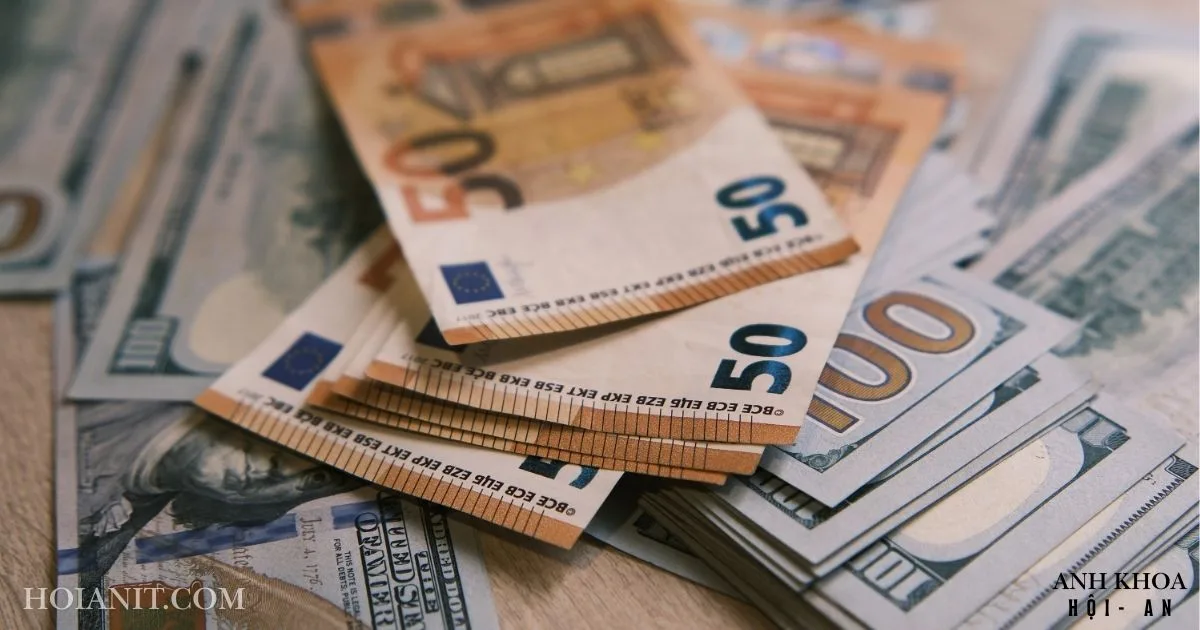
How to read the rates before you exchange money in Hoi An
The table repeats three columns twice, so each row holds two currencies side by side. Find your currency, then find the line that matches the notes in your wallet. The number on the right is what one unit of that currency earns in dong.
Worked examples, using the board dated 9 November 2026:
- US dollars. Three $100 notes at 25,400 come to 7,620,000₫.
- Euros. Four €50 notes at 28,100 come to 5,620,000₫.
- Korean won. The rate looks tiny because one won is worth very little. ₩1,000,000 in ₩50,000 notes at 17.00 comes to 17,00,000₫.
- Japanese yen. ¥50,000 in ¥10,000 notes at 155 comes to 7,750,000₫.
- Indian rupees. ₹10,000 in ₹500 notes at 230 comes to 2,300,000₫.
Those sums show the method only. Use today’s line in the table for your own money.
What no added fee really means
Anh Khoa does not put a service charge on top of the rate, so the rate on the board is the rate you get. We still earn money: our margin sits inside the rate, in the gap between what we pay for your currency and what we can sell it for. Banks and every other counter earn in much the same way. So judge any offer by the total dong you will receive, not by a fee label.
Why note size changes your exchange rate
Look down the US dollar lines and the pattern is plain: the bigger the note, the better the rate. Counters generally prefer large notes because they are easier to resell, while small notes cost more to count and move.
On the 9 November 2026 board, $300 brought as three $100 notes comes to 7,620,000₫. The same $300 brought as sixty $5 notes, at 23,000, comes to 6,900,000₫. That is 720,000₫ gone without any fee being charged, more than a motorbike costs for several days.
The gap is not the same for every currency. Euros barely move, from 28,100 for €100 and €50 notes to 27,700 for €20, €10 and €5. Rupees move a lot: ₹200 and ₹100 notes earned 130 that day against 230 for ₹500 notes, more than 40% less. If you are packing cash at home, ask your bank for the largest notes it will give you.
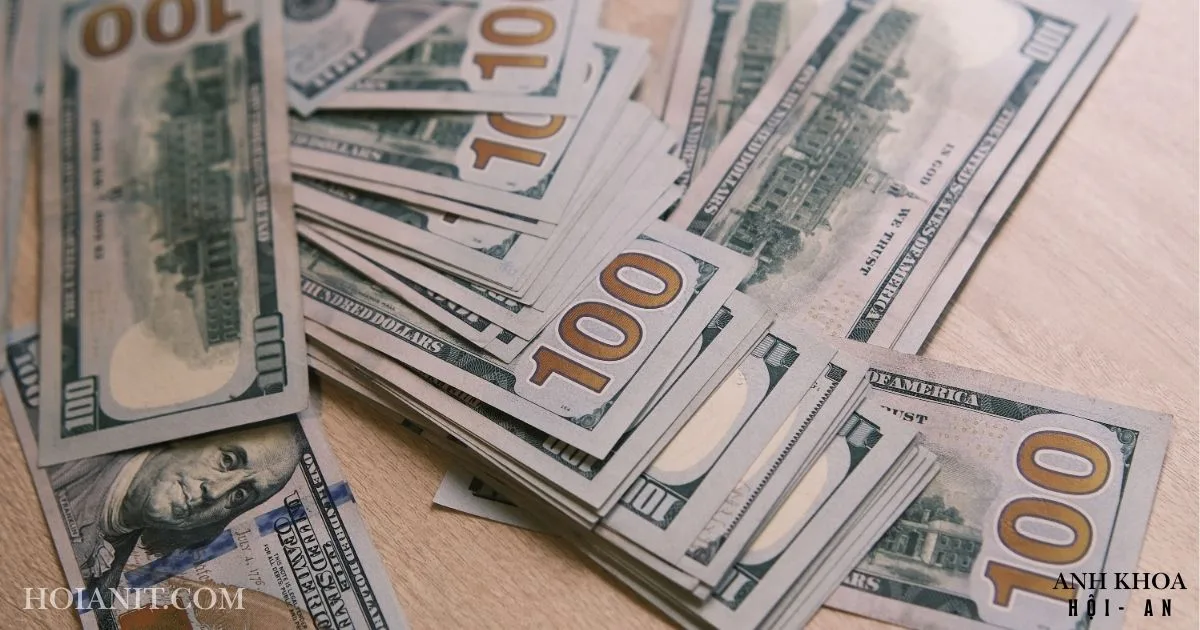
The state of the paper counts too
Torn, taped, written-on or heavily creased notes are often refused in Vietnam, or taken at a lower rate. Older US series can get the same treatment. Keep your large notes flat in an envelope rather than folded in a pocket, and if a note looks doubtful, ask about it before you plan your budget around it.
How to exchange at Anh Khoa, step by step
- Check today’s line in the table above and work out a rough total for your note sizes.
- Come to 84 Phan Chau Trinh, Hoi An (map). Bring your passport, especially for a larger amount.
- Agree the total in dong before you hand anything over.
- Count the cash yourself at the counter before you leave. It is counted in front of you, and you should do the same.
Planning a late visit? Message first on WhatsApp +84 935 206 306 or Zalo 0935 439 306, or email info@hoianit.com.
Cash or ATM: which costs less in Hoi An?
An ATM has two possible costs: the fee charged by the machine, and whatever your own bank adds for foreign withdrawals and its exchange rate. Fees vary by bank and change without notice. A 2026 traveller guide lists VPBank and ACB with no ATM fee for foreign cards, with limits of up to 10,000,000₫ and 3,000,000₫ per withdrawal, and Vietcombank at about 50,000₫ each time. Treat those as a starting point. The machine shows its fee before you confirm, and that screen is what counts.
Withdrawal size matters as much as the bank. A 50,000₫ fee is about 1.7% of a 3,000,000₫ withdrawal but only 0.5% of 10,000,000₫, so fewer, larger withdrawals usually cost less.
There is no single winner. If you are already carrying clean, large notes, changing them avoids machine and card fees. If you arrive without cash or are staying for weeks, an ATM with a low-fee card is simpler and means carrying less. Bring both a card and some cash, because a machine can be empty and a card can be blocked.
Where to exchange money in Hoi An: your options compared
| Option | What to expect | Cost | Good for |
|---|---|---|---|
| Banks | Official counters, office hours, passport usually requested | Margin inside the rate | Larger sums and formal paperwork |
| Anh Khoa, 84 Phan Chau Trinh | Walk in, rates published on this page | No added fee, margin inside the rate | Changing cash near the Old Town |
| ATM | Many machines, open around the clock | Machine fee plus your bank’s charges | Arriving with no cash, longer stays |
| Hotel desk | Easy, but rates vary widely | Ask for the total first | A small top-up |
| Airport counter | Open when you land | Ask for the total first | Just enough for the ride into town |
| Someone on the street | No address, no comeback | Highest risk | Nothing. Walk away |
We do not claim to beat every counter on every day. Rates move, and yours depends on your notes, so it is worth asking two places for the total dong on the same amount. The comparison takes a minute.
How to avoid scams when you exchange money in Hoi An
Changing money here is usually uneventful, but a few tricks turn up anywhere tourists carry cash.
- The fee label. A sign promising free exchange says nothing about the rate. Ask how much dong you will get in total.
- Fast counting. Notes counted quickly, then a few palmed on the way back. Take the stack and count it yourself, slowly, before you step away.
- A rate that changes at the till. Confirm the board rate applies to your notes and your amount before you hand over your cash.
- Damaged change. Hand back any torn note at once, because shops may refuse it later.
- The offer on the street. A great rate from a stranger is the classic setup. There is no address to return to if the stack comes up short.
Count the dong, not the promise.
Know your dong before you spend it
The Vietnamese dong has a lot of zeros, and that is where most expensive mistakes happen. The larger notes in everyday use are 10,000, 20,000, 50,000, 100,000, 200,000 and 500,000.
- 20,000 and 500,000 are both blue. Paying with the wrong one costs you almost the whole note if nobody corrects it.
- 10,000 and 200,000 are similar brownish tones, and easy to confuse in poor light.
- Written prices drop the zeros. A menu showing 50 or 50K means 50,000₫.
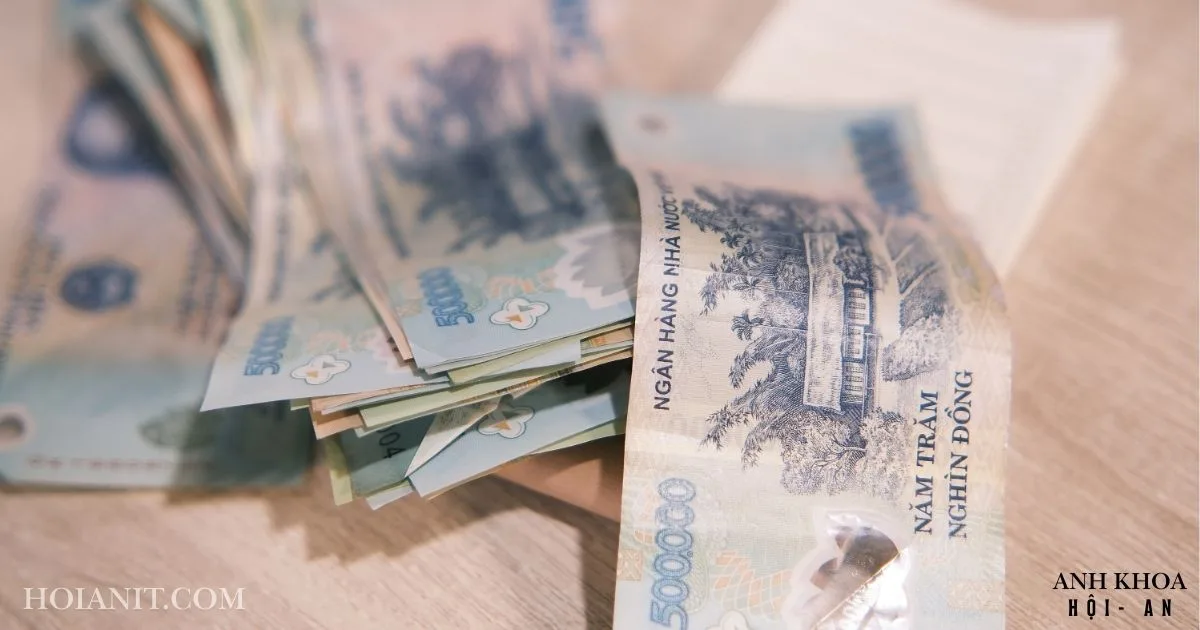
When you change money, ask for some smaller notes as well. A market vendor or a parking attendant may struggle to break a 500,000₫ note.
How much cash to bring to Hoi An
There is no perfect figure, but our Hoi An budget guide shows what a day here really costs. Change enough for a few days at a time rather than everything at once. You carry less, and you are not stuck with a big pile of dong on your last morning.
Prices in Hoi An are set in dong, and most shops and restaurants expect to be paid in it, so a foreign note is not a substitute for local cash. Larger hotels and tour desks may take cards.
FAQs about exchanging money in Hoi An
Where can I exchange money in Hoi An?
Banks in town handle exchange during office hours, and Anh Khoa at 84 Phan Chau Trinh changes more than 10 currencies on a walk-in basis. Avoid anyone offering to change money on the street.
Does Anh Khoa charge a fee to exchange money?
No fee is added on top of the rate. Our margin is inside the rate itself, so the rate on the board for your note size is the rate you get.
Why is the rate lower for small notes?
Large notes are easier for a counter to resell, while small notes cost more to count and move. Bringing $100 notes rather than $5 notes can make a real difference to your total.
Do I need a passport to exchange money in Hoi An?
Bring it, especially for a larger amount. Banks usually ask for one, and it saves a second trip if it is requested.
Is it better to exchange cash or use an ATM in Hoi An?
If you already carry clean, large notes, changing them avoids machine and card fees. If you have no cash or are staying for weeks, an ATM with a low-fee card is simpler. Keep both as options.
What is the best currency to bring to Vietnam?
US dollars and euros in large, clean notes are the easiest to change. Other major currencies are listed in the table on this page, each with its own rate per note size.
Can I pay with foreign currency in Hoi An?
Most shops and restaurants expect dong, so change some money before you go shopping or eating out.
Are the rates on this page the same at the counter?
They are updated by hand and can move during the day, so the board at 84 Phan Chau Trinh is final. Message us on WhatsApp to confirm the total before a larger exchange.
Note. Exchange rates on this page are set by Anh Khoa and updated by hand, and the date above reflects Hoi An time. Rates can move during the day, so the board at the counter at 84 Phan Chau Trinh is final. No fee is added on top of the rate. ATM fees and limits are reported figures and change without notice.
Keep reading Services