
Riding Rules & Licenses
Do You Need an IDP to Ride a Motorbike in Vietnam? (2026)
Do You Need an IDP to Ride a Motorbike in Vietnam? (2026)
Yes, you need an IDP for anything over 50cc, but the one your country gives you by default may be the wrong kind. Vietnam recognises only 1968 Vienna Convention permits. Here is the ten-second test, and what to do if yours fails it.
Almost every guide answers “do I need an IDP in Vietnam?” with a flat yes. That answer is right but useless, because it skips the part that actually decides whether you are legal: there are two different kinds of International Driving Permit, and Vietnam accepts only one of them. Travellers from the USA, Canada, Australia, New Zealand, Japan and South Korea routinely arrive holding a permit that has no legal effect here at all, and they paid for it, and it looks entirely official.
We hand bikes to visitors every day at our shop in Hoi An, and whether they really need an IDP is the single most misunderstood thing we deal with. Below: which permit is valid, how to check yours in ten seconds without reading a word of Vietnamese, what it actually costs if you’re stopped, why your travel insurance is the bigger risk, and four legal options if your country doesn’t issue the right permit.
- Vietnam acceded to the 1968 Vienna Convention on 20 August 2014, in force for Vietnam from 2015. IDPs issued under that convention by member states are recognised here.
- 1949 Geneva Convention IDPs are not recognised. That includes the standard permits issued in the USA, Canada, Australia, New Zealand, Japan, South Korea and India.
- An IDP alone is never enough. It is a translation of your home licence, not a licence. Carry both.
- Your home licence must cover motorcycles. A car-only licence does not let you ride a scooter, IDP or no IDP.
- Riding without a valid licence: 2–4 million₫ (up to 125cc) or 6–8 million₫ (over 125cc), and the bike can be held.
- 50cc or under, or electric up to 4 kW: no licence of any kind required. This is the fully legal route for many visitors.
- Do you need an IDP? The short answer by nationality
- 1968 vs 1949, and the ten-second test
- Which countries issue which permit
- Why you need an IDP and your home licence together
- What it costs if you’re stopped
- The bigger risk: your travel insurance
- How to get a valid 1968 IDP before you fly
- If your country only issues a 1949 permit
- “International Driver’s Licence” websites
- Riding legally in Hoi An
- FAQ
Do you need an IDP? The short answer by nationality
Whether you need an IDP, and whether you can even get a valid one, depends entirely on which convention your country has joined. Find yourself here first.
| You hold a licence from… | Can you ride a 110cc+ scooter legally in Vietnam? |
|---|---|
| UK, Germany, France, Netherlands, Switzerland, Austria, Belgium, Sweden, Denmark, Norway, Finland, Poland, Czechia, Italy, Portugal, Russia, Israel, Brazil, South Africa, UAE, Philippines, Thailand | Yes: get a 1968 IDP at home and carry it with your licence. UK riders must ask for the 1968 version specifically |
| USA, Canada, Australia, New Zealand, Ireland, Japan, South Korea, India, Spain | Not with an IDP. These countries are not parties to the 1968 convention, so their permits are not recognised here. See section 08 for your legal options |
| Other ASEAN states (Malaysia, Singapore, Indonesia, Cambodia, Laos) | Check first. The US Embassy in Hanoi notes that an ASEAN licence “may be recognized in certain circumstances”. It is not automatic, so ask the rental shop and your insurer before relying on it |
| Anyone, riding a 50cc bike or an electric bike up to 4 kW | Yes, with no licence at all, minimum age 16. See section 08 |
This is general information, not legal advice. We rent motorbikes; we are not lawyers. Traffic law in Vietnam changed substantially on 1 January 2025 and enforcement practice varies by province and by month. Treat everything here as a starting point and check your own country’s issuing authority before you travel.
1968 vs 1949, and the ten-second test
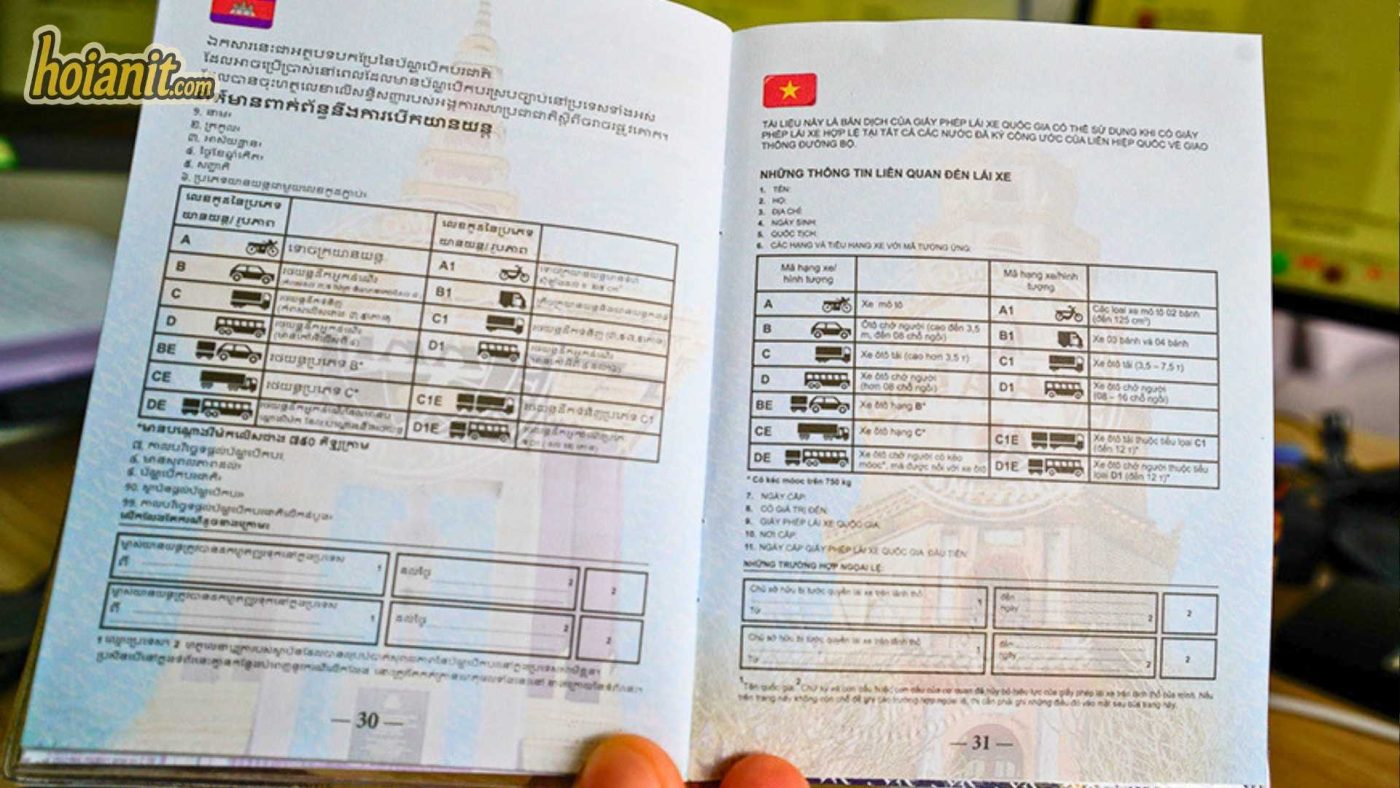
There is no such thing as “an International Driving Permit” in the singular. There are three, created by three different treaties (Paris 1926, Geneva 1949 and Vienna 1968), and a country only has to honour the ones it has joined.
Vietnam acceded to the 1968 Vienna Convention on Road Traffic on 20 August 2014, and the treaty took effect for Vietnam twelve months later. It is the only one of the three that Vietnam is party to. A permit issued under the 1949 Geneva Convention is a perfectly genuine document; it simply has no standing on Vietnamese roads, in the same way a Vietnamese driving licence has no standing in Ohio.
The ten-second test
Take out your IDP booklet and read the front cover or first page. It states the treaty it was issued under, usually as “Convention on Road Traffic of 8 November 1968” or “Convention on International Road Traffic of 19 September 1949”. Some booklets print the year alone.
If it says 1968, you are covered in Vietnam for the categories stamped inside. If it says 1949 or 1926, you are not, regardless of who issued it, what it cost, or how official it looks. You do not need to read a word of Vietnamese and you do not need to ask anyone.
- The booklets look almost identical. Usually the same grey cover, same size, same multilingual pages. The convention line is the only visible difference.
- Some countries issue more than one type. The UK issues 1926, 1949 and 1968 permits; you get whichever you ask for.
- The permit is a translation, not a licence. It has no validity by itself anywhere in the world.
- Validity: a 1968 permit lasts up to three years, or until your home licence expires if that comes first. A 1949 permit lasts one year.
Need a bike for this?
Anh Khoa delivers motorbikes, electric bikes and bicycles to your hotel in Hoi An, with helmets, raincoats and 24/7 support.
84 Phan Chau Trinh, Hoi An · 24/7 supportMore Bike Options in Hoi An
E-Bike · No license


No License? No Worries!
Rent a 50cc Bike in Hoi An Today!Which countries issue which permit
This is the table most guides leave out, and several of the ones that include it get it wrong. We checked every row against the UN treaty record for the 1968 Convention on Road Traffic, which lists 91 parties. Check your own country before you decide whether you need an IDP or a different plan.
| Country | Status in the 1968 treaty | Valid in Vietnam? |
|---|---|---|
| United Kingdom | Party since 2018; issues 1926, 1949 and 1968 permits | Yes, if you ask for the 1968 |
| Germany, France, Netherlands, Belgium, Switzerland, Austria | Party | Yes |
| Italy, Portugal, Poland, Czechia, Sweden, Denmark, Norway, Finland | Party | Yes |
| Russia, Ukraine, Israel, UAE, Brazil, South Africa, Philippines | Party | Yes |
| Thailand | Party since 1 May 2020 | Yes, check your permit says 1968 |
| South Korea | Signed in 1969, never ratified; issues 1949 permits | No |
| Spain | Signed in 1968, never ratified | No |
| India | Not a party; issues 1949 permits | No |
| United States | Not a party; 1949 permits (AAA / AATA) | No |
| Canada | Not a party; 1949 permits (CAA) | No |
| Australia | Not a party; 1949 permits | No |
| New Zealand | Not a party; 1949 permits | No |
| Ireland, Japan | Not a party; 1949 permits | No |
The rows that surprise people are South Korea and Spain. Both signed the 1968 treaty decades ago and never ratified it, and a signature is not membership. Da Nang sees a great many Korean visitors, and a Korean permit, however official, is the 1949 kind. Indian riders run into the same wall: India never joined the 1968 treaty, so the permit issued there, including the plastic card version, is not recognised here. For the full country list with treaty dates, see our guide to the IDP 1968 in Vietnam.
British riders, read this twice. UK permits are now sold over the counter at PayPoint shops for £5.50, and three types exist. The GOV.UK page on international driving permits confirms that Vietnam needs the 1968 one. Ask for it by name: “a 1968 IDP, please”. It costs the same. Getting the wrong one and finding out in Hoi An costs a great deal more.
Why you need an IDP and your home licence together
An International Driving Permit contains no test, no assessment and no authority. It is a standardised translation of a licence you already hold. So even when you do need an IDP, it only works as half of a pair.
Under Decree 168/2024, a permit without the matching national licence counts as riding with no valid licence, so the full 2–4 million₫ or 6–8 million₫ penalty applies, not the small “forgot to carry it” fine. Your home licence and your IDP travel together or they are worth nothing.
- Carry both, physically. A photo on your phone is not a legal substitute. Keep the pair in a waterproof sleeve; Hoi An rain is not gentle.
- Check the categories on your home licence. A car-only licence plus an IDP does not authorise a motorcycle. The IDP simply reproduces the categories you already hold; if there’s no motorcycle entitlement at home, there’s none here.
- Watch the engine size. Most licences from Europe distinguish A1 (up to 125cc), A2 and A. Vietnam draws the same line: since 1 January 2025 its own A1 licence covers up to 125cc or 11 kW. A 155cc scooter is a common rental in Hoi An and it sits outside an A1 entitlement.
- Check the expiry. A 1968 permit can last up to three years, but it dies the moment your home licence does.
- Leave your passport at the hotel. Carry a photocopy plus the licence pair. No rental shop needs to hold your passport, and none should.
What it costs if you’re stopped
Vietnam’s traffic penalties were rewritten by Decree 168/2024/ND-CP, in force since 1 January 2025. The increases were large and they apply to foreign riders exactly as they apply to Vietnamese ones.
| Situation | Penalty |
|---|---|
| No valid licence, motorbike up to 125cc | 2,000,000 – 4,000,000₫ (≈ $75–150) |
| No valid licence, motorbike over 125cc | 6,000,000 – 8,000,000₫ (≈ $230–300) |
| Valid licence held but left at the hotel | 200,000 – 300,000₫ |
| Owner handing a motorbike to someone not entitled to ride it (individual) | 8,000,000 – 10,000,000₫ |
| Same, where the owner is a business | 16,000,000 – 20,000,000₫ |
- The bike can be held. This is the part that ruins trips: a temporary seizure can run up to seven days, and you are still paying the rental company for a bike sitting in a police compound.
- The penalty is per stop. Paying it does not make you legal; ride on and the next officer can issue it again.
- The shop is exposed too. Those last two rows are why a serious rental business asks to see your licence. If a shop hands you a 155cc bike without a glance at your papers, that tells you what kind of shop it is.
- Always ask for the official record (biên bản). A written fine paid at the treasury or by bank transfer is the legitimate process.
We’ve written separate, practical guides on roadside checks: what happens at a police stop in Hoi An and tips to avoid fines when riding in Vietnam.
The bigger risk: your travel insurance
Most visitors weigh the question of whether they need an IDP against the fine. That is the wrong number. The fine is a few hundred dollars. A medical evacuation from central Vietnam can run to tens of thousands.
Read the motorcycle clause in your policy
Most travel insurance policies make cover for a motorcycle accident conditional on you being legally entitled to ride that vehicle in that country, and many add a second condition: that you were wearing a helmet. If you were riding on a 1949 permit that Vietnam does not recognise, an insurer can take the position that you were not legally licensed and decline the claim.
The scooter costs about $7 a day. A serious injury on the Hai Van Pass without cover is life-changing. If there is one paragraph in this article worth acting on, it is this one: open your policy, search for “motorcycle”, and read what it says before you get on a bike.
- Some policies exclude motorbikes over 125cc outright, whatever your licence says.
- Some require a licence valid in your home country for the same class, not just any licence.
- Helmet clauses are common, and helmets are compulsory in Vietnam for rider and passenger anyway.
- 50cc and low-power electric bikes need no licence here, but check whether your policy still requires one. The two rules are independent.
How to get a valid 1968 IDP before you fly
If you need an IDP and your country is a party to the 1968 convention, getting one is usually a short errand, and it must be done before you leave. No Vietnamese authority can issue you a foreign IDP after you arrive.
| Country | Where to apply | What to expect |
|---|---|---|
| United Kingdom | PayPoint shops, in person. Ask for the 1968 permit | £5.50, over the counter |
| Germany, Austria, Switzerland | Your local licensing office (in Germany the Führerscheinstelle) | Usually quick; small fee |
| France | ANTS, online | Allow several weeks |
| Netherlands, Belgium, Nordic countries, Italy | The national motoring club or licensing office your government designates | Check current fees and processing time on their site |
- Bring: your full home licence, a passport photo, your passport, and the fee. That is normally the entire list.
- Check the categories printed inside before you leave the counter. Motorcycle entitlements must be stamped or they are not there.
- Apply at least a month out if your country posts the permit rather than issuing it over the counter.
- There is no online shortcut. Only a government authority or the officially designated motoring organisation can issue a real IDP.
If your country only issues a 1949 permit
Americans, Canadians, Australians, New Zealanders, Irish, Japanese, Korean and Indian riders: your permit will not make a 110cc scooter legal here. You still need an IDP of the right kind for that, and you cannot get one. That is not the end of the trip; it just means choosing from these four routes instead. They are listed best to worst.
- Ride a 50cc bike, or a low-power electric bike. Under the Road Traffic Order and Safety Law 2024 (in force 1 January 2025) no licence of any kind is required for a moped of 50cc or less, or an electric one up to 4 kW and 50 km/h, for anyone, foreign or Vietnamese. Minimum age 16. This is not a loophole or a grey area; it is the plain text of the law, and for a Hoi An holiday a 50cc scooter or an e-bike covers almost everything. Details in our guides to the licence for a 50cc scooter and whether electric bikes need a licence.
- Don’t ride, be ridden. Grab bike, a private driver, or a guided motorbike tour with a licensed rider. You still get the Hai Van Pass and the countryside, legally, and someone else deals with the traffic.
- Convert to a Vietnamese licence. Available if you are staying a while: you generally need a visa or residence card valid for more than three months, your home licence with a notarised translation, a health check and a fee. Since 1 March 2025 licensing is handled by the traffic police under the Ministry of Public Security. It takes days to weeks, not hours. Worth it for expats and long-stay riders; not for a two-week holiday.
- Ride a larger bike anyway, unlicensed. Plenty of people do. We are not going to pretend otherwise, but understand exactly what you are choosing: a 2–8 million₫ fine per stop, a bike that can be held, and a travel insurance policy that may not pay if you are hurt. Our honest advice is option 1.
For US riders specifically, including how a motorcycle endorsement on a state licence is treated and what the practical options look like on the ground, we have a dedicated guide: what US citizens need to ride a motorcycle in Vietnam.

“International Driver’s Licence” websites: what you’re buying
Search for whether you need an IDP and the first results will be commercial sites selling an “International Driver’s Licence” or “International Driving Document” for $40–100, delivered as a PDF in twenty minutes. They look convincing: holograms, a photo, a booklet, dozens of languages.
These are not International Driving Permits. A real IDP can only be issued by a government authority or the motoring organisation that government has designated. A private company on the internet has no such authority in any country. What you receive is a privately printed translation, with no legal standing in Vietnam and none anywhere else either.
- The tell is the issuer. If it is not your government or your national motoring club, it is not an IDP.
- “Valid in 150+ countries” is marketing, not a legal statement. Validity comes from a treaty, not a claim on a website.
- Instant issue is the giveaway. Real permits require your physical licence to be presented or verified.
- If you already bought one, it is not a disaster; it is just not a licence. Fall back to the options in section 08.
One of these sites, read closely
Take internationaldrivingauthority.com, one of the sites that ranks near the top for this search. It sells what it calls an International Driving Document. The site is operated by Pathway Travel Pte. Ltd., a Singapore company owned by International Automobile Authority LLC of Florida.
Its own legal disclaimer is unusually candid. In the company’s own words the product is not an International Driving Permit: it is a certified translation of your home licence. The same page states that the company is not a government agency, not a licensing authority, and has no connection to the United Nations, the AAA, the CAA or the FIA, and that the word “Authority” in the brand name refers to the parent company rather than to any legal power. On whether anyone has to accept it, the page is blunt: no acceptance is guaranteed in any country.
None of that is hidden. It is simply on a page most buyers never open before paying.
This is not a theoretical risk. Vietnam’s Traffic Police Department published a public notice stating that IAA international driving permits are not recognised in Vietnam, and Ho Chi Minh City police issued a matching advisory. Riders who presented an IAA document at a roadside check were written up for riding without a driving licence, not for carrying the wrong paperwork.
Under Decree 168/2024 that is 2–4 million₫ for a bike up to 125cc and 6–8 million₫ above that, and the bike can be held. Note the initials: International Automobile Authority is the parent company of the website described above.
Riding legally in Hoi An
Hoi An is unusually forgiving terrain for a visitor who would otherwise need an IDP: flat, short distances, and most of what you want to see is within five kilometres of the Old Town. That matters because it makes the fully legal, no-licence option practical here in a way it wouldn’t be for a Ha Giang loop. Distances below are Google Maps directions from our shop at 84 Phan Chau Trinh.
| Trip | Distance | 50cc / e-bike? |
|---|---|---|
| Old Town ↔ An Bang beach | ~4.6 km | Easily |
| Old Town ↔ Tra Que herb village | ~3.2 km | Easily |
| Old Town ↔ Thanh Ha pottery village | ~2.9 km | Easily |
| Old Town ↔ Marble Mountains | ~18 km | Yes, allow extra time |
| Hai Van Pass | ~54 km each way | No: take a licensed rider or a tour |
- Helmets are compulsory for rider and passenger, and come with every rental.
- The Old Town closes to motorbikes twice a day, 09:00–11:00 and from 15:00 into the evening. Plan around it with our guide to the Old Town vehicle restriction hours.
- Check what you’re actually being given. Ask the engine size before you sign. “Scooter” covers everything from a 50cc SYM Shark to a 155cc NVX, and only the first is licence-free.
- New to riding in Vietnam? Read our riding safely in Hoi An notes before your first afternoon.

Frequently asked questions
Do I need an International Driving Permit to ride a motorbike in Vietnam?
Yes, if you ride a motorbike over 50cc on a foreign licence. It must be an IDP issued under the 1968 Vienna Convention, stamped for motorcycles, and you must carry your home licence with it. Mopeds of 50cc or less and electric bikes up to 4 kW require no licence at all.
Is a US or Australian International Driving Permit valid in Vietnam?
No. The USA, Canada, Australia, New Zealand, Ireland and Japan issue permits under the 1949 Geneva Convention, and South Korea and India also issue 1949 permits. Vietnam is party only to the 1968 Vienna Convention and does not recognise 1949 permits. Riders from these countries should use a 50cc or electric bike, hire a licensed driver, or convert to a Vietnamese licence if staying long term.
How do I tell whether my IDP is a 1968 or a 1949 permit?
Read the front cover or first page of the booklet. It names the treaty it was issued under, usually the Convention on Road Traffic of 8 November 1968 or the Convention on International Road Traffic of 19 September 1949. If it says 1968 you are covered in Vietnam for the categories stamped inside; if it says 1949 or 1926 you are not.
What is the fine for riding without a licence in Vietnam?
Under Decree 168/2024, in force since 1 January 2025, it is 2 to 4 million VND for a motorbike up to 125cc and 6 to 8 million VND for one over 125cc, and the bike can be held for up to seven days. Having a valid licence but leaving it at your hotel is a much smaller 200,000 to 300,000 VND.
Can I get an International Driving Permit after I arrive in Vietnam?
No. An IDP must be issued by the country that issued your licence, before you travel. Vietnamese authorities issue IDPs only to holders of Vietnamese licences, for use abroad. If you arrive without a valid one, your legal options are a 50cc bike, an electric bike, a licensed driver, or converting to a Vietnamese licence.
Is the “International Driver’s Licence” sold online valid in Vietnam?
No. Only a government authority or its designated motoring organisation can issue a genuine International Driving Permit. Documents sold by private websites have no legal standing in Vietnam, however official they look. Vietnam’s Traffic Police Department has published a notice stating that IAA international driving permits are not recognised here, and riders who presented one were fined for riding without a licence.
Do I need a licence for a 50cc or electric motorbike in Vietnam?
No. Under the Road Traffic Order and Safety Law 2024, effective 1 January 2025, no driving licence is required for a moped of 50cc or less, or an electric one up to 4 kW and 50 km/h. The minimum age is 16. This applies to foreign visitors as well as Vietnamese riders, and it is the simplest legal route for anyone whose country issues only a 1949 permit.
Will my travel insurance cover a motorbike accident in Vietnam?
Usually only if you were legally entitled to ride that vehicle here and were wearing a helmet. Riding a 125cc scooter on a permit Vietnam does not recognise can give an insurer grounds to decline a claim. Check the motorcycle clause in your own policy before you ride; it is a far larger financial risk than the fine.
Not sure what you’re allowed to ride? Ask us before you book.
Anh Khoa is a family-run rental at 84 Phan Chau Trinh, Hoi An. Send us a photo of your licence and IDP and we’ll tell you honestly what you can legally ride here, including whether a 50cc or an electric bike is the better answer for your trip. No deposit, no passport held, helmets and raincoats with every bike, and 24/7 roadside help.
Zalo 0935 439 306 · 84 Phan Chau Trinh, Hoi An
The treaty side in depth: IDP 1968 Vietnam: which permit lets you ride · Bản tiếng Việt: Thuê xe máy Hội An có cần bằng lái không?
Updated October 2026. Treaty membership from the UN Treaty Collection record for the 1968 Convention on Road Traffic; penalties from Decree 168/2024/ND-CP, in force 1 January 2025; licence exemptions from the Road Traffic Order and Safety Law 2024. Distances measured with Google Maps directions from 84 Phan Chau Trinh, Hoi An. USD amounts are rounded approximations. We rent motorbikes and are not lawyers: this is general information, not legal advice, and enforcement practice varies. Confirm your own permit type with the issuing authority in your country before you travel.








Pick your ride in Hoi AnChọn xe cho chuyến đi Hội An
Scooters, electric bikes and bicycles from one shop in the Old Town — delivered to your hotel, helmets and roadside help included.Xe máy, xe điện và xe đạp — giao tận khách sạn, kèm hai nón bảo hiểm và hỗ trợ dọc đường.
Not sure which one fits? Message us on WhatsApp and we’ll recommend a bike for your plans.
Chưa biết chọn xe nào? Nhắn Zalo 0935 439 306, tụi mình tư vấn theo lịch trình của bạn.