
Hoi An Travel Tips
Hoi An Ancient Town: What It Is, How It Works, What to See
Hoi An Ancient Town: What It Is, How It Works, What to See
Thirty hectares. 1,107 timber-frame buildings. One trading port that stopped being important at exactly the right moment — and survived because of it.
Hoi An Ancient Town is a UNESCO World Heritage Site: a 15th-to-19th-century Southeast Asian trading port that has kept its street plan and almost all of its buildings intact. This guide explains what you are actually looking at, how the town works day to day — tickets, pedestrian hours, opening times — and how to choose between the heritage sites without wasting your five tabs.
Some links in this article are affiliate links — if you book through them, we earn a small commission at no extra cost to you. It helps keep this local guide free and updated.
- What Hoi An Ancient Town actually is
- How the town works: tickets, hours, pedestrian times
- The Japanese Covered Bridge — and why it looks brand new
- The five kinds of site on your ticket
- What to actually look at: reading the architecture
- Lantern nights: the 14th of every lunar month
- The rhythm of a day — and the hours worth planning around
- Practical notes most guides skip
It does not list every fee — our Hoi An entrance ticket guide covers every price for every site, museum, show and craft village in one table. And it is not an itinerary — if you want the hour-by-hour version, read Hoi An in one day. This page is about understanding the place so the other two make sense.
What Hoi An Ancient Town actually is
Between the 15th and 19th centuries, Hoi An was one of Southeast Asia’s busiest international ports. Japanese, Chinese, Dutch, Portuguese and Indian merchants waited here for the monsoon winds to turn, sometimes for months, and while they waited they built.
UNESCO inscribed the town in 1999 under two criteria. Criterion (ii): Hoi An is “an outstanding material manifestation of the fusion of cultures over time in an international commercial port.” Criterion (v): it is “an exceptionally well-preserved example of a traditional Asian trading port.”
The protected core covers 30 hectares, wrapped in a 280-hectare buffer zone, and contains 1,107 timber-frame buildings with brick or wooden walls — monuments, shophouses and ordinary homes together, which is exactly why it works as a place rather than a monument park.
Hoi An survived by becoming unimportant
By the late 19th century the Thu Bon River had silted up and the deep-water harbour at Da Nang took over. The money left. Nobody demolished Hoi An’s wooden shophouses to build concrete ones, because nobody had a reason to.
Then the wars of the 20th century largely passed it by. What you are walking through is not a restoration of a trading port — it is an actual trading port that was simply never redeveloped. That is rare enough in Asia that UNESCO wrote it into the citation.
One administrative note that confuses returning visitors: since 1 July 2025, following the national merger of provinces, Hoi An is administratively part of Da Nang City rather than Quang Nam Province. Nothing about the town changed. Older signs, tickets and websites still say Quang Nam.

How the town works: tickets, hours, pedestrian times
Three separate systems run in parallel here, and confusing them is the single most common reason visitors get frustrated.
| System | What it governs | Times |
|---|---|---|
| The Ancient Town ticket | Entry to heritage buildings, not the streets | Booths 07:00–21:30 summerto 21:00 in winter |
| Heritage house hours | When the sites are actually open | ≈08:00–17:00 daily |
| Pedestrian hours | When motorbikes and cars are banned | 09:00–11:00 and 15:00–21:30 |
120,000₫ for a foreign adult, issued as a strip of five tear-off tabs. Each tab admits you to one heritage site, and you choose five from a list of twenty-two. It is printed as valid for 24 hours.
You do not need a ticket to walk around. Inspection happens at the doors of the heritage buildings, not on the streets. From late afternoon the town fills with people who never bought one, and that is entirely normal. Full breakdown in our entrance ticket guide.
The pedestrian hours matter more than most people realise. Between 09:00–11:00 and 15:00–21:30 the core streets — Tran Phu, Nguyen Thai Hoc and Bach Dang — close to vehicles. Outside those windows motorbikes come through, and the difference in atmosphere is enormous.
The Japanese Covered Bridge — and why it looks brand new
The Chua Cau, the covered bridge with a small temple built into its northern side, is the image on the 20,000₫ note and the thing everybody photographs. It was built roughly 400 years ago by the Japanese merchant community, and recognised as a national heritage site in 1990.

“Why does the 400-year-old bridge look like it was painted last week?”
Because, more or less, it was. The bridge had deteriorated to the point of collapse risk, and a major restoration closed it for 19 months, at a cost of 20 billion đồng — around $860,000. It was inaugurated on 3 August 2024, timed to the 20th Hoi An–Japan Cultural Exchange.
Authorities state the architecture and structure were fully preserved. But when the hoardings came down, the fresh finish caused genuinely mixed reactions — a great many people felt their 400-year-old bridge suddenly looked new.
Worth knowing before you arrive, because photographs taken before 2023 look noticeably different. It is the eighth restoration the bridge has had. It is still the same bridge.
The five kinds of site on your ticket
Twenty-two sites, five tabs. Most visitors burn tabs at random and end up seeing three versions of the same thing. The list breaks into five categories — take one from each and you will have seen the whole town in five stops.
- Old merchant houses. Private homes still lived in by descendants of the original families. The deep, narrow “tube house” plan, family altars, and in several of them, flood marks on the wall going back decades. The most human of the five.
- Chinese assembly halls. Built by regional Chinese communities — Fujian, Cantonese, Chaozhou, Hainan — as clan meeting places and temples. The most spectacular buildings in town: carved timber, ceramic dragons, incense coils hanging from the ceiling.
- Temples and communal houses. Quieter, older, less visited. Where you go when the assembly halls are full of tour groups.
- Museums. Small municipal collections — trade ceramics, Sa Huynh archaeology, folk culture. Modest, air-conditioned, and genuinely useful for context if you go early.
- The Japanese Covered Bridge. One tab, and note that you can walk past and photograph it without spending one.
Use one on an assembly hall and one on an old merchant house. Those two together explain Hoi An: the wealth that came from outside, and the family life that grew around it. Everything else is elaboration.
What to actually look at: reading the architecture
Hoi An rewards knowing what you are looking at more than almost any town in Vietnam, because the details are the whole point. Five things to spot:
- The tube house planHouses are narrow at the street and run deep back — sometimes 40 or 50 metres, all the way to the parallel street behind. Frontage was taxed; depth was not. Inside, a small open courtyard sits partway down to bring light and air into the middle of a very long building.
- Yin-yang roof tilesCurved terracotta tiles laid alternately convex and concave, locking together without mortar. They shed monsoon rain, they let heat escape, and after a century they hold the moss that gives the roofs their colour. Look up at any old roofline.
- The door eyesAbove many old doorways sit two carved wooden discs, often with a spiral or a yin-yang. These are mat cua — door eyes — placed to watch over the house and turn away bad luck. Once you notice the first one you will see them everywhere.
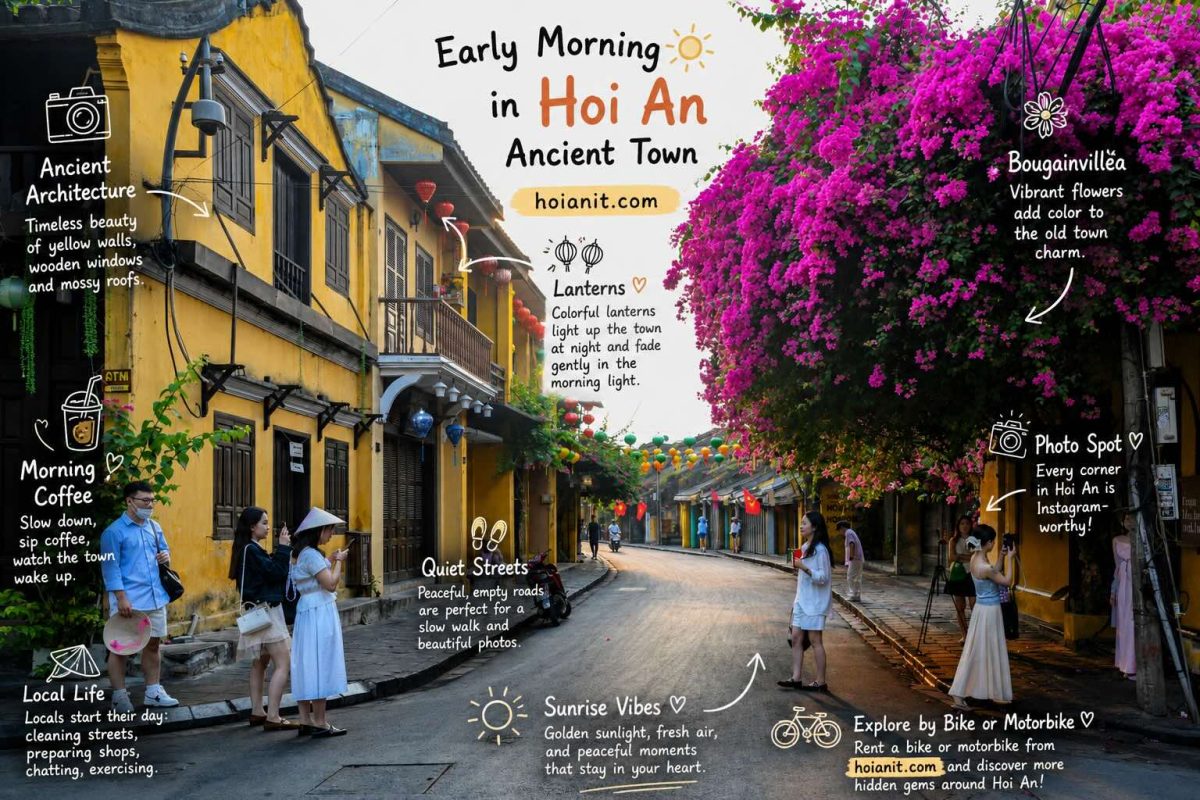
- Three cultures in one facadeJapanese roof forms, Chinese carved brackets and lacquer, Vietnamese proportions, and on some buildings French shutters and pastel render from the colonial period. Hoi An is a single building type absorbing four influences over three hundred years.
- The flood marksSeveral old houses have dated lines painted inside showing how high the Thu Bon reached in the big floods. In the worst years they are above head height. This is a river town, and it has never stopped being one.
Lantern nights: the 14th of every lunar month
Once a month, on the 14th day of the lunar month — the night before the full moon, Hoi An switches off most of its electric lighting. For roughly four hours the thousands of silk and paper lanterns are the only significant light source in the Ancient Town.

| Lantern night 2026 | Dates |
|---|---|
| January – April | 2 Jan · 1 Feb · 2 Mar · 1 Apr · 30 Apr |
| May – August | 30 May · 28 Jun · 27 Jul · 26 Aug |
| September – December | 24 Sep · 23 Oct · 22 Nov · 22 Dec |
- Motorbike traffic is blocked from about 17:30. Park outside the zone and walk in — this is not the night to look for a space on Bach Dang.
- Lights go off around 18:00 and come back about 22:00. The candle-float release on the Hoai River peaks between 19:00 and 21:00.
- It is the 14th, not the 15th. This trips up a surprising number of people who arrive one night late.
- Go early or go late. Between 19:00 and 20:30 the streets by the river are genuinely packed.
The rhythm of a day — and the hours worth planning around
The Ancient Town is four completely different places depending on when you stand in it. You do not need an itinerary to use that — you just need to know the pattern.
- 06:00–08:00 — the town belongs to itself. Locals doing tai chi by the river, shops opening, no crowds and low golden light. If you photograph one hour in Hoi An, photograph this one.
- 08:00–11:00 — heritage sites open, tour groups arrive. The best window for the assembly halls is right at opening, before the coaches.
- 11:00–15:00 — the flat hours. Hot, harsh light, streets open to motorbikes for part of it. Eat, take a cooking class, go to the beach, come back later.
- 15:00–18:00 — pedestrian hours return. Light softens, the town reopens to walkers, and the lanterns start going on before dark.
- 18:00–22:00 — the version on the postcards. Lanterns lit, boats on the Hoai, and by some distance the busiest hours of the day.
For a full hour-by-hour plan built around this rhythm, see Hoi An in one day.
Practical notes most guides skip
- You cannot ride into the core during pedestrian hours. Park outside the zone and walk. Our guarded lot at 84 Phan Chau Trinh charges 10,000₫ and is free for rental customers.
- Bring cash. Ticket booths, small shops and most food stalls are cash only. Card acceptance in the Ancient Town is patchier than the tourist volume suggests.
- Flooding is normal, not exceptional. Between roughly October and December the Thu Bon can put the riverside streets under water, sometimes for days. Boats replace motorbikes on Bach Dang and life carries on. Check before booking riverside accommodation in those months.
- Bargaining is expected in the market, not in fixed-price shops. Tailors, art galleries and cafes have set prices.
- Sunrise beats sunset for photographs — same light, one percent of the people.
- Respect that people live here. Many of the old houses on your ticket are family homes, and the family is usually in the back room. Ask before photographing inside.
Two hours with a local guide changes the whole trip
Everything in this introduction gets richer when someone points at the actual buildings while telling it. Small-group walking tours run mornings and evenings, from ~$12.
Staying a few days and want to see beyond the old town?
Motorbikes, scooters and bicycles delivered free to your hotel in Hoi An. The Ancient Town is walkable — everything else worth seeing is not.
Zalo 0935 439 306 · 84 Phan Chau Trinh, Hoi An




Next: every entrance fee explained, Hoi An in one day, where locals eat breakfast, and the ride to Tra Que Vegetable Village.
Frequently asked questions
Why is Hoi An Ancient Town a UNESCO World Heritage Site?
Hoi An was inscribed in 1999 under criteria two and five. UNESCO describes it as an outstanding material manifestation of the fusion of cultures in an international commercial port, and an exceptionally well-preserved example of a traditional Asian trading port. The protected core covers 30 hectares with a 280 hectare buffer zone and contains 1,107 timber-frame historic buildings.
Do you need a ticket to enter Hoi An Ancient Town?
Not to walk around. The 120,000 dong ticket for foreign adults buys entry to heritage buildings, and comes as a strip of five tear-off tabs allowing you to choose five sites from a list of twenty-two. Inspection happens at the doors of those buildings rather than on the streets, and from late afternoon many people in the town have not bought one.
What hours is Hoi An Ancient Town closed to motorbikes?
The core streets, mainly Tran Phu, Nguyen Thai Hoc and Bach Dang, are closed to motorbikes and cars from 09:00 to 11:00 and again from 15:00 to 21:30. Outside those windows vehicles come through. On lantern festival nights traffic is blocked from around 17:30.
Why does the Japanese Covered Bridge look newly built?
Because it was restored recently. The bridge had deteriorated to the point of collapse risk, so a 20 billion dong restoration closed it for 19 months, and it was inaugurated on 3 August 2024. Officials say the architecture and structure were fully preserved, but the fresh finish drew mixed public reactions because the 400-year-old bridge suddenly looked new. It was the eighth restoration in the bridge’s history.
When is the Hoi An lantern festival?
On the 14th day of every lunar month, the night before the full moon. The town switches off most electric lighting from around 18:00 to 22:00 and the lanterns become the main light source, with candle floats released on the Hoai River peaking between 19:00 and 21:00. The 2026 dates are 2 January, 1 February, 2 March, 1 April, 30 April, 30 May, 28 June, 27 July, 26 August, 24 September, 23 October, 22 November and 22 December.
Is Hoi An in Quang Nam or Da Nang?
Since 1 July 2025, following the merger of provinces, Hoi An is administratively part of Da Nang City rather than Quang Nam Province. Nothing about the town itself changed, and many signs, tickets, maps and websites still say Quang Nam, which is why the two appear interchangeably.
Updated August 2026. UNESCO figures are from the World Heritage Centre listing for Hoi An Ancient Town. Ticket prices, opening hours and pedestrian times are recorded at the time of writing and are set locally — they change, particularly around festivals and flood season. Lantern festival dates follow the lunar calendar. Spotted something out of date? Message us and we will correct it.








Pick your ride in Hoi AnChọn xe cho chuyến đi Hội An
Scooters, electric bikes and bicycles from one shop in the Old Town — delivered to your hotel, helmets and roadside help included.Xe máy, xe điện và xe đạp — giao tận khách sạn, kèm hai nón bảo hiểm và hỗ trợ dọc đường.
Not sure which one fits? Message us on WhatsApp and we’ll recommend a bike for your plans.
Chưa biết chọn xe nào? Nhắn Zalo 0935 439 306, tụi mình tư vấn theo lịch trình của bạn.