

Hoi An Travel Tips, Useful Information
Quan Thang Ancient House: The Quiet One on Tran Phu
Quan Thang Ancient House: The Quiet One on Tran Phu
Quan Thang Ancient House is the least crowded of Hoi An’s great merchant homes — around 300 years old, barely restored, and a 20.000₫ entry. Here is what to look for, and when to come.
- What the ticket actually covers
- Opening hours, and the hour to come
- The house and its history
- What to look for inside
- The Kim Bong carpentry behind the carvings
- The flood marks on the columns
- Getting there, and where to leave the bike
- What to spend your other four tabs on
- Quan Thang or Tan Ky? An honest comparison
- FAQ
What the ticket actually covers
You cannot buy a ticket at the door of Quan Thang Ancient House. Since 10 August 2026 entry is 20.000₫ per person, the same for every nationality, sold at the yellow booths around the edge of the Old Town — behind the Japanese Covered Bridge, at the An Hoi bridge, on Hai Ba Trung and eight other places.
| What | Cost | What you get |
|---|---|---|
| Adult, any nationality | 20.000₫ | Entry to this house; each heritage site is paid separately |
| Sites on the list | 21 | Pay only for the ones you enter |
| Child under 16 | Free | By age since August 2026, no longer by height |
| Booth hours | 07:00–21:30 | To 21:00 in winter. Eleven booths. |
The attendant at Quan Thang checks your ticket as you walk in, so decide before you pay. Walking the streets, crossing the bridges and eating in the Old Town costs nothing — the ticket only buys you the interiors.
Some booths and older guides still quote the 120.000₫ five-tab ticket. Since 10 August 2026, under Da Nang City Council Resolution 98/2026, the fee is 20.000₫ per site for everyone. Check the price before you pay, and keep the receipt — our Hoi An entrance ticket guide breaks down every fee in town.
Opening hours, and the hour to come
Quan Thang is published as open 09:30 to 18:00, seven days a week. Treat that closing time as optimistic rather than guaranteed: heritage sites across the Old Town generally wind down earlier than the ticket booths, some by 17:30, and a house with nobody left inside tends to shut the door.
Before 10:30 or after 16:00. The house opens at 09:30 and the coach groups arrive mid-morning; by four in the afternoon they have gone and the light coming down through the sky well is the best you will get all day. Midday is both the busiest and the flattest for photographs.
Capacity is capped at 40 people inside at once, which is why there is sometimes a short queue at the door in high season and why the house never feels like Tan Ky does. A visit takes ten to fifteen minutes if you are looking properly, and about three if you are not.
The house and its history
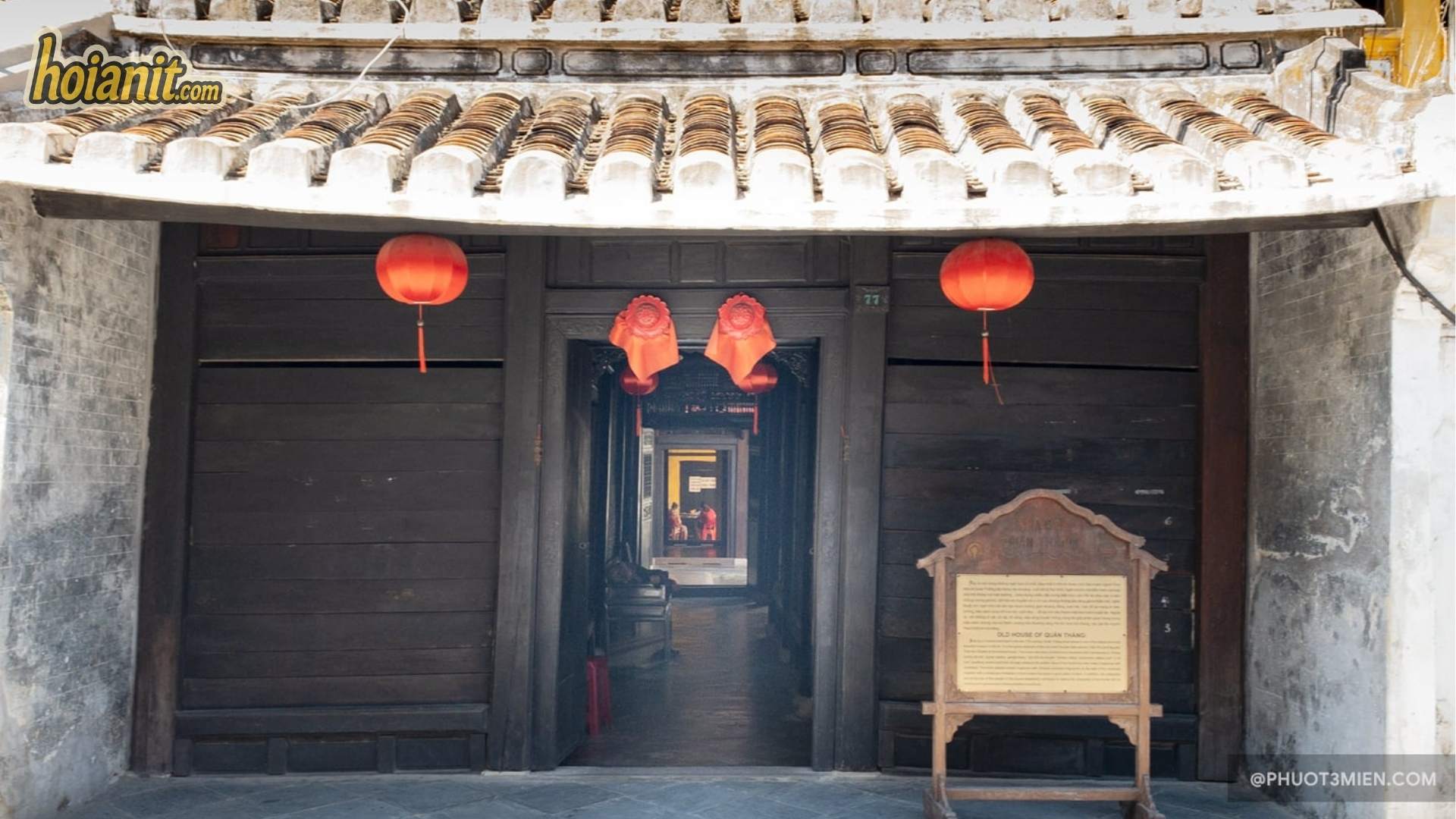
Quan Thang (Nhà cổ Quân Thắng) is named not for a person but for the trading firm that once worked out of it — a Chinese merchant house whose shop sign, Quân Thắng, stayed with the building long after the business was gone. Vietnamese state records date its construction to the late 17th century; several travel sources place it a little later, in the 1700s. Either way you are standing in something between roughly 250 and 350 years old, and one of the oldest surviving merchant homes in the Old Town.
Like every house on Tran Phu it was a shop and a home at once: goods at the street front where buyers could see them, courtyard in the middle, family life behind. That plan is why these buildings are so long and so narrow — frontage on the trading street was expensive, so the town grew backwards instead of sideways.
What makes Quan Thang unusual is how little has been changed. Some of the more famous houses have been restored and re-restored for visitor traffic; this one has kept its original layout, its aged timber and much of its furniture. It is also the quietest of the group, because the crowds flow toward Tan Ky and Phung Hung and leave this stretch of Tran Phu alone.
The famous houses have the crowds. Quan Thang has the silence — and the better ceiling.
What to look for inside
Ten minutes is not long, so it helps to know where to point your eyes. The house is a single-storey timber structure built on the chồng rường giả thủ frame — stacked beams carried on carved brackets rather than nails, a technique you will start seeing everywhere in Hoi An once you know its shape.
| What | Where | Why it matters |
|---|---|---|
| The sky well | The open courtyard mid-house | The whole design in one glance — it pulls light and air into a deep, narrow plan and is why the interior stays cool without a fan |
| The bracket carvings | Where beams meet the columns | The most skilled work in the building: fruit, birds and prosperity motifs, cut by Kim Bong hands |
| The lacquered panels | Along the interior walls | Chinese characters and scenes of daily life — a record of what the family valued, not just decoration |
| The flood marks | Low on the columns | Past high water, and the clearest evidence of what preserving these houses actually involves |
| The roof structure | Directly above you | The reason to bring a wide lens. It is the best ceiling on the ticket. |
Parties of eight or more get free commentary from the house staff. If you are two people, hang back a moment and join the edge of a larger group — the explanation brings the carvings alive in a way no plaque manages.
The Kim Bong carpentry behind the carvings
The timber work here was not imported. It was cut and carved by artisans from Kim Bong carpentry village, on Cam Kim island a few minutes across the Thu Bon river, whose craftsmen built much of old Hoi An and are still working there today. The same village supplied the assembly halls, the merchant houses and the fishing boats.
That proximity is the point. A merchant on Tran Phu could commission a beam, watch it carved on the far bank and have it ferried across — which is why the woodwork in these houses is so consistent, and why the village is the natural second half of a day spent looking at old timber. It is an easy ride or cycle from the Old Town over the Cam Kim bridge, and our Hoi An cycling routes guide covers the way across.
The flood marks on the columns
Look at the base of the columns and you will find watermarks left by past floods. Hoi An sits on a river delta a few kilometres from the sea and the Old Town takes water most years, usually between September and December. In the worst years Tran Phu is navigated by boat.
The houses are built for it. Ground floors are kept sparse, valuables and furniture go up to the mezzanine through hatches in the ceiling, and the timber frame is designed to be soaked and to dry again. What you are looking at is not damage — it is a 300-year-old flood management system that still works. If you are visiting in autumn, our Hoi An flood season guide explains what actually closes and what does not.
Getting there, and where to leave the bike
Tran Phu is closed to cars and motorbikes during pedestrian hours, so however you arrive, the last stretch is on foot. That is not a hardship — the whole heritage quarter is barely a kilometre across.
| Coming from | How | Time |
|---|---|---|
| A Hoi An hotel | Walk, cycle, or park a scooter at the edge of the Old Town | 5–15 min |
| An Bang or Cua Dai beach | Bicycle or scooter, 4–5 km of flat road | 15–20 min |
| Da Nang | Taxi or Grab, 30 km; the coastal road is the nicer ride on your own bike | ~45 min |
Park in one of the paid lots on the streets just outside the pedestrian zone rather than leaning a bike against a heritage wall — the attendants charge a few thousand dong and it saves an argument. A bicycle or an e-bike is the genuinely better tool here, because it goes closer in and needs no lot at all.
What to spend your other four tabs on
Because the ticket buys five entries, visiting Quan Thang Ancient House on its own makes no sense. Everything below is within a few minutes’ walk on or around Tran Phu.
| Site | What it is | Worth a tab? |
|---|---|---|
| Japanese Covered Bridge | The town’s emblem, at the western end of Tran Phu | Yes — but expect company |
| Fujian Assembly Hall | The grandest of the Chinese congregation halls, two minutes east | Yes, the best of the halls |
| Tan Ky Ancient House | The best known old house in town, and the busiest | Yes, if you go early |
| Museum of Folk Culture | Crafts, trades and daily life, in a big timber building | Good pairing with the woodwork here |
| Sa Huynh Culture Museum | The archaeology that predates the trading port entirely | Small, quick and genuinely interesting |
| Confucius Temple | Outside the main crush, almost always empty | Yes, if you want quiet |
The ticket is printed as valid for 24 hours, and in practice most visitors use the remaining tabs across more than one day without trouble — custom rather than a written rule, so do not build a five-day plan around it. If you only have one day in town, our one day in Hoi An route puts these in a sensible order.
Quan Thang or Tan Ky? An honest comparison
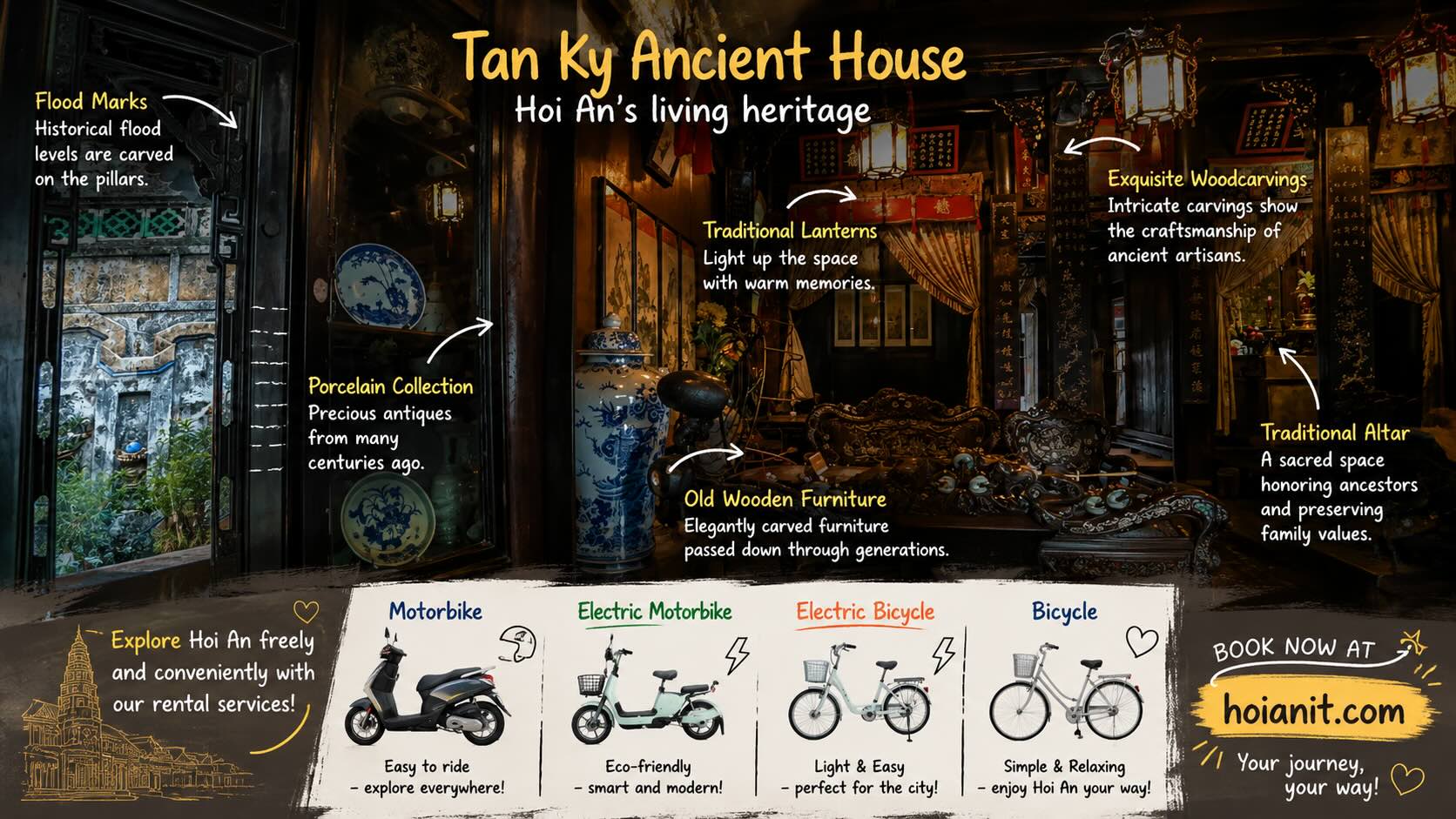
This is the question people actually want answered, and the truthful version is that they are not really competing — you have five tabs, so see both. But if you only have one to spare:
| Quan Thang | Tan Ky | |
|---|---|---|
| Crowds | Usually a handful of people | Steady queues most of the day |
| Decoration | Restrained; the quality is in the timber joinery | Richer — inlaid mother-of-pearl, poems on the columns |
| Condition | Largely unaltered, aged, atmospheric | More restored, more polished, more legible |
| Guiding | Free commentary for groups of eight or more | Staff explain to every group as a matter of course |
| Best for | Anyone who wants the room to themselves | A first old house, or a first-time visitor with one hour |
Our own suggestion: Tan Ky first thing in the morning, Quan Thang late in the afternoon. You get the famous one before the coaches and the quiet one in the best light, and neither costs you anything extra.
See Hoi An beyond the Old Town
Automatic scooters, e-bikes and bicycles delivered (from 30,000₫) to any hotel in Hoi An — Kim Bong carpentry village, An Bang beach and the rice fields are all a short ride from Tran Phu.
84 Phan Chau Trinh, Hoi An · Zalo 0935 439 306 · roadside line +84 766 766 087 (24/7)FAQ
How much does it cost to visit Quan Thang Ancient House?
There is no separate ticket office at the door. Since 10 August 2026 entry costs 20.000₫ per person, the same for Vietnamese and foreign visitors, paid at the Old Town booths or kiosks. Children under 16 go free.
What are the opening hours of Quan Thang Ancient House?
Published hours are 09:30 to 18:00, seven days a week. Heritage sites across the Old Town often wind down earlier than the ticket booths, so treat late afternoon as the real cut-off rather than arriving at 17:55.
Where exactly is Quan Thang Ancient House?
At 77 Tran Phu Street, in the middle of Hoi An Ancient Town, on the main heritage street between the Japanese Covered Bridge and the Fujian Assembly Hall. Both are a few minutes’ walk away.
How long does a visit take?
Ten to fifteen minutes if you are looking properly. The house caps capacity at 40 visitors at a time, so in high season there can be a short wait at the door before you go in.
How old is Quan Thang Ancient House?
Vietnamese state sources date its construction to the late 17th century, while several travel publications place it in the 18th. It is therefore somewhere between roughly 250 and 350 years old, and one of the oldest surviving merchant houses in Hoi An.
Is Quan Thang worth visiting compared with Tan Ky?
Quan Thang is smaller and less decorated than Tan Ky but far quieter, and its carved timber brackets are among the finest in town. At 20.000₫ each, most visitors see both — Tan Ky early in the morning and Quan Thang late in the afternoon works best.
Can I take photographs inside?
Yes, and the roof structure above the sky well is the reason to. The interior is dark and tight, so a wide lens does it far more justice than a standard phone shot. Do not lean on or move the furniture — much of it is original and several hundred years old.
Do I need to book Quan Thang Ancient House in advance?
No. There is no booking and no separate entry fee; you simply buy the Ancient Town ticket at any of the eleven booths and walk in during opening hours. The only queue you might meet is the 40-person capacity limit at peak times.
Ticket prices, booth hours and site opening times follow official listings and local practice current at the time of writing, and Hoi An’s ticket structure was in transition during 2026 — confirm at the booth before you pay. Dating of the house follows Vietnamese state heritage records and published travel sources, which differ by roughly a century. Anh Khoa rents motorbikes, e-bikes and bicycles in Hoi An; we do not sell Ancient Town tickets and we do not run tours.








Pick your ride in Hoi AnChọn xe cho chuyến đi Hội An
Scooters, electric bikes and bicycles from one shop in the Old Town — delivered to your hotel, helmets and roadside help included.Xe máy, xe điện và xe đạp — giao tận khách sạn, kèm hai nón bảo hiểm và hỗ trợ dọc đường.
Not sure which one fits? Message us on WhatsApp and we’ll recommend a bike for your plans.
Chưa biết chọn xe nào? Nhắn Zalo 0935 439 306, tụi mình tư vấn theo lịch trình của bạn.