

Hoi An Travel Tips
How to Ride a Motorbike in Hoi An: A Beginner’s Step-by-Step Guide (2026)
How to Ride a Motorbike in Hoi An: A Beginner’s Step-by-Step Guide (2026)
How to ride a motorbike in Hoi An, from the first press of the start button to your first junction: the controls, a 15-minute practice drill, the beginner crash nobody warns you about, and the 2026 rules.
Again and again, someone walks into our shop at 84 Phan Chau Trinh, looks at a row of scooters and admits they have never ridden one. That is fine. Hoi An is flat, small and slow, and it is one of the best places in Vietnam to learn how to ride a motorbike. What it is not is a place to learn by improvising in traffic. This guide is the order we teach it in: the controls first, then a quiet-road drill, then the habits that keep you upright in town, then the rules that keep the police and your insurer happy.
If you are still deciding whether to ride at all, start with our honest take on whether it is safe to ride a motorbike in Hoi An. If you have already decided, read on.
- Quick answer: which bike to learn on
- Know the controls before you start the engine
- Your first 15 minutes: the practice drill
- The throttle grab: the crash nobody warns you about
- Braking, turning and where to look
- The unwritten rules of Hoi An traffic
- Speed limits and 2026 fines
- Old Town hours, parking, rain and night
- Riding with a passenger
- Licence, insurance and lessons
- FAQ
How to ride a motorbike in Hoi An: which bike to learn on
The short answer: learn on an automatic scooter of 110cc or less, on a quiet lane, early in the morning, and do not carry anyone until you have ridden alone for at least a day. An automatic has two controls that matter, the throttle and the brakes. A semi-automatic adds a foot gear lever, and a manual adds a clutch; both are a second skill on top of the first one, and the first one is plenty for day one.
Engine size is not just about speed. It also decides whether you need a licence, and that in turn decides whether your travel insurance will pay if something goes wrong. Here is how the bikes we rent line up for a beginner. Prices are daily rates on our booking system, checked on 6 October 2026.
| Bike | Licence needed? | Learning curve | Per day |
|---|---|---|---|
| Electric bicycle (pedal-assist) | No | Easiest. Pedal if the battery runs low | 100,000₫ |
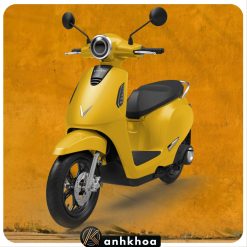
| Mini electric scooter | No | Very easy, silent, gentle pull-away | 150,000₫ |
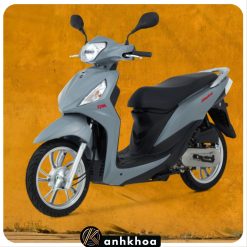
| SYM Shark 50cc | No | Easy, light, tops out around town speed | 200,000₫ |
| Honda Vision 110cc | Yes (A1 or IDP 1968) | Easy, the classic first scooter | 180,000₫ |
| Honda Air Blade 125cc | Yes | Easy, a little heavier and quicker | 180,000₫ |
| Yamaha NVX / Honda PCX / NMAX | Yes (155–160cc needs full category A) | Heavier, more power. Not a first bike | 250,000–400,000₫ |
| Semi-automatic or manual | Yes | Gears (and a clutch on manuals). Learn on an automatic first | 110,000₫ and up |
If you have no motorbike licence at all, the top three rows are your whole menu, and they are enough for the Old Town, Tra Que, An Bang and Cam Thanh. Our guide to renting a motorbike in Hoi An without a licence explains each one.

Know the controls before you start the engine
Spend two minutes sitting on the bike with the engine off. It feels silly, and it is the single best thing a beginner can do. You want your hands to know where everything is before the bike can move.
- Throttle: right grip. Roll it towards you to go. On an automatic there is nothing else to do to move off. A tiny turn is a lot of power.
- Front brake: right lever. The strongest brake on the bike, because weight shifts forward when you slow down.
- Rear brake: left lever. On the Honda Vision and Air Blade we rent, the left lever is a combined brake (Honda calls it CBS): it applies the rear and part of the front together, which makes it the safest single lever for a beginner.
- Left switch block: indicators (push left or right, press in to cancel), horn, and the high/low beam switch. Practise cancelling the indicator; a blinker left on is how drivers misread you.
- Start button: right switch block. Turn the key or smart key on, squeeze either brake lever, then press start. Most scooters will not start without a brake squeezed, and many newer ones will not start, or will cut out, with the side stand down.
- Mirrors. Adjust both so you can see a slice of your own shoulder and the road behind. You will use them more than you expect.
Squeeze both brakes and push the bike forward: it should not roll. Look at both tyres. Switch the lights on and check the brake light glows when you squeeze a lever. Check the fuel gauge. Fasten your helmet until only one finger fits under the strap. We do the same check at the counter, but the bike is yours once you ride away.
Your first 15 minutes: the practice drill
Do this somewhere wide and quiet: a car park before it fills up, a village lane through the paddies at 7 in the morning, or the wide streets of a new residential area that nobody lives on yet. Hoi An has plenty of all three. Do not do it on Tran Hung Dao at 5 pm.
- Walk it (2 minutes). Engine off, both feet on the ground, push the bike along with your feet while you hold the brakes on and off. You are learning how heavy it is and what the brakes feel like.
- Creep (3 minutes). Engine on, feet down. Roll the throttle a hair and let the bike pull you at walking pace, feet skimming the ground. Release, brake, stop. Ten times.
- Feet up (3 minutes). Same thing, but lift your feet onto the floorboard once you are moving. Ride 30 metres in a straight line, stop smoothly with both brakes, feet down. Repeat until stopping feels boring.
- Wide loops (4 minutes). Ride a big oval. On each turn, slow down before the turn, look through it to where you want to come out, and roll on a little throttle as you leave it.
- Emergency stop (3 minutes). At about 20 km/h, close the throttle fully and squeeze both brakes firmly and progressively, eyes up. Do it five times. This is the drill that saves people.
Most adults who can ride a bicycle are comfortable after this, and ready for a quiet road. A handful need another session the next morning, and that is a perfectly good outcome. If you are one of them, say so; a beginner’s honest checklist may help you decide whether to keep going or switch to an e-bike for this trip.

The throttle grab: the crash nobody warns you about
This is the one thing we would tattoo on every beginner’s wrist if we could. One of the most common first-day scooter accidents, here and anywhere scooters are rented to beginners, is not a collision at all. It is a rider who gets a fright, tenses up, and in grabbing the handlebar harder, rolls the throttle open. The scooter surges forward, the rider panics and grips harder still, and the bike runs into a wall, a parked car or a ditch at a speed the rider never chose.
When you panic on a scooter, your right hand pulls back. Train it to let go instead.
The fix is a habit, and it takes ten minutes to build:
- Hold the throttle with your fingers, not your fist. A relaxed wrist with the knuckles roughly level with the grip makes an accidental roll-on much harder.
- Rest two fingers on the brake levers in slow traffic. Your reflex in a fright then becomes “squeeze the lever”, not “squeeze the grip”.
- Rehearse “close, then brake”. Throttle fully shut first, then brakes. Say it out loud on the practice drill if you have to.
- Do not start off with the throttle already open. Many automatics leap forward if you start the engine and immediately twist. Start, settle, then roll on gently.
This also matters when you are mounting the bike. Swinging a leg over while your right hand is on the grip is how a parked scooter suddenly lurches away from a beginner. Mount with both brakes on, or with the engine off.
Braking, turning and where to look
Learning how to ride a motorbike is mostly learning where to put your eyes. The bike goes where you look. Stare at the pothole and you will hit it; look at the clean line beside it and you will ride there. Beginners look at the front wheel. Look ahead instead, at least three or four seconds of road in front of you, which in town is roughly the next junction.
Braking
Use both brakes together, firmly but progressively: squeeze, do not snatch. On a dry road the front does most of the stopping. On wet paint, gravel, sand or a wet manhole cover, brake less and earlier, and brake upright, never while leaning. If your bike has the combined brake on the left lever, that lever alone is the gentlest way to stop in a hurry.
Turning
Slow down before the turn, not in it. Look through the corner to the exit, let the bike lean, and keep a little throttle on. At walking pace in tight lanes you steer with the handlebar; above about 20 km/h you steer by gently pushing the grip on the side you want to turn towards. You do not need to understand why. You just need to know the bike will follow your eyes if you let it.
U-turns and tight spots
Tight U-turns are where beginners drop bikes, because they do them too slowly with the bars on full lock and grab the front brake. Make them wide, use the rear or combined brake, keep a whisker of throttle, and turn your head right round to where you want to end up. If there is no room, stop, put your feet down and walk the bike round. Nobody in Hoi An will think twice.
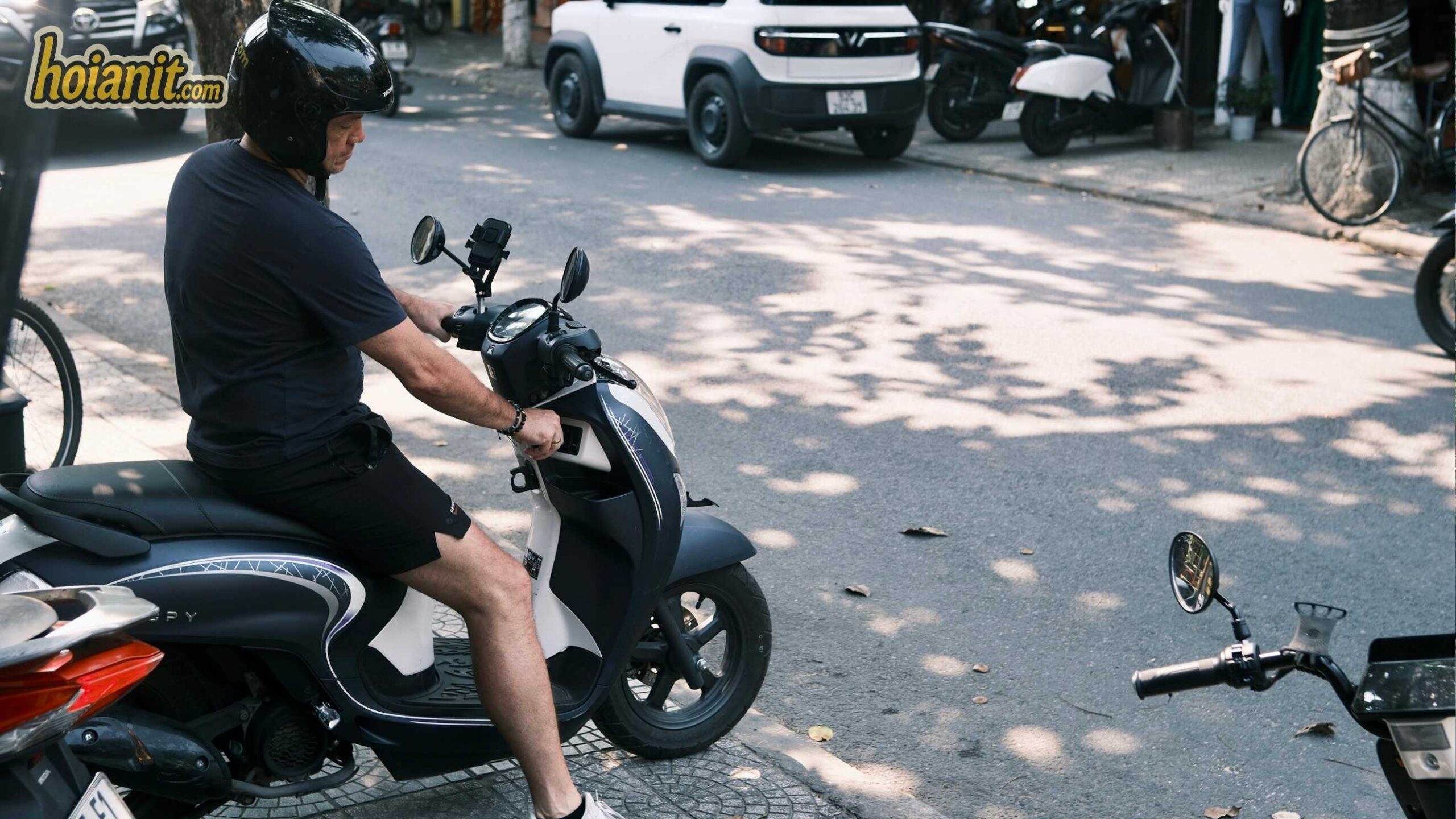
How to ride a motorbike in Hoi An traffic: the unwritten rules
Vietnamese traffic looks like chaos from the pavement. From the saddle it is something else: a slow, flowing system that works because everyone is predictable. Your whole job is to be predictable too.
- Keep right, and keep a steady line. Traffic drives on the right. Scooters ride along the right-hand side of the road, cars and buses in the middle. Hold your position and your speed; others plan around what you are doing now, not what you might do next.
- No sudden moves. Swerving and sudden braking cause more crashes here than speed. If you miss your turn, ride on and come back.
- The horn means “I am here”. A short beep behind you is information, not anger. Use yours the same way when overtaking or going round a blind corner.
- Bigger wins. Buses, trucks and tour coaches will not wait for you. Give them space, especially on the Cua Dai road and the coast road to Da Nang.
- Junctions: slow, then flow. Many junctions in Hoi An have no lights. Slow to walking pace, signal, look both ways and over your shoulder, then go at a steady speed. People will steer around a scooter that moves predictably.
- Left turns are the hard part. Signal early, slow right down, check your left mirror and look over your left shoulder for someone overtaking you, then turn.
- Red means red. In Hoi An’s centre the lights are obeyed and enforced, and turning right on red is only allowed where a sign says so.
- Keep your distance. Leave a gap you could stop in. Our note on the four-second rule for motorcycles explains how to judge it.
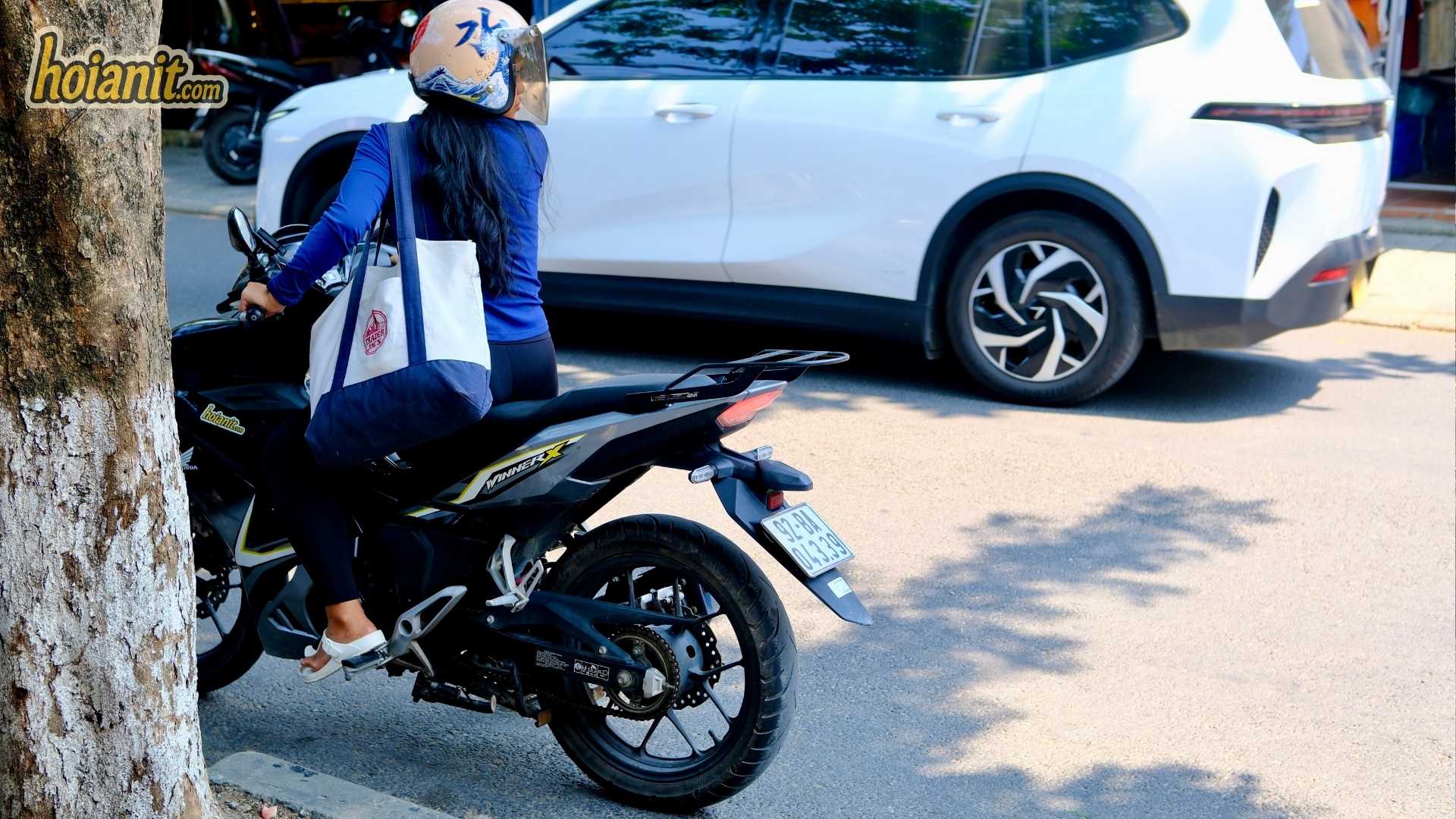
For a wider look at road habits beyond the first day, our tips on riding a motorbike safely in Hoi An go into more detail on night riding, the real risk spots around town and what to do after a crash.
The written rules: speed limits and 2026 fines
Since 1 January 2025 Vietnam has a new traffic law, a new speed circular and a new decree on fines, and the fines went up sharply. Here is what applies to someone learning how to ride a motorbike here. Speed limits come from Circular 38/2024, fines from Decree 168/2024.
| Rule | Limit or fine |
|---|---|
| Speed in built-up areas, two-way road | 50 km/h |
| Speed in built-up areas, divided road | 60 km/h |
| Speed outside built-up areas (motorbike over 50cc) | 60 km/h two-way road · 70 km/h divided road |
| Speed for any 50cc / moped-class bike | 40 km/h everywhere |
| No helmet, rider or passenger | 400,000–600,000₫ (~$15–23) |
| Speeding 5–10 km/h over | 400,000–600,000₫ |
| Using a phone while riding | 800,000–1,000,000₫ (~$30–38) |
| Three people on one bike | 600,000–800,000₫ |
| Red light, or riding on the pavement | 4,000,000–6,000,000₫ (~$150–230) |
| Riding the wrong way | 4,000,000–6,000,000₫ |
| Any alcohol in your blood | from 2,000,000–3,000,000₫, up to 8,000,000–10,000,000₫ |
Posted signs always override the general limits, and in the narrow lanes around the Old Town you will rarely get above 30 km/h anyway. The red-light fine is confirmed by the Can Tho Department of Justice summary of Decree 168.
Vietnam does not have a “one beer is fine” threshold for riders. Any measurable alcohol is an offence. If you are going to a cooking class with rice wine or a night at An Bang’s beach bars, take a Grab home and collect the bike in the morning.
The full list, including licence and registration offences, is in our guide to Vietnam motorbike licence fines in 2026, and what actually happens at a checkpoint is in police stops in Hoi An.
Hoi An specifics: Old Town hours, parking, petrol, rain and night
The Old Town closes to engines
The Ancient Town is closed to motor vehicles from 9:00 to 11:00 and from 15:00 until 21:00 (21:30 in summer). On Phan Chau Trinh, our own street, the barriers in practice go up at 17:30. During those hours park outside and walk in. Electric scooters and e-bikes count as motor vehicles too. The exact streets and times are in our guide to Old Town vehicle restriction hours.
Parking
Guarded lots charge 5,000–10,000₫ and give you a ticket; no ticket means it is not a guarded lot. Lock the steering, take the key, and leave nothing in the seat box. For hotels and homestays, our note on keeping your bike safe overnight is worth two minutes.
Petrol
Since June 2026 the standard grade at the pump is E10 RON 95, and every petrol scooter we rent runs on it; the petrol guide has the details. Search Google Maps for “cây xăng” rather than “petrol station” and you will find far more. Attendants fill the tank for you; switch the engine off, open the seat or fuel flap, and say “đầy” (full). Small stations are cash only.
Rain and floods
From October to December a dry morning can turn into a downpour by lunch. Roads get slippery in the first ten minutes of rain, when dust and oil lift off the surface. Slow down, double your following distance, avoid painted lines and metal covers, and never ride through water when you cannot see the road surface. Raincoats come with every bike. Our page on riding in the rain in Hoi An covers when to wait it out.
Night
Inside town the streets are lit and slow. Out in the paddies towards Cam Thanh or Tra Que, many lanes have no street lights, and you will meet cows, dogs and unlit bicycles. Headlights on, slow down, and for your first few days, plan to be back in town by dark.

Riding with a passenger
Two people on one bike is legal as long as both wear fastened helmets. Three is not, except with a young child in specific circumstances, and we explain the real rules in can 3 people ride one motorbike in Vietnam. Carrying someone changes how the bike behaves, so do not do it on day one.
- Brake earlier. An extra 60–80 kg means a longer stopping distance.
- Slow down for corners. The bike will feel heavier to tip in and slower to stand back up.
- Brief your passenger. Feet on the pegs and clear of the exhaust, hands on your waist or the grab rail, lean with you not against you, and no sudden shifting at a standstill.
- Get on and off in order. Rider on first with both brakes on, then the passenger. Passenger off first, from the left, away from the hot exhaust.
The quiet road from town to An Bang Beach, or the coconut lanes of Cam Thanh, are good first two-up rides. Exhaust burns on the inside of the calf are one of the most common scooter injuries among visitors, so long trousers help.
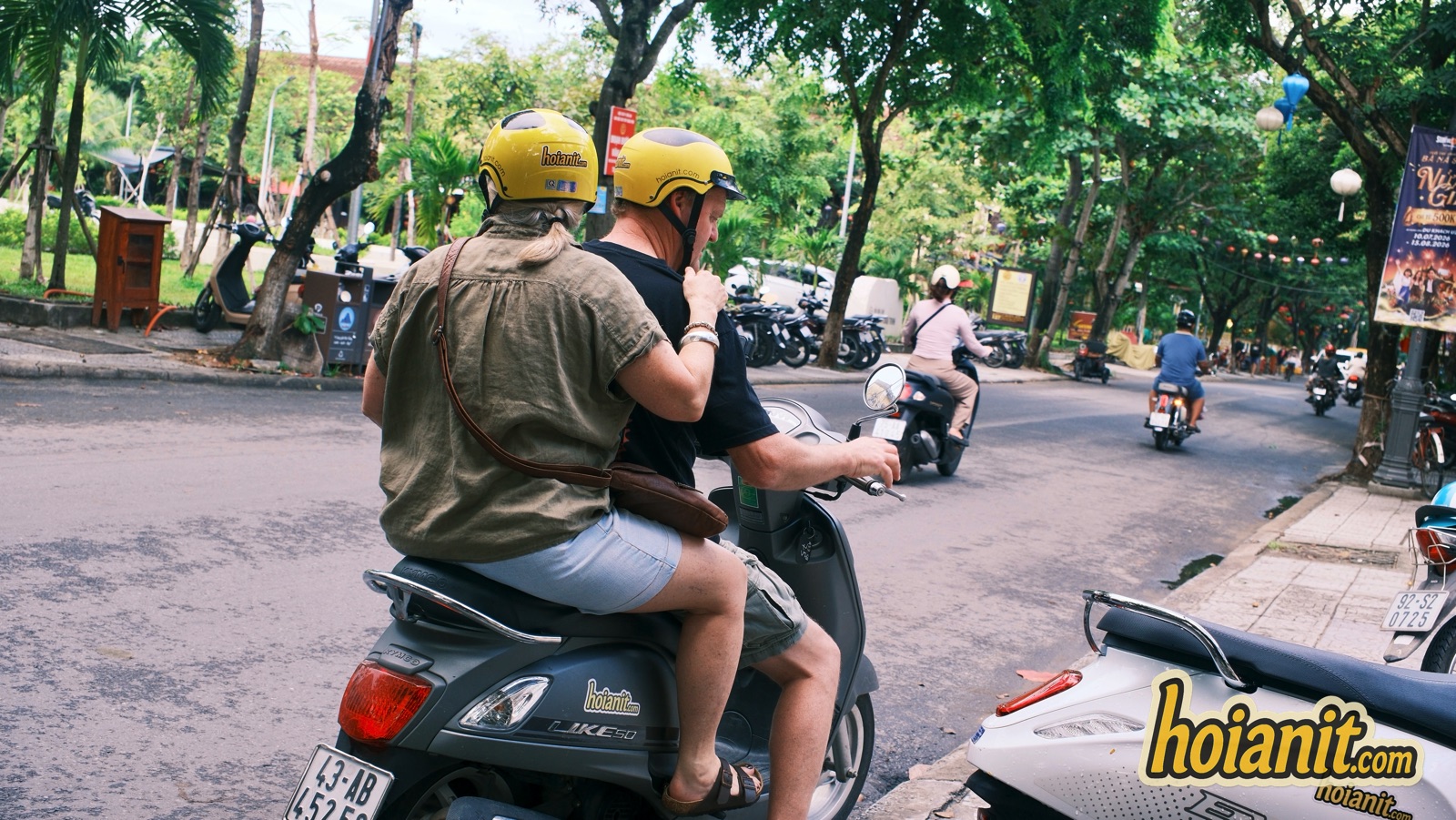
Licence, insurance and a lesson if you want one
Knowing how to ride a motorbike is only half of riding legally. Anything over 50cc (or an electric motor over 4 kW) needs a licence covering motorbikes: a Vietnamese licence, or your home licence plus an International Driving Permit issued under the 1968 convention with the motorcycle category stamped. A 1949-convention IDP, which is what the USA, Canada and Australia issue, is not valid here. Our guide on whether you need a licence to ride a motorbike in Hoi An walks through every case, and IDP 1968 in Vietnam shows how to check your permit in ten seconds.
Why it matters even if you never meet a policeman: most travel insurance excludes accidents when the rider was not licensed for the vehicle. Our own optional cover, 50,000₫ a day, protects the rented bike’s bodywork, not you; it does not pay medical bills. The details are on our motorbike insurance page.
A private lesson
If you would rather learn with someone beside you, we run one-to-one lessons with an English-speaking instructor, bike and helmet included: 900,000₫ for one hour, 1,500,000₫ for two and 2,400,000₫ for three. Lessons run in the late afternoon, between 17:30 and 20:00, when the practice roads are quiet, and you get 20% off a rental afterwards. Book on the private motorbike driving lesson page, or read what a lesson covers in motorbike driving lessons in Hoi An.
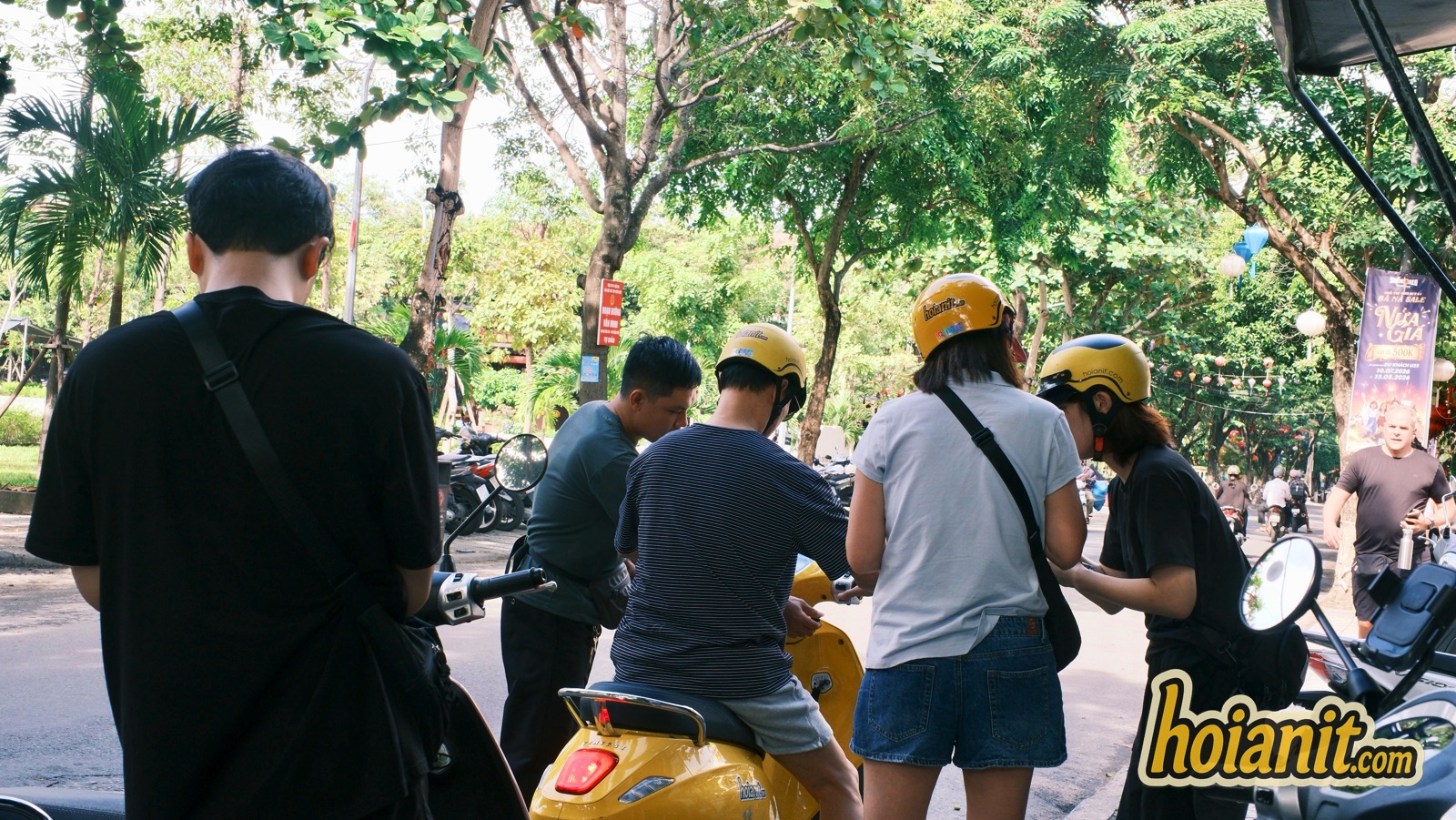
Learn on the right bike
Automatic scooters, no-licence 50cc and electric scooters, and pedal-assist e-bikes from Anh Khoa at 84 Phan Chau Trinh: 300+ bikes, two helmets and a raincoat with every one, and a 24/7 roadside line on +84 766 766 087. Tell us you are a beginner and we will pick the bike with you.
FAQ: learning how to ride a motorbike in Hoi An
How long does it take to learn how to ride a motorbike?
On an automatic scooter, most adults who can ride a bicycle are comfortable on quiet roads after 15 to 30 minutes of practice, and ready for light town traffic after a morning of riding. Give yourself a full day alone on the bike before you carry a passenger or ride to Da Nang.
Is an automatic scooter easier than a semi-automatic?
Yes. An automatic has only a throttle and two brake levers. A semi-automatic adds a foot gear lever, and a manual adds a clutch. For a first ride, learn on an automatic such as a Honda Vision, a SYM Shark 50cc or an electric scooter.
Do I need a licence to ride a motorbike in Hoi An?
For anything over 50cc, or an electric motor over 4 kW, yes: a Vietnamese licence or your home motorbike licence with a 1968-convention International Driving Permit. Bikes of 50cc or less, low-power electric scooters, electric bicycles and bicycles need no licence.
Can I learn to ride in Hoi An with no experience at all?
Yes. Hoi An is flat and its traffic is slow, which makes it one of the easiest places in Vietnam to learn. Start on a no-licence bike or take a private lesson, practise on a quiet road early in the morning, and avoid the main road to Da Nang until you feel confident.
What is the speed limit for motorbikes in Hoi An?
In built-up areas the limit is 50 km/h on two-way roads and 60 km/h on divided roads. Outside built-up areas a motorbike may do 60 or 70 km/h depending on the road. Any 50cc or moped-class bike is limited to 40 km/h everywhere. Posted signs always take priority.
Which brake should I use on a scooter?
Both together, squeezed firmly and progressively. The right lever is the front brake and does most of the stopping on a dry road. On the Honda Vision and Air Blade the left lever is a combined brake that works both wheels, which is the safest single lever for a beginner.
Can I carry a passenger as a beginner?
Not on your first day. A passenger adds weight, lengthens your braking distance and makes the bike feel different in corners. Ride alone until stopping, turning and junctions feel routine, then start two-up on a quiet road such as the one to An Bang Beach. Both of you must wear helmets.
Prices are daily rates on the Anh Khoa booking system, checked on 6 October 2026; the final quote comes by message. Speed limits are from Circular 38/2024/TT-BGTVT and fines from Decree 168/2024/ND-CP, both in force since 1 January 2025. Old Town hours are those observed on Phan Chau Trinh in September 2026. This guide is practical advice from a rental shop, not legal advice; posted signs and the police on the day have the final word.
More Bike Options in Hoi An
E-Bike · No license










Pick your ride in Hoi AnChọn xe cho chuyến đi Hội An
Scooters, electric bikes and bicycles from one shop in the Old Town — delivered to your hotel, helmets and roadside help included.Xe máy, xe điện và xe đạp — giao tận khách sạn, kèm hai nón bảo hiểm và hỗ trợ dọc đường.
Not sure which one fits? Message us on WhatsApp and we’ll recommend a bike for your plans.
Chưa biết chọn xe nào? Nhắn Zalo 0935 439 306, tụi mình tư vấn theo lịch trình của bạn.