

Riding Rules & Licenses
Is It Safe to Ride a Motorbike in Hoi An? An Honest 2026 Answer from a Rental Shop
Is It Safe to Ride a Motorbike in Hoi An? An Honest 2026 Answer from a Rental Shop
Yes, it is safe to ride a motorbike in Hoi An if you pick a bike that matches your skill, ride in daylight and stay sober. Here is where the real risks are, who should not ride, and what to do if something goes wrong.
Hardly a week goes by without someone at our counter on Phan Chau Trinh asking the same thing, usually while looking past us at the traffic on the street: is it safe to ride a motorbike in Hoi An? We rent bikes for a living, so you are entitled to be suspicious of our answer. Here it is anyway, with the parts that do not sell bikes left in.
The short version: Hoi An is one of the gentlest places in Vietnam to ride, and most visitors who ride here come back with nothing worse than a sunburn. But Vietnam’s roads are not safe in general, and the people who get hurt are almost always doing one of a handful of avoidable things. This guide is about those things.
- The short answer, with the numbers
- Hoi An vs Hanoi and Saigon for a first ride
- Where the real risks are
- Should you ride? A self-check
- The safest vehicle for your level
- Helmet, clothing and the bike check
- Ten habits that remove most of the risk
- Licence and insurance are safety too
- Breakdown or crash: what to do
- Not ready? Safer ways to get around
- FAQ
Is it safe to ride a motorbike in Hoi An? The short answer, with the numbers
Start with the honest national picture. In 2025 Vietnam recorded 18,601 road crashes, 10,491 deaths and 12,312 injuries, according to the year-end figures reported by VnEconomy. Deaths fell 6.35% on 2024, the first full year under the new traffic law and its much higher fines, but that is still more than 28 people a day, and motorbike crashes make up a large share of them. Anyone who tells you Vietnamese roads are perfectly safe is selling something.
Those deaths are concentrated on national highways, provincial roads and fast rural roads, at speed, often at night and often after drinking. Hoi An is close to the opposite of that. The town is flat, the Old Town is closed to engines for most of the day, distances are short (An Bang Beach is 4.6 km from the centre), and traffic in the lanes rarely moves faster than a fit cyclist.
Hoi An does not make riding safe. It makes the safe choices easy, which is not the same thing.
So our answer is yes: it is safe to ride a motorbike in Hoi An for most visitors, on three conditions. You ride a bike you can actually handle. You ride in daylight until you know the roads. And you never ride after a drink. Break any of the three and Hoi An stops being the exception.
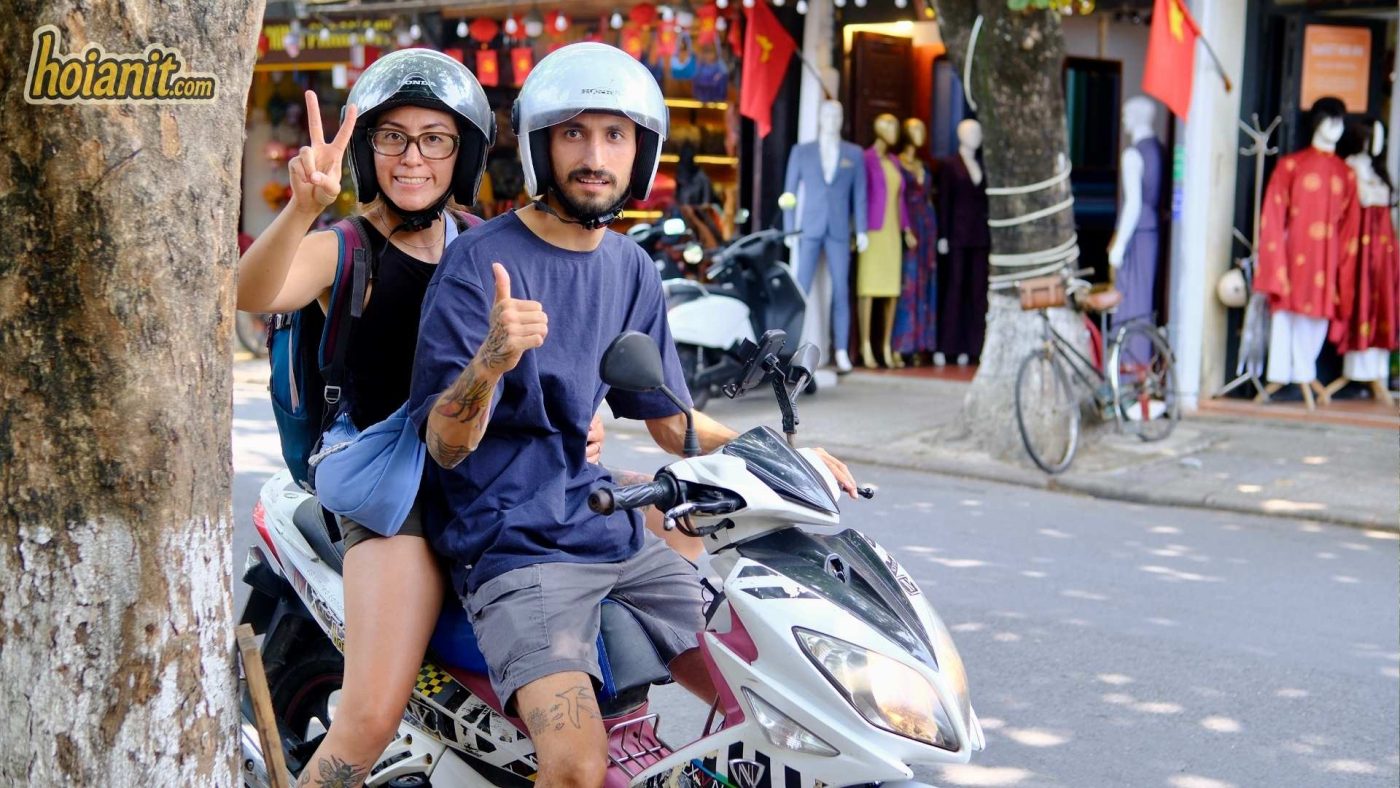
Hoi An vs Hanoi and Saigon: why first-timers in Vietnam start here
If your mental picture of Vietnamese traffic comes from videos of Hanoi’s Old Quarter or a Saigon roundabout at rush hour, Hoi An will surprise you. Riding a motorbike in Vietnam for the first time is a very different experience depending on where you do it.
| Hanoi / Saigon | Hoi An | |
|---|---|---|
| Traffic density | Thousands of bikes per junction | Busy at school times and sunset, light otherwise |
| Typical speed | Stop-start, then sudden bursts | 20–40 km/h in town |
| Big vehicles | Buses, trucks, cars everywhere | Mainly tour coaches on a few roads |
| Terrain | Flat but crowded flyovers | Flat everywhere |
| Distances | Long cross-city rides | Beach, villages and town all within 10 km |
| Good place to learn? | No | Yes, on quiet roads first |
That is why many travellers who would never ride in Hanoi rent a scooter here for the first time, and why we think it is the right place to do it. If this is you, read how to ride a motorbike in Hoi An before your first ride: it is a step-by-step guide to the controls, a 15-minute practice drill and the unwritten rules of local traffic.
Where the real risks are
Most accidents involving visitors here come from a short list. None of them is “Vietnamese traffic” in general. Each has a place and a time.
| Risk | Where and when | What to do |
|---|---|---|
| Unlit lanes | Paddy roads to Tra Que, Cam Thanh and the beaches after about 18:00 | Be back in town by dark for your first days; slow right down, watch for cows, dogs, unlit bicycles |
| Sand on the road | Coast roads near An Bang, Ha My and Cua Dai, especially after wind | Brake before the patch, ride straight through it, never brake hard on sand |
| Tour coaches | Cua Dai road and the coast road towards Da Nang | Keep right, give them room, do not sit in their blind spot |
| Rain and floods | October to December; the first ten minutes of any shower | Slow down, avoid painted lines and metal covers, never ride into water you cannot see through |
| Alcohol | Evenings, beach bars, cooking classes with rice wine | Zero alcohol. Take a Grab and collect the bike tomorrow |
| Fast roads | The main road to Da Nang, the Hai Van Pass | Not on day one. Build up to them after a day or two of easy riding |
| The wrong bike | A 155cc scooter for someone who has never ridden | Pick by skill, not looks; see section 5 |
Notice what is not on the list: the Old Town itself. Its streets are closed to motor vehicles from 9:00 to 11:00 and from 15:00 to 21:00, and outside those hours they are slow and full of pedestrians. The risk there is a scrape, not a serious crash. Our guide to Old Town vehicle restriction hours has the exact times.

Should you ride? A self-check for beginners
We would rather lose a rental than put someone on a bike they should not be on. Be honest with yourself about these.
| You are probably fine to ride if… | Think twice, or start smaller, if… |
|---|---|
| You can ride a bicycle confidently, including slow turns | You have never balanced on two wheels |
| You stay calm when someone honks or overtakes close | You freeze or panic easily in traffic |
| You will practise on a quiet road before riding in town | You plan to ride straight into town traffic |
| Your plans are town, beaches and villages | Your first ride is the Hai Van Pass or Da Nang at rush hour |
| You hold the right licence for the bike you want | You have no motorbike licence and want a 110cc scooter |
| You are happy to ride sober and in daylight | Your evenings involve beer and you want the bike for them |
A “think twice” answer does not mean you cannot ride in Hoi An. It means you should start on something lighter (section 5), take a lesson, or ride a bicycle for the first day and decide afterwards. Plenty of visitors who arrive nervous are happily riding an e-bike to the beach by their second morning.
The easiest beginner routes are short and flat: the Old Town to An Bang Beach, the lanes of Tra Que vegetable village, the coconut lanes of Cam Thanh, and the riverside roads around Cam Nam. Leave highways, mountain passes and Da Nang until you feel at home on the bike.
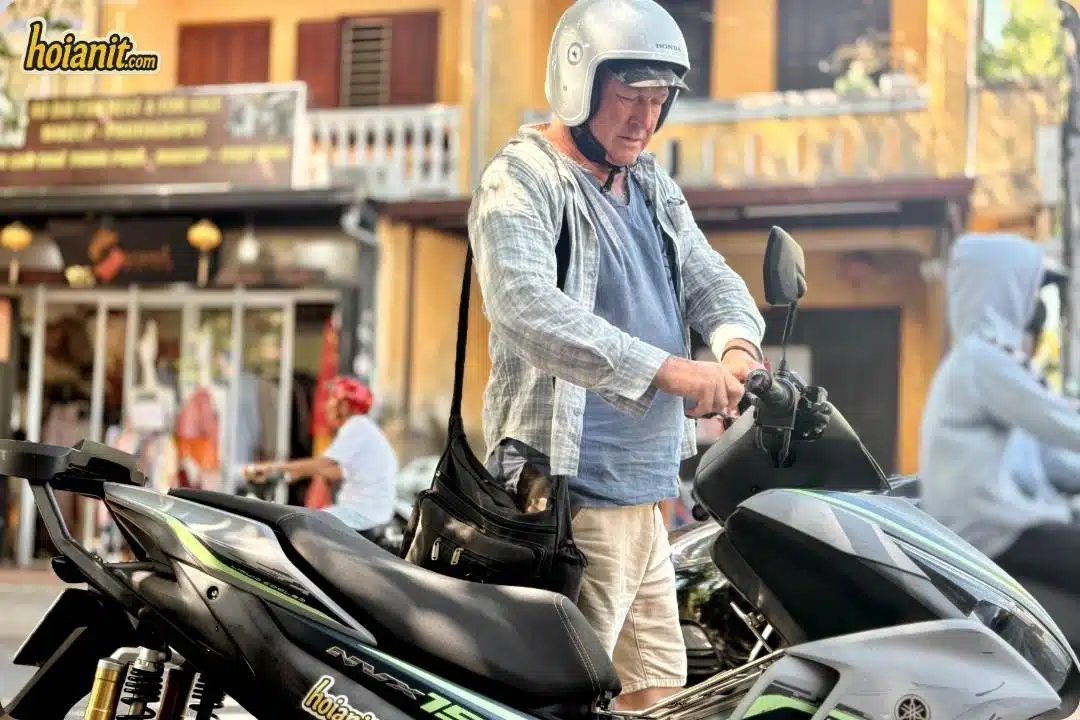
The safest vehicle for your level
Speed and weight are what turn a mistake into an injury, so the safest bike is the lightest, slowest one that still does what you need. Daily prices are from our booking system, checked on 7 October 2026.
| Vehicle | Top speed | Licence | Best for | Per day |
|---|---|---|---|---|
| Bicycle | Your legs | No | Old Town, short rides, the nervous | 50,000₫ |
| Electric bicycle (pedal-assist) | 25 km/h | No | Beaches and villages for beginners | 100,000₫ |
| Mini electric scooter | 40 km/h | No | Town and beach, gentle pull-away | 150,000₫ |
| SYM Shark 50cc | around 40–50 km/h | No | Beginners who want a “real” scooter | 200,000₫ |
| Honda Vision 110cc | Plenty | Yes | Licensed riders, day trips | 180,000₫ |
| 155–160cc scooters | Plenty and then some | Yes, full category A | Experienced riders only | 300,000–500,000₫ |
For the beach in particular, a pedal-assist e-bike is hard to beat: stable, slow enough that sand is not a drama, and no licence question at all. Our guide to the Hoi An beaches by motorbike compares the routes and which bike suits each. For a full side-by-side of bikes for learners, including semi-automatics and manuals, see the “which bike to learn on” table in our beginner’s riding guide.

Helmet, clothing and the bike check
The helmet
Riders and passengers must wear a fastened helmet; an unfastened strap counts as no helmet, and the fine is 400,000–600,000₫ each. More importantly, it is the one piece of kit that decides how a fall ends. A proper helmet has a rigid shell, a thick foam liner and the CR conformity mark required under Vietnam’s helmet standard. Squeeze it: if it flexes like a bucket, ask for another. Every bike we rent leaves with two, and our page on helmets and raincoats explains how to check one anywhere.
What to wear
Closed shoes rather than flip-flops, long trousers if you can bear the heat (exhaust burns on the inside of the calf are among the most common scooter injuries), light long sleeves against the sun on longer rides, and sunglasses or a visor for dust.
The two-minute bike check
- Brakes: squeeze each lever and push the bike. It should stop dead, and the lever should not touch the grip.
- Tyres: look at the tread. Bald tyres are the main reason scooters slide in the rain.
- Lights and horn: headlight, both indicators, brake light, horn.
- Mirrors: both present, both adjusted to you.
- Fuel or battery: ask how far it will go.
- Photos: four corners of the bike and any existing scratches, so nobody argues at return.

Ten habits for riding a motorbike safely in Hoi An
Skills come with practice. These habits are what keep the skills from being tested.
- Helmet on and fastened, every ride, including the two-minute run for coffee.
- Zero alcohol. Vietnam has no “one beer” allowance for riders, and the fines start at 2,000,000₫.
- Daylight first. Save the unlit countryside for when you know the roads.
- Phone in a holder, not your hand. Holding a phone while riding is an 800,000–1,000,000₫ fine and a very good way to miss a pothole.
- Slow in the Old Town. Walking pace near pedestrians, under 20 km/h in the narrow streets.
- Go with the flow. Steady speed, steady line, signal early, no sudden swerves or braking.
- Brake early, and gently in the wet. Both brakes together, upright, never on sand or paint.
- Download offline maps and tell your hotel roughly where you are going and when you expect to be back.
- Save the numbers in section 9 before you leave, not after you need them.
- No passengers until day two. A passenger changes how the bike brakes and corners.

Licence and insurance are safety too
The legal side and the safety side are the same question. A rider who is not licensed for the bike is usually also a rider whose travel insurance will not pay for a hospital, and in Vietnam the hospital bill is the expensive part, not the police fine.
- Over 50cc (or electric over 4 kW): you need a motorbike licence: Vietnamese, or your home licence with a 1968-convention International Driving Permit stamped for motorcycles. Our guide on whether you need a licence to ride a motorbike in Hoi An covers every case.
- 50cc and under, low-power electric scooters, e-bicycles and bicycles: no licence needed, which is why they are the honest choice for unlicensed riders. See renting in Hoi An without a licence.
- Insurance: read your travel policy’s motorcycling clause before you ride. Our own optional cover (50,000₫ a day) protects the rented bike’s bodywork, not people; details on the motorbike insurance page.
- Checkpoints: routine and usually quick if your papers and helmet are in order. Our guide to a police stop in Hoi An walks through one.
Breakdown or crash: what to do
If there is a collision, stop. Turn on your hazard lights if the bike has them, and move people and bikes to the side of the road if it is safe to do so. Do not leave the scene, whoever was at fault. Check yourself and anyone else for injuries first, then photograph the scene, the bikes and their number plates, and call the right number.
| You need | Call |
|---|---|
| Ambulance | 115 |
| Police | 113 |
| Fire and rescue | 114 |
| Anh Khoa rental bike: breakdown, flat tyre, accident (24/7) | +84 766 766 087 |
The two emergency departments closest to the Old Town:
- Hoi An Regional Medical Centre (public hospital), 04 Tran Hung Dao, Hoi An ward. Phone 0235 3861 364, emergency 24/7.
- Saigon Hoi An General Hospital (private, formerly Pacific Hospital), 06 Phan Dinh Phung, Hoi An Tay ward. Switchboard 0235 3921 656.
For a simple breakdown on one of our bikes, do not let a roadside mechanic you do not know start taking it apart. Call the roadside line: we either bring another bike or send you to a workshop we know. Fuel (“xăng”) is sold at stations and in bottles at small roadside stalls almost everywhere, so running dry is an annoyance rather than an emergency.
Put 115, 113, our roadside line and your hotel’s number into your phone before you set off. Standing shaken at the side of a road with a cracked screen is not the time to search for them.
Not ready? Safer ways to get around Hoi An
Not everyone needs a motorbike, and Hoi An is one of the few places in Vietnam where you can see nearly everything without one.
- Walk the Old Town. It is closed to engines for most of the day anyway.
- Cycle. A city bike costs 50,000₫ a day, and the beaches are a flat 20 minutes away.
- Take an e-bicycle for the beach and villages: all the range of a scooter for these trips, none of the licence or speed.
- Grab for evenings out and anything involving alcohol.
- Take a lesson. If you want to ride but do not trust yourself yet, a one-to-one private riding lesson starts at 900,000₫ for an hour, bike and helmet included, in the quiet late-afternoon slot between 17:30 and 20:00.
Our comparison of bicycle vs e-bike vs motorbike in Hoi An goes through the trade-offs in detail.
A bike that matches your skill
Bicycles, pedal-assist e-bikes, no-licence 50cc and electric scooters and automatic scooters from Anh Khoa at 84 Phan Chau Trinh: 300+ bikes, two helmets and a raincoat with every one, and a roadside line that answers 24/7. Tell us how much you have ridden and we will tell you honestly what to take.
FAQ: is it safe to ride a motorbike in Hoi An?
Is it safe to ride a motorbike in Hoi An?
For most visitors, yes. Hoi An is flat, small and slow, and the Old Town is closed to engines for much of the day. The real risks are riding after dark on unlit country lanes, riding after drinking, sand on the coast roads and choosing a bike that is too powerful. Avoid those and Hoi An is one of the safest places in Vietnam to ride.
Is Hoi An good for beginner riders?
Yes. It is one of the best places in Vietnam to learn, because roads are flat, distances are short and traffic in town is slow. Start on a quiet road early in the morning, ride a light bike such as an e-bike, a 50cc or a 110cc automatic, and leave Da Nang and the Hai Van Pass for later.
Is it dangerous to ride a motorbike in Vietnam for the first time?
It depends on where. Riding for the first time in Hanoi or Ho Chi Minh City traffic is hard and not recommended. In Hoi An, with slower traffic and short distances, many first-time riders are comfortable within a morning, provided they practise first, wear a helmet, ride sober and stay off fast roads.
Who should not ride a motorbike in Hoi An?
Anyone who cannot ride a bicycle confidently, anyone who panics easily in traffic, and anyone who plans to ride after drinking. If you have no motorbike licence, do not ride a bike over 50cc. A bicycle, an e-bike or a lesson first are better options.
What is the safest vehicle to rent in Hoi An?
A pedal-assist electric bicycle limited to 25 km/h, or an ordinary bicycle. Both need no licence, are light and stable, and are fast enough for the beaches and villages. For a scooter, a 50cc or a 110cc automatic is far safer for beginners than a 155cc model.
Do I need a helmet to ride in Hoi An?
Yes. Riders and passengers must wear a fastened helmet on motorbikes, scooters and electric bicycles, and the fine is 400,000 to 600,000₫ each. Every Anh Khoa rental comes with two helmets.
What should I do if I have an accident in Hoi An?
Stop, move to the side of the road if it is safe, check for injuries and call 115 for an ambulance or 113 for the police. Photograph the scene and number plates. If you are on an Anh Khoa bike, call our 24/7 roadside line on +84 766 766 087.
National road crash figures for 2025 are as reported by VnEconomy from official year-end data. Fines are from Decree 168/2024/ND-CP and speed limits from Circular 38/2024/TT-BGTVT, both in force since 1 January 2025. Prices are daily rates on the Anh Khoa booking system, checked on 7 October 2026; the final quote comes by message. Hospital details were checked in September 2026. This is practical advice from a rental shop, not medical or legal advice.
More Bike Options in Hoi An
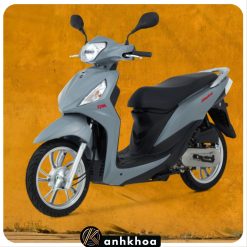
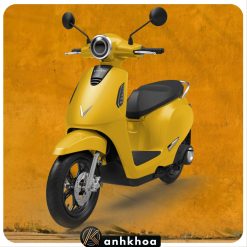
E-Bike · No license










Pick your ride in Hoi AnChọn xe cho chuyến đi Hội An
Scooters, electric bikes and bicycles from one shop in the Old Town — delivered to your hotel, helmets and roadside help included.Xe máy, xe điện và xe đạp — giao tận khách sạn, kèm hai nón bảo hiểm và hỗ trợ dọc đường.
Not sure which one fits? Message us on WhatsApp and we’ll recommend a bike for your plans.
Chưa biết chọn xe nào? Nhắn Zalo 0935 439 306, tụi mình tư vấn theo lịch trình của bạn.