

Hoi An Travel Tips, Routes & Day Trips
My Son Sanctuary by Motorbike from Hoi An — Route, Timing & the Quiet Hours
My Son by Motorbike from Hoi An: Route, Timing and the Quiet Hours
My Son by motorbike from Hoi An is 38 km of flat rice road — a thousand-year-old brick valley, and a crowd clock that almost every guide gets wrong.
Most people see My Son from the middle seat of a minibus, between 09:30 and 11:00, in full sun, shoulder to shoulder with four other groups. It is a beautiful place and that is a bad way to see it. On your own bike you control the one variable that changes everything here — what time you walk through the gate — and the ride out through the rice fields turns out to be half the day’s pleasure.
This guide is the practical version: the exact route, what the ticket actually includes, the full Cham performance timetable that almost nobody publishes in English, and an honest account of when the site is empty and when it is not. Plus the two stories that make the ruins make sense — what a B-52 took away in 1969, and why the bricks have no mortar lines.
- My Son by motorbike, or take the tour?
- The route to My Son from Hoi An, turn by turn
- The My Son crowd clock — the part other guides get wrong
- My Son tickets, hours and the full performance timetable
- What survives, and what 1969 took away
- The brick mystery and the Pole who stayed 17 years
- Which bike for My Son by motorbike, and what it costs
- Riding DT610 safely
- Make it a loop, not an out-and-back
- Frequently asked questions
My Son by motorbike, or take the tour?
We rent motorbikes, so treat the following with the appropriate suspicion — but we would rather you have a good day than a booking. Riding to My Son is the right choice for most people and the wrong choice for some.
Not riding at all? We compare the shuttle bus, the public bus, a guided tour and a private car in the My Son shuttle bus guide.
| Ride yourself if… | Take a tour if… |
|---|---|
| You want to be there at 06:00 or after 15:30, when it’s quiet | You want the history explained by a guide as you walk |
| You’re comfortable on 38 km of flat provincial road | You’ve never ridden a scooter before this trip |
| You want to stop at Tra Kieu, Go Noi or a roadside ca phe | It’s the wet season and the forecast is bad |
| You’d rather spend 3 hours there than the 2 a tour allows | You want lunch and a rice-paper demo bundled in |
| Two of you — it’s far cheaper than two tour seats | You’re travelling alone and want the company |
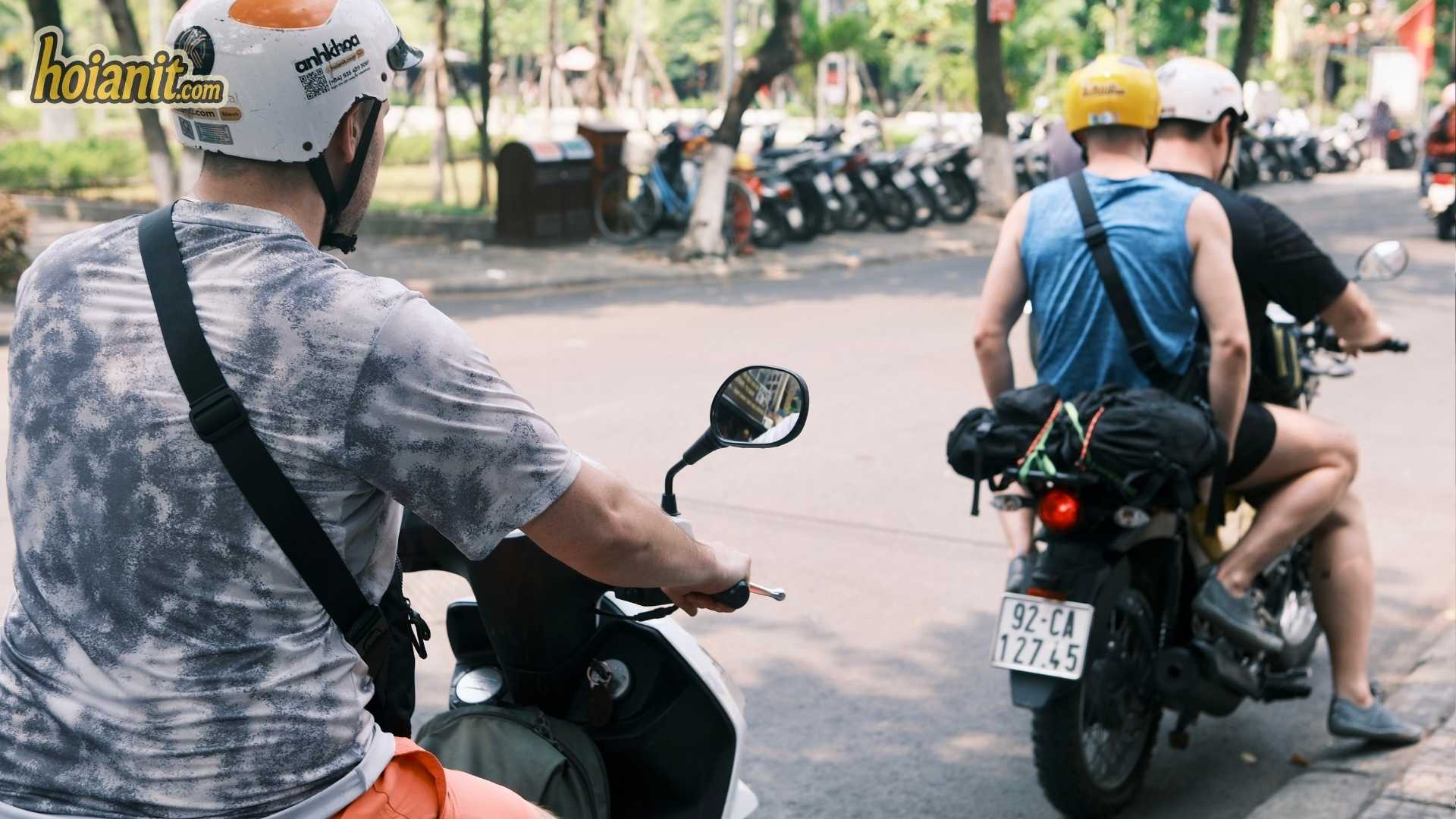
There is a middle option people forget. Ride out yourself in the early morning for the quiet and the light, then hire one of the site’s own guides at the entrance for the walk around. You get the empty valley and the explanation, and you’re not tied to a minibus schedule. If you’d rather not ride at all, our Hoi An – My Son shuttle runs the same route with a driver.
The whole day, added up. Bike from 120,000₫, fuel about 50,000₫, entry 150,000₫ — roughly 320,000₫ (~US$13) for a completely self-paced day at My Son. A group tour costs more and hands you someone else’s timetable; the trade is that the history gets explained properly. Worth knowing too: the sunrise convoys leave Hoi An and Da Nang at 4:30–5:00, standard morning tours at 8:00–8:30, and the site closes around 17:00–17:30 depending on season.
The route to My Son from Hoi An, turn by turn
My Son sits in a bowl of hills 38,2 km south-west of Hoi An, in what is now Thu Bon commune. There are two ways in, one on each bank of the Thu Bon river, and the smart move is to use one going and the other coming back.
- Leave the Old Town heading west on Hung Vuong / Ly Thuong Kiet and pick up DT608 towards Vinh Dien. Fifteen minutes of ordinary town road — this is the dullest part, get it done early.
- At Vinh Dien, join the road south towards Nam Phuoc. You’re following the river valley now. Traffic thins noticeably once you’re past the junction.
- At Nam Phuoc, turn right onto DT610. This is the classic approach and the prettier of the two. Rice fields on both sides, buffalo, village markets, and the road runs dead flat.
- Pass Tra Kieu at roughly the halfway point. This was Simhapura, the Cham capital — worth ten minutes for the hilltop church view even if you don’t stop long.
- Follow DT610 to the My Son junction and turn left towards the hills. The last 8 km narrow and start to climb gently; you’ll know you’re close when the rice ends and the forest begins.
- Park at the main entrance. Attended motorbike parking, small fee. Buy your ticket, then take the free electric buggy the 2 km up to the temples — or walk it if you’d rather, it’s a pleasant shaded track.
Google Maps will sometimes send you the “fast” way. On a bike that usually means a stretch of QL1A, which is the national highway — trucks, buses and no reason to be there. If your route ever puts you on QL1A for more than a couple of kilometres, back out and take the DT610 line instead. It’s barely slower and it’s the whole reason you’re riding.
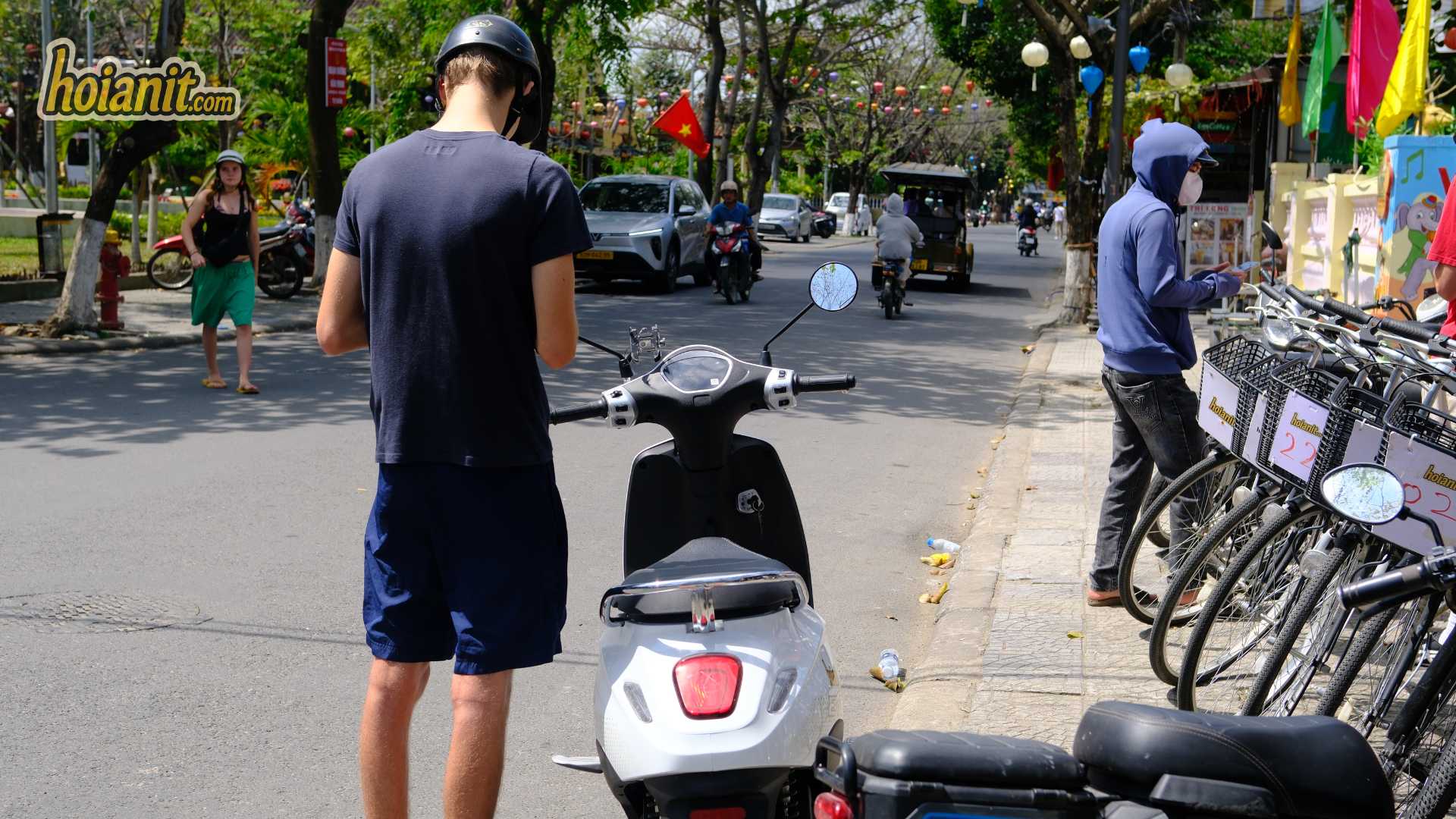
- Fuel up in Hoi An before you leave. There are pumps along DT610 but they thin out after Tra Kieu, and a round trip is around 80 km.
- Download the offline map. Signal is fine most of the way, but the last few kilometres run through hills and it drops in patches.
- Allow 75 minutes, not 60. The distance says an hour; village traffic, a level crossing and one wrong turn say otherwise.
- Coming back, take DT609 or the Go Noi road for a different view — see section 09.


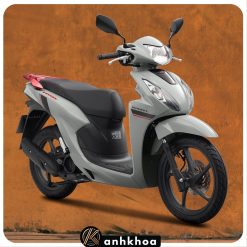
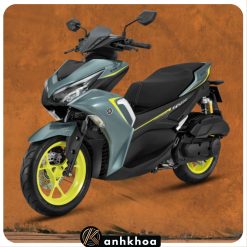

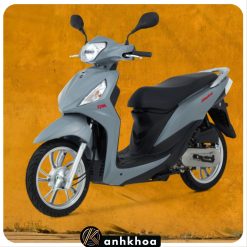




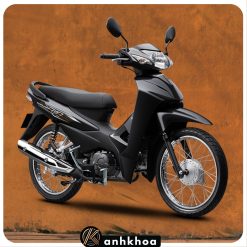



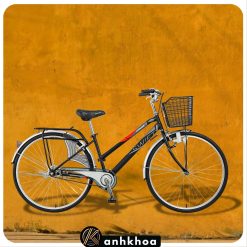
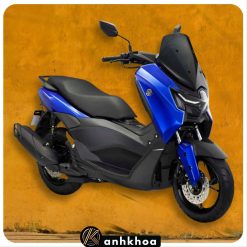



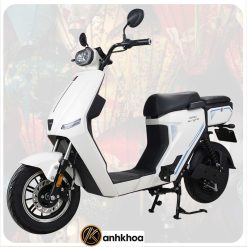
Bikes Rental


The My Son crowd clock — the part other guides get wrong
Nearly every article about the site says the same thing: go early to beat the crowds. That advice is half right and it costs people the best hour of the day, because it ignores what actually happens at the gate.
The site opens at 06:00. The sunrise and early-morning tours from Hoi An and Da Nang pick up their guests between about 05:00 and 05:30 and are designed to be standing at that gate the moment it opens. So 06:00 is not an empty site — it is the site with every sunrise group in it at once. They’re small groups in minibuses rather than full coaches, and they cluster tightly around groups B, C and D with their guides, but they’re there.
Then something useful happens. Those groups have roughly two hours on site and leave around 08:00–08:30 to get back for the rest of their itinerary. The big coaches from Da Nang and the standard half-day tours don’t start landing until about 09:00, and the real crush is 09:30 to 14:00. In between there is a gap that almost nobody writes about.
07:15 to 08:45, and again after 15:30
Arrive at the gate around 07:00, not 06:00. You’ll pay, ride the buggy up, and by the time you’re walking into the temple groups the sunrise crowd is already thinning and heading down. For the next hour and a half the valley is functionally yours, the light is still low and warm, and the heat hasn’t arrived.
The second window is the afternoon one. From about 15:30 the coaches have gone and closing is at 17:00 — an hour and a half of warm light, long shadows on red brick, and almost nobody. It’s the better photographic light of the two, and it’s the window motorbike riders can actually use because you’re not tied to anyone’s schedule.
| Time | Who’s there | Verdict |
|---|---|---|
| 06:00–07:00 | Every sunrise minibus group, all at once | Busier than you expect |
| 07:15–08:45 | Sunrise groups leaving, coaches not yet arrived | The best window |
| 09:00–09:30 | First coaches; buggy queue starts | Filling fast |
| 09:30–14:00 | Peak. Multiple coaches, full sun, no shade | Avoid |
| 14:00–15:30 | Thinning, still very hot | Tolerable |
| 15:30–17:00 | Almost empty, warm low light | Excellent |
Walk the groups backwards. Guided groups almost always start at B–C–D, the big central cluster nearest the buggy drop-off, then work outward. If you start at the far end instead — groups A, H and K — you spend the whole visit moving against the flow and meet each group once, briefly, instead of shuffling behind them. It costs you nothing and it’s the single most effective thing you can do about crowds after choosing your hour.

My Son tickets, hours and the full performance timetable
Straightforward, and better value than it first looks — the ticket is not just admission.
| Item | Detail |
|---|---|
| Foreign visitors | 150,000₫ |
| Vietnamese visitors | 100,000₫ |
| Included | Admission, the electric buggy both ways, and the Cham performances |
| Opening hours | 06:00–17:00, Monday to Sunday, including public holidays and Tet |
| Motorbike parking | Attended, small fee at the entrance |
| Guides | Available at the entrance if you want one on the day |
The performances are the part travellers most often miss, because they arrive, walk, sweat and leave without ever knowing there was a schedule. There are several separate programmes running at different points in the valley:
If you’re using the afternoon window, the 14:45 Group G performance is the one to aim for. It’s staged out among the towers rather than in the hall, the afternoon crowd has already thinned, and you can be back on the bike by 15:30 with the best light of the day still ahead of you. Schedules do shift for weather and for major festival days — if a specific performance is the reason you’re going, it’s worth a quick call to the site before you ride out.
What survives, and what 1969 took away
The valley was a working religious centre for roughly nine centuries, from the 4th to the 13th, built and rebuilt by Cham kings who came here to be crowned and to be remembered. Then it was simply forgotten — swallowed by forest for more than four hundred years, until the French scholar Camille Paris came across it in 1895.
When French archaeologists surveyed and cleared the valley in 1903–1904 they documented around seventy structures. Today roughly twenty remain standing, concentrated in groups B, C and D. Understanding the gap between those two numbers is most of what you need to read the site properly.
Tower A1 and the week of August 1969. The tallest and finest building here was A1, a 24-metre tower that French scholars had called the masterpiece of Cham architecture. During the war the valley was used as a base, and in 1969 US bombing brought A1 down. What you see at Group A today is a foundation, scattered carved sandstone, and a hole in the record — the single most important Cham building ever constructed no longer exists. Every guidebook photograph of the place you have ever seen is of the buildings that happened to survive that week.
UNESCO inscribed the sanctuary as a World Heritage Site on 4 December 1999. Since the 2025 provincial reorganisation the valley — like Hoi An itself — sits within Da Nang City rather than Quang Nam, which is why older signage and articles disagree about the address.
- Stay on the marked paths. Large parts of the valley floor are still unexcavated, and this ground was heavily fought over. The paths exist for good reasons.
- Look for the bomb craters. Once you know they’re there you’ll start seeing them — shallow circular depressions in the flat ground between the groups, now grassed over.
- Group A is worth the walk precisely because it’s the emptiest. It’s the far end of the site, most groups skip it, and it is where the history actually happened.
- The sandstone carvings are the originals. The brickwork has been restored in places; the reliefs, lintels and pedestals have not. Look at the faces.
More Bike Options in Hoi An
E-Bike · No license

No License? No Worries!
Rent a 50cc Bike in Hoi An Today!
The brick mystery and the Pole who stayed 17 years
Stand close to any intact wall at My Son and look for the mortar lines. There aren’t any. The bricks meet so tightly that a fingernail won’t go between them, and the carving often runs straight across the joins — meaning the Cham carved the wall after it was built, as if it were a single block of stone. Nobody has been able to reproduce it convincingly, and for over a century it was the standing embarrassment of Vietnamese archaeology: every modern restoration using cement mortar aged badly and stood out.
The answer came out of the restoration of Group G. Italian specialists from the University of Milan, working with Vietnamese conservators, identified a plant resin in both the bond and the brick body itself — traced to dau rai, the resin tree that grows abundantly in the hills around the valley. A local craftsman, Le Van Chinh, had reached much the same conclusion years earlier working by hand and was largely ignored at the time.
Kazik — the man Hoi An built a park for
Kazimierz Kwiatkowski (1944–1997), a Polish architect from Lublin known here simply as Kazik, arrived in 1980 to lead a Polish team on the Cham towers. He stayed seventeen years. He brought scientific conservation method to Vietnam, produced thousands of pages of drawings and records that are still the primary documentation of what My Son looked like before and after, and he did the same work for Hoi An’s Old Town — a substantial part of the reason both places carry a UNESCO listing today.
He died of a heart attack on 19 March 1997, on site, directing restoration work at the The Mieu in Hue’s citadel. Hoi An built Kazik Park at 138 Tran Phu in 2007: a granite bust, a plaque in Vietnamese, English and Polish, and a couple of stone benches under an old tree. It takes two minutes and almost no visitor stops there.
A small ritual we’d suggest. Kazik Park is right in the Old Town, on the way out of town if you leave westward. Stop for two minutes on your way to the bike, read the plaque, then ride to My Son. The ruins land differently when you know who put them back together.
Restoration has continued in waves since: the Polish work through to 1994, the Italy–UNESCO project on Group G, and from 2017 to 2022 an Indian team from the Archaeological Survey of India working on groups A, H and K, which recovered some 740 artefacts. In 2020 that team uncovered a 9th-century monolithic sandstone Shiva linga — a reminder that the valley is still giving things up after 130 years of digging.

Which bike for My Son by motorbike, and what it costs
The route is flat and paved the whole way, so this is not a question of engine size — it’s a question of comfort over 80 km round trip.
| Bike | Suits | Notes |
|---|---|---|
| Automatic scooter 110–125cc | Almost everyone | The default. Comfortable two-up, easy to ride, plenty for this road |
| 50cc | Riders without a licence Vietnam recognises | Fine solo on this flat route; slow two-up. See our IDP guide |
| Electric bike | Short hops around town | Not for this trip — 80 km is beyond usable range and there’s no charging out there |
| Semi-auto / manual | Experienced riders | No advantage here; the road is flat |
- Water — two litres minimum per person. The valley is a bowl with almost no shade and it is reliably several degrees hotter than the coast.
- Sun protection and a hat. There is no cover between the temple groups. This is the number one thing people underestimate.
- Closed shoes if you can. The paths are uneven brick, sand and tree root.
- Cash. Tickets, parking and roadside drinks; card acceptance out there is patchy.
- A rain jacket from September to December. Weather in the hills turns faster than on the coast.
- Phone mount and a charged phone — ask us for a mount, we fit them free.
Riding DT610 safely
This is one of the easier long-ish rides out of Hoi An — no mountain pass, no highway if you route it properly — but it is a provincial road through working villages, and that has its own rhythm.
- Assume every side lane has someone coming out of it. Village roads meet DT610 constantly and locals pull out expecting you to adjust. You adjust.
- Rice on the road is real. In harvest season families dry rice on the tarmac. It’s normal, it’s not an obstacle to swerve around at speed — slow down and ride straight through the edge of it.
- Watch for cattle and dogs, especially early morning when you’ll be riding. A buffalo will not move for you.
- School hours are chaos. Around 06:45 and 11:15 the road fills with kids on bicycles. Ease off through villages at those times.
- The last 8 km are narrower. Gentle bends, some gravel at the edges, occasional tour coach coming the other way taking more than its half. Stay left, stay off the crown.
- Helmets on, both of you, properly fastened. Non-negotiable, and it’s also the law.
If you’re riding the afternoon window, do the maths on the light. Closing is 17:00, and it’s a 60–75 minute ride home. Leaving the gate at 17:00 in December means the last stretch is in the dark on a road with essentially no street lighting. Either go earlier, or accept the night ride and make sure your headlight works before you leave Hoi An. Our full notes on riding safely around Hoi An cover the rest.
Make it a loop, not an out-and-back
Riding the same 38 km home is a waste of a bike. The Thu Bon river has a road down each bank, so you can come back a different way for no extra time.
| Add-on | Where | Worth it for |
|---|---|---|
| Tra Kieu | Halfway on DT610 | The Cham capital of Simhapura. Climb to the hilltop church for the valley view |
| Go Noi island | DT610B, on the way back | A river islet of silk villages and mulberry fields. Almost no tourists |
| DT609 return | North bank of the Thu Bon | Same distance, different villages, completes the loop |
| Thanh Ha pottery village | Just outside Hoi An | Fits neatly on the way home if you still have an hour |
| Marble Mountains | Towards Da Nang | Too much for one day — do it as an overnight, see below |
- Want the two-day version? My Son one day, Marble Mountains and the coast the next — we’ve written that up as a 2-day Hoi An – My Son – Marble Mountains trip.
- Want the history rather than the ride? Our guide to the Cham temples themselves covers what you’re actually looking at, group by group.
- Don’t want to ride? The shuttle from Hoi An does the same run with a driver and a guide.
- Riding out at dawn anyway? Pair it with a sunrise stop at Ha My beach the following morning — different direction, same early-start logic.
Add a Cham stop on the way. The DT608 road out of Hoi An passes within two kilometres of Bang An Tower, the only octagonal Cham tower still standing, free to enter and usually empty. Our Dien Ban loop guide strings it together with the Phuoc Kieu bronze village and Cau Mong roast veal; ridden in the morning, it hands you to DT610 and My Son for the quiet afternoon hours.
Keep going up DT610. Thirty kilometres beyond the sanctuary the same road reaches Dai Binh village, where southern fruit grows in the mountains, and the boats for the Hon Kem Da Dung gorge, where the Champa king Prakasadharma — whose inscriptions you have just seen at My Son — left another one on a riverside boulder.
Frequently asked questions
How far is My Son from Hoi An by motorbike?
My Son is 38,2 km south-west of Hoi An Old Town, and the ride takes 60 to 75 minutes each way on a scooter. The most pleasant route is DT608 to Vinh Dien, south to Nam Phuoc, then DT610 through Tra Kieu to the sanctuary. Avoid routes that put you on the QL1A national highway for any distance.
Can you ride a scooter to My Son Sanctuary?
Yes. The road is paved and flat the entire way with no mountain pass, so an ordinary 110–125cc automatic scooter is more than enough, and a 50cc is fine for a solo rider. Electric bikes are not suitable because the round trip is around 80 km with no charging available at the site.
What time should I arrive at My Son to avoid the crowds?
Around 07:00 rather than at opening. The site opens at 06:00, which is exactly when every sunrise minibus tour arrives, so 06:00 is busier than most guides suggest. Those groups leave between 08:00 and 08:30 and the coaches do not arrive until about 09:00, giving a genuinely quiet window from roughly 07:15 to 08:45. The second quiet window is after 15:30, when the coaches have gone and closing is at 17:00.
How much is the My Son entrance ticket in 2026?
150,000₫ for foreign visitors and 100,000₫ for Vietnamese visitors. The price includes admission, the free electric buggy that runs the 2 km between the entrance and the temples, and the Cham performances. Motorbike parking at the entrance costs a small extra fee.
What time are the Cham dance performances at My Son?
The main programme in the performance house runs at 09:45, 10:30, 11:15, 14:00 and 16:00. There are additional shows at the Group G towers at 09:00 and 14:45, Cham folk singing on Mondays, Wednesdays and Fridays near Group H at 09:00 and 14:45, and the “Am vang My Son” programme in the B–C–D group on the 15th of each month at 09:00 and 14:45. Schedules can shift for weather and festival days.
What are My Son’s opening hours?
My Son is open from 06:00 to 17:00 every day of the week, including public holidays and Tet. Allow at least two hours on site, and three if you want to reach Group A at the far end and catch a performance.
Why are so many of the towers ruined?
French archaeologists documented around seventy structures when they cleared the valley in 1903 and 1904; roughly twenty survive today. The single greatest loss was tower A1, a 24-metre building regarded as the masterpiece of Cham architecture, which was destroyed by US bombing in 1969 when the valley was used as a base during the war. Centuries of forest, weather and looting account for the rest.
Do I need a licence to ride to My Son?
To ride a motorbike over 50cc legally in Vietnam you need a Vietnamese licence or a licence recognised under the 1968 Vienna Convention, together with an International Driving Permit issued under that convention. Vietnam does not recognise the older 1949 Geneva IDP. Bikes of 50cc and under and low-powered electric bikes do not require a licence, which is why many visitors take a 50cc for this route — it handles the flat road perfectly well. Our IDP guide explains how to tell the two permits apart.
Riding out for the quiet hour? We open early.
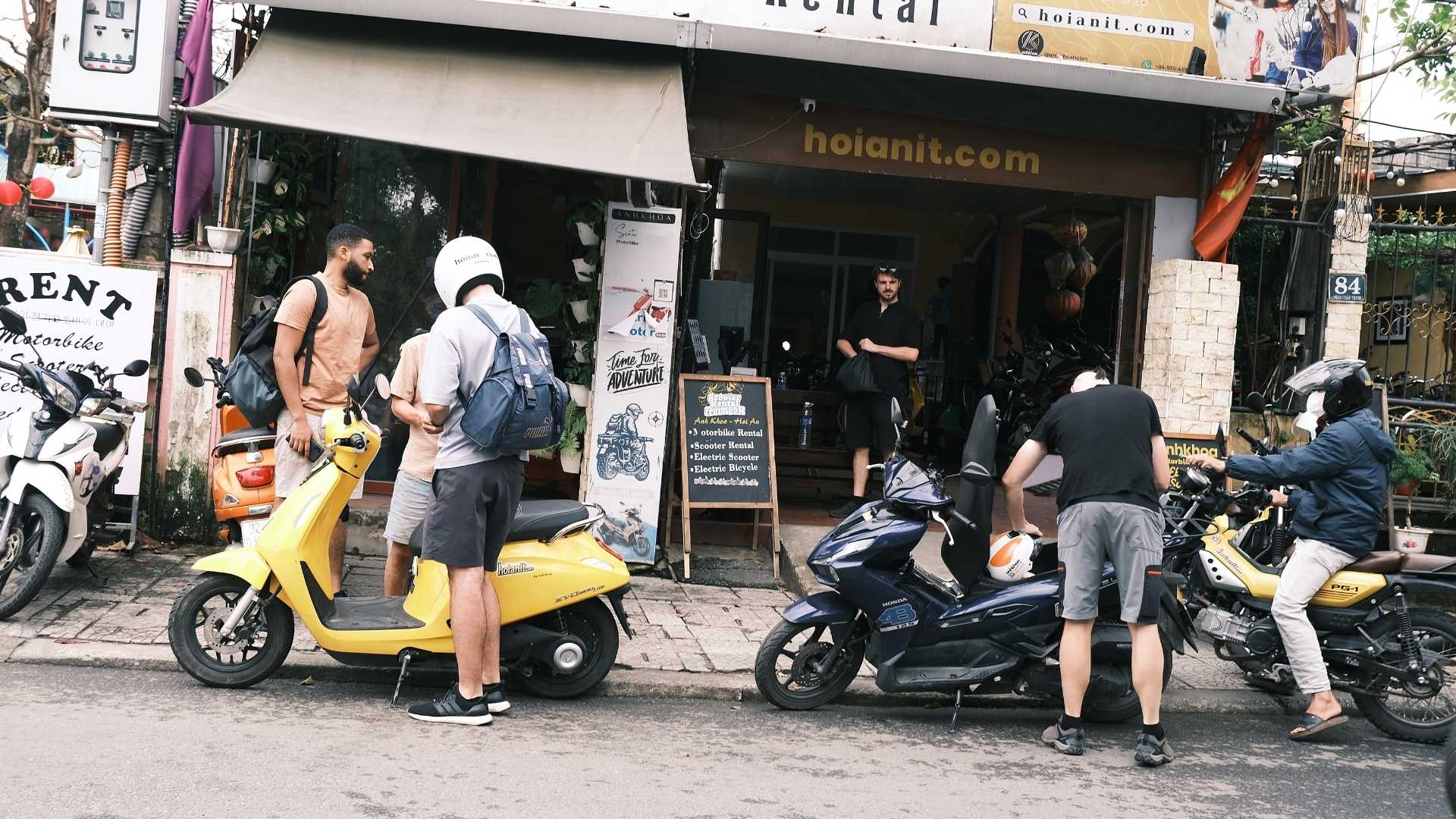
Anh Khoa is a family-run rental at 84 Phan Chau Trinh, Hoi An — five minutes from the Old Town. Automatic scooters, 50cc and electric bikes with helmets, raincoats, phone mounts and 24/7 roadside help. Tell us you’re going to My Son and we’ll check the headlight, mark the DT610 route and the Go Noi return on your map, and have the bike ready before dawn.
Zalo 0935 439 306 · 84 Phan Chau Trinh, Hoi An
Prices, opening hours and the performance timetable were checked against the My Son heritage site’s own published information in August 2026; ticket prices and show times are set by the site and can change, and performances are occasionally cancelled for weather or festival days. Historical figures follow the site’s own account and the published records of the Polish, Italian and Indian conservation missions. Distances and ride times are our own, measured from 84 Phan Chau Trinh.








Pick your ride in Hoi AnChọn xe cho chuyến đi Hội An
Scooters, electric bikes and bicycles from one shop in the Old Town — delivered to your hotel, helmets and roadside help included.Xe máy, xe điện và xe đạp — giao tận khách sạn, kèm hai nón bảo hiểm và hỗ trợ dọc đường.
Not sure which one fits? Message us on WhatsApp and we’ll recommend a bike for your plans.
Chưa biết chọn xe nào? Nhắn Zalo 0935 439 306, tụi mình tư vấn theo lịch trình của bạn.