
Routes & Day Trips
Bang An Tower from Hoi An by Motorbike: The Half-Day Dien Ban Craft Loop (2026)
Bang An Tower from Hoi An by Motorbike: The Half-Day Dien Ban Craft Loop (2026)
Bang An Tower is the only octagonal Cham tower left, 12 km from Hoi An on a loop most visitors never ride: a 400-year-old bronze village, the birthplace of the Vietnamese alphabet and the best roast veal in the province.
Why ride this loop instead of (or before) My Son
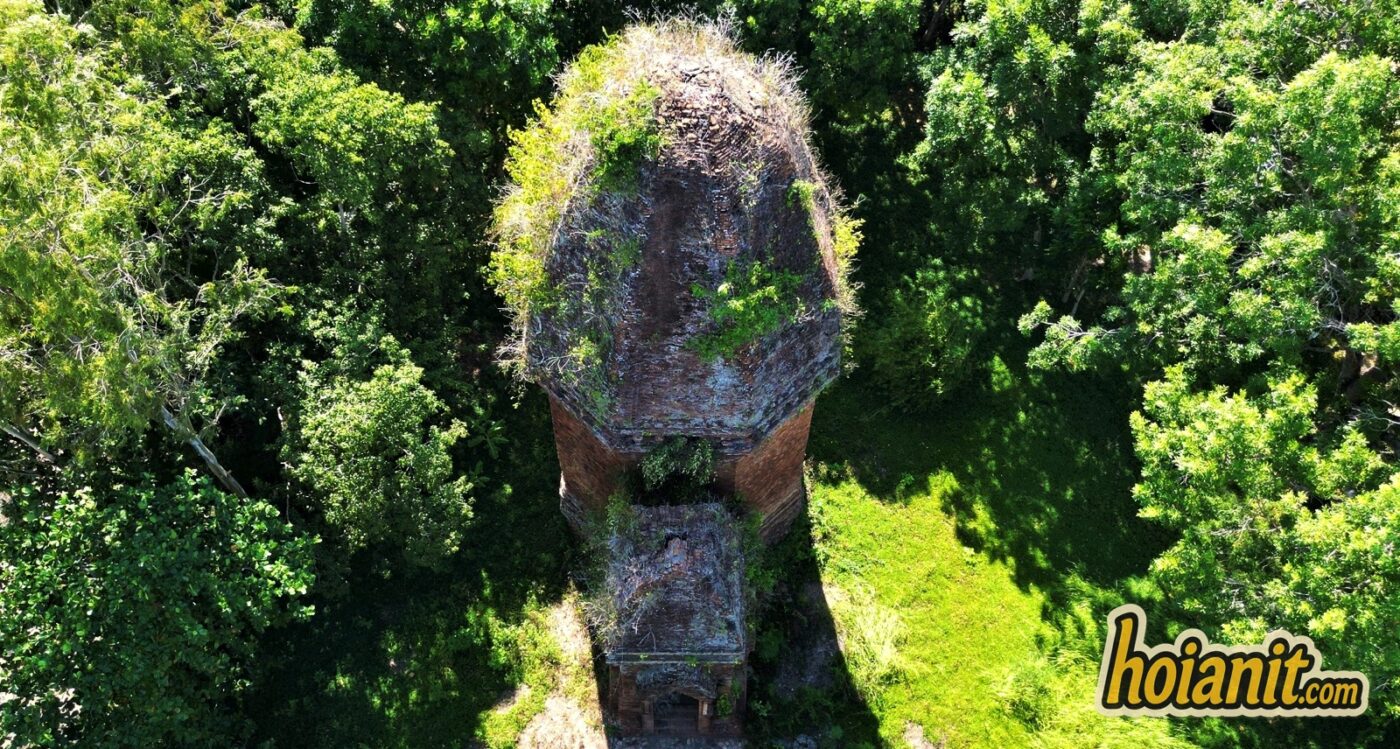
Every rider in Hoi An knows the road west to My Son. Almost nobody knows that the same river plain, one district closer to town, holds a Cham tower you can have entirely to yourself. Bang An Tower is a 21.5-metre brick sanctuary from the 10th century, the last octagonal tower in the whole of the former Champa kingdom, and it stands in a quiet garden behind a coffee shop sign in Dien Ban, roughly 25 minutes from the Old Town.
That alone would justify a morning. But the roads around it string together three more things that sit in each other’s back yards and appear in no tour brochure together (our Thanh Ha and Kim Bong guide covers the craft villages inside Hoi An itself): Phuoc Kieu, a bronze-casting village that has been pouring gongs and temple bells for more than 400 years; the site of Thanh Chiem, the Nguyen lords’ garrison where a Portuguese Jesuit began writing Vietnamese in Latin letters in the 1620s; and Cau Mong, a strip of roadside restaurants that roast whole calves over rice straw and mulberry wood. Cross the Thu Bon at Cau Lau and you can add Ma Chau, a silk village that once wove for the imperial court and is being revived by a father-and-daughter team with digital looms.
It is the kind of loop that only works on a motorbike. The stops are 6 to 12 kilometres apart, the roads are flat and paved, and the whole thing is over by early afternoon, which leaves the beach or the lantern streets for the rest of the day.
| You are… | Do this | Time |
|---|---|---|
| Short on time, want the tower only | Hoi An → Bang An Tower → back the same way | 1.5–2 h |
| A history person | Phuoc Kieu → Thanh Chiem stele → Bang An Tower | 3 h |
| Here for the food | Phu Chiem mi Quang breakfast → tower → Cau Mong veal lunch | 4 h |
| Making a full day of it | Loop + Ma Chau silk, or continue west to My Son | 5–7 h |
The route at a glance: Hoi An to Bang An Tower and back
Everything below starts and ends at our shop at 84 Phan Chau Trinh in the Old Town. Distances are road distances between the actual pins, not the straight-line numbers you see quoted elsewhere; Bang An Tower alone is variously described online as 12, 14 or 20 kilometres away, and the truth is 11.9 km by the fastest road.
| Leg | Road | Distance | Riding time |
|---|---|---|---|
| Hoi An → Phuoc Kieu bronze village | Hung Vuong → DT608 | 9.3 km | 20–25 min |
| Phuoc Kieu → Thanh Chiem stele | DT608, same village | 0.5 km | 2 min |
| Thanh Chiem → Bang An Tower | DT608 → Vinh Dien → DT609 | 5.9 km | 12–15 min |
| Bang An Tower → Cau Mong (lunch) | DT609 → old QL1A south | 6.2 km | 15 min |
| Cau Mong → Hoi An | old QL1A → DT608 | 12.3 km | 25–30 min |
| Loop total | 33.7 km | ~1.5 h riding | |
| Optional: Cau Mong → Ma Chau silk → Hoi An | Cau Lau bridge → Nam Phuoc → DT608 | +9 km | +25 min |
Pins for your map app: Bang An Tower 15.884473, 108.232726; Phuoc Kieu bronze village 15.868779, 108.261339; Ma Chau silk workshop is listed at 211 Truong Chi Cuong, Nam Phuoc. Search Google Maps for “Thap Bang An” and it resolves correctly; whichever name you use, check that the pin sits just south-west of Vinh Dien town before you ride.
Ride it clockwise, as above. Phuoc Kieu’s furnaces are lit early and the workshops close for lunch; the tower is at its best when the sun is high enough to drop through the roof opening; and Cau Mong veal comes out of the fire mid-morning and is at its best before 13:00. Reverse the loop and you hit each stop at the wrong hour.
Stop 1: Phuoc Kieu, the village that cast the Nguyen lords’ cannons
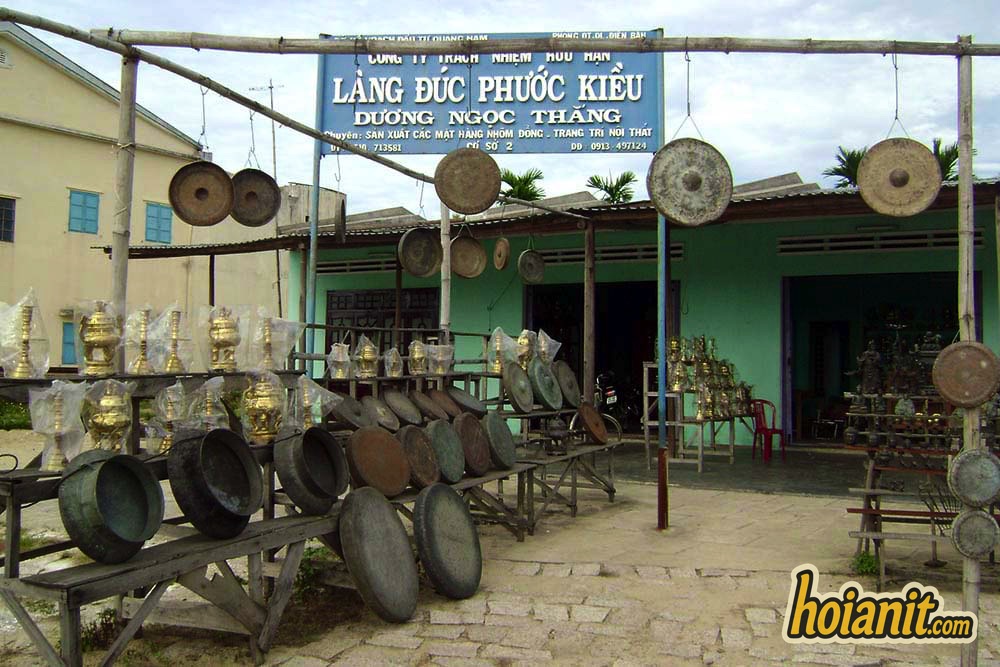
Leave the Old Town on Hung Vuong and keep going west as it becomes DT608, the straight two-lane road to Vinh Dien. After about nine kilometres, in the hamlet of Thanh Chiem, the shops on both sides start displaying gongs, bells and Buddha statues in the doorway. This is Phuoc Kieu. There is no gate and no ticket: the village is a working strip of family foundries and showrooms along the road.
The craft came here in the 16th century with a founder remembered as Duong Tien Hien, a migrant from Thanh Hoa, and by the early 1600s the village was reputedly casting weapons for Nguyen Hoang’s new southern domain; in 1832 Emperor Minh Mang merged Phuoc Kieu with neighbouring Dong Kieu into one commune. Its peak came in the 1970s, when, according to Viet Nam News, it turned out more than 200 tonnes of bronze a year. Today there are around three private enterprises and roughly twenty household workshops, employing about a hundred people, and the products have shifted from ploughshares to what temples and collectors want: bells, gongs, incense burners, drums and portrait statues. Two full-size replica Nguyen-dynasty cannons, each 100 kg and 1.2 m long, came out of these furnaces in recent years.
What you see depends on the day. Pouring happens in the morning, typically several times a week rather than daily, so the honest advice is to ride in around 08:30–09:30 and simply look for smoke. A dry-mould gong casting is spectacular: clay moulds bound with rice husk, bronze at around 1,200 °C, then an artisan tapping the still-warm gong with a hammer to tune it by ear. On a quiet day you will still find someone chasing patterns into a finished bell or polishing a statue, and the showrooms are always open to walk through.
Dong Phuoc Kieu — Duong Ngoc Tien workshop
Third-generation master caster with over 40 years at the furnace; his family’s website calls itself “the essence of 400 years of Phuoc Kieu”. The workshop makes temple bells, gongs and commissioned statues and is the one most used to visitors wandering in. A Google review from July 2025 says the village “looks like it has been closed for a while”, which matches what riders tell us: individual workshops open and shut with orders, so if you want to see a pour, phone the day before or accept that you may see finishing work only.
Small souvenirs — a palm-sized gong, a bell, a feng-shui tortoise — run roughly 100.000₫ to 500.000₫; a real ceremonial gong is several million dong and made to order. Prices are marked in the larger showrooms and there is little bargaining. If you photograph someone at work, 20.000₫–50.000₫ left on the bench is appreciated and not expected.
Stop 2: Thanh Chiem, where Vietnamese was first written in Latin letters
You are already standing on it. The hamlet of Thanh Chiem, where the bronze village sits, was Dinh tran Thanh Chiem: the garrison capital that Lord Nguyen Hoang founded in 1602 to govern Quang Nam, and where his heirs were sent to learn to rule before inheriting the throne in Hue. For 230 years, until 1832, this was the second city of the Nguyen domain, the administrative brain behind the port at Hoi An.
The reason it matters to anyone who has ever read a Vietnamese street sign is a Portuguese Jesuit named Francisco de Pina. He arrived in Da Nang in 1617, moved to Hoi An, and by early 1618 had translated the Lord’s Prayer into Vietnamese. Between roughly 1618 and his death in 1625 he lived and worked at Thanh Chiem, working out how to write the tones of Vietnamese with a Latin alphabet, and it was here in 1624–25 that he taught the language to a newly arrived colleague, Alexandre de Rhodes, whose 1651 dictionary is usually credited with the script. The alphabet you are reading Vietnamese in today was drafted in this village.
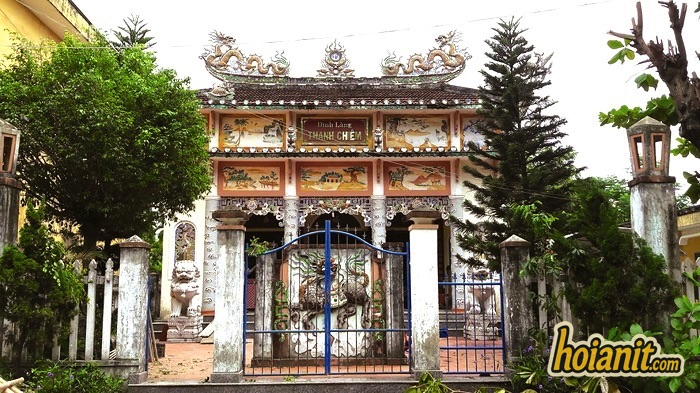
Almost nothing of the garrison survives above ground; the site was declared a national historic monument on 12 June 2017, and about ten markers have been mapped for future excavation. What you can visit in five minutes is the village communal house, Dinh Thanh Chiem, which now sits inside the grounds of Nguyen Du Secondary School just off DT608, with a stone stele reading, in Vietnamese, “In 1602 Lord Nguyen Hoang established the garrison of Quang Nam, called Dinh Chiem.” Nearby is a small shrine to Saint Andrew of Phu Yen, the young catechist who worked with the Jesuits here. Go outside school hours or ask at the gate; the caretaker is used to the occasional visitor. A display centre for the citadel and the alphabet has been planned for years and had not opened at the time of writing.
A brick tower, a bronze furnace and a Latin alphabet, all within one hamlet’s walk of each other. Nowhere else in Vietnam packs three civilisations that tightly.
Stop 3: Bang An Tower, the last octagon of Champa
From Thanh Chiem continue west on DT608 into Vinh Dien, the market town at the crossroads of the old highway. Cross straight over QL1A onto DT609, the road towards Ai Nghia and Dai Loc, and after about a kilometre and a half look for the coffee-shop sign on your left: the turn to Bang An Tower is here, a short lane running to a small parking pull-off in front of a walled garden. There is no ticket booth and no fee. Hours are informally 07:00–17:00; the gate is sometimes simply open.
Bang An Tower is unusual before you even look at it closely. Every other surviving Cham tower, from My Son to Po Nagar, has a square body. This one is an octagon, each face four metres wide, rising 21.5 metres to a rounded roof, with a long rectangular vestibule on the east side that gives the whole building, seen from above, the plan of a linga set in a yoni. A stele found on the site names the sanctuary Linga Paramesvara and dates it to the reign of King Bhadravarman II, which puts construction between 875 and 977 — most scholars settle on the 10th century. Inside, a broken lingam-yoni pedestal survives on the floor of the cella, with a modern aluminium altar and incense beside it; local families still make offerings here.
Two stone gajasimha, elephant-lion guardians, flank the entrance. They are not a pair: the signboard dates the one on the left to the 10th century and the one on the right to the 12th, which tells you the shrine stayed in use for at least two hundred years. Look at the brickwork on the north and south walls and you can pick out the French restoration of the early 1940s (the relic file says 1943), when two side doors were bricked into windows and modern mortar was used; the original Cham builders used no mortar at all but an organic resin, and the joints are almost invisible. It was declared a national historic and cultural relic in 1989; VietNamNet’s 2024 feature has good photographs of the roof interior if you want to know what to look for before you go.
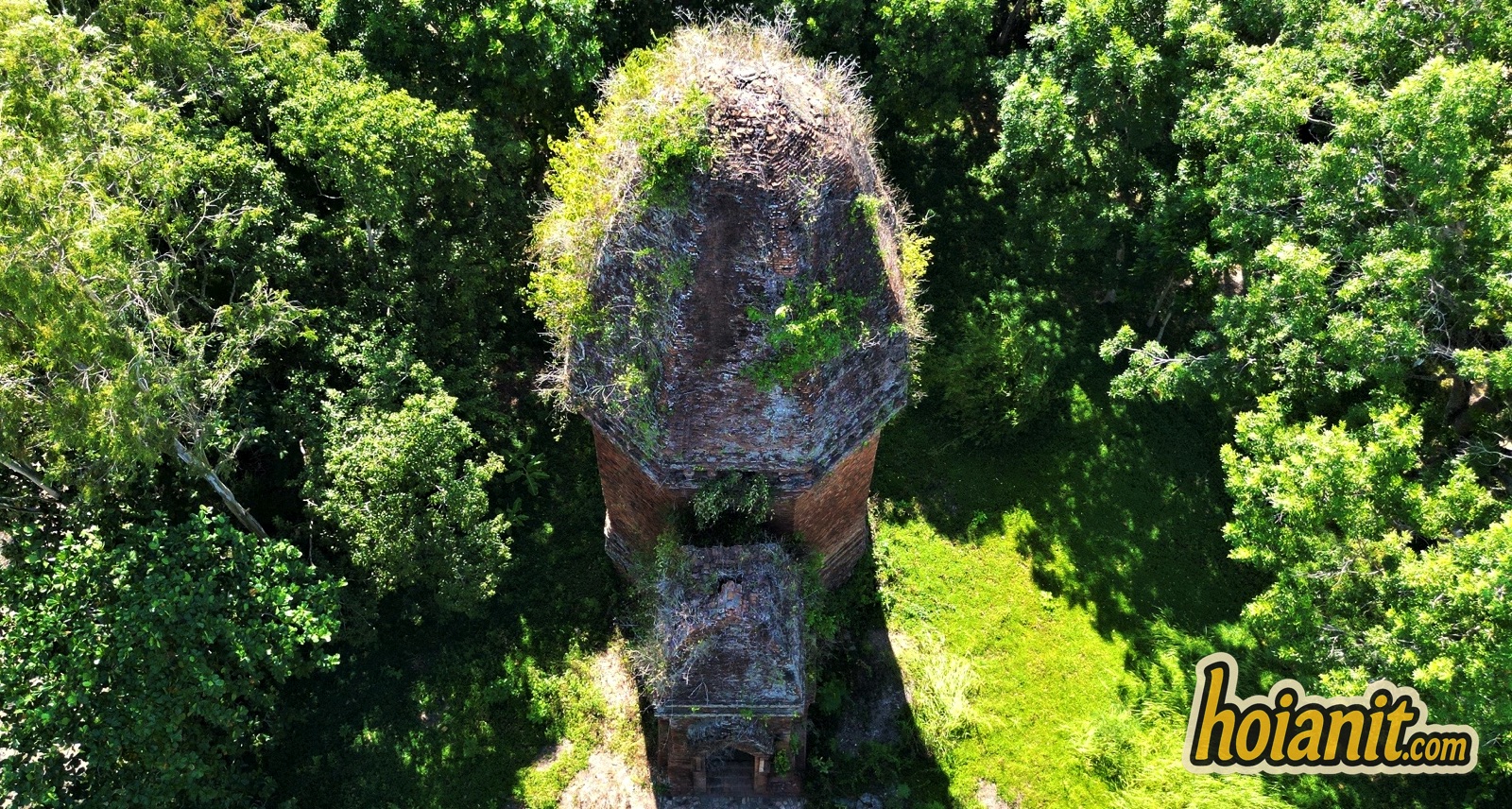
The roof has a small opening at its apex. On a clear day between roughly 11:30 and 12:30 a column of sunlight drops straight down onto the lingam pedestal, and for a few minutes the dark cella is lit from above. It is the single best photograph on this loop and the reason we schedule the tower for late morning. A phone is enough; the cella is a few metres across and there is no room to set up anything bigger.
Allow 30 to 45 minutes. There is an information board in Vietnamese and English on Cham religion, and a ground diagram showing the foundations of two smaller structures that once stood in front of the tower. The garden is shaded and quiet; on a weekday you are likely to share it with nobody but the gardener and, perhaps, a wedding-photo couple. The site collects a few dozen Google reviews a year, which is a remarkably small number for the only octagonal Cham tower in existence.
If the gajasimha at the door caught your eye, their bigger, fiercer cousin from Thap Mam is one of the twelve national treasures at the Cham Museum in Da Nang — the natural next ride for anyone the tower has hooked.
Lunch: Cau Mong roast veal, and the breakfast noodle it grew up next to
Ride back to Vinh Dien and turn south on the old QL1A, the original highway that runs beside the modern bypass. Two kilometres on, just before the old Cau Lau bridge over the Thu Bon, the road narrows into a line of open-fronted restaurants with whole roasted calves hanging in glass cabinets. This is Cau Mong, and be thui Cau Mong is the dish this stretch of road is famous for across all of central Vietnam; the Vietnam Records Organisation lists it among the country’s top 50 specialities.
The method has not changed in living memory. A male calf around a year old and under 30 kg is fed sugar-cane for a fortnight before slaughter to sweeten the meat, stuffed with guava leaves, lime leaves and a few medicinal herbs, then turned over a fire of rice straw and dried mulberry wood and finished over charcoal. Done right, each slice shows two layers: a pink, barely-cooked centre and a thin, golden, crackling skin. It is eaten as a wrap. You get a plate of thin-sliced veal, a stack of rice paper, a mountain of herbs — fish mint, lettuce, Vietnamese balm, mint — with cucumber, sour green banana and shredded papaya, and a bowl of mam nem, fermented anchovy sauce cut with pineapple, sugar and green chilli. Roll, dip, repeat.
| Restaurant | Where | Price | Notes |
|---|---|---|---|
| Be Thui Muoi | Old QL1A, Cau Mong, north end of the old bridge | 100.000₫–300.000₫ per plate · 10:00–22:00 | The best-known name; also sells vacuum-packed veal to take away |
| Quan Bay Lep | Old QL1A beside the bridge, the three-room family house | similar | Over 50 years in the same house; started as a shoulder-pole trade across the bridge |
Two practical notes. A plate for two with rice paper and herbs comes to about 200.000₫ (~$8), and the veal keeps only about six hours, so restaurants roast for the lunch rush; arrive between 11:00 and 13:00 for the best cut and skip it after 15:00. And when the old Cau Lau bridge was closed to cars for repairs in 2024–25, owners here told the press their trade fell by 80 percent, because the long-distance traffic moved to the new bridge. The bridge repair was scheduled to finish in late August 2025 and motorbikes were allowed across throughout; the strip is quieter than it was, which for a rider is no bad thing.
The same village, Dien Phuong, is also the birthplace of mi Quang, the province’s turmeric-yellow noodle. The Phu Chiem version is the original: a small ladle of broth made from ground shrimp shell, peanut and duck egg over thin rice noodles, with pork belly, whole prawns, toasted rice cracker and a handful of banana blossom. In August 2024 the knowledge of making Quang noodles was inscribed as national intangible cultural heritage. Most Phu Chiem households cook before dawn and sell out by mid-morning — many of the famous Da Nang stalls buy their broth here — so the way to eat it at source is to leave Hoi An around 06:30, ask for “mi Quang Phu Chiem” at any roadside table in Dien Phuong for 25.000₫–35.000₫ a bowl, and then carry on to the bronze village as the furnaces light.
Optional stop 4: Ma Chau, the silk village that wove for the palace
If you have the afternoon, cross the Thu Bon at Cau Lau — the old bridge is 841 metres long, built 1965–70 and rebuilt around eight scoured piers in 2024–25; if it is closed to bikes on the day, the new bridge is 500 m upstream — and you are in Nam Phuoc, the old district town of Duy Xuyen. A kilometre or so east of the highway is Ma Chau, one of the four “Tu Ma” silk villages that supplied the Nguyen court from the 15th and 16th centuries; the trade grew rich on the same Hoi An port that made the town you are staying in.
What survives is honest rather than pretty. When the village cooperative dissolved in 2017, only four or five families were still weaving. The cooperative’s former director, Tran Huu Phuong, an 18th-generation weaver with five decades at the loom, turned it into a family company that year, and his daughter Tran Thi Yen came back from university in Da Nang to run it. They took a large loan, replaced the cardboard punch-card looms with ten digital-head looms, and now weave around 3,000 metres of 100 percent mulberry silk a month for designers in Saigon and Hanoi — including a revival of the “lanh hoa” pattern used for imperial robes and lost for two centuries. The 2026 order book was full through August.
This is a working factory, not a show village, and there is no ticket or fixed tour yet: the family’s stated plan is to turn the workshop into a small museum and visitor centre as its next phase. In practice, if you turn up on a weekday morning and ask politely at the front, someone will usually walk you through the loom hall and sell you a scarf or a length of plain silk at factory prices, which are well below anything in the Old Town’s silk shops. The address to search is 211 Truong Chi Cuong, Nam Phuoc, and the listed phone is 097 900 3511; a call the day before is the polite move. If you would rather see silkworms and a demonstration loom without the drive, the tourist-facing Hoi An Silk Village on Nguyen Tat Thanh is ten minutes from the shop.
From Nam Phuoc you can also skip the return to Hoi An and ride straight west on DT610 to My Son, 30 km away, which turns this into the best possible full-day version of our My Son by motorbike route.
Riding notes: roads, bridges, parking and police
DT608 from Hoi An to Vinh Dien is the one road on this loop with real traffic: two lanes, trucks heading for the highway, and school-run scooters at 07:00 and 11:00. Ride on the right, expect overtaking on both sides, and do not attempt it at dusk without a good headlight. DT609 beyond Vinh Dien is quiet. The old QL1A south of Vinh Dien is a slow local road now that the bypass carries the through traffic, and pleasant to ride.
Crossing QL1A at Vinh Dien is the one moment that needs care. The new highway is a fast four-lane road with a central barrier; use the signalled junction in the centre of town, wait for the green, and do not follow locals who dart across gaps. If you are on a 50 cc or an electric scooter, this is well within range: the loop is about 34 km and there are petrol stations in Vinh Dien and on DT608 (our guide to the E10 RON 95 switch explains which pump to pick).
Parking is informal everywhere on this loop. At the tower, use the pull-off inside the lane and turn the wheel to lock; at Phuoc Kieu, park in front of whichever showroom you enter; at Cau Mong, restaurants have a boy who waves you into a space. Nobody charges. Use the disc lock we give you anyway and keep your helmet with you; it is the helmets that walk.
Police check the DT608 junction with QL1A and the Cau Lau bridgeheads from time to time, mostly for trucks and helmets. Wear the helmet strapped, carry your licence and the registration card we hand over with the bike, and if you are stopped, be pleasant and slow. Our full guide to what to do if the police stop you covers the rest.
Signage. Since 1 July 2025 the whole of Quang Nam has been merged into Da Nang City and the old districts abolished. Dien Ban town became five wards and a commune; Dien Phuong (Phuoc Kieu, Thanh Chiem, Cau Mong) is now part of Dien Ban ward, Dien An (the tower) is part of An Thang ward, and Nam Phuoc town is now Nam Phuoc commune. Google Maps has switched to the new names, so if a sign still says “Dien Phuong” or “thi xa Dien Ban”, that is the same place, one administration ago.
When to go and which bike to take
The loop works year-round because it is flat and paved, but the tower is best with a high sun, which means a dry-season morning between February and August. In the rainy months from October to December the Thu Bon plain floods: the Cau Lau bridge approaches and the low lanes around Ma Chau go under first, and DT608 itself can close in a bad year. Check our month-by-month weather guide and, in flood season, ask us on the morning before you ride; we will know which roads are open.
For the bike, anything in the fleet handles this loop. A 110–125 cc automatic scooter is the sensible choice for the DT608 traffic; a Honda Blade or Wave semi-automatic if you prefer gears; the 50 cc SYM Shark or a VinFast electric if you are riding without a motorcycle licence — the loop is comfortably inside one charge and there is nowhere on it that needs speed. We deliver (from 30,000₫) to any hotel in Hoi An (Da Nang delivery is available too), and every bike comes with two helmets, a phone holder, a rain poncho and a free paper map.
Ride the Dien Ban loop tomorrow morning
Scooter, semi-auto, 50 cc or electric — delivered to your hotel in Hoi An for free. No passport deposit, no hidden fees.
84 Phan Chau Trinh, Hoi An · Zalo 0935 439 306 · roadside line +84 766 766 087 (24/7)FAQ
How far is Bang An Tower from Hoi An by motorbike?
Bang An Tower is 11.9 km from Hoi An Old Town by the fastest road, via Hung Vuong, DT608 to Vinh Dien and DT609. Allow 25 to 30 minutes each way on a scooter. The full Dien Ban loop with the bronze village and Cau Mong lunch is about 34 km, or 43 km if you add Ma Chau silk village.
Is there an entrance fee for Bang An Tower?
No. Bang An Tower is free to enter and there is no ticket booth. Hours are informally 07:00 to 17:00 and the gate is often simply open. Parking in the lane is free; leave a small donation at the altar if you like.
Why is Bang An Tower special compared with My Son?
Bang An Tower is the only octagonal Cham tower still standing anywhere. Every other surviving Cham tower, including all of those at My Son, has a square body. It is also the only standing Cham tower in the Thu Bon delta, it is intact enough to walk inside, and a shaft of sunlight falls through the roof opening onto the lingam pedestal around midday.
Can I see bronze being cast at Phuoc Kieu?
Sometimes. Phuoc Kieu is a working village of family foundries along DT608 and pours are scheduled around orders, usually in the morning and not every day. Ride in between 08:30 and 09:30 on a weekday and look for smoke, or phone the Duong Ngoc Tien workshop the day before. On quiet days you will still see finishing, engraving and tuning, and the showrooms are open.
What is be thui Cau Mong and how much does it cost?
Be thui Cau Mong is whole calf roasted over rice straw and mulberry wood, sliced thin and eaten wrapped in rice paper with herbs, green banana, papaya and fermented anchovy sauce. A plate at Be Thui Muoi or Quan Bay Lep on the old QL1A at Cau Mong costs 100.000₫ to 300.000₫ depending on size; about 200.000₫ feeds two. Eat it between 11:00 and 13:00 while it is fresh.
Can I ride this loop on a 50 cc or electric scooter without a licence?
Yes. The loop is about 34 km on flat, paved roads with a top speed limit of 50 to 60 km/h, which is within the range of a VinFast electric scooter on one charge and easy for a 50 cc SYM Shark. The only section that needs care is crossing the QL1A highway at the signalled junction in Vinh Dien.
Can I combine Bang An Tower with My Son in one day?
Yes, and it is the best full-day version of this ride. Do the loop clockwise in the morning, eat at Cau Mong, cross the old Cau Lau bridge to Nam Phuoc, then ride west on DT610 for about 30 km to My Son for the quiet afternoon hours. You will be back in Hoi An around 17:00 having covered roughly 90 km.
Distances were measured on the road between the pins given in this guide, starting from 84 Phan Chau Trinh, Hoi An; riding times assume a scooter in normal traffic. Prices are from our visits and from published menus in 2025–26 and will drift. Administrative names follow the 1 July 2025 merger of Quang Nam into Da Nang City. Historical facts on Bang An Tower are from the Vietnamese Ministry of Culture’s relic file and Vietnam News; on Thanh Chiem from the 2017 national relic decision; on Phuoc Kieu and Ma Chau from Viet Nam News, Dan Tri and Tuoi Tre reporting between 2018 and May 2026. If you find a workshop closed or a price changed, tell us on WhatsApp and we will update this page.








Pick your ride in Hoi AnChọn xe cho chuyến đi Hội An
Scooters, electric bikes and bicycles from one shop in the Old Town — delivered to your hotel, helmets and roadside help included.Xe máy, xe điện và xe đạp — giao tận khách sạn, kèm hai nón bảo hiểm và hỗ trợ dọc đường.
Not sure which one fits? Message us on WhatsApp and we’ll recommend a bike for your plans.
Chưa biết chọn xe nào? Nhắn Zalo 0935 439 306, tụi mình tư vấn theo lịch trình của bạn.