
Routes & Day Trips
Dai Binh Village and Hon Kem Da Dung by Motorbike from Hoi An: The Upper Thu Bon Loop (2026)
Dai Binh Village and Hon Kem Da Dung by Motorbike from Hoi An: The Upper Thu Bon Loop (2026)
Dai Binh village is a Mekong-style fruit orchard 54 km upriver from Hoi An; Hon Kem Da Dung is the gorge above it, where the Thu Bon squeezes between 500-metre cliffs carved with 7th-century Cham script. Out on DT610, boat the gorge, home over Deo Le.
- Why ride up the Thu Bon
- The loop: DT610 out, Deo Le home
- Dai Binh village: the orchard that should not exist
- The fruit calendar, and the pomelo you cannot grow anywhere else
- Hon Kem Da Dung: the gorge and the 7th-century inscription
- Getting on the water: the two docks
- Eating and sleeping upriver
- Riding notes: roads, the pass, fuel, new names
- When to go and which bike
- FAQ
Why ride up the Thu Bon past My Son
Almost every rider who leaves Hoi An on DT610 stops at My Son and turns round. Keep going. Twenty kilometres beyond the sanctuary the road leaves the rice plain, the Truong Son mountains close in on both sides, and the Thu Bon — the same river that flows past the lanterns of the Old Town — narrows into a green valley of orchards, ferries and fishing boats. Two things are up here that nothing near the coast can match.
The first is Dai Binh village, a bend of the south bank where, three hundred-odd years after the first settlers arrived and forty-odd years after one of them came back from the Mekong Delta with a bag of seeds, three hundred families grow durian, mangosteen, jackfruit, langsat and a hairy cylindrical pomelo that fruits properly nowhere else on earth. The Vietnamese call it “the Mekong orchard of Quang Nam”, and in July and August you eat your way down its lanes. The second is Hon Kem Da Dung, ten kilometres upstream, where the river cuts a gorge between two rock walls that rise sheer to 500 metres, and where a Cham king had a dedication to Shiva carved into a riverside boulder in the seventh century. It is reached by boat, and it is the most dramatic piece of river scenery in the province.
Ride the two together, go home over the Deo Le pass, and you have a 117 km loop that touches every landscape Quang Nam has — coast, plain, river, orchard, gorge and mountain pass — in one long day or one easy two.
| You are… | Do this | Time |
|---|---|---|
| Here for the fruit | Hoi An → Dai Binh orchards → lunch in the village → home over Deo Le | 1 day, 117 km |
| Here for the gorge | Hoi An → Dai Binh dock → boat to Hon Kem Da Dung after 15:00 → sleep in Dai Binh → home | 2 days |
| Combining with My Son | My Son at 07:00 → Dai Binh for lunch and fruit → Deo Le chicken → home | 1 long day, ~125 km |
| Not a strong rider | Dai Binh only, out and back on DT610 (flat) — skip the pass | 1 day, 108 km |
The loop: DT610 out to Dai Binh village, Deo Le home
Everything below starts at our shop at 84 Phan Chau Trinh. The outward road is the My Son road, extended; the return crosses the Que Son hills on the pass we wrote about in our Deo Le guide. Ride it clockwise as below so that the pass, with its chicken restaurants, comes at the end of the day.
| Leg | Road | Distance | Riding time |
|---|---|---|---|
| Hoi An → Vinh Dien → Ai Nghia | DT608 → QL1A north → DT609 | ~22 km | 40 min |
| Ai Nghia → Giao Thuy bridge → Nong Son (Trung Phuoc) | DT609B / DT610 along the north bank | ~30 km | 50 min |
| Trung Phuoc → Dai Binh village | Nong Son bridge over the Thu Bon | ~2 km | 5 min |
| Hoi An → Dai Binh | 54 km | 1 h 35 | |
| Dai Binh → Hon Kem Da Dung (by road to the Que Phuoc bank) | DT611 → Que Lam | 15 km | 30 min |
| Dai Binh → Deo Le (Suoi Nuoc Mat) | DT611 east over the pass | 17 km | 30 min |
| Deo Le → Hoi An | DT611 → QL1A → DT608 | 46 km | 1 h 15 |
| Full loop, no boat | 117 km | 3 h 20 riding |
Two navigation notes. First, if Google offers you a route south on QL1A to Huong An and over the pass first, decline it; ride DT610 out instead — it is flatter, quieter and passes the My Son turn if you want to add it. Second, DT610 is signed for Nong Son and Trung Phuoc, not for Dai Binh; the village is across the Nong Son bridge from Trung Phuoc town, on the south bank. Search “Lang Dai Binh” in Google Maps and it lands correctly.
Dai Binh village: the orchard that should not exist
Central Vietnam does not grow durian. The soil is sand and laterite, the summers are furnace-hot and the autumns drown everything; the fruit of the region is jackfruit, banana and whatever the pomelo trees manage. Dai Binh is the exception, and the reason is geography: the village sits on a deep, silty bend of the Thu Bon with the mountains at its back, its air a few degrees cooler and wetter than the plain, its soil renewed by the river every year. Settlers found it around three centuries ago. In the 1980s a villager named Huynh Chau, back from the Mekong Delta, planted southern seedlings in his garden and they thrived; his neighbours followed, and within a generation the village had the only durian, mangosteen and rambutan orchards in central Vietnam worth the name; Dan Tri’s August 2026 feature has the photographs.
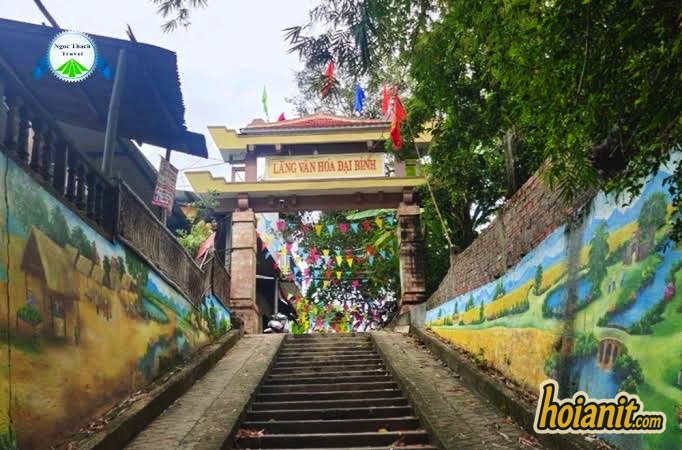
Today more than 300 households tend around 14 hectares of orchard, and 150 of them have gardens over 1,000 square metres — which is to say the whole village is one orchard with lanes through it. It has other superlatives the locals will tell you about: over 200 residents past 70 and 15 past 90, which they attribute to the fruit and the river air; a traditional tuong opera troupe that still performs; and a row of wooden garden-houses several decades old that look older. There is no gate and no ticket. You ride in over the bridge, park under a jackfruit tree and walk.
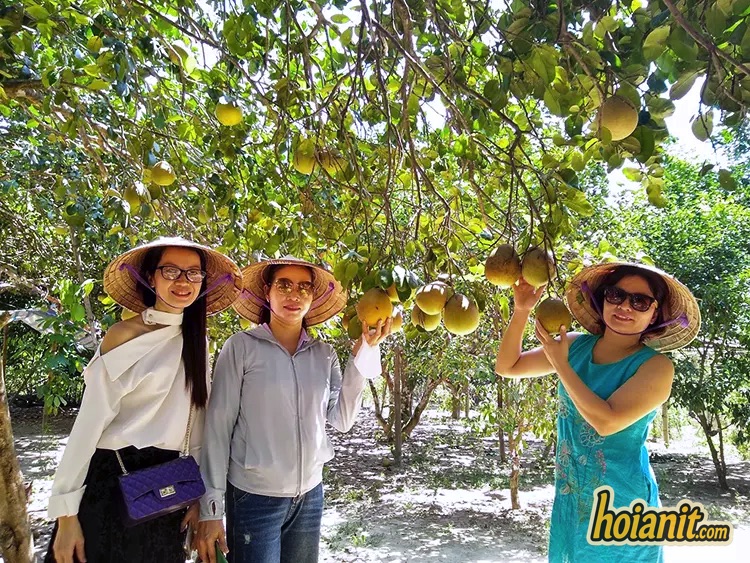
Pick any garden with an open gate and someone in it. Ask, in whatever language you have, whether you may look; you may. The owner will walk you round, pull a fruit off a tree and cut it for you, and when you leave you pay for what you ate and for whatever you carry away at the price they name, which is farm price and roughly a third of the Hoi An market. A number of families now do this as a business, with tables under the trees, cold water and, in season, a set lunch. Nobody charges for walking in and looking.
The fruit calendar, and the pomelo you cannot grow anywhere else
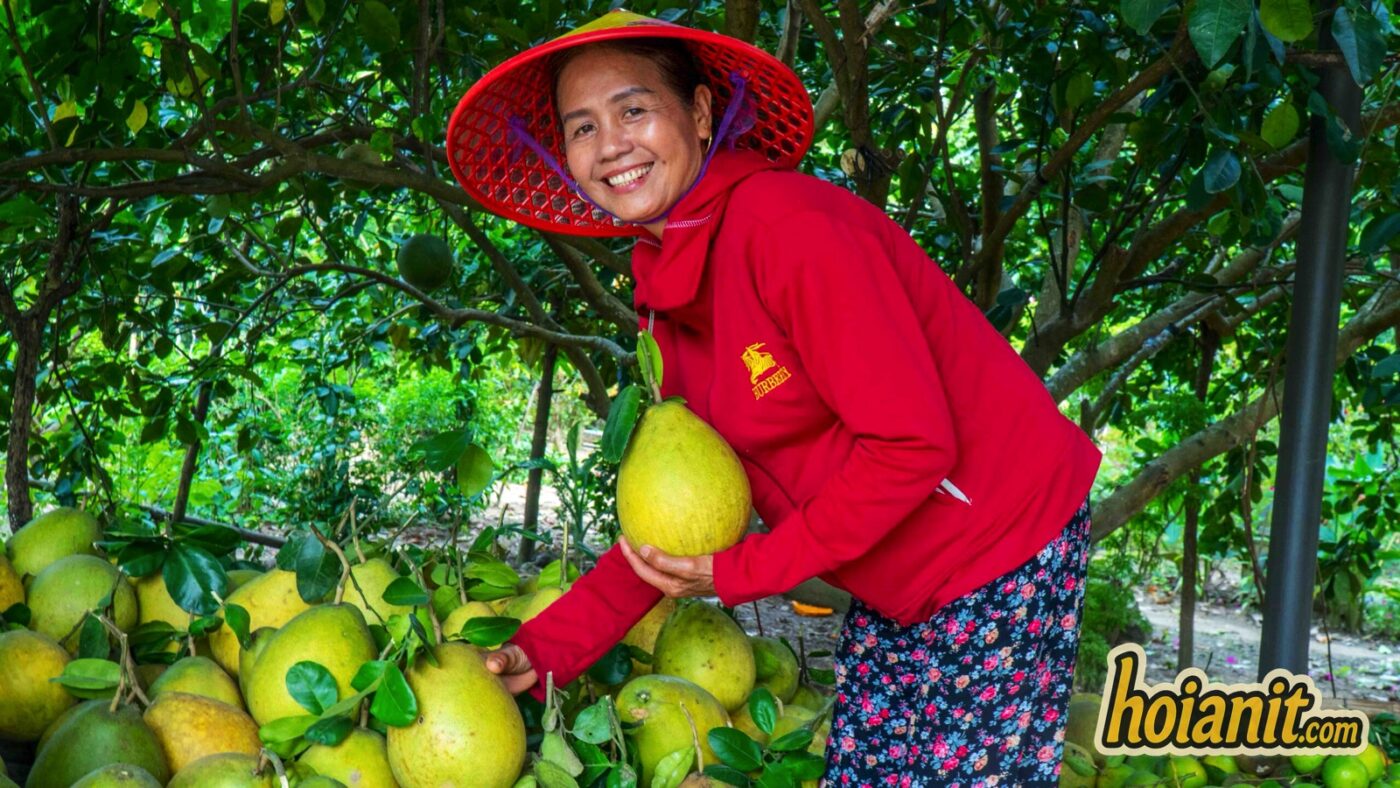
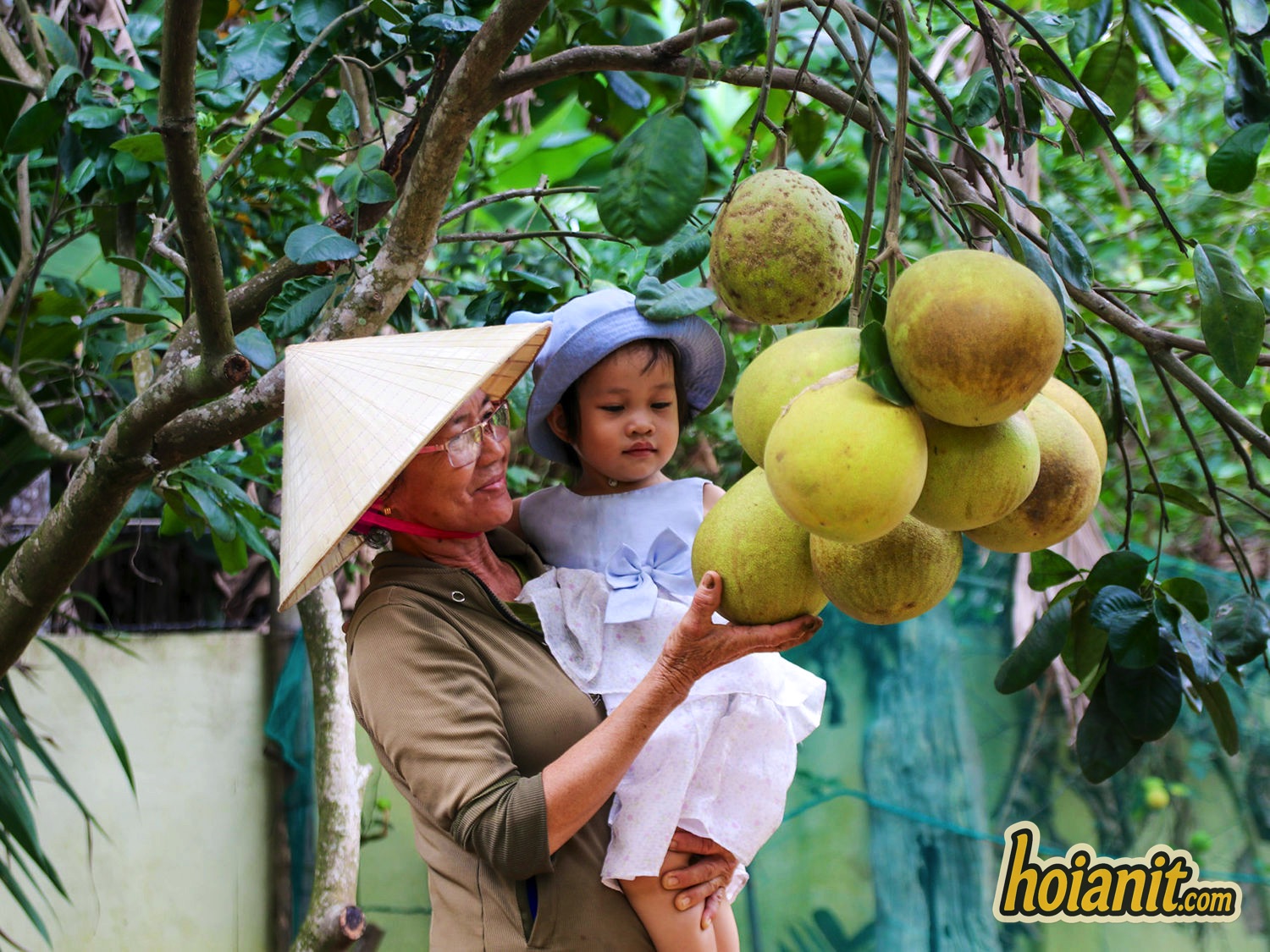
The village’s signature fruit is buoi tru, or tru long: a pomelo shaped like a cylinder rather than a globe, covered in fine soft hair when ripe, with pale pink flesh in straight segments, a faint perfume and a sweetness with no bitterness behind it. It ripens in July and sells in the gardens for 20.000₫ to 50.000₫ a fruit, each weighing a kilo or so. What makes it a curiosity is that it is site-specific: plant a seed from a Dai Binh tru long ten kilometres away and the tree that grows gives ordinary, sourer pomelos. Whatever the river and the soil do here, they do only here.
| Month | In the gardens |
|---|---|
| March | Watermelon on the river flats; orchards in flower |
| May–June | Durian, the first mangosteen, jackfruit; rambutan starts |
| July | Tru long pomelo, mangosteen, rambutan at their peak |
| August | Langsat (bon bon), late pomelo, sapodilla; the village fruit festival |
| September | Last of the langsat and pomelo |
| December–January | Mandarins and sweet oranges for Tet |
| October–November | Flood season — nothing to pick, and often no way in |
Two honest notes. The village holds a fruit festival most years in August, with market stalls, music and boat races on the river; it is fun and it is crowded, so if you want the orchards to yourself, go on a weekday in July. And the floods of late October 2025 hit Dai Binh hard: the water stood in the gardens for days, killed around 500 pomelo trees and 1,000 dragon-fruit plants, and washed out the mandarin crop. The village replanted through the winter, and by the 2026 season most gardens were fruiting again, but you will see gaps in the rows and some thinner trees. Buying fruit here this year is a small act of rebuilding.
Hon Kem Da Dung: the gorge, and the king who signed it
Ten kilometres above Dai Binh the valley closes. Two mountains, Hon Kem on one bank and Da Dung on the other, drop straight into the Thu Bon and the river, a hundred metres wide below, squeezes through a gap of dark rock with cliffs rising 500 metres above the water. There is no road along it; there was never a road along it, which is why every Quang Nam child knows the folk verse about it — Ngo len Hon Kem Da Dung / Thuong cha nho me qua chung bau oi, “look up at Hon Kem Da Dung and miss your father and mother beyond bearing” — sung by women who married downstream and could only look back at the mountains that hid their homes. In the dry months the water is green and glass-flat, the cliffs double in reflection, and at the top of the gorge the little hamlets of Ti and Se sit on the banks with their fishing boats and buffalo.
What makes the gorge more than scenery is on a boulder at the water’s edge on the Que Lam side: a line of Cham script two metres long and fifteen centimetres high, known as the Thach Bich inscription. It records a dedication to Shiva by Prakasadharma, the Champa king who reigned in the second half of the seventh century and whose other inscriptions are at My Son. That puts a royal act of worship a hundred kilometres upriver from the coast, thirteen centuries ago, in a place that has no temple and never did — evidence that the Cham used the Thu Bon as a highway into the mountains for gold, forest products and the trade with the highland peoples. The boatmen know where it is and will hold the boat against the rock so you can read it. In July 2024 a second inscription, six lines long and dated to the ninth to eleventh centuries, was found on a boulder at Ho Nhi in the neighbouring valley; the district is only starting to understand what else is up here (Bao Da Nang reported the find).
A Cham king carved his name on this river bank when Hoi An was a fishing beach. The gorge has not changed; the way to reach it has not changed either.
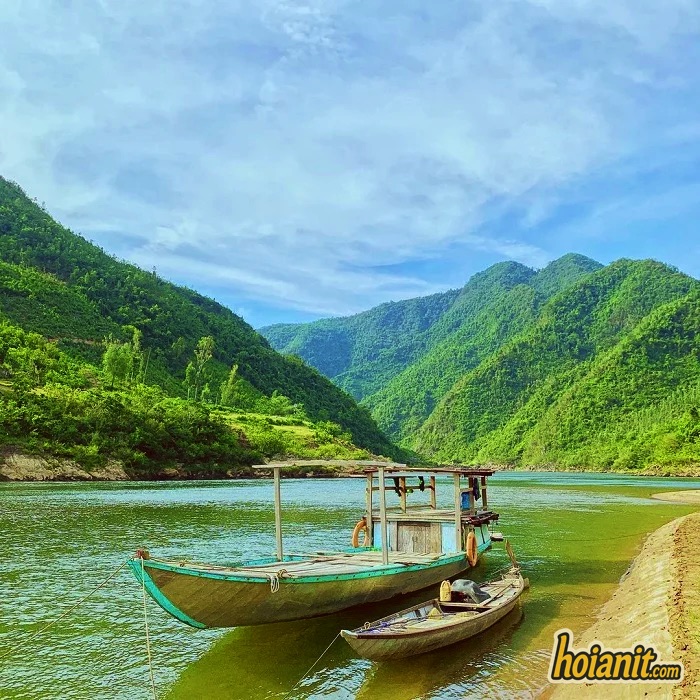
Getting on the water: the two docks
Hon Kem Da Dung is seen from a boat, and there are two ways to get one. From Dai Binh and Trung Phuoc, wooden passenger boats run upstream from the landing by the bridge, roughly 45 minutes each way to the gorge with a stop to see the inscription; you charter the boat, and the homestays and orchard families in Dai Binh will arrange one — expect to pay for the boat, not per head. Alternatively, ride on 15 km up DT611 to the Que Lam bank (now Que Phuoc commune), where a dock at the foot of the gorge sends larger boats — 15 to 20 seats — up the narrows for about 30 minutes; the commune quotes around 2.000.000₫ for a boat return, which is cheap for a group and expensive for a couple, so join others if you can. On either side you leave the bike in a yard by the dock for a few thousand dong.
The light is the thing. Go after 15:00, when the sun drops behind Hon Kem and the cliffs and the water turn gold; the morning boat is fine but flat. That timing is the argument for sleeping in Dai Binh: ride up in the morning, eat fruit at lunch, boat the gorge at 16:00, sleep in the village, and ride home over Deo Le the next day.
The Thu Bon here is a mountain river. From mid-October to January it runs brown and fast, the boats stop, and the DT610 road along the north bank floods at the low points — the same floods that hit the orchards. From March to September it is calm and clear. Do not come for the boat outside those months, and even in season ask the day before if there has been rain in the mountains.
Eating and sleeping upriver
The Nong Son valley has its own table. Ga co nau xoi — free-range village chicken boiled and served over sticky rice cooked in the broth — is the dish every homestay puts in front of you, followed by Nong Son beef, grilled river catfish and prawns from the Thu Bon, and a plate of whatever is ripe. A meal like that in a Dai Binh garden runs about 200.000₫ a head, and the family will want a few hours’ notice; there is no restaurant as such, but every garden that takes visitors will feed you. On the way home, the Deo Le pass is famous for its bantam ga tre, grilled or boiled whole for 140.000₫–160.000₫ a bird at the roadside places by the Suoi Nuoc Mat stream — our Deo Le guide has the details.
Sleeping: Dai Binh has a handful of garden homestays, simple rooms in a family compound, at roughly 200.000₫–400.000₫ a night with dinner extra; ask when you arrange the boat. Trung Phuoc across the river has a couple of guesthouses. And a few kilometres from Trung Phuoc at Tay Vien is a modest natural hot spring where local families soak in the evening — worth an hour after the boat if you are staying over.
Riding notes: roads, the pass, fuel and the new names
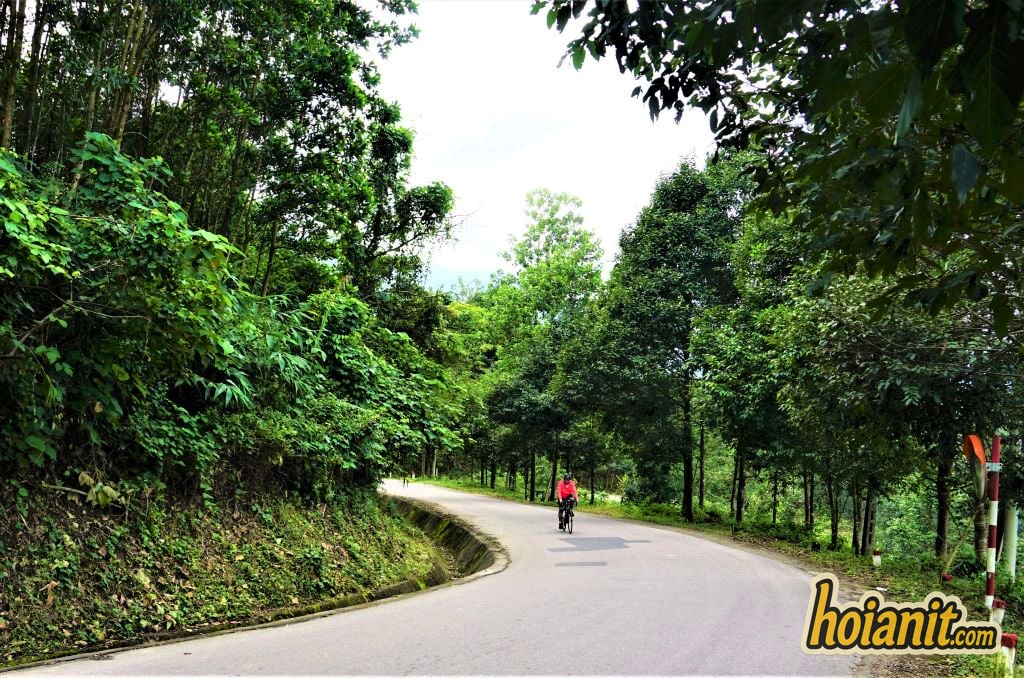
DT610 from Ai Nghia to Nong Son is a good two-lane road along the north bank of the Thu Bon, quiet after the My Son turn, with a few sandy patches where trucks feed the river sand quarries and one long, slow climb before Trung Phuoc. The Nong Son bridge is wide and paved. DT611 over Deo Le is a real mountain pass, short but steep with tight bends; take it in daylight and in second gear on a semi-automatic, and remember there is a coal mine and its trucks on the Nong Son side. The Que Lam road to the upper dock is narrow and patched; fine in the dry.
Fuel. Fill up in Hoi An or Vinh Dien; there are stations at Ai Nghia, at Trung Phuoc and at Dong Phu on the far side of the pass, and nothing between. A 125 cc automatic does the loop on one tank with a margin. Money. The valley is cash only — orchards, boats, homestays, chicken. There are ATMs in Ai Nghia and Trung Phuoc.
Names. Since 1 July 2025 the district of Nong Son has gone — it was merged into Que Son on 1 January 2025 and then the districts themselves were abolished — and the area is now part of Da Nang City. Dai Binh and Trung Phuoc sit in the new Nong Son commune; the far bank of the gorge, the old Que Lam, is now Que Phuoc commune. Signs, Google and older guides still say “Que Trung” and “Nong Son district”; it is the same village and the same bridge.
When to go, and which bike
June to September for the fruit and the boat, with July the best single month: tru long, mangosteen and rambutan all at once, the river at its clearest, the festival still a month away. March to May is pretty, green and quieter, with watermelons on the flats and the orchards in flower but little to eat. October to January is out — floods, closed boats, and a road that can be under water at Giao Thuy.
For the bike, the loop is 117 km with a mountain pass at the end, so take a 125 cc automatic or a Honda semi-automatic rather than a 50 cc, and leave the electric scooters for the coast. If you would rather skip the pass, DT610 out and back is flat and fine on anything. We deliver (from 30,000₫) to any hotel in Hoi An with two helmets, a phone holder and a rain poncho, and the bike comes with a rack for a box of pomelos if you ask.
Ride the upper Thu Bon this week
125 cc automatics and Honda semi-autos, delivered (from 30,000₫) to your hotel in Hoi An. No passport deposit, roadside help 24/7 on DT610 and the pass.
84 Phan Chau Trinh, Hoi An · Zalo 0935 439 306 · roadside line +84 766 766 087 (24/7)For the other great inland village of the old province, ride south to Loc Yen in Tien Phuoc: 150-year-old timber houses and dry-stone lanes, 64 km from Hoi An and free to walk.
FAQ
How far is Dai Binh village from Hoi An by motorbike?
Dai Binh village is about 54 km from Hoi An Old Town by DT608, DT609 and DT610 through Vinh Dien, Ai Nghia and the Giao Thuy bridge to Trung Phuoc, then over the Nong Son bridge; allow 1 hour 35 minutes on a scooter. Returning over the Deo Le pass on DT611 makes a 117 km loop.
Is there an entrance fee for Dai Binh village?
No. Dai Binh village has no gate and no ticket. You walk into any orchard with an open gate, the owner shows you round, and you pay only for the fruit you eat or take away, at farm prices — for example 20.000₫ to 50.000₫ for a tru long pomelo in July.
When is the best time to visit Dai Binh village?
July, when the tru long pomelo, mangosteen and rambutan ripen together and the Thu Bon is clear for the boat to Hon Kem Da Dung. June has durian, August has langsat and the village fruit festival, September the last of the harvest. Avoid October to January, when the valley floods.
What is Hon Kem Da Dung?
Hon Kem Da Dung is a gorge on the upper Thu Bon river about 10 km above Dai Binh village, where the river narrows between two mountains with cliffs up to 500 m high. A boulder on the bank carries the Thach Bich inscription, a 7th-century dedication to Shiva by the Champa king Prakasadharma. It is reached only by boat.
How much is the boat to Hon Kem Da Dung?
Boats are chartered, not sold per seat. From the Que Phuoc dock at the foot of the gorge the commune quotes around 2.000.000₫ return for a 15–20 seat boat, about 30 minutes each way; from Dai Binh and Trung Phuoc smaller wooden boats take about 45 minutes each way and are arranged through the homestays. Go after 15:00 for the light, and only from March to September.
Can I combine Dai Binh village with My Son in one day?
Yes. My Son is on the same DT610 road, about 30 km before Dai Binh. Be at the sanctuary for opening at 06:30, ride on to Dai Binh for a late lunch in the orchards, and return over the Deo Le pass with a stop for bantam chicken; the day is around 125 km and needs a 125 cc bike.
Is the ride to Dai Binh village suitable for a beginner?
The outward road, DT610, is flat and quiet and fine for a confident beginner on an automatic scooter. The Deo Le pass on the return is steep with tight bends; if that worries you, ride DT610 back the way you came instead. Either way, ride it in daylight and outside the October–January flood season.
Distances were measured on the road from 84 Phan Chau Trinh, Hoi An, to the Nong Son bridge, the Que Lam dock and the Suoi Nuoc Mat stream at Deo Le; riding times assume a scooter in normal traffic. Village figures follow Dan Tri, Dan Viet and Bao Da Nang reporting from 2019 to August 2026, including the flood recovery of late 2025; the Thach Bich and Ho Nhi inscriptions follow Bao Da Nang and Quang Nam museum reporting of 2024. Boat and meal prices are the commune’s own quotes and what riders have paid, and will move with the season. Anh Khoa does not sell boat tickets or tours upriver; arrange them in the village.








Pick your ride in Hoi AnChọn xe cho chuyến đi Hội An
Scooters, electric bikes and bicycles from one shop in the Old Town — delivered to your hotel, helmets and roadside help included.Xe máy, xe điện và xe đạp — giao tận khách sạn, kèm hai nón bảo hiểm và hỗ trợ dọc đường.
Not sure which one fits? Message us on WhatsApp and we’ll recommend a bike for your plans.
Chưa biết chọn xe nào? Nhắn Zalo 0935 439 306, tụi mình tư vấn theo lịch trình của bạn.