
Routes & Day Trips
Loc Yen Ancient Village by Motorbike from Hoi An: Stone Lanes, Jackfruit-Wood Houses and the Tien Phuoc Hills (2026)
Loc Yen Ancient Village by Motorbike from Hoi An: Stone Lanes, Jackfruit-Wood Houses and the Tien Phuoc Hills (2026)
Loc Yen is a hill village 64 km south-west of Hoi An where eight jackfruit-wood houses, some over 150 years old, stand over moss-covered dry-stone lanes. A national relic since 2019, it is free, quiet and reached on empty roads.
- Why ride to Loc Yen
- The route: two ways into the Tien Phuoc hills
- What Loc Yen is: the houses
- The stone lanes, the gardens and the fruit
- How to visit without being a nuisance
- Lo Thung and the Huynh Thuc Khang house
- Further into Tien Phuoc: caves, a backward river, a waterfall
- Eating and sleeping
- When to go, which bike, and the new names
- FAQ
Why ride to Loc Yen
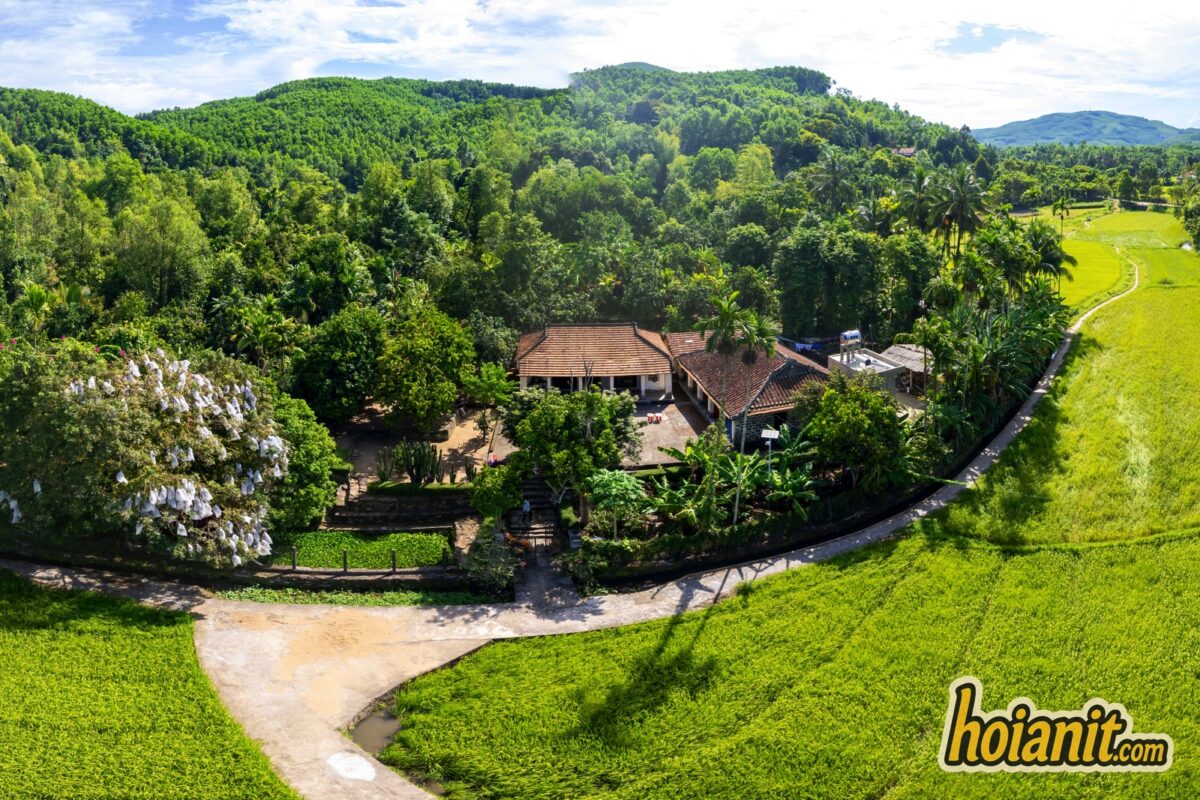
Most of what is old around Hoi An is old in a coastal, mercantile way: shophouses, assembly halls, a Japanese bridge. Loc Yen is old in the other Quang Nam way, the one the tour buses never reach. It is a farming village in the low hills of Tien Phuoc, two hours inland, where a handful of families have lived in the same timber houses for five, six and seven generations, and where the lanes between the houses are walled and paved with river stones laid without mortar, green with moss for eight months of the year.
In 2019 the Ministry of Culture listed it as a national relic, and Vietnamese writers — and the national tourism board — routinely put it in the country’s four most beautiful ancient villages alongside Duong Lam near Hanoi, Phuoc Tich near Hue and Dong Hoa Hiep in the Mekong Delta. Unlike the other three it has no ticket booth, no souvenir stalls and, on a weekday, quite possibly no other visitors. You park under a jackfruit tree, walk up a stone lane, and if a door is open somebody’s grandmother will show you the ancestral altar and offer you tea.
The ride is half the point. Once you leave QL1 the roads through Thang Binh and into Tien Phuoc are small, well surfaced and nearly empty, running between pepper gardens and rice terraces with the Truong Son foothills stacked up behind. It is one of the most pleasant 60 km we know of from Hoi An, and it ends somewhere that feels a century away from the lantern shops.
| You are… | Do this | Time |
|---|---|---|
| Here for the village | Hoi An → Loc Yen for 09:00 → Lo Thung → lunch in Tien Ky → home | 1 day, ~130 km |
| Here for the whole district | Loc Yen → Huynh Thuc Khang house → Tien An caves → sleep Tien Ky → O O waterfall → home | 2 days |
| Combining with the coast | Tam Thanh murals at dawn → Tam Ky → DT616 to Loc Yen → home via Ha Lam | 1 long day, ~150 km |
| Not a strong rider | Out and back via Tam Ky on QL1 and DT616 — busier but simpler | 1 day, ~150 km |
The route: two ways into the Tien Phuoc hills
Everything below starts at our shop at 84 Phan Chau Trinh. There are two sensible ways in, and the best day uses one out and the other home.
The inland way (64 km). Leave Hoi An on QL14H through Vinh Dien and join QL1 southbound. Ride QL1 for about 13 km to Ha Lam, the Thang Binh town centre, and turn right onto QL14E. After 3 km bear left onto DT612, which runs south-west for 17 km through the rice country of Binh Quy and Binh Phu, then becomes DT614 and climbs gently for 11 km into Tien Phuoc, arriving on Phan Chau Trinh street in Tien Ky, the district town. Loc Yen is 5 km west of Tien Ky, signed from the QL40B roundabout.
Riding time is about two hours; the OSRM router gives 63.5 km and just over an hour, which is a car’s time, not a scooter’s.
The Tam Ky way (75 km). Stay on QL1 all the way to Tam Ky, then take DT616 west for 27 km through Tam Dan and Tien Tho to Tien Ky. It is 11 km longer and QL1 is busy with trucks, but the turns are simpler and Tam Ky has fuel, banks and lunch. We ride the inland way out, when we are fresh, and the Tam Ky way home if we want the wide road in the late afternoon.
| Leg | Road | Distance | Riding time |
|---|---|---|---|
| Hoi An → Vinh Dien → QL1 | QL14H | ~11 km | 25 min |
| QL1 → Ha Lam (Thang Binh) | QL1 south | ~13 km | 20 min |
| Ha Lam → Tien Ky | QL14E → DT612 → DT614 | ~35 km | 1 h |
| Tien Ky → Loc Yen | QL40B, then the village road | ~5 km | 10 min |
| Hoi An → Loc Yen | 64 km | ~2 h | |
| Alternative: Hoi An → Tam Ky → Tien Ky | QL1 → DT616 | 75 km | 2 h 15 |
What Loc Yen is: the houses
The village covers about 280 hectares of a shallow valley in what was Tien Canh commune, with rice on the flat, fruit gardens on the slopes and the houses set in a line along the hillside, each with its back to the mountain and its front to the fields. People have farmed here since at least the Le dynasty, and the settlement is usually dated to the fifteenth or sixteenth century, but what draws visitors is later: the nha ruong, the timber-framed houses built by prosperous families in the nineteenth century, of which eight survive at over a hundred years old and several past a hundred and fifty.
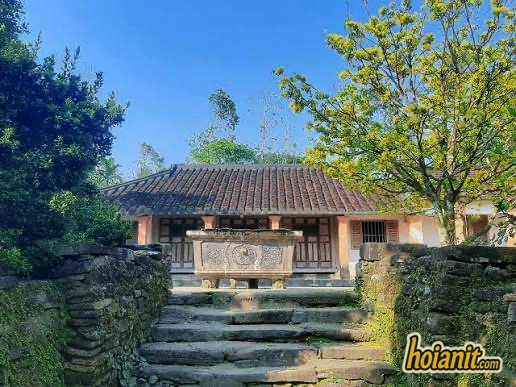
They are built almost entirely of jackfruit wood, the dark, close-grained timber that Quang Nam carpenters used for anything meant to last, on the classic ba gian hai chai plan — three central bays with an altar in the middle and two side wings — under a low tiled roof that sweeps almost to the ground. The largest is a five-bay house standing on 36 columns.
Inside, the beams, panels and cabinets are carved with dragons, phoenixes, chrysanthemums and grapevines in the manner of Quang Nam’s carpenters’ villages — Van Ha near Tam Ky and Kim Bong across the river from Hoi An — whose masters were hired for houses like these across the province. Look at the joinery: no nails, every joint pegged, the columns standing on stone footings so they never touch damp earth.
The best-known house belongs to the Nguyen Dinh family and is about two hundred years old. Its story is told in every Vietnamese article about the village: the president of South Vietnam, Ngo Dinh Diem, twice sent officials to buy it and was twice refused. The family still lives in it. Another, owned by Mr Dong Viet Mao, who is in his eighties, is two of the oldest houses in the village standing side by side in their original condition, with the lacquered ancestral altar, the carved cabinets and the wooden shutters exactly where the builders put them.
In Hoi An the old houses are shops that used to be homes. In Loc Yen they are homes, and the family that shows you round is the family that built them.
The stone lanes, the gardens and the fruit
What photographs, and what makes Loc Yen different from every other collection of old houses in the country, is the stone. The lanes between the houses — the ngo da — are a metre or so wide and walled on both sides to head height with river stones stacked dry, no mortar, the way the terraces and garden walls are built throughout the Tien Phuoc hills. Some run for a hundred metres between hedges of tea and ornamental shrubs; the whole network in the village is a couple of kilometres.
In the wet half of the year the stones are furred with moss and the lanes turn the deep green that ends up on every postcard. Walk them slowly, early, when the light comes through the jackfruit canopy in shafts.
Behind the walls are the gardens, and the gardens are the village’s living. Tien Phuoc is pepper country — the district’s peppercorns are famous across the province — and every house has vines climbing the trees. In among them are langsat (lon bon, the small sweet fruit in bunches that Quang Nam people prize above almost any other), mangosteen, durian, thanh tra pomelo, areca palms and the tea hedges themselves. From August into September the langsat ripens and the village sells it by the kilo at the gate; if you are here then, buy a bag and eat it on the stone wall. In early spring the gardens are in flower and the village holds its festival.
How to visit Loc Yen without being a nuisance
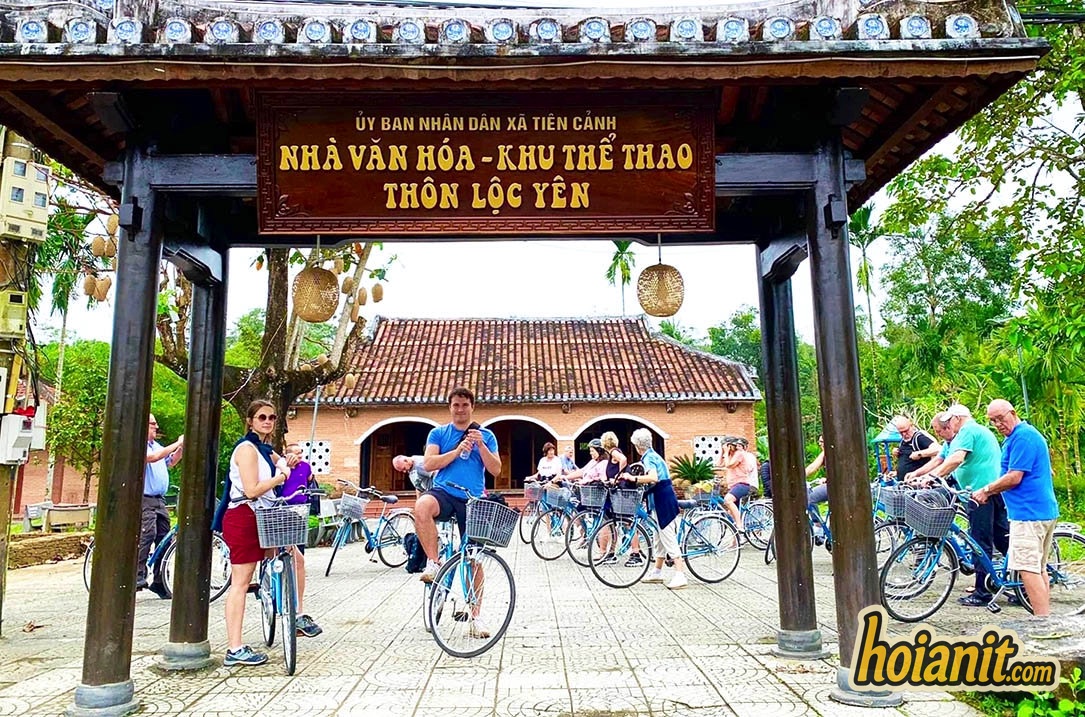
There is no ticket, no gate and no guide office. You arrive, park where the road ends by the cultural house, and walk. The village is used to visitors — Vietnamese day-trippers and the occasional foreigner — and the etiquette is simple. Walk the lanes freely; they are public. Enter a house only if the door is open and someone waves you in, which they often will.
Remove your shoes, do not photograph the ancestral altar without asking, and when you leave, leave 10.000₫ to 20.000₫ on the table or in the family’s hand as a thank-you; nobody will ask for it and everybody will appreciate it. If a household is selling fruit, pepper or tea, buying some is the best possible way to say thank you.
Two practical things. Give it time: the lanes reward an hour and a half of wandering, not twenty minutes, and the light in the lanes is best before eleven and after two. And ask for it by name: “Loc Yen” in Tien Ky will get you pointed the right way; “the ancient village” may not.
Lo Thung and the Huynh Thuc Khang house
Two more stops sit within minutes of the village and belong in the same morning.
Lo Thung is the stretch of the Da Giang stream immediately beside the village where the water has cut through beds of ancient sedimentary rock, leaving a chaos of tilted grey slabs, potholes, a channel where the stream disappears under the rock and bursts out again, and small waterfalls between them. The province listed it as a scenic relic in August 2021. There is a suspension footbridge across the stream, the rocks are flat enough to sit on with a picnic, and in the dry months families swim in the pools. It is free, open all day, and five minutes from the last house in the village.
The Huynh Thuc Khang memorial house stands on QL40B in the same commune, a few kilometres back towards Tien Ky. Huynh Thuc Khang was a scholar from these hills who became one of the great figures of the early independence movement — a leader of the 1908 tax protests, a prisoner on Con Dao, a newspaper editor, and for five months in 1946, from 31 May to 20 October, acting president of the Democratic Republic of Vietnam while Ho Chi Minh was negotiating in France.
The house his family built in 1869 is a Nguyen-dynasty timber house of the same kind you have just seen, with a jackfruit-wood frame carved by Kim Bong craftsmen, and it holds his books, portraits and papers. It is open 07:30–17:00, closed on Sundays, and free. Even if the history is new to you, it is worth twenty minutes to see a house of this type kept as a museum, with the carving lit and labelled.
Further into Tien Phuoc: caves, a backward river, a waterfall
If you have made it this far, or better, if you are sleeping in Tien Ky, the district has three more things worth the extra kilometres. The Tien An bat caves, in the next commune to the south, are a jumble of sandstone blocks the size of houses that have fallen against each other to form two chambers, a lower “fairy cave” and an upper “heaven cave” reached over ten-metre drops. Go with someone who knows it; it is not a place to scramble alone.
The Tien river is famous in Quang Nam for flowing the wrong way: every other river in the province runs east to the sea, but the Tien runs 43 km west into the mountains before it finds a way down; the river and the district share the name, which means “fairy”. You cross it on the way in; there are quiet swimming spots along it below Tien Ky.
O O waterfall in Tien Chau, on the eastern side of the district, drops in five broad tiers of white water over seven kilometres of stream, with pools deep enough to swim in summer. It gets crowded with local families after lunch on hot weekends; go in the morning.
None of these has a ticket, and none has much in the way of facilities. Take water, take a dry bag, and treat the roads beyond Tien Ky as mountain roads: narrow, sometimes gravel at the edges, with buffalo and children on them.
Eating and sleeping
Loc Yen itself has no restaurant and no homestay. Some families will feed you a garden lunch if arranged in advance through a local guide, but do not turn up hungry expecting a menu. Instead eat in Tien Ky, five kilometres away, where the market street has mi Quang and com ga for 30.000₫ to 50.000₫, iced coffee, and shops selling the district’s pepper, langsat and thanh tra by the kilo. Buy the pepper: it is the one Tien Phuoc product you can carry home in a pocket.
To stay, Tien Ky has a handful of guesthouses and small homestays at roughly 200.000₫ to 400.000₫ a night, of the plain, clean, family-run kind; prices and availability move, so book by phone or through the usual apps a day ahead rather than on arrival. Sleeping in the town lets you walk the stone lanes at seven the next morning, when the moss is wet and the village is entirely yours, which is the best hour of the whole trip.
When to go, which bike, and the new names
January to April for the green: the moss is thick, the gardens are in flower and the weather is mild. August to September for the langsat. May to July is hot but dry and fine if you ride early. Avoid October to December, when Tien Phuoc gets some of the heaviest rain in the province, the stone lanes are slick, the stream at Lo Thung is a torrent and DT612 through the rice country can be under water.
For the bike, this is 130 km of mostly small roads with a climb into the hills at the end and no fuel for a long stretch, so take a 125 cc automatic or a Honda semi-automatic with a full tank, not a 50 cc and not an electric scooter. The roads are good tarmac throughout as far as the village; only if you go on to the caves and the waterfall do you meet gravel.
If you like this kind of inland day, the orchards of Dai Binh village on the upper Thu Bon and the dawn fish market at Tam Tien are the other two we rate. We deliver (from 30,000₫) to any hotel in Hoi An with two helmets, a phone holder and a rain poncho, and the roadside line below works in Tien Phuoc.
The names have changed. On 1 July 2025 Quang Nam province was merged into Da Nang City and its districts were abolished, so Tien Phuoc district no longer exists as an administrative unit and Tien Canh commune, where the village lies, has been merged with three neighbours into the new Thanh Binh commune. In June 2026 the local authorities proposed renaming the merged hamlet around the old houses simply Loc Yen hamlet, so the name on the signs will be the name you are looking for. Google, road signs and most guides still say “Tien Canh, Tien Phuoc”; it is the same village and the same lanes.
Ride to the stone-walled village this week
125 cc automatics and Honda semi-autos, delivered (from 30,000₫) to your hotel in Hoi An. No passport deposit, roadside help 24/7 anywhere in the old Quang Nam.
84 Phan Chau Trinh, Hoi An · Zalo 0935 439 306 · roadside line +84 766 766 087 (24/7)FAQ
How far is Loc Yen from Hoi An by motorbike?
Loc Yen is about 64 km from Hoi An Old Town by the inland route: QL14H to QL1, south to Ha Lam, then QL14E, DT612 and DT614 into Tien Ky and 5 km west to the village. Allow about two hours on a scooter. The alternative via Tam Ky and DT616 is about 75 km and simpler to navigate.
Is there an entrance fee for Loc Yen ancient village?
No. Loc Yen has no gate, no ticket and no guide office. The stone lanes are public. If a family invites you into one of the old houses, leaving 10.000₫ to 20.000₫ as a thank-you is the custom, and buying their pepper, tea or fruit is welcome.
What is special about Loc Yen?
Loc Yen has eight timber houses of jackfruit wood between 100 and 200 years old, built in the three-bay two-wing style and carved by Quang Nam master carpenters, linked by about two kilometres of moss-covered lanes walled in dry-laid river stone. It was listed as a national relic in 2019 and is counted among the four most beautiful ancient villages in Vietnam.
When is the best time to visit Loc Yen?
January to April, when the moss on the stone lanes is thickest and the gardens are in flower, or August to September for the langsat harvest. Visit between 07:00 and 11:00 or after 14:00 for the light in the lanes. Avoid October to December, when heavy rain makes the lanes slippery and floods the roads in.
Can I stay overnight in Loc Yen?
Not in the village itself, which has no homestay or restaurant. Tien Ky, the district town 5 km away, has guesthouses and small homestays at roughly 200.000₫ to 400.000₫ a night and plenty of places to eat. Staying there lets you walk the lanes at 07:00, the best hour of the day.
What else is there to see near Loc Yen?
Lo Thung, a stretch of rock slabs, potholes and small waterfalls on the Da Giang stream five minutes from the village, is free and good for a swim in the dry months. The Huynh Thuc Khang memorial house, an 1869 timber house on QL40B, is open 07:30 to 17:00 except Sundays. Further out are the Tien An bat caves and the five-tier O O waterfall in Tien Chau.
Is the ride to Loc Yen suitable for a beginner?
The roads are good tarmac all the way to the village, but it is a 130 km day with a long stretch without fuel and a gentle climb at the end, so it suits a confident rider on a 125 cc automatic rather than a first-timer. A beginner should take the Tam Ky route on QL1 and DT616, which has fewer turns, and ride in daylight outside the October to December rains.
Distances were measured on the road from 84 Phan Chau Trinh, Hoi An, to the village car park at Loc Yen by the Ha Lam route and the Tam Ky route; riding times assume a scooter in normal traffic. House ages, the 2019 national listing, the 280-hectare extent and the Nguyen Dinh and Dong Viet Mao houses follow the Vietnam National Authority of Tourism, Dan Viet and Bao Da Nang reporting from 2019 to June 2026, including the June 2026 hamlet-renaming proposal; the Thanh Binh commune merger follows Resolution 1659/NQ-UBTVQH15. Lo Thung, the Huynh Thuc Khang house hours and the Tien An, Tien river and O O details follow Da Nang tourism listings of January 2026. Meal and room prices are what riders have paid recently and will move. Anh Khoa does not sell tours or guiding in Tien Phuoc; arrange a local guide in Tien Ky if you want one.








Pick your ride in Hoi AnChọn xe cho chuyến đi Hội An
Scooters, electric bikes and bicycles from one shop in the Old Town — delivered to your hotel, helmets and roadside help included.Xe máy, xe điện và xe đạp — giao tận khách sạn, kèm hai nón bảo hiểm và hỗ trợ dọc đường.
Not sure which one fits? Message us on WhatsApp and we’ll recommend a bike for your plans.
Chưa biết chọn xe nào? Nhắn Zalo 0935 439 306, tụi mình tư vấn theo lịch trình của bạn.