
Riding Rules & Licenses
IDP 1968 Vietnam: Which Permit Lets You Ride a Motorbike in 2026
IDP 1968 Vietnam: Which Permit Lets You Ride a Motorbike in 2026
The IDP 1968 Vietnam answer is yes: a permit issued under the 1968 Vienna Convention is valid here, but only with your home license and only for the categories stamped inside. Here is who can get one, and who can’t.
Most weeks someone walks into our shop on Phan Chau Trinh holding a grey booklet and asking the same thing: is this enough to ride a scooter here? Most of the time the answer depends on one line printed on the first page, and on one stamp a few pages later. This guide covers both, plus the countries whose permits look right but are not, what police actually check, and what you can ride legally if your paperwork falls short.
The short video below is our own quick version of this article, made for TikTok. The rest of the page is the long version with the legal detail.
- IDP 1968 Vietnam rules at a glance
- 1968 vs 1949: two permits that look almost identical
- IDP 1968 Vietnam country check: who can get one
- The stamp that matters: A, A1 or B
- What to carry, and what a missing paper costs
- Five ways a real permit still fails
- Living in Vietnam: when an IDP stops being enough
- No 1968 IDP? What you can still ride
- How we check permits at Anh Khoa
- Frequently asked questions
IDP 1968 Vietnam rules at a glance
Vietnam does not accept a foreign driving license on its own. It accepts a foreign license when it is carried together with an International Driving Permit issued under the Convention on Road Traffic signed in Vienna on 8 November 1968. Vietnam deposited its accession on 20 August 2014, and under the treaty’s own rules that took effect twelve months later. That is why you will read “2014” in some places and “2015” in others; both are right.
So the IDP 1968 Vietnam question has a clear legal answer, but it comes with three conditions that trip up far more people than the convention year itself:
| What you show the officer | Valid for a motorbike? | Why |
|---|---|---|
| 1968 IDP, motorcycle category stamped, plus your original home license | Yes | This is the combination the law recognises |
| 1968 IDP with only the car category (B) stamped | No | The permit covers cars, not motorbikes |
| 1968 IDP without the home license | No | An IDP is a translation, not a license |
| 1968 IDP that has expired, or a home license that has expired | No | The permit dies with the license it translates |
| 1949 Geneva IDP (USA, Canada, Australia, Japan, Korea, India and others) | No | Vietnam is not a party to the 1949 convention |
| “International driver’s license” bought online | No | Private product, no legal status anywhere |
| Vietnamese license, including one converted from a foreign license | Yes | For the classes printed on it |
If you only remember one line: a valid IDP 1968 Vietnam setup is three things together, the right convention, the right stamp and the original license, all in date.
The convention year gets the attention, but at a checkpoint the officer turns straight to the category page. A 1968 permit stamped only for cars is, for a scooter, the same as no permit.
1968 vs 1949: two permits that look almost identical
There are two international road traffic treaties still in use, and each has its own model of International Driving Permit. Both are usually small grey booklets. Both carry your photo, your name in Latin letters and a grid of vehicle categories. The difference is legal, and it is printed on the cover or first inside page.
| 1968 Vienna IDP | 1949 Geneva IDP | |
|---|---|---|
| Wording on the permit | “Convention on Road Traffic of 8 November 1968” | “Convention on International Road Traffic of 19 September 1949” |
| Accepted in Vietnam | Yes | No |
| Maximum validity | 3 years from issue, or until your home license expires if that comes first | 1 year from issue |
| Countries in the treaty | 91 parties | Around 100 parties |
| Typical holders | Most of Europe, UK (on request), Russia, Israel, Brazil, Gulf states | USA, Canada, Australia, New Zealand, Japan, South Korea, India |
Here is the ten-second test we use at the counter: open the permit and find the treaty date. If you see 1968, keep reading to the category page. If you see 1949, stop there, because nothing else in the booklet can make it valid in Vietnam. A third, older model dated 1926 still exists in a few places; it is not valid here either.
The validity rule catches people too. A 1949 permit lasts one year. A 1968 permit can last up to three years, but the convention caps it at the expiry date of the license it translates. If your home license runs out next spring, so does your IDP, even if the booklet was issued last month.
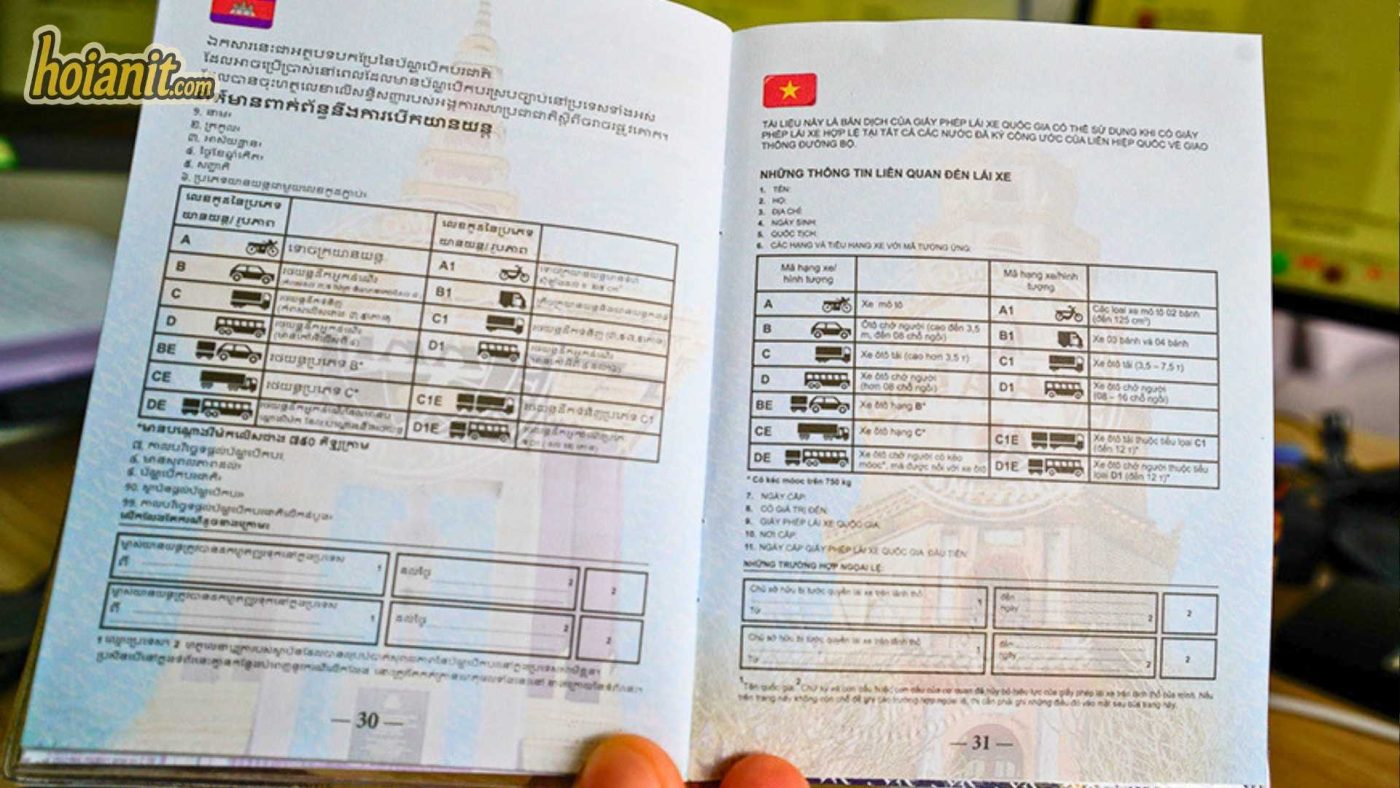
That translation page is the whole point of the document. A traffic officer in Hoi An cannot be expected to read a Finnish or Brazilian license; the IDP gives him the same information in a format he recognises, with the categories laid out in Vietnamese.
IDP 1968 Vietnam country check: who can get one
You cannot choose which convention your permit follows. Your motoring authority issues what its government signed up to. The UN treaty record for the 1968 Convention on Road Traffic lists 91 parties, and it is the only list that settles an IDP 1968 Vietnam question for certain. These are the countries we see most often in Hoi An:
| Where your license is from | Party to Vienna 1968? | What it means in Vietnam |
|---|---|---|
| Germany, France, Italy, Netherlands, Belgium, Switzerland, Austria, Poland, Czechia, Sweden, Denmark, Norway, Finland | Yes | Ask for the IDP; it will be the 1968 model |
| United Kingdom | Yes, since 28 March 2018 | Three IDP types exist (1926, 1949, 1968). Ask for the 1968 one by name |
| Russia, Ukraine, Belarus, Kazakhstan, Israel | Yes | 1968 permits are standard |
| Thailand | Yes, since 1 May 2020 | Newer to the treaty, so check which model you were issued |
| Philippines | Yes, since 1973 | Check the treaty date on your permit |
| Brazil, Peru, Uruguay, UAE, Qatar, Saudi Arabia, Turkey, Portugal, Greece | Yes | 1968 permits available |
| South Korea | No. Signed in 1969, never ratified | Korean permits follow 1949, so they are not valid here |
| Spain, Mexico, Chile, Indonesia | No. Signed, never ratified | Not a party, so they cannot issue a 1968 permit |
| United States, Canada, Australia, New Zealand, Japan, India, Malaysia, Singapore, Ireland | No | These issue 1949 permits only, not valid in Vietnam |
| Mainland China | No (and not in the 1949 treaty either) | No IDP route at all |
The row that surprises people most is South Korea. Da Nang is full of Korean visitors, many of whom arrive with a perfectly official permit from their licensing office, and every one of those is a 1949 permit. The same goes for Spain: it signed the 1968 treaty on the day it opened and never ratified it. A signature on a treaty is a promise to consider it, not membership.
If your country is not in the table, the PDF linked above has the full list with dates. Listed with a ratification or accession date means your authority can issue a 1968 permit. Listed with a signature only, or not listed at all, means it can’t. For UK riders, the GOV.UK page on international driving permits confirms Vietnam needs the 1968 version, sold over the counter at PayPoint shops for £5.50.
The two bodies authorised to issue IDPs in the United States, AAA and AATA, issue the 1949 model only, because the US never joined the 1968 treaty. A US IDP is useful in Japan or Thailand, but it does not make a 110cc scooter legal in Vietnam. Our guide on whether you need an IDP to ride in Vietnam goes through the alternatives.
The stamp that matters: A, A1 or B
A 1968 permit does not grant anything your home license doesn’t. It copies your categories into a standard grid, and an issuing officer stamps the boxes you hold. For an IDP 1968 Vietnam check, three boxes matter:
- A: motorcycles of any size. Covers a Honda Vision, an Air Blade and a Winner 150.
- A1: light motorcycles, up to 125cc and 11 kW. Covers a Vision, Wave or Air Blade, but not a 150cc manual.
- B: cars. On its own it covers no motorbike at all.
Vietnam drew its own line in the same place. Under the Law on Road Traffic Order and Safety, in force since 1 January 2025, a Vietnamese A1 license covers motorcycles up to 125cc or electric motors up to 11 kW, and anything above needs class A. So the 125cc boundary on your permit is exactly the boundary an officer here works to.

Many people with a car-only license at home apply for an IDP, receive a genuine 1968 booklet, and never notice that only B is stamped. Open yours now. If the motorcycle box is empty, no rental shop paperwork can fix it here; plan around the no-license bikes in section 8 instead.
What to carry, and what a missing paper costs
A traffic check in and around Hoi An usually takes a couple of minutes. The officer asks for the rider’s license and permit, the bike’s registration card and its insurance certificate. Our walkthrough of a police stop in Hoi An covers the conversation itself. These are the papers and the fines under Decree 168/2024, in force since 1 January 2025:
| Situation | Fine |
|---|---|
| No valid license, motorbike up to 125cc or electric up to 11 kW | 2,000,000–4,000,000₫ |
| No valid license, motorbike over 125cc or electric over 11 kW | 6,000,000–8,000,000₫ |
| License held but not carried | 200,000–300,000₫ |
| Registration card or compulsory insurance not on the bike | 200,000–300,000₫ each |
| No helmet, or helmet not fastened (rider or passenger) | 400,000–600,000₫ |
A 1949 permit, a car-only stamp or an expired booklet all count as “no valid license”, so they land in the first two rows, not the third. Riding without a valid license can also mean the bike is held at the station for several days, which turns a fine into a lost week of plans. The full breakdown is in our Vietnam motorbike license fines guide.
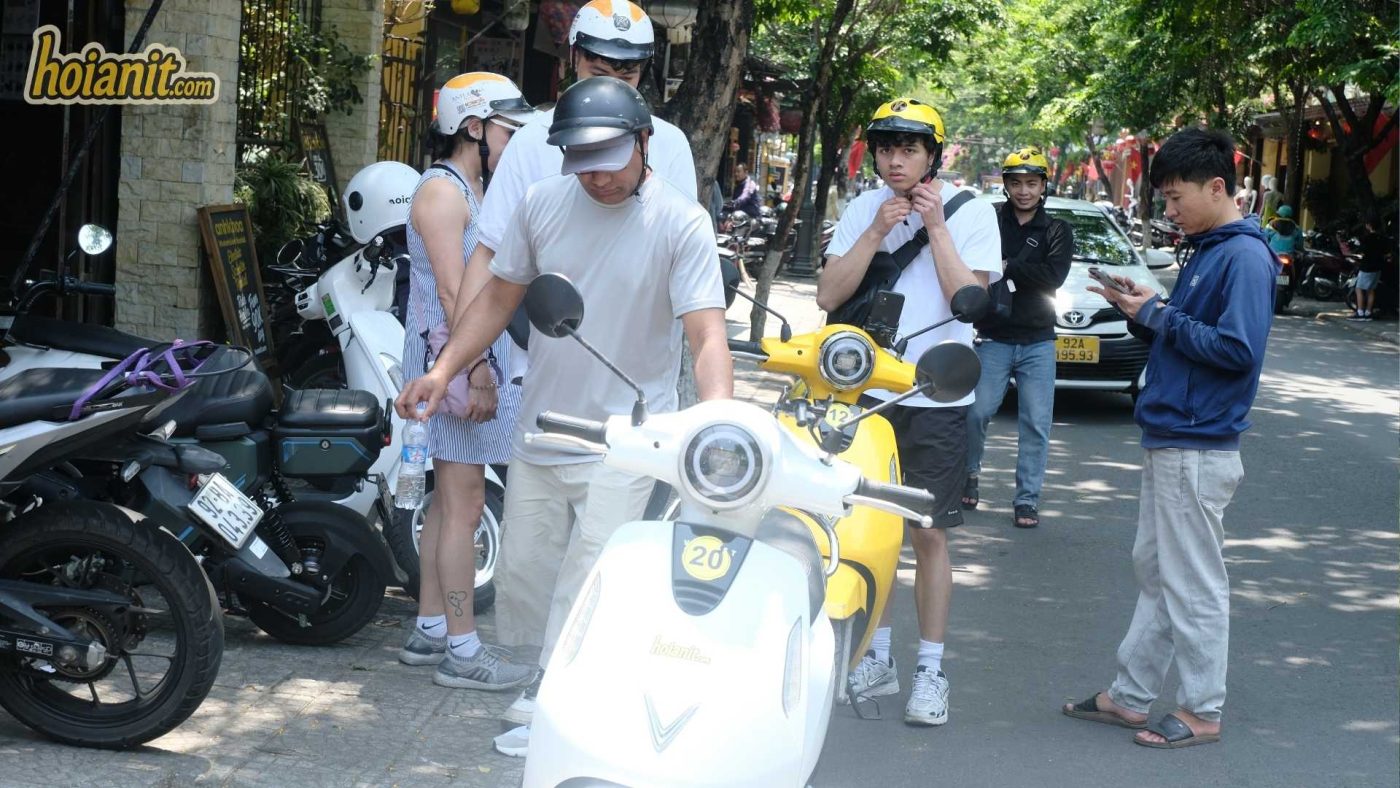
Carry the original home license and the IDP together, in a zip bag under the seat or in a money belt. A phone photo helps the conversation but is not a legal substitute. Your passport can stay in the hotel safe; a clear photo of the photo page and visa is usually enough for a traffic check.
Five ways a real permit still fails
1. The home license stayed at home
The IDP translates a license; it does not replace one. People leave the plastic card at home “to be safe” and bring only the booklet. At a checkpoint that is treated as riding without a license.
2. The permit outlived the license
If your home license expired or was renewed with a new number, the old IDP no longer matches anything. Renew both together.
3. The online “international license”
Websites selling an “international driver’s license” or “international driving document” are private businesses. Their booklets are translations with no legal status, however official the design. A real IDP comes only from the body your government authorises: PayPoint in the UK, AAA or AATA in the US, the national automobile club or licensing office elsewhere. We also see plastic “IDP” cards from some countries; if the treaty date and category page are not there, it is not the document Vietnam recognises.
4. The bike is bigger than the stamp
An A1 stamp and a Winner 150 do not match. Neither does a 125cc permit and a 155cc NVX. The officer reads the engine size off the registration card, then looks for the category that covers it.
5. “Nobody checks”
Checks are routine on the roads to Da Nang, the beach roads and around My Son, and more frequent around Tet and public holidays. More importantly, travel insurers check after an accident. Most policies exclude claims when the rider did not hold a valid license for the vehicle, and a broken wrist in Da Nang can cost far more than any fine.
Living in Vietnam: when an IDP stops being enough
The IDP 1968 Vietnam route is designed for visitors. If you live here on a work permit or temporary residence card, the practical answer is to convert your home license into a Vietnamese one. Conversion is generally open to foreigners staying at least three months, needs your original license, a notarised Vietnamese translation, a health certificate and your residence papers, and leads to a Vietnamese license for the same classes.
Two changes since 2025 are worth knowing. First, driver licensing moved from the Ministry of Transport to the Ministry of Public Security on 1 March 2025, so conversion is now handled by the traffic police rather than the old Department of Transport offices. Second, Vietnam now issues IDPs itself to holders of Vietnamese or convention-country licenses, but an IDP issued in Vietnam is for driving abroad. It cannot be used in place of a Vietnamese license inside Vietnam, so getting one here does not solve the problem for a resident.
Residents from the US, Australia or Korea cannot ride larger bikes on their home IDP, but conversion does not depend on the IDP at all. For long-stay riders it is the usual route once the residence card comes through.
No 1968 IDP? What you can still ride
Missing the right permit does not mean missing Hoi An. Vietnamese law lets anyone aged 16 or over ride the following without any license, and they cover most of what visitors actually do here: the Old Town, the rice fields at Tra Que, An Bang and Cua Dai beaches.
| Vehicle | License needed | Good for |
|---|---|---|
| Bicycle | None | Old Town, Tra Que, Cam Thanh |
| Electric bicycle (pedal-assist) | None | Beaches, longer flat rides |
| 50cc moped (SYM Shark 50, KYMCO Like 50) | None, rider 16+ | Around Hoi An, Ha My beach |
| Low-speed electric scooter (up to 50 km/h, up to 4 kW) | None, rider 16+ | Around Hoi An, the beaches |
| 110–125cc scooter | A1 or A on a 1968 IDP | Da Nang, My Son |
| Over 125cc | A on a 1968 IDP | Hai Van Pass, long trips |
A genuine 50cc is slow on the coast road and not built for mountain passes, so it suits short trips rather than a day out to the Hai Van Pass. Make sure a “50cc” really is one: our guide to the license for a 50cc scooter in Vietnam shows how to read the registration card, and renting a motorbike in Hoi An without a license compares the options in more detail.
How we check permits at Anh Khoa
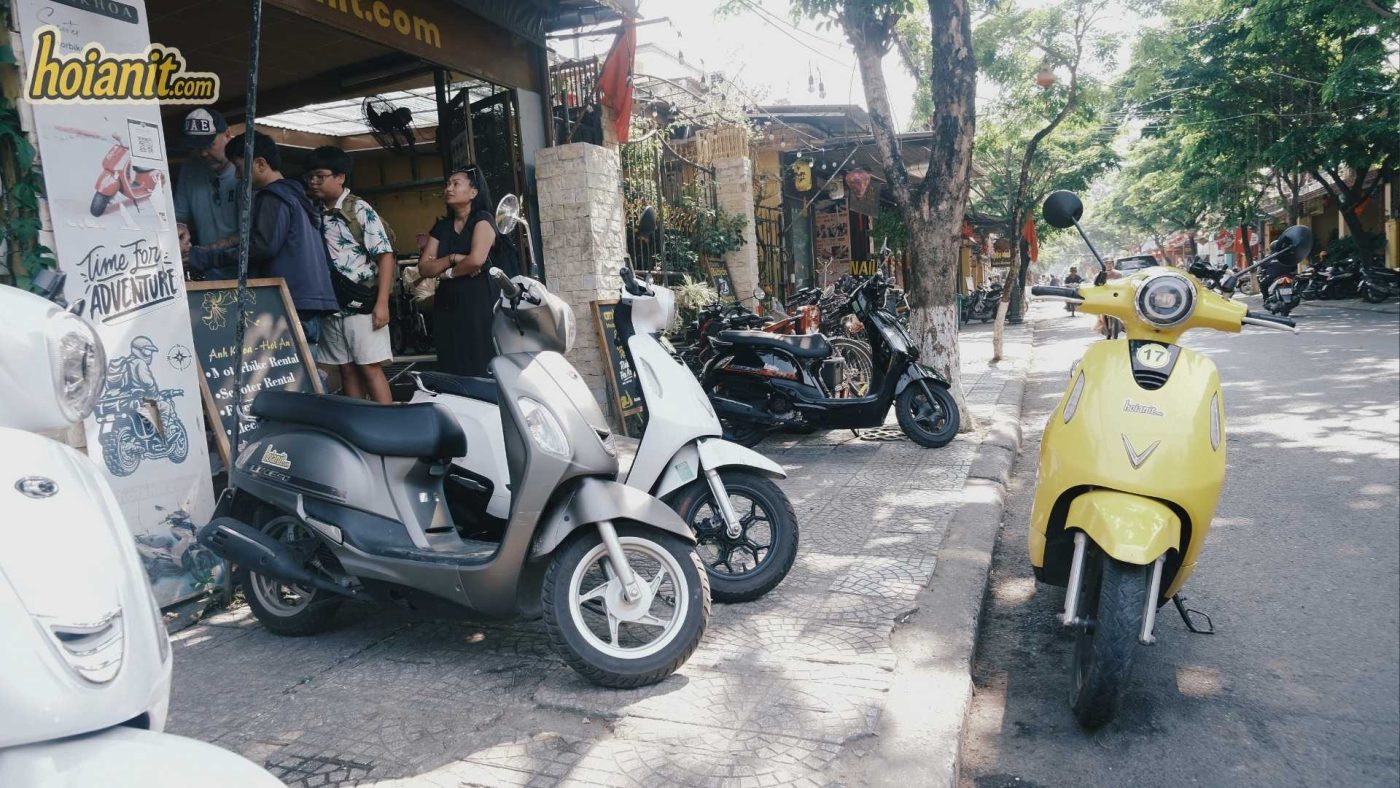
We would rather lose a booking than hand a 125cc scooter to someone whose paperwork will not hold up, for their sake more than ours. So our IDP 1968 Vietnam check is simple and the same for everyone:
- Before you book: send a photo of your IDP’s cover page and category page on WhatsApp. We tell you which bikes you can ride legally before you pay anything.
- At handover: we look at the original permit and the original home license together. A 1949 permit, an online booklet or a car-only stamp means we offer a 50cc, a low-speed electric scooter or an e-bike instead.
- What we don’t do: we don’t take a deposit and we don’t keep your passport. Helmets come with every bike, and our roadside line answers 24/7 if a bike stops on you.
Send us the cover and the category page of your IDP and we will tell you which bikes fit, in a few minutes. No deposit, no passport held.
Frequently asked questions
Is an IDP 1968 valid in Vietnam?
Yes. Vietnam joined the 1968 Vienna Convention on Road Traffic in 2014, and a 1968 International Driving Permit is recognised for riding and driving here, provided you carry it together with your original home license, both are in date, and the permit is stamped for the category of vehicle you ride (A or A1 for a motorbike).
Can I use a 1949 IDP in Vietnam?
No. Vietnam is not a party to the 1949 Geneva Convention, so a 1949 permit has no legal value here. That covers permits from the United States, Canada, Australia, New Zealand, Japan, South Korea and India. With one, you can legally ride only the no-license vehicles: bicycles, e-bikes, genuine 50cc mopeds and low-speed electric scooters.
How can I tell if my IDP is the 1968 or the 1949 version?
Look at the cover or the first inside page. A 1968 permit refers to the Convention on Road Traffic of 8 November 1968; a 1949 permit refers to the Convention on International Road Traffic of 19 September 1949. A 1968 permit can also be valid for up to three years, while a 1949 permit lasts one year.
My 1968 IDP is only stamped for cars. Can I ride a scooter?
No. A permit stamped only for category B covers cars. To ride a 110–125cc scooter you need A1 or A stamped, and anything over 125cc needs A. With a car-only stamp you are treated as having no motorbike license.
Do I need to carry my original home license with the IDP?
Yes. The IDP is a translation of your home license and is only valid together with it. Carry both originals; a photo on your phone is not a legal substitute.
Can I get a 1968 IDP after arriving in Vietnam?
Not as a visitor. An IDP must be issued by the country that issued your license, so it has to be arranged at home before you travel. Vietnam issues IDPs to holders of Vietnamese licenses for use abroad, and those cannot be used in place of a Vietnamese license inside Vietnam.
What can I ride in Hoi An without an IDP?
Anyone aged 16 or over can ride a bicycle, an electric bicycle, a genuine 50cc moped or a low-speed electric scooter (up to 50 km/h and 4 kW) without a license. That covers the Old Town, Tra Que and the beaches at An Bang and Cua Dai.
The wider picture, bike by bike: Do you need a license to ride a motorbike in Hoi An? · Bản tiếng Việt: Thuê xe máy Hội An có cần bằng lái không?
Updated October 2026. Treaty membership and dates are taken from the UN Treaty Collection record for the 1968 Convention on Road Traffic; Korea, Spain, Mexico, Chile and Indonesia appear there as signatories without ratification. Legal points reflect Vietnam’s Law on Road Traffic Order and Safety 2024 (in force 1 January 2025) and Decree 168/2024/ND-CP on traffic penalties. USD amounts are rounded approximations. This is general information written by a motorbike rental business, not legal advice; if your situation is unusual, ask the issuing authority in your home country.
More Bike Options in Hoi An
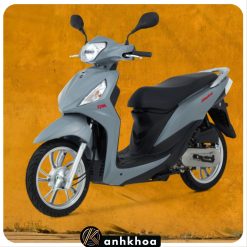
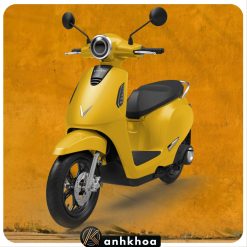
E-Bike · No license










Pick your ride in Hoi AnChọn xe cho chuyến đi Hội An
Scooters, electric bikes and bicycles from one shop in the Old Town — delivered to your hotel, helmets and roadside help included.Xe máy, xe điện và xe đạp — giao tận khách sạn, kèm hai nón bảo hiểm và hỗ trợ dọc đường.
Not sure which one fits? Message us on WhatsApp and we’ll recommend a bike for your plans.
Chưa biết chọn xe nào? Nhắn Zalo 0935 439 306, tụi mình tư vấn theo lịch trình của bạn.