Riding Rules & Licenses
Motorbike Accident in Hoi An: What to Do in the First Hour, Step by Step
Motorbike Accident in Hoi An: What to Do in the First Hour, Step by Step
A motorbike accident in Hoi An is usually a slow-speed fall, not a disaster. What you do in the first hour decides your health, your fine and your insurance claim.
Most of the motorbike accident calls we get as a rental shop are small: sand on a corner, a dog, a scooter that pulls out of an alley without looking. Nobody breaks anything, and the damage is a scraped fairing and a bruised knee. The trouble starts afterwards. People leave too fast, agree to pay cash before they know what happened, or forget the one photo that would have settled the argument.
This guide is the order of things after a motorbike accident, written for visitors riding a rental bike around Hoi An, An Bang, Cam Thanh and the coast road to Da Nang. It is based on Vietnam’s road traffic law that took effect on 1 January 2025, the current penalty decree, and what we see happen at our counter at 84 Phan Chau Trinh.
- The first 60 seconds after a motorbike accident
- Who to call: 112, 113, 114 or 115
- What Vietnamese law requires of you at the scene
- Photos and details to collect before anything moves
- Minor crash, nobody hurt: settling it on the spot
- Someone is hurt: police, hospital and the alcohol test
- Where to get treated in Hoi An and Da Nang
- Insurance after a motorbike accident: who pays for what
- Calling your rental shop, and what happens to the bike
- Frequently asked questions
The first 60 seconds after a motorbike accident
Adrenaline is the problem in the first minute. It hides pain, it makes you want to stand up and say “I’m fine”, and it makes you want to get away from the crowd that gathers in seconds on any Hoi An street. Slow down and do these four things, in this order.
- Get out of the traffic laneMove yourself first, then your passenger, then the bike if it is safe to lift. On a narrow road like Cua Dai or the An Bang beach road, traffic keeps moving around a fallen bike, so the second impact is the real danger.
- Warn the traffic behind youSwitch on the hazard lights if the bike still has power, or ask someone to stand back up the road and wave traffic past. The law asks the people involved to warn others of the danger, and at night it matters more than anything else on this list.
- Check bodies before bikesSit down for a minute. Check your head, neck, wrists and the passenger’s legs, which take the hit in most low-speed falls. If anyone hit their head, felt dizzy, or cannot move a limb normally, treat it as serious and call 115.
- Switch the engine off and leave the key in placeDo not try to restart it to “see if it works”. A fuel leak or a bent brake lever is easier to find on a cold, still bike, and the position of the bike may matter later.
The fall takes two seconds. The decisions that cost money happen in the twenty minutes after it.
Who to call: 112, 113, 114 or 115
Vietnam does not yet have one single emergency number for a motorbike accident or anything else. There are separate lines, and they are free from any phone, including a tourist SIM.
| Number | Who answers | Call it when |
|---|---|---|
| 115 | Medical emergency / ambulance | Anyone is injured beyond scrapes, hit their head, or cannot stand up |
| 113 | Police | Someone is hurt, the other party is aggressive, or nobody agrees on what happened |
| 114 | Fire and rescue | A bike is leaking fuel or smoking, or someone is trapped |
| 112 | National search and rescue line | You cannot get through on the others; it can pass calls on to 113, 114 and 115 |
Operators on 113 and 115 speak Vietnamese first. If you do not, the fastest route is often to hand your phone to a local person at the scene. Someone always stops. Before you call, open Google Maps and long-press your position to get a pin you can share. “Near the rice fields on the way to the beach” describes half of Hoi An.

What Vietnamese law requires of you at the scene
The rules sit in Article 80 of the Law on Road Traffic Order and Safety (Law 36/2024/QH15), in force since 1 January 2025. They apply to foreigners exactly as they apply to Vietnamese riders, and they apply to anyone “involved” in a crash, not only the person who caused it.
- Stop immediately, warn other traffic, keep the scene as it is, help the injured person, and report to the police, a medical facility or the nearest commune office.
- Stay at the scene until the police arrive. The exceptions are going to hospital yourself, taking an injured person to hospital, or a real threat to your safety. Even then you must report to the police or commune office straight afterwards.
- Give your identity and the details of the accident to the authorities when they ask.
- Use the bikes involved to carry a victim only if there is no other vehicle, and mark where the bike and the injured person were lying before you move them.
The same article also gives bystanders duties: help the victim, call it in, protect the scene and the victim’s belongings. And any rider passing an accident is expected to carry an injured person to hospital. That is why, in Hoi An, a stranger on a Honda Wave will often offer to take you to the clinic. It is normal, and it is legal.
The fine for leaving
Riding off is the most expensive mistake on this page. Under Decree 168/2024/ND-CP, a motorbike rider who caused the crash and then fails to stop, leaves the scene or does not help the victim faces a fine of 8,000,000–10,000,000₫. A rider who was involved but did not cause it and still does not stop faces 1,000,000–2,000,000₫. If someone is seriously hurt, the case can stop being an administrative matter at all and become a criminal one under Article 260 of the Penal Code.
People at the scene sometimes ask for a passport “as a guarantee” until money is paid. Do not give it to anyone who is not a police officer in uniform. Show a photo of it if they need your details. Your rental shop never keeps your original passport either; our deposit is 2,000,000₫ or a passport copy.
Photos and details to collect before anything moves
Every argument after a motorbike accident comes down to the same question: where were the bikes, and who hit whom? Photos taken before anything is moved answer it. Photos taken after are mostly useless. Spend three minutes on this.
| Photograph | Why it matters |
|---|---|
| Wide shot of the whole scene from both directions | Shows lanes, junctions and who had the right of way |
| Both bikes where they fell, then each from four sides | Proves which part of which bike made contact |
| Both licence plates, close up | The plate is how police and insurers identify the other vehicle |
| Skid marks, sand, potholes, a missing sign | Road conditions can shift the blame away from you |
| The other rider’s licence and registration card | Name, address and plate in one image |
| Any shop camera pointing at the road | Note the shop name; footage is often overwritten within days |
| Injuries, as soon as you can | Your travel insurer will ask for them with the medical report |
Write down the time and the exact place, and save the phone number of anyone who saw it happen. A witness is worth more than a dozen photos if the other side changes its story later.

Minor crash, nobody hurt: settling it on the spot
A minor motorbike accident in Vietnam usually ends the local way: the two riders agree a sum for the damage and go home, without police. That is allowed when nobody is hurt and only property is damaged. It can also go badly for a visitor, because the first number named is rarely the real repair cost.
- Call your rental shop before you agree anything. We know what a mirror, a lever or a fairing costs in a Hoi An workshop, and that number is the fair starting point.
- Never pay just to make the crowd go away. If the amount feels wrong, or the other side becomes aggressive, call 113 and let the police record it.
- Put any agreement in writing. A few lines on paper or in a phone note: date, place, both plates, the amount, and that both sides consider the matter settled. Photograph both people holding it.
- Pay against a receipt or by bank transfer, so there is a record.
- Do not let a roadside mechanic repair the rental bike. A cheap fix with the wrong part is still damage at handover, and it can cancel the shop’s damage cover.
The same rules apply in reverse. Take the photos, take their plate, and do not accept “I pay you later”. A promise at the roadside is hard to enforce; a police record is not.
Someone is hurt: police, hospital and the alcohol test
Once someone is injured in a motorbike accident, the order changes. Treatment comes first, and the paperwork follows the patient, not the other way round.
- Call 115, then 113If the ambulance will take a while, a taxi or a passing rider taking the injured person to the nearest hospital is allowed. Note who took them and where.
- Expect a blood alcohol testArticle 81 of the road traffic law requires the hospital that treats accident victims to test the drivers involved for alcohol and drugs, and to tell the police. Vietnam’s limit for riders is zero, so the beer at lunch shows up.
- Let the police record the sceneTraffic police will measure, photograph and take statements. They can keep the vehicles involved while the case is examined, rental bikes included.
- Ask for written recordsKeep every paper you are given: the police record, the hospital admission, the bill, and the doctor’s report. Your travel insurer will not pay without them.
- Call your travel insurer’s emergency line earlyMany policies want to be told before major treatment or a hospital transfer. The number is on your policy, not on a website you find later.
A zero alcohol limit means one drink turns a crash you did not cause into a crash you cannot claim for.
Article 81 also requires insurance companies that cover the people or vehicles involved to send someone, or an authorised representative, to the scene once they are told about the accident. It is one more reason to report the crash to your insurer straight away.

Where to get treated in Hoi An and Da Nang
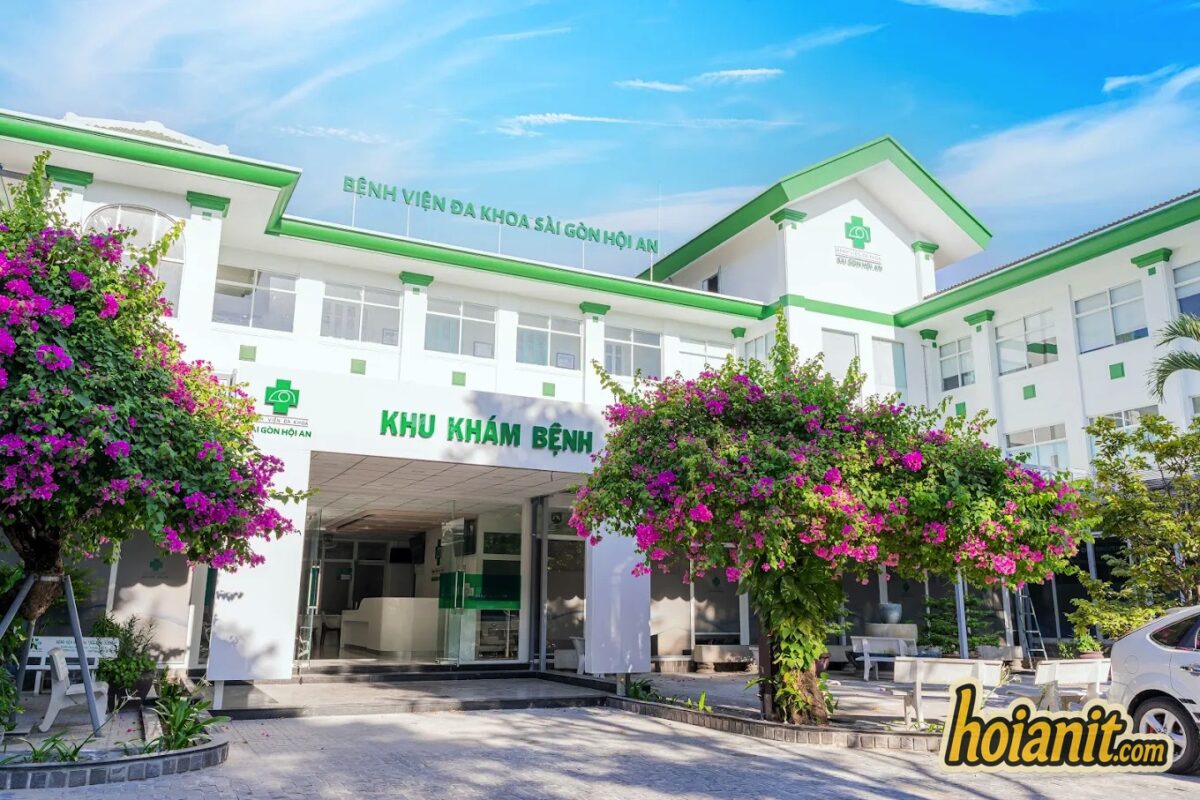
After a minor motorbike accident, Hoi An has what you need for scrapes and stitches. For a suspected fracture, a head injury or anything needing a scan or surgery, the larger hospitals are in Da Nang. If you have travel insurance, call its emergency line before a transfer; it may choose the hospital for you.
| Hospital | Address | Emergency | Phone |
|---|---|---|---|
| Saigon Hoi An General Hospitalprivate, formerly Thai Binh Duong (Pacific) Hospital | 06 Phan Dinh Phung, Hoi An Tay ward | 24/7 | 0235 3921 656emergency line 1900 8686 30 |
| Hoi An Regional Medical Centerpublic, Trung tam Y te khu vuc Hoi An | 4 Tran Hung Dao, Hoi An | 24/7 | — |
| Vinmec Da Nang International Hospital | 30 Thang 4 Street, Hoa Cuong ward, Da Nang | 24/7 | 0236 3711 111 |
| Hoan My Da Nang Hospital | 291 Nguyen Van Linh, Thanh Khe ward, Da Nang | 24/7 | 1800 6381group hotline |
Details are from the hospitals’ own sites: Saigon Hoi An General Hospital and Vinmec Da Nang. Have your passport photo and your insurance policy number ready at the desk. Saigon Hoi An General Hospital lists direct billing with insurers; ask whether yours is one of them.
Pharmacies on every main street sell antiseptic, gauze and bandages without a prescription. Clean a road rash the same day. In Hoi An’s heat and humidity, an uncleaned graze gets infected fast.
Insurance after a motorbike accident: who pays for what
This is where most visitors are surprised. There are up to four layers of cover after a motorbike accident in Vietnam, and none of them covers everything.
| Cover | What it pays for | What it does not |
|---|---|---|
| Compulsory third-party (on every bike) | Injury to other people up to 150,000,000₫ per person, and their property up to 50,000,000₫ per accident | You, your passenger’s own policy claims, the rental bike, theft |
| Your travel insurance | Your medical treatment and evacuation, if motorbike riding is covered | Usually nothing if you rode without a valid licence, or after any alcohol |
| The shop’s optional damage cover | Accidental damage to the rented bike’s bodywork | Personal injury, theft, alcohol, racing, off-road, no licence |
| You | Everything above the limits, and everything excluded | — |
The compulsory third-party limits come from Decree 67/2023/ND-CP (amended in 2026). They are maximums for the other party’s losses, not an amount you receive. Our own optional cover costs 50,000₫ a day and is explained line by line in our guide to motorbike insurance in Hoi An.
The licence question
The single biggest reason travel insurers refuse a claim after a motorbike accident is the licence. Most policies only cover riding that was legal: a motorbike class on your home licence plus a recognised permit, or a Vietnamese licence. If your permit is the wrong convention, the policy may treat you as unlicensed. Check this before you ride, not in the hospital. Our guides to the 1968 IDP in Vietnam and to riding in Hoi An with or without a licence explain which documents count.
Calling your rental shop, and what happens to the bike
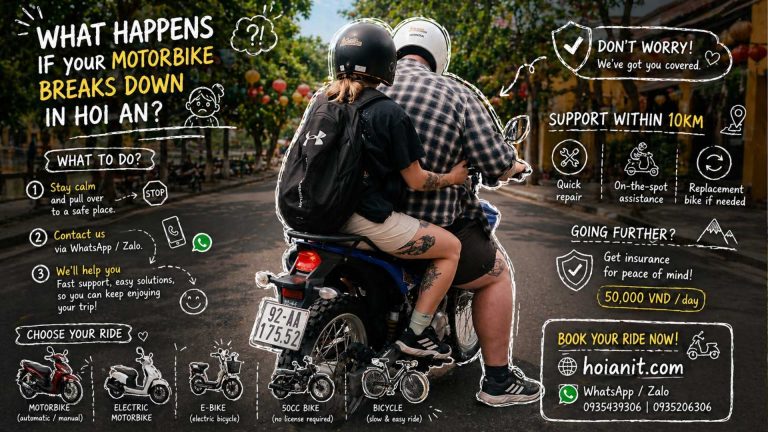
After a motorbike accident on one of our bikes, call us on WhatsApp +84 935 206 306, or the 24/7 roadside line +84 766 766 087, as soon as everyone is safe and before you agree any payment at the scene. Roadside help is free within 10 km of our shop, at any hour. Further out, we tell you the fee on the phone before anyone sets off.
- If the bike can be ridden, ride it back slowly or wait for us. Do not ride it if the front wheel wobbles, the brakes feel different, or the steering pulls to one side after the fall.
- If the police keep the bike, send us a photo of the paper they give you and the address of the station. The bike is registered to us, so we need those details to deal with it.
- Do not repair it yourself. Bring it back as it is. With our optional damage cover, accidental bodywork damage is covered under the rental agreement. Without it, the repair is yours to pay; typical Hoi An workshop prices are listed in our insurance guide.
A breakdown is a different call from a crash, and it has its own guide: what happens if your motorbike breaks down in Hoi An. If a police officer stops you on the way back, see police stops in Hoi An. And if you are still deciding whether to ride at all, start with is it safe to ride a motorbike in Hoi An.
Had a fall on one of our bikes?
Stop, get safe, take the photos, then call us before you pay anyone.
24/7 roadside line: +84 766 766 087Frequently asked questions
What is the first thing to do after a motorbike accident in Hoi An?
Get yourself and your passenger out of the traffic lane, warn traffic behind you, and check for injuries before looking at the bikes. If anyone hit their head or cannot stand, call 115 for an ambulance.
What number do I call for an ambulance in Vietnam?
Call 115 for an ambulance, 113 for the police and 114 for fire and rescue. The calls are free from any phone. 112 is the national search and rescue line and can pass calls on to the others.
Can I leave the scene if nobody is hurt?
Not straight away. The law requires everyone involved to stop, keep the scene and stay until the police arrive, unless both sides settle a minor damage-only crash between themselves. Leaving after a crash you caused can cost 8,000,000 to 10,000,000 VND.
Should I pay the other rider cash on the spot?
Only for a minor crash where nobody is hurt, only after calling your rental shop for a fair repair price, and only with a short written agreement that both sides sign. If the amount feels wrong, call 113 and let the police record it.
Will my travel insurance pay after a motorbike accident in Vietnam?
It depends on your policy. Most only pay if motorbike riding is covered, you held a valid licence for the bike, you wore a helmet and you had not been drinking. Check the wording and the licence rules before you ride.
Does the compulsory motorbike insurance cover my own injuries?
No. The compulsory third-party insurance on every bike pays for injury and damage you cause to other people, up to 150,000,000 VND per person for injury. Your own treatment is a job for your travel insurance.
What happens to my rental bike if the police keep it?
Police can keep the vehicles involved while they examine the accident. Send your rental shop a photo of the police paper and the station address straight away, because the bike is registered to the shop.
Checked on 17 November 2026 against Law 36/2024/QH15 on Road Traffic Order and Safety (Articles 80 and 81), Decree 168/2024/ND-CP on traffic penalties, and Decree 67/2023/ND-CP on compulsory motor vehicle insurance as amended. Hospital details are from the hospitals’ own websites and our shop on the same date; call before you travel, as numbers change. This is practical guidance from a rental shop, not legal advice. Anh Khoa Hoi An Motorbike Rental, 84 Phan Chau Trinh, Hoi An.
Keep reading Riding Rules & Licenses