

Hoi An Travel Tips
Phap Bao Pagoda Hoi An – A Local Guide to the Quietest Temple in the Old Town
The pagoda named after the monk who founded an entire Vietnamese Zen lineage · free entry · a 10-minute walk from the Japanese Covered Bridge
Ten minutes on foot from the Japanese Covered Bridge, Phap Bao Pagoda sees almost no tourists — which is precisely the reason to go. This is not a ticketed monument dressed up for visitors. It is a working temple, the administrative seat of Hoi An Buddhism, and a place locals still call by its old name: the Provincial Association Pagoda.
- Where it is and what it costs
- Where the name Phap Bao comes from
- Seventy years in seven moments
- The summer of 1963
- Architecture and what to look at
- How to read the main altar
- When to go and how to behave
- Festivals worth timing your visit around
- Getting there, parking and a half-day route
- Local tips before you go
- Frequently asked questions
Where it is and what it costs
Phap Bao Pagoda stands at 07 Hai Ba Trung Street, near the junction with Phan Chau Trinh. It is a few hundred metres from Hoi An Market and roughly 700–800m from the Japanese Covered Bridge — comfortably walkable, even in the heat.
One administrative note that trips up almost every guidebook: since 1 July 2025, Quang Nam province has been merged into Da Nang City. The pagoda’s correct address today is Hoi An ward, Da Nang City. Older articles listing it under “Quang Nam province” are not wrong about the place, only out of date about the paperwork.
The practical part matters more. Phap Bao is not one of the ticketed heritage sites in the Old Town. You do not need to buy the Hoi An Ancient Town entrance ticket to walk in, and nobody checks anything at the gate. If you want to know how that ticket works for the monuments that do require it, we explain it in our guide to the Hoi An smart ticket kiosks.
Phap Bao does not publish visiting hours the way a museum does. In practice the gates stand open through most of the day, but the easiest and least intrusive windows are 7:00–10:30 in the morning and 14:30–17:00 in the afternoon. Avoid roughly 11:00–12:30, when the monks take their midday meal, and stay outside during chanting sessions rather than walking through them.
Where the name Phap Bao comes from
This is the detail almost no guide mentions, and it is the reason the pagoda is worth more than the ten minutes its facade suggests.
The temple is not named after a place or a generic Buddhist virtue. Phap Bao was the dharma title of Master Minh Hai Dac Tri Phap Bao (1670–1746) — a Chinese-born Zen monk from Fujian who founded Chuc Thanh Pagoda in Hoi An and became the first patriarch of the Lam Te Chuc Thanh Zen lineage, a school that spread from Quang Nam down through the south-central coast and into southern Vietnam.
Born Luong The An in Quanzhou prefecture, Fujian, he entered monastic life at the age of nine and came to Dang Trong — the southern Nguyen-ruled part of Vietnam — in the late seventeenth century. He settled in Cam Pho village, today the Tan An area of Hoi An, built a modest hermitage, and watched it grow into the monastery he named Chuc Thanh. The transmission verse he composed is what gave rise to an entire branch of Vietnamese Zen.
In 1967, the Quang Nam Provincial Buddhist Association chose that exact dharma title for its headquarters temple. So when you stand in front of the sign reading “Chua Phap Bao”, you are reading the name of a real person who laid the foundations of Buddhism in this region more than three centuries ago.
A surprising number of travel articles — including some large ones — describe the history of “Phap Bao Pagoda, Hoi An” with a story that begins: in the 1980s the Vietnamese Buddhist Society of New South Wales rented a house in Lakemba… That is Phap Bao Temple in Sydney, Australia, a completely different temple that happens to share the name. The two have no shared founding history. If you see that paragraph in an article about Hoi An, treat the rest of it with caution.
Seventy years in seven moments
Next to Chuc Thanh Pagoda, founded at the close of the seventeenth century, Phap Bao is a young temple. What it has instead is the closest connection of any building in Hoi An to the organised Buddhist life of central Vietnam over the past seven decades.
- Mid-1950s — the Buddhist Studies pagodaVenerable Thich Tri Minh (1904–1971), born in Dien Tien village near Hoi An, was invited to lead the Provincial Association Pagoda and elected president of the An Nam Buddhist Studies Association of Quang Nam. He preached across the province, and most lay Buddhists in Quang Nam at the time took refuge under him.
- 1964 — provincial headquartersThe Unified Buddhist Church of Vietnam was founded and the Quang Nam Provincial Buddhist Association established its headquarters here. From then on, every significant Buddhist affair in the province passed through this courtyard.
- 1967 — the name Phap BaoThe association adopted Master Minh Hai’s dharma title as the temple’s official name. Locals never quite switched over: older residents still say “chua Phat Hoc” (the Buddhist Studies pagoda) or “chua Tinh Hoi” (the provincial association pagoda).
- 1971 — the lecture hallEarly that year, Venerable Thich Tri Minh and the church broke ground on a lecture hall and monks’ quarters. The work was still unfinished when he fell seriously ill and passed away on 4 April 1971, after seventeen years as abbot.
- 1981 — a change of generationsVenerable Thich Nhu Hue left for Australia to teach; Venerable Thich Long Tri (1928–1998) came over from Vien Giac Pagoda to take charge of temple affairs while serving as deputy head of the Quang Nam – Da Nang Buddhist Association.
- Early 2000s — major restorationA large-scale renovation gave the pagoda the layout and appearance you see today, and it continued as the office of the Hoi An Buddhist executive council.
- 19 April 2021 — casting the bronzesDuring the memorial ceremony for Venerable Thich Tri Minh, the temple held a consecration and poured bronze for six statues — Amitabha Buddha, Maitreya, Avalokitesvara, Mahasthamaprapta, Skanda the dharma protector and the Burning-Face Great Being — plus the lotus throne of the principal Buddha. Many of the figures you see in the main hall are only a few years old.
The summer of 1963
Read the usual travel write-ups and you would assume nothing has ever happened here. In fact this courtyard was one of the most charged places in central Vietnam during the Buddhist crisis of 1963.
Hoi An was the centre of Buddhist protest in Quang Nam, and this temple was where it gathered. Venerable Thich Tri Minh and Venerable Thich Chon Phat held a hunger strike for several days outside the Quang Nam administrative headquarters — the building is now the Hoi An Hotel on Tran Hung Dao Street, a few hundred metres away. At the height of the protests he asked permission to immolate himself; the senior monks refused, and lay Buddhists took turns keeping watch over him.
On the night of 20 August and into 21 August 1963, government forces raided every pagoda in Hoi An as part of the nationwide crackdown. The monks were arrested and taken down to Cua Dai beach for interrogation. They were not released until 1 November 1963, the day of the coup.
We mention this not to weigh down your morning, but because it changes what you are looking at. The quiet tiled courtyard you step into on a mild sunny day was, in one particular summer, packed with people whose lives were genuinely at risk. Knowing that, fifteen minutes standing there lands very differently.
Historical material in this section follows the biography of Venerable Thich Tri Minh compiled by Venerable Thich Nhu Tinh and reporting by Quang Nam Buddhism.
Architecture and what to look at
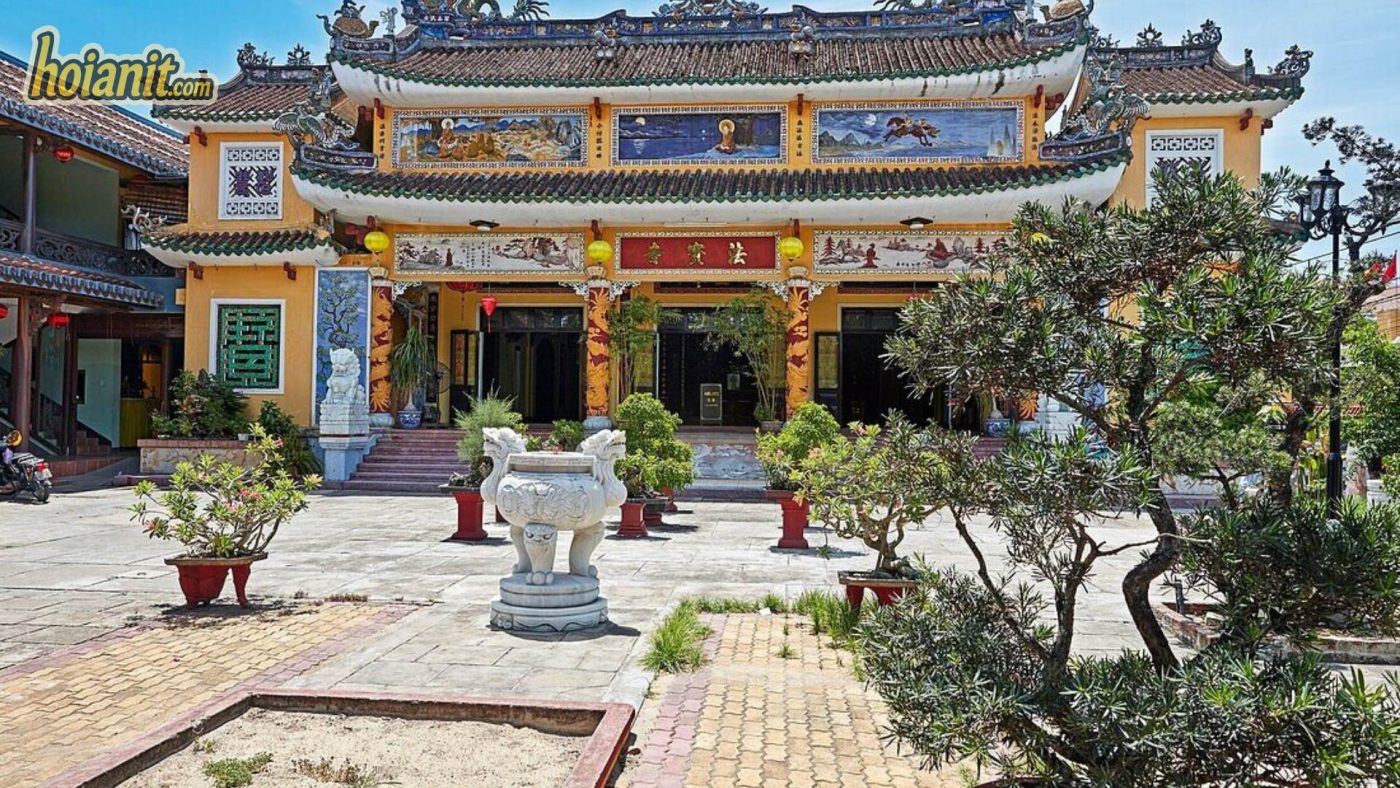
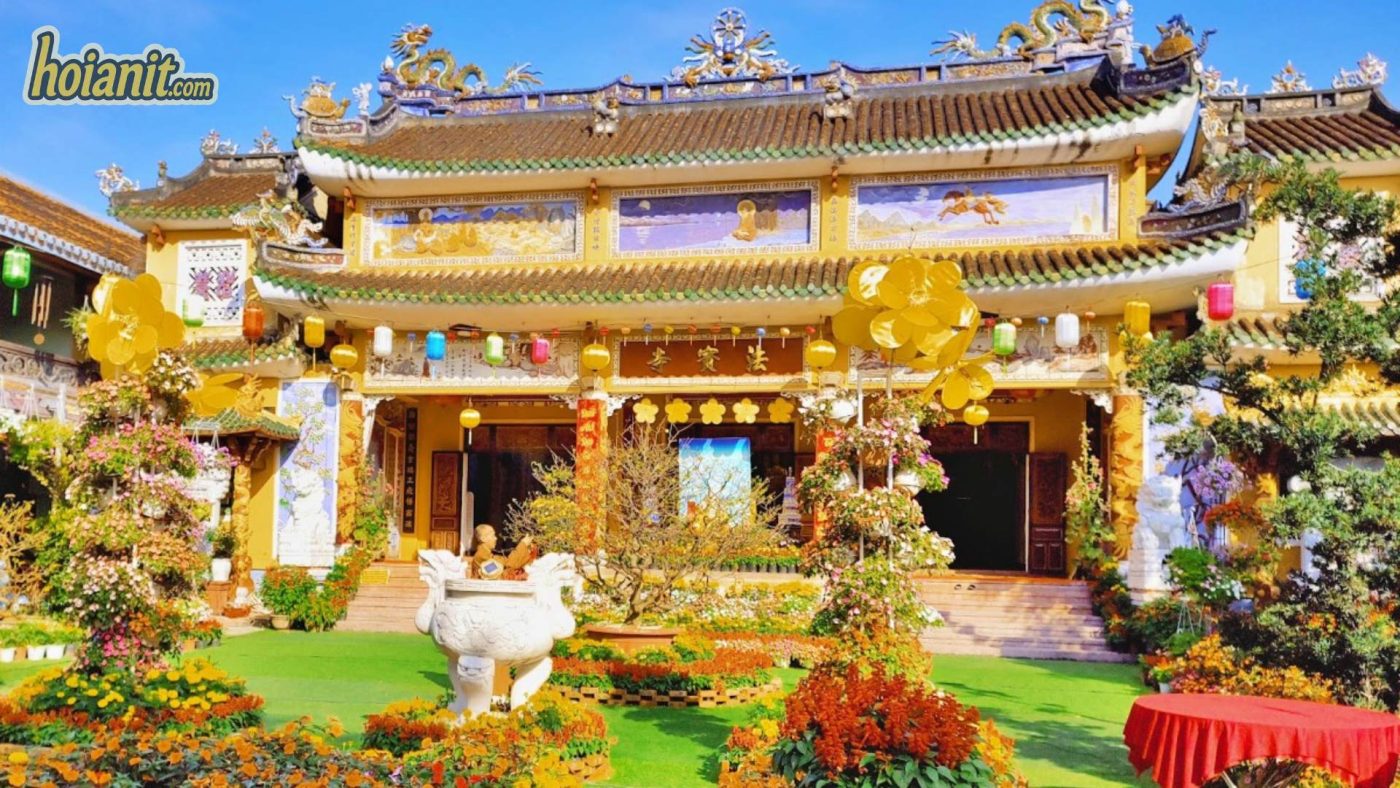
Phap Bao is not the mossy, weather-beaten kind of temple that photographers hunt for in Hoi An. It is a substantial Northern-school Vietnamese Buddhist pagoda: a wide forecourt, a two-tiered roof in yin-yang tiles, upturned eave corners, and a decorated triple gate. The vocabulary is Vietnamese Buddhist rather than Chinese assembly hall — noticeably different from the Fujian and Cantonese halls on Tran Phu.
What actually makes the place feel good is not carving detail but the proportion of empty space. After threading through streets a few metres wide in the Tran Phu and Nguyen Thai Hoc block, stepping through the gate into an open courtyard with trees and potted plants is a genuine change of tempo. Nowhere inside the ticketed heritage zone gives you that.
A tidy 30-minute visit
1. The triple gate (3 min). Step back to the far pavement for the full roofline and the ornamentation along the top of the gate. This is also the cleanest photo angle, least affected by backlight in the afternoon.
2. Forecourt and plantings (5 min). Walk the edge of the courtyard rather than cutting straight to the hall. The potted plants are meticulously kept, and this is the coolest spot around midday.
3. Main hall (10–15 min). Leave your shoes outside, move along the sides, and do not stand in the centre aisle. Look closely at the bronze figures — most were cast in 2021.
4. Rear garden and stupas (5–10 min). If the back gate is open, the grounds behind are quieter still. Do not open doors into areas where the monastic community lives.
How to read the main altar
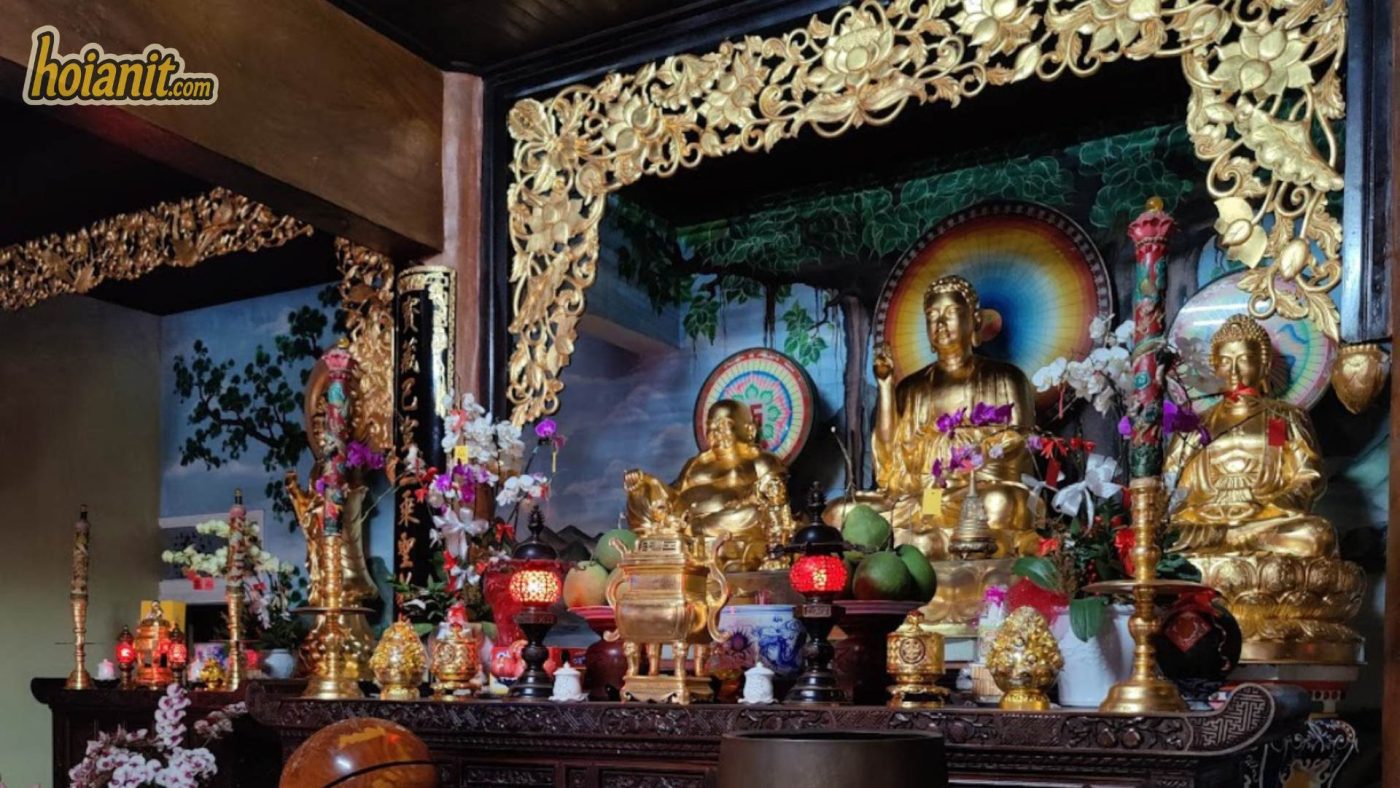
Most visitors stand in the doorway of a Vietnamese main hall and have no idea what they are looking at. The arrangement follows clear rules, and a handful of pointers is enough to decode it.
| Position | Figure | What it represents |
|---|---|---|
| Centre, highest | Shakyamuni Buddhateaching posture, on a lotus throne | The historical Buddha, founder of Buddhism |
| Front left | Amitabha Buddha | Buddha of the Western Pure Land |
| Front right | Maitreya | The Buddha of the future age |
| Flanking the hall | Avalokitesvara (Quan The Am)willow branch and vase of nectar | Compassion and relief from suffering |
| Flanking the hall | Mahasthamaprapta (Dai The Chi)holding a blue lotus | Wisdom and steadfast effort |
| Beside the entrance | Skanda · the Burning-Face Great Being | Dharma protectors guarding the temple |
One shortcut worth remembering: Avalokitesvara and Mahasthamaprapta always appear as a pair, standing either side of Amitabha. Together the three are called the Western Triad. Spot one figure holding a vase and another holding a lotus, and you have identified the group.
There is also a nice contradiction here. The institution is seventy years old, the name is three centuries old, and the bronzes are barely five years old — cast in April 2021 with senior monks from Chuc Thanh, Phuoc Lam and Long Tuyen presiding. That layering is very typical of a temple that is still in active use rather than preserved as a museum piece.
When to go and how to behave
Phap Bao is a place of practice, not a photo stop. The points below are not decorative advice — they are the difference between being welcomed and being quietly tolerated.
- Dress modestly. Sleeved top, trousers or skirt below the knee. Swimwear, singlets and short shorts belong at the beach. Hoi An is hot; the temple is not a workaround.
- Remove your shoes before entering the main hall. Line them up to one side, clear of the doorway.
- Walk along the sides, not up the centre. The central aisle is traditionally reserved for the monks and for ritual.
- Silence your phone. If chanting is underway, wait outside rather than walking in mid-service.
- Ask before photographing monks. Photographing the buildings is fine; photographing people deserves a question, and the answer is almost always yes.
- No food or alcohol inside the grounds. Drinking water is fine.
- If you wish to make an offering, use the donation box or speak to one of the monks. Do not place money on the altar or tuck it into a statue.
Summer (May–August): come before 9:00 or after 16:00. The tiled courtyard throws off serious heat at midday.
Rainy season (October–December): mornings are usually drier than afternoons; carry a thin poncho, because rain arrives fast in Hoi An.
For maximum quiet: 7:00–8:00 on a weekday. The full moon and first day of each lunar month bring crowds of local Buddhists — still visitable, but watch from the edges rather than moving around.
Festivals worth timing your visit around
Land on one of these dates and the pagoda becomes an entirely different experience: busy, ceremonial, full of music and colour, and a window into Buddhist life in Hoi An rather than just its architecture.
| Occasion | When | What you will see |
|---|---|---|
| Vesak (Buddha’s Birthday) | 15th day of the 4th lunar monthusually in May | Bathing-the-Buddha ritual, flower floats, chanting and performances. Buddhist flags go up across the whole town. |
| Vu Lan (Ghost Festival) | 15th day of the 7th lunar monthusually in August | The rose-pinning ceremony honouring parents, filial-piety sutras and the release of live animals. |
| Summer retreat | June–July each year | A programme for teenagers and young adults. The grounds fill with young people in grey robes. |
| Memorial for Venerable Thich Tri Minh | 9th day of the 3rd lunar month | The commemoration of the abbot who led the temple from the mid-1950s to 1971. |
| Full moon and new moon | Twice each lunar month | The busiest days for local worshippers, and the most atmospheric. |
Bear in mind that lunar dates shift against the Western calendar each year, and the detailed programme is set by the temple close to the day. If you want to catch a ceremony, the surest method is to ask your hotel reception or a shopkeeper on Hai Ba Trung a few days beforehand.
Getting there, parking and a half-day route
Getting around Hoi An is trickier than it looks, because the Old Town core closes to vehicles during set hours. The good news here: Hai Ba Trung Street sits outside the pedestrian zone, so you can ride a motorbike close to the gate even during the restricted periods. If you are unsure which streets close when, we keep a current breakdown in our guide to Hoi An Old Town vehicle restriction hours.
- From the Japanese Covered BridgeWalk east along Tran Phu, then turn left onto Hai Ba Trung. Around 700–800m, roughly 10–12 minutes at an easy pace. Read more about the Japanese Covered Bridge before you set off.
- From Hoi An MarketCloser still, only a few hundred metres. Breakfast at Hoi An Market followed by a stroll to the pagoda is a sensible pairing.
- From An Bang or Cua Dai beachAbout 4–6km, or 10–15 minutes by motorbike along Hai Ba Trung or Cua Dai Road into the centre.
- From Da NangAround 30km. Allow 45–60 minutes by motorbike via Vo Nguyen Giap and Lac Long Quan along the coast.
- ParkingGuarded motorbike parking is easy to find around Hai Ba Trung and Phan Chau Trinh, typically 5,000–10,000 VND. Arriving by car is far more awkward: the streets here are narrow and spaces are scarce.
A half-morning around Phap Bao
6:30 – 7:15 · Breakfast in the Old Town. The streets are at their best at this hour — see our notes on a peaceful early morning in Hoi An.
7:30 – 8:15 · Phap Bao Pagoda. Cool courtyard, effectively no other visitors.
8:30 – 9:15 · Chua Ong (Quan Cong Temple) and Hoi An Market, both a short walk away.
9:30 – 10:30 · Loop back through the Japanese Covered Bridge and the old houses on Tran Phu. This portion does require the Old Town ticket.
Statue meanings, altar arrangements, the trading history of the quarter — these land very differently when a local explains them. If you would rather fold Phap Bao into a guided morning, browse tours and experiences in Hoi An on GetYourGuide. Prices can be shown in VND and cancellation is free up to 24 hours ahead. Booking through that link supports this guide at no extra cost to you.
Local tips before you go
A few things we have learned from taking guests here over the years:
- Do not come expecting centuries of moss. If it is antiquity you want, Chuc Thanh Pagoda and Phuoc Lam Pagoda out towards Tan An are the ones to visit. Phap Bao’s strengths are quiet and story, not patina.
- Pair it with Chua Ong and the market. The three sit close together, are all walkable, and only one of them needs a ticket.
- Late afternoon light beats midday by a distance. Around 16:00–17:00 the sun rakes across the triple gate and photographs come out soft instead of blown out.
- It is a good place to sit out a downpour. The covered veranda is generous and nobody will move you along.
- Ask questions. The monks and the lay volunteers on duty are approachable, and a question about a statue or an upcoming ceremony gets you a better answer than any article online.
- Skip the car if you can. Around Hai Ba Trung and Phan Chau Trinh the lanes are tight, turning is awkward and parking is genuinely scarce. Two wheels solve all three problems — see our scooter rental in Hoi An options.
Phap Bao is not trying to impress anyone. That is exactly why it is worth your half hour.— Anh Khoa, Hoi An local
More Bike Options in Hoi An
E-Bike · No license


No License? No Worries!
Rent a 50cc Bike in Hoi An Today!See all of Hoi An before lunch
Phap Bao, Chua Ong, the market, then out to the beach — with your own wheels it all fits in one morning. Anh Khoa delivers to your hotel and supports you on the road 24/7.
84 Phan Chau Trinh, Hoi An · info@hoianit.comFrequently asked questions
Where is Phap Bao Pagoda in Hoi An?
Phap Bao Pagoda is at 07 Hai Ba Trung Street, Hoi An ward, Da Nang City. Before 1 July 2025 the address was listed as Minh An ward, Hoi An City, Quang Nam province. It is roughly 700–800m from the Japanese Covered Bridge and a few hundred metres from Hoi An Market, so it is easy to reach on foot.
Do you need a ticket to visit Phap Bao Pagoda?
No. Phap Bao is an active place of worship and is not one of the ticketed heritage sites in Hoi An Ancient Town. Entry is free and you do not need the Old Town entrance ticket to walk in and look around.
What are the opening hours of Phap Bao Pagoda?
The pagoda does not publish fixed visiting hours the way a museum does. The gates are generally open through the day, but the easiest windows for visitors are 7:00 to 10:30 in the morning and 14:30 to 17:00 in the afternoon. Avoid roughly 11:00 to 12:30, when the monks take their midday meal.
What does the name Phap Bao mean?
Phap Bao was the dharma title of Master Minh Hai Dac Tri Phap Bao (1670–1746), a Fujian-born Zen monk who founded Chuc Thanh Pagoda in Hoi An and became the first patriarch of the Lam Te Chuc Thanh lineage in Vietnam. The Quang Nam Provincial Buddhist Association adopted his title as the temple name in 1967.
Is Phap Bao the oldest pagoda in Hoi An?
No. Phap Bao has carried its present name since 1967 and has served as a Buddhist headquarters for around seven decades. Much older temples in Hoi An include Chuc Thanh Pagoda, founded in the late seventeenth century, and Phuoc Lam Pagoda, both in the Tan An area.
What should you wear to visit Phap Bao Pagoda?
Wear a top with sleeves and trousers or a skirt below the knee. Avoid singlets, short shorts and beachwear. Remove your shoes before entering the main hall, walk along the sides rather than up the centre aisle, and keep your phone silent.
How far is Phap Bao Pagoda from the Japanese Covered Bridge?
About 700–800m, or a 10 to 12 minute walk east along Tran Phu and then north onto Hai Ba Trung. Because Hai Ba Trung lies outside the pedestrian zone, you can also ride a motorbike close to the temple gate.
Is there motorbike parking near Phap Bao Pagoda?
Yes. Guarded motorbike parking is available around Hai Ba Trung and Phan Chau Trinh for roughly 5,000 to 10,000 VND. Arriving by car is much harder, as the streets in this quarter are narrow with very few parking spaces.
Updated August 2026. Historical material in this guide follows the biography of Venerable Thich Tri Minh compiled by Venerable Thich Nhu Tinh and published by Quang Duc, together with reporting from Quang Nam Buddhism. Opening times, parking fees and ceremony dates are set by the temple and can change — treat this article as a starting point and confirm on the ground if you are visiting for a major festival. Phap Bao is an active place of worship rather than a commercial attraction; please dress appropriately and keep noise to a minimum.








Pick your ride in Hoi AnChọn xe cho chuyến đi Hội An
Scooters, electric bikes and bicycles from one shop in the Old Town — delivered to your hotel, helmets and roadside help included.Xe máy, xe điện và xe đạp — giao tận khách sạn, kèm hai nón bảo hiểm và hỗ trợ dọc đường.
Not sure which one fits? Message us on WhatsApp and we’ll recommend a bike for your plans.
Chưa biết chọn xe nào? Nhắn Zalo 0935 439 306, tụi mình tư vấn theo lịch trình của bạn.