

Hoi An Travel Tips
Chua Ong Pagoda Hoi An 2026: The Temple Your Old Town Ticket Makes You Choose
Chua Ong Pagoda Hoi An 2026: The Temple You No Longer Have to Choose
Chua Ong Pagoda — properly Quan Cong Temple — has stood at 24 Tran Phu since 1653. The old ticket made you pick this or the Japanese Bridge; since August 2026 each is a 20,000₫ entry of its own.
Most guides tell you Chua Ong Pagoda is old, red and full of dragons, and leave it there. For years the thing that actually affected your day was the ticket: on the old 80,000₫ book, Chua Ong and the Japanese Covered Bridge shared one slot, so you got one or the other. Since 10 August 2026 that rule is gone — every ticketed site is 20,000₫ per person, so both together cost 40,000₫.
This Chua Ong Pagoda guide covers that decision first, then everything worth knowing once you are inside: what the 1653 stele actually proves, why the building is laid out in the shape of a written character, who the three figures on the altar are, and the two days a year when the courtyard fills with lion dancers instead of tourists.
- What Chua Ong Pagoda actually is — and why “pagoda” misleads
- The old ticket rule, and what changed in 2026
- Where it is and how to get there
- 1653, and six restorations since
- A building laid out in the shape of a character
- Who is on the altar: one general, two companions, two horses
- Thirty boards and ten couplets: a merchants’ temple
- The two festival days that change the place
- Inside in 25 minutes, in order
- Etiquette, photography and the best hours
- What to combine it with
- Chua Ong Pagoda: frequently asked questions
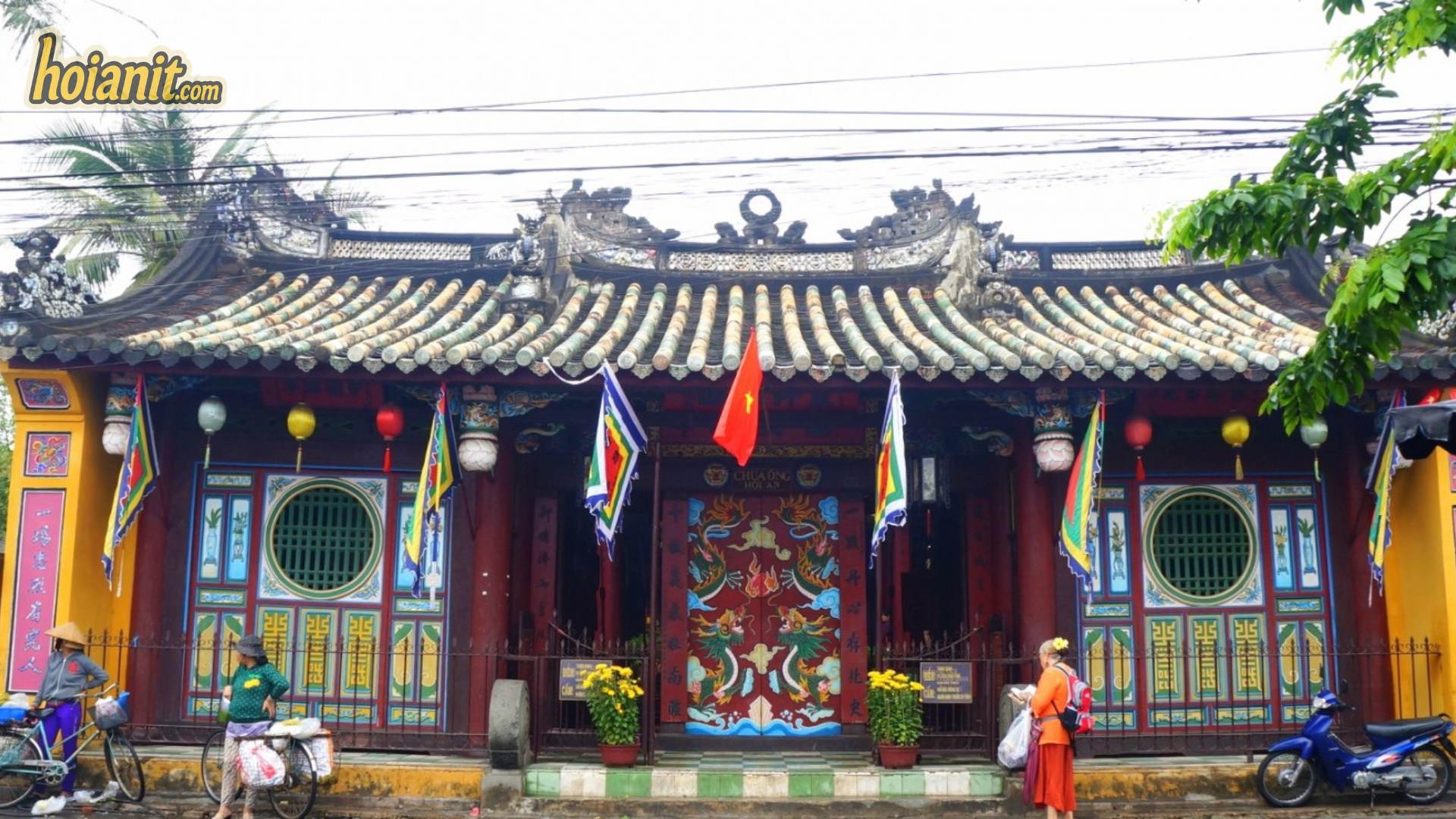
What Chua Ong Pagoda actually is — and why “pagoda” misleads
Chua Ong Pagoda is not a pagoda. It is a temple, and the distinction matters more than it sounds. A Vietnamese chua is a Buddhist establishment with monks, a Buddha hall and a resident community. What stands at 24 Tran Phu, and what everyone calls Chua Ong Pagoda, is a mieu — a shrine to a deified historical person, run by a lay community, with no monks and no Buddha as its principal figure.
The official name is Quan Cong Mieu, the Temple of Quan Cong. Older documents call it Trung Han Cung. Locals call it Chua Ong, which translates roughly as “the gentleman’s temple” — a habit of speech, not a classification. English signage then converted chua into “pagoda”, and the name stuck to every map and every ticket.
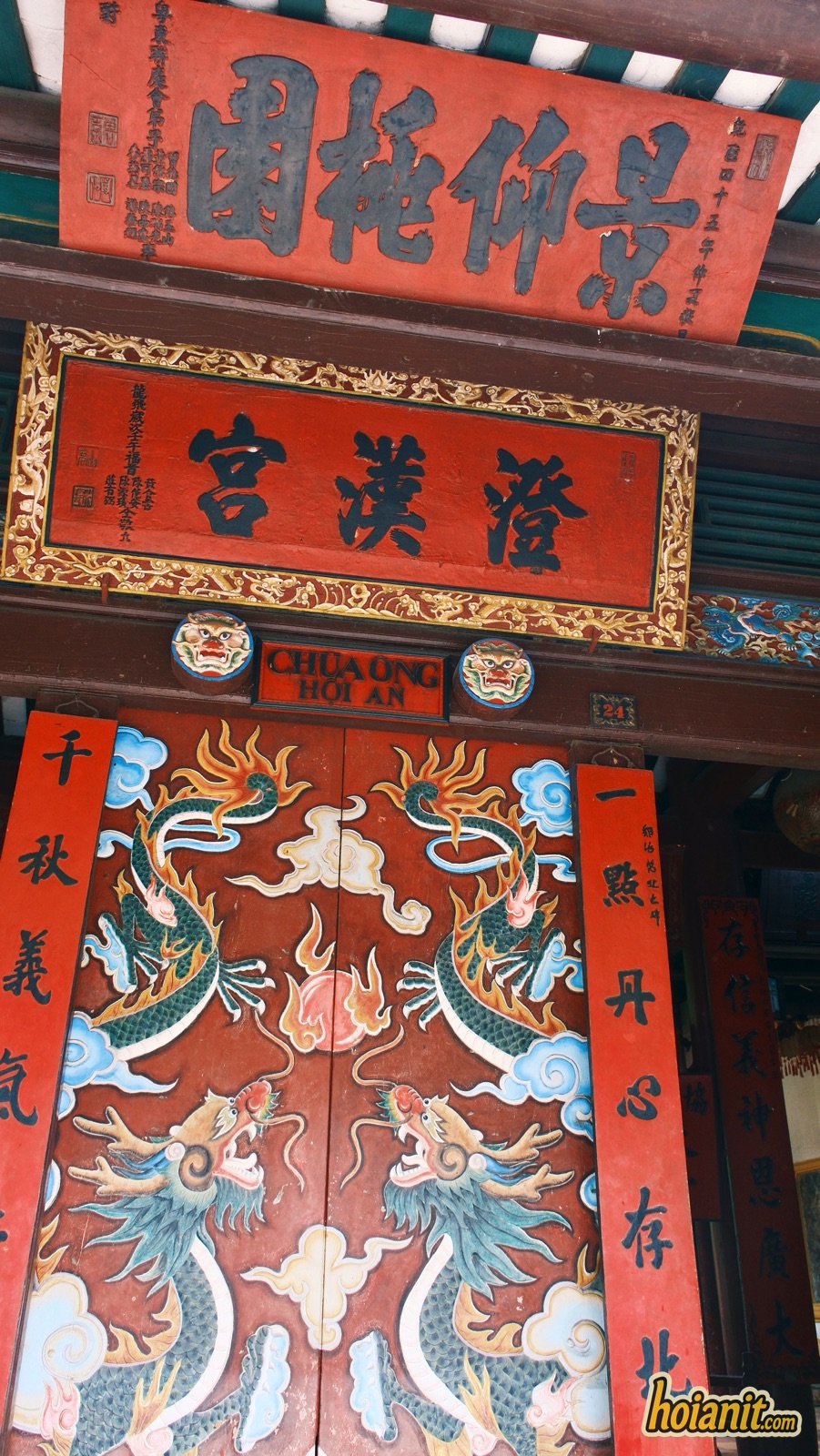
So when you walk in expecting incense-blackened Buddhas and monks in brown, you will find instead a red-faced general in armour, a war horse standing in a side hall, and a hall built for merchants swearing oaths. Knowing that in advance changes what you look at.
If you only remember one thing before you step through the door: this is a temple to a soldier, not a monastery. Everything inside follows from that.
The old ticket rule, and what changed in 2026
Chua Ong Pagoda is one of the ticketed monuments of the Old Town. For years the way the ticket was structured was the most useful thing to know before visiting; since 10 August 2026 it has become much simpler.
| Ticket | Price | What it covers |
|---|---|---|
| Adults, any nationality | 20,000₫ | Quan Cong Temple only; every other ticketed site is a separate 20,000₫ |
| Children under 16 | free | — |
Under the old 80,000₫ and 120,000₫ ticket books, the Japanese Bridge and Chua Ong Pagoda shared one slot, so choosing one closed the other. That rule ended on 10 August 2026, when Da Nang City Council moved to a flat 20,000₫ per site. Seeing both now costs 40,000₫. Ticket booths sell from 07:30 to 21:30.
Take the Japanese Bridge if this is your only day in Hoi An and you want the picture everyone recognises. Take Chua Ong Pagoda if you have more than one day, if you have already photographed the bridge from outside (you can, freely, at any hour), or if you would rather spend forty quiet minutes in a working temple than four minutes crossing a short covered bridge with a queue behind you.
Two more things worth knowing before you buy. Entry is free for visitors under 16 and over 60, for students, and for Vietnamese visitors with a documented disability — bring the document. And a group buying eight or more tickets is entitled to a guide at no extra cost, which is worth asking about at the booth rather than hiring one on the street.
Where it is and how to get there
Chua Ong Pagoda stands at 24 Tran Phu, on the north side of the street, directly opposite Hoi An Market. That position is not an accident — a temple to the god of merchants was built where the merchants were, and the market has been its neighbour for as long as either has existed.
From our shop at 84 Phan Chau Trinh it is 700 m, about 10 minutes on foot, straight down Phan Chau Trinh and left at the end. From the Japanese Covered Bridge, the other end of Tran Phu, it is 600 m, about 8 minutes. Both routes are flat the whole way.
Do not plan to ride to the door. The Old Town core is closed to motorbikes for most of the day — roughly 09:00 to 21:30 in summer and 09:00 to 21:00 in winter, with Phan Chau Trinh itself restricted from 17:30. Park outside the zone and walk in; if you are renting from us, you can leave the bike with us free of charge while you walk the Old Town, which removes the parking problem entirely.

Ten minutes from the temple door
We are at 84 Phan Chau Trinh, 700 m from Chua Ong Pagoda. Scooters, semi-automatics, electric bikes and bicycles, all with two helmets, raincoats and a map marked with the vehicle-free hours. Free parking with us while you walk the Old Town, and delivery to your hotel if you would rather not come to the shop. Prefer twist-and-go? Automatic scooter rental in Hoi An starts at 110,000₫ a day.
1653, and six restorations since
The founding date of Chua Ong Pagoda rests on a stele kept in the temple, cut in the Khanh Duc reign era in a quy ty year — 1653. The careful way to state it, and the way the Hoi An heritage authority states it, is that the temple existed by 1653 at the latest. It may be older. The stele proves the lower bound, not the beginning.
What happened afterwards is documented with unusual precision. The temple was restored in 1753, 1783, 1827, 1864, 1904 and 1966 — six recorded campaigns in a little over two centuries. The building you walk into today is essentially the nineteenth-century one; the major work of that period set the shape, the proportions and most of the decoration you see.
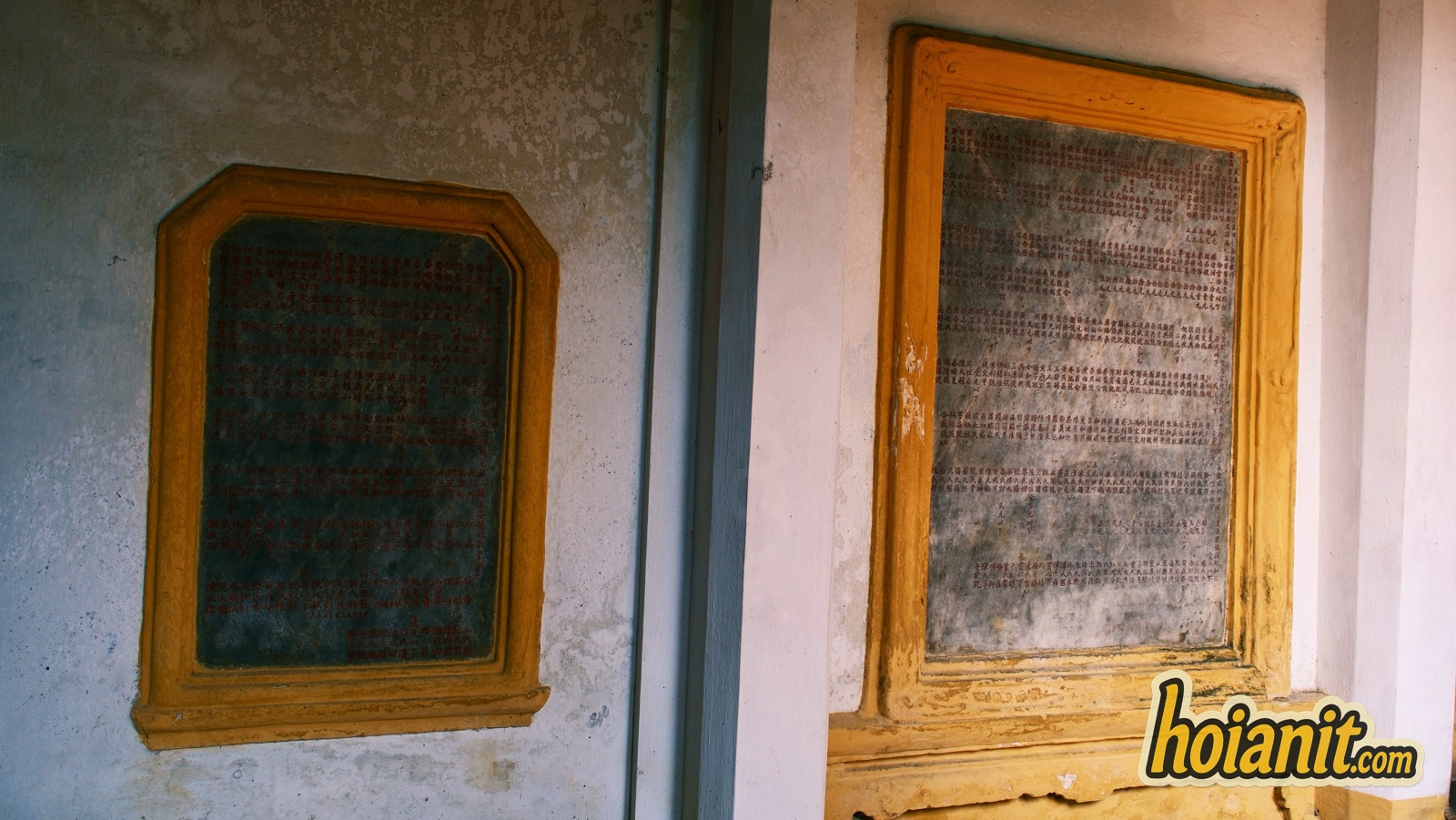
That list of dates is worth pausing on. Hoi An floods. The Thu Bon rises into these streets most autumns, and a timber building at street level on Tran Phu does not survive three and a half centuries by being lucky. It survives because a community kept rebuilding it, roughly every forty years, for three hundred years. In 1991 it was classified as a national historical and cultural monument.
A building laid out in the shape of a character
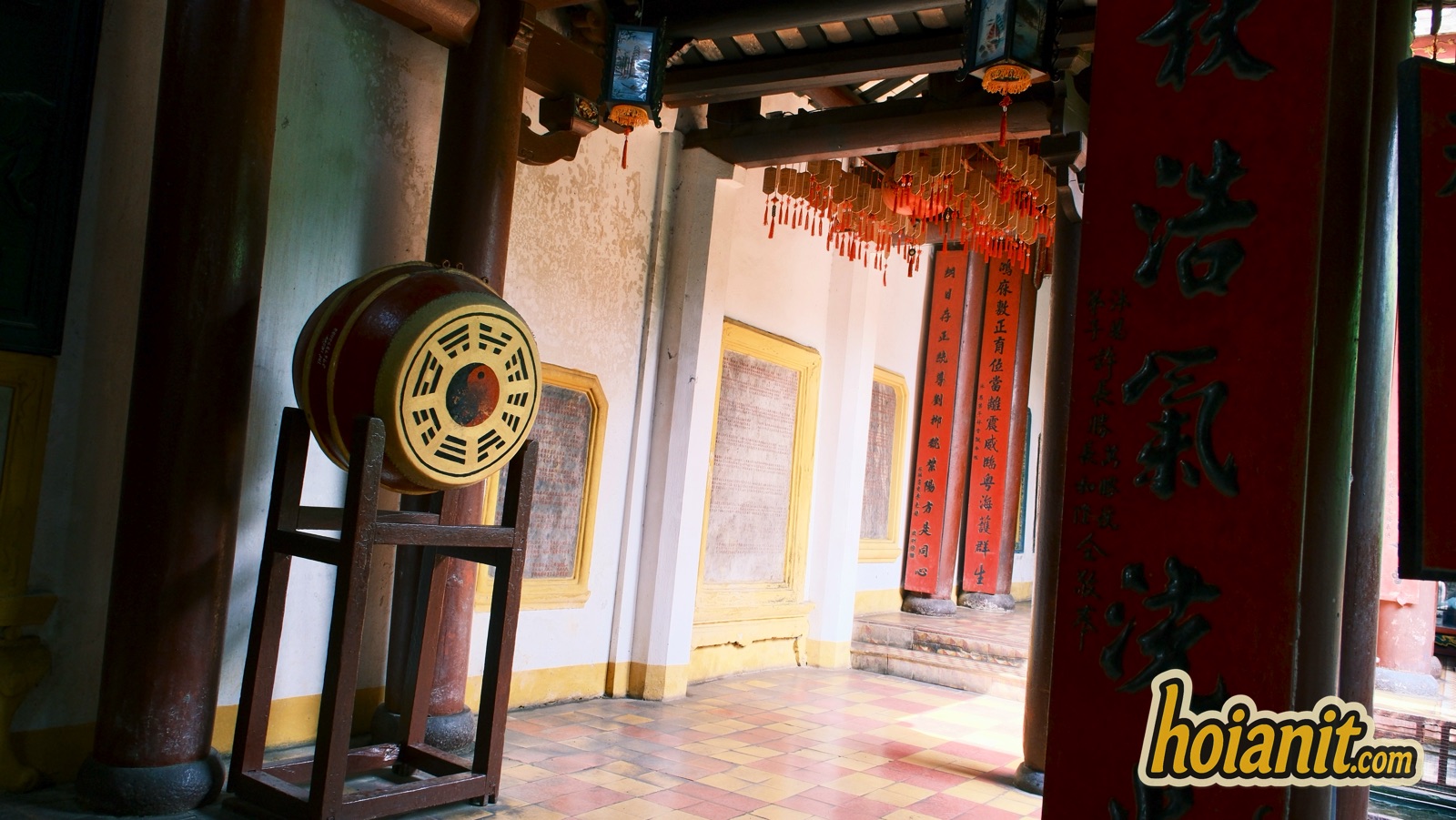
Chua Ong Pagoda is built to the plan the Chinese communities of Hoi An used for their most important halls: the shape of the written character 國 (quoc, “nation”) — a closed rectangle with a courtyard inside it.
Four structures make up that rectangle:
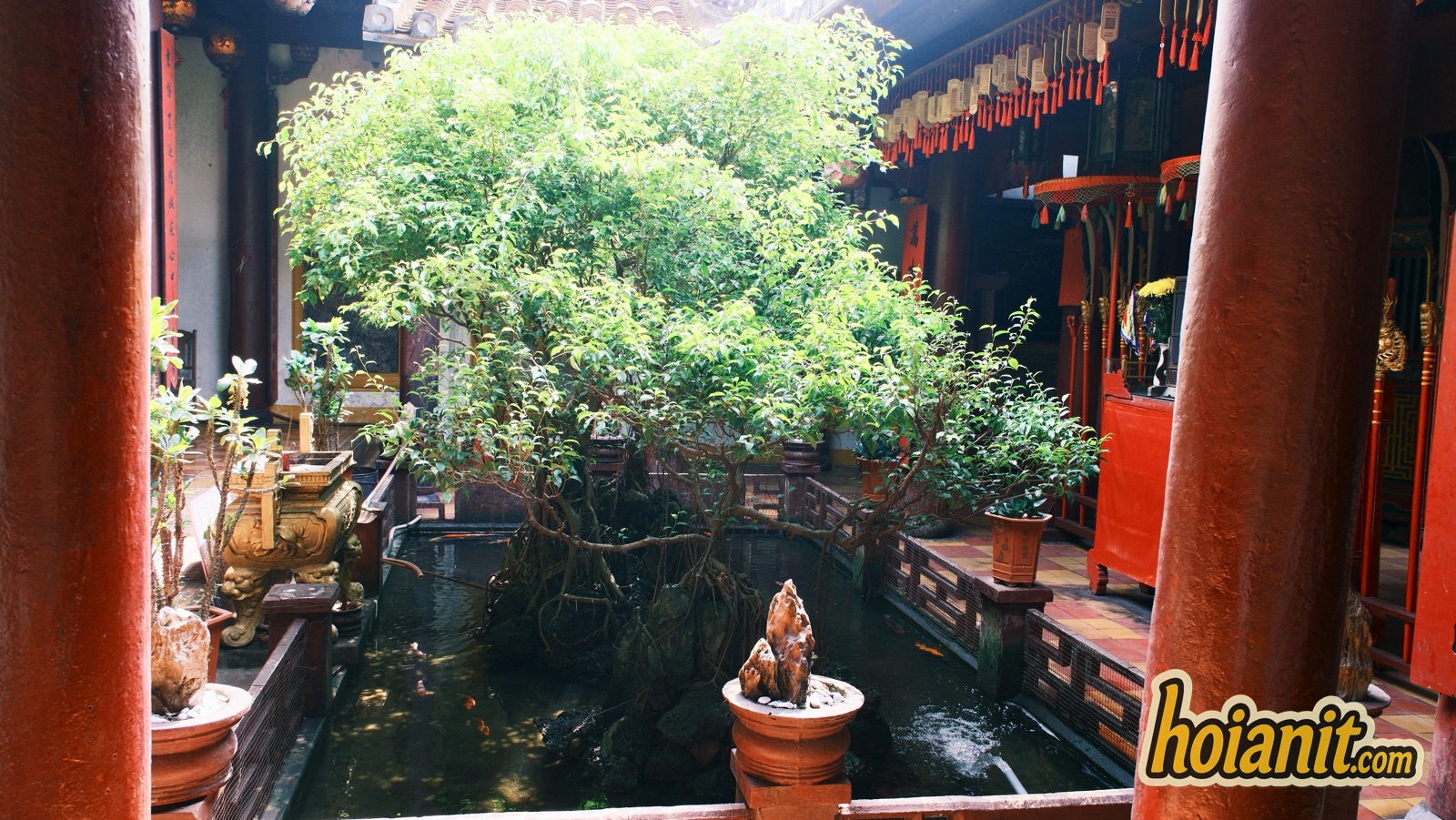
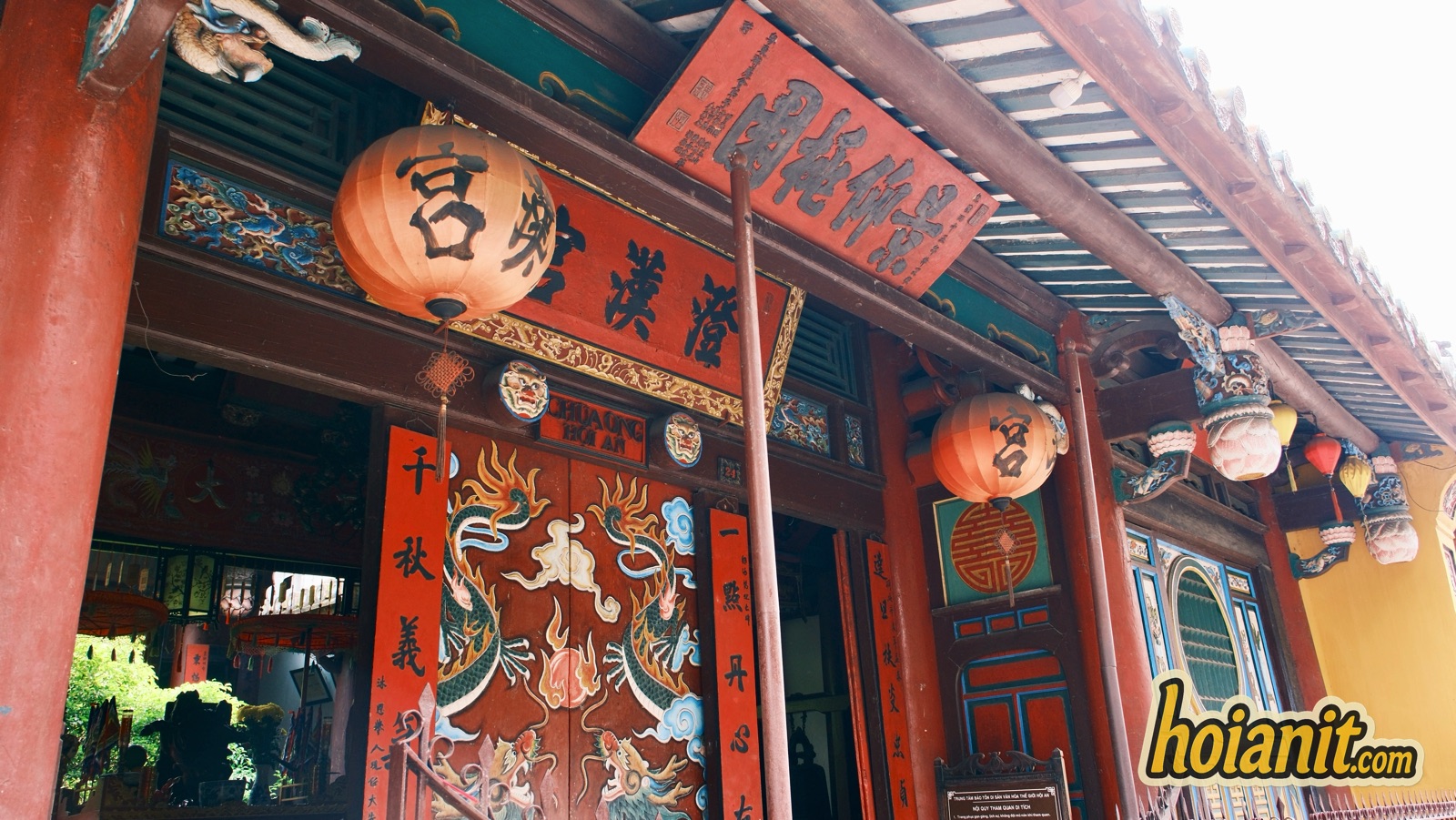
- Tien dinh — the front hall, the part you see from Tran Phu, with the painted doors and the ridge figures.
- Ta vu and huu vu — the left and right wings, running back along both sides of the courtyard. This is where the two horses stand.
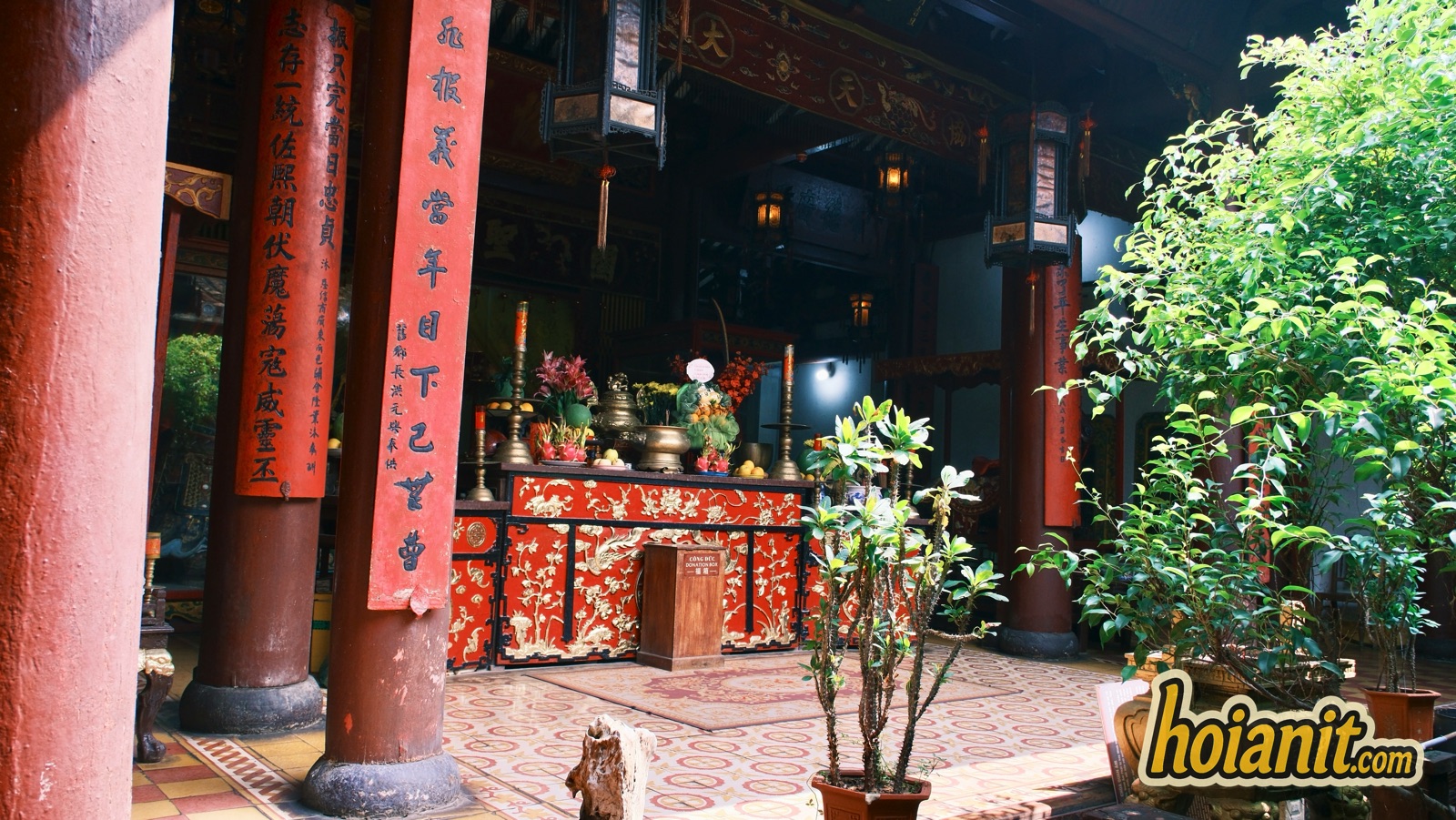
- Chinh dien — the main hall at the back, with the principal altar.
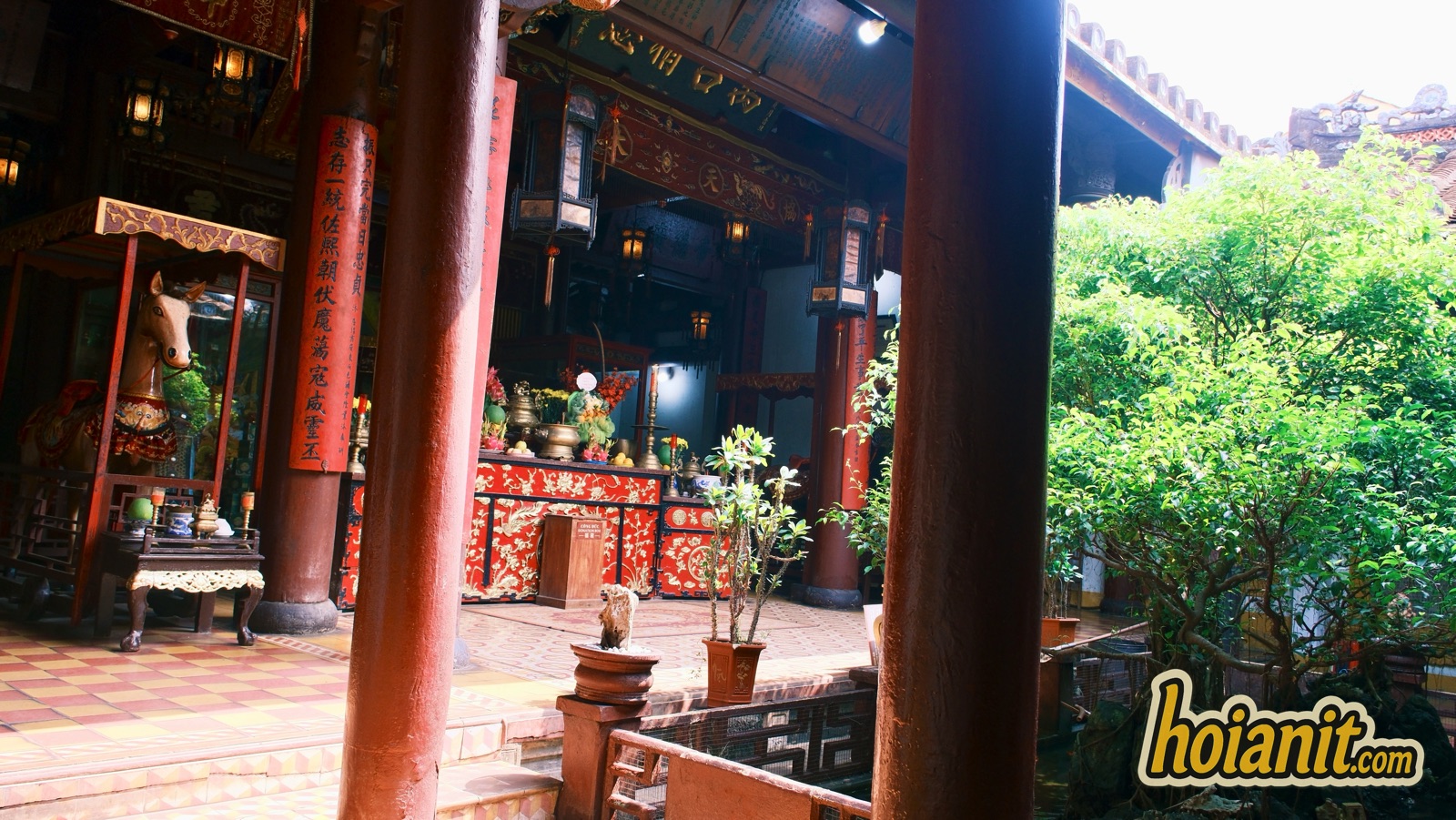
The four buildings enclose a paved open courtyard, which is the part most visitors underrate. It is where the light is, where the old trees grow out of raised stone beds, and where you can actually stand back far enough to look at a roofline. The roofs are laid with glazed tube tiles, the type the Chinese communities here traditionally used, and the roof frame is carpentered in a distinctive local manner that the heritage records single out as unusual.
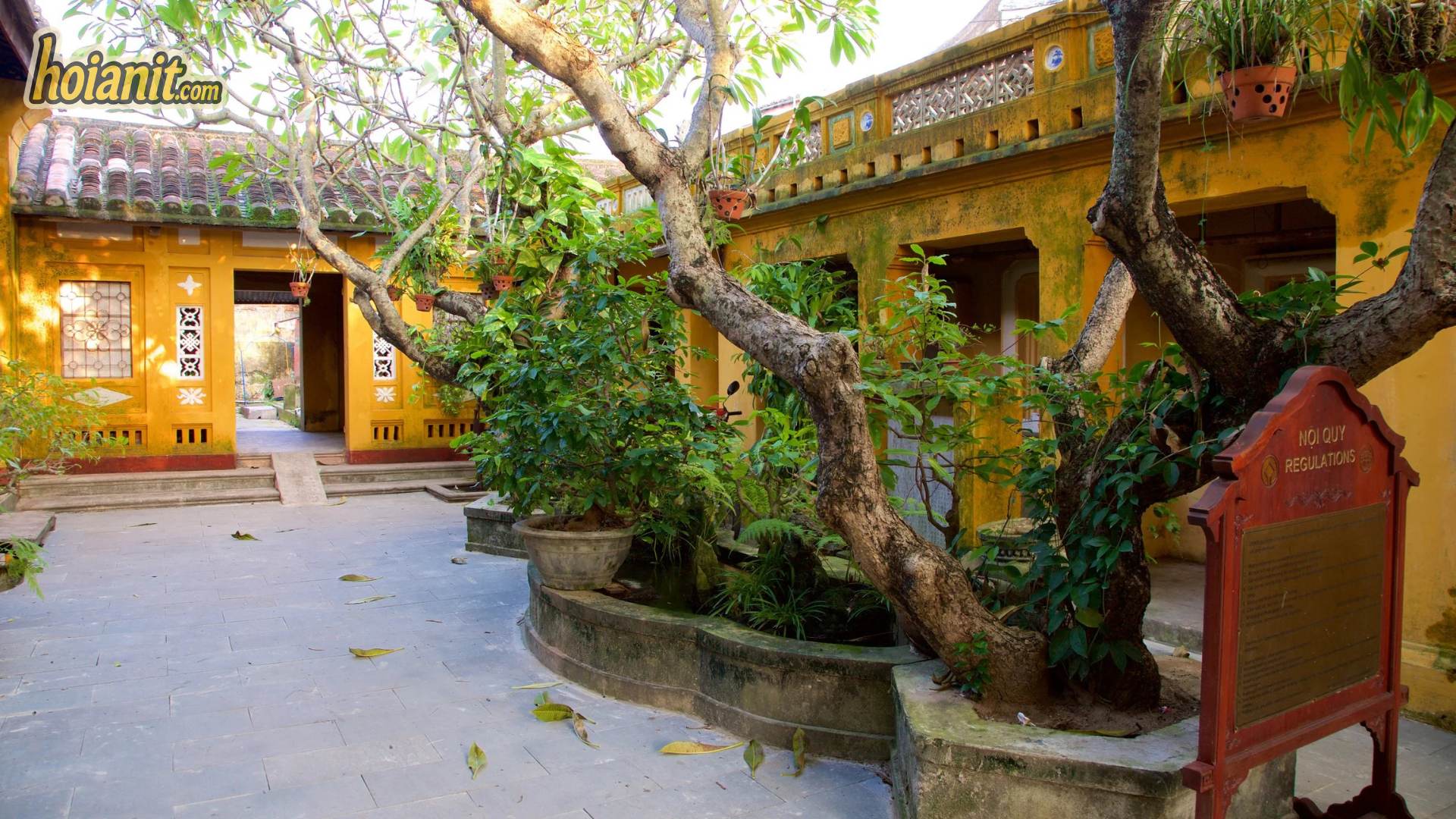
One practical consequence of the closed plan: the interior is dark and the courtyard is bright, which is a difficult combination for a phone camera. More on that in section 10.
Who is on the altar: one general, two companions, two horses
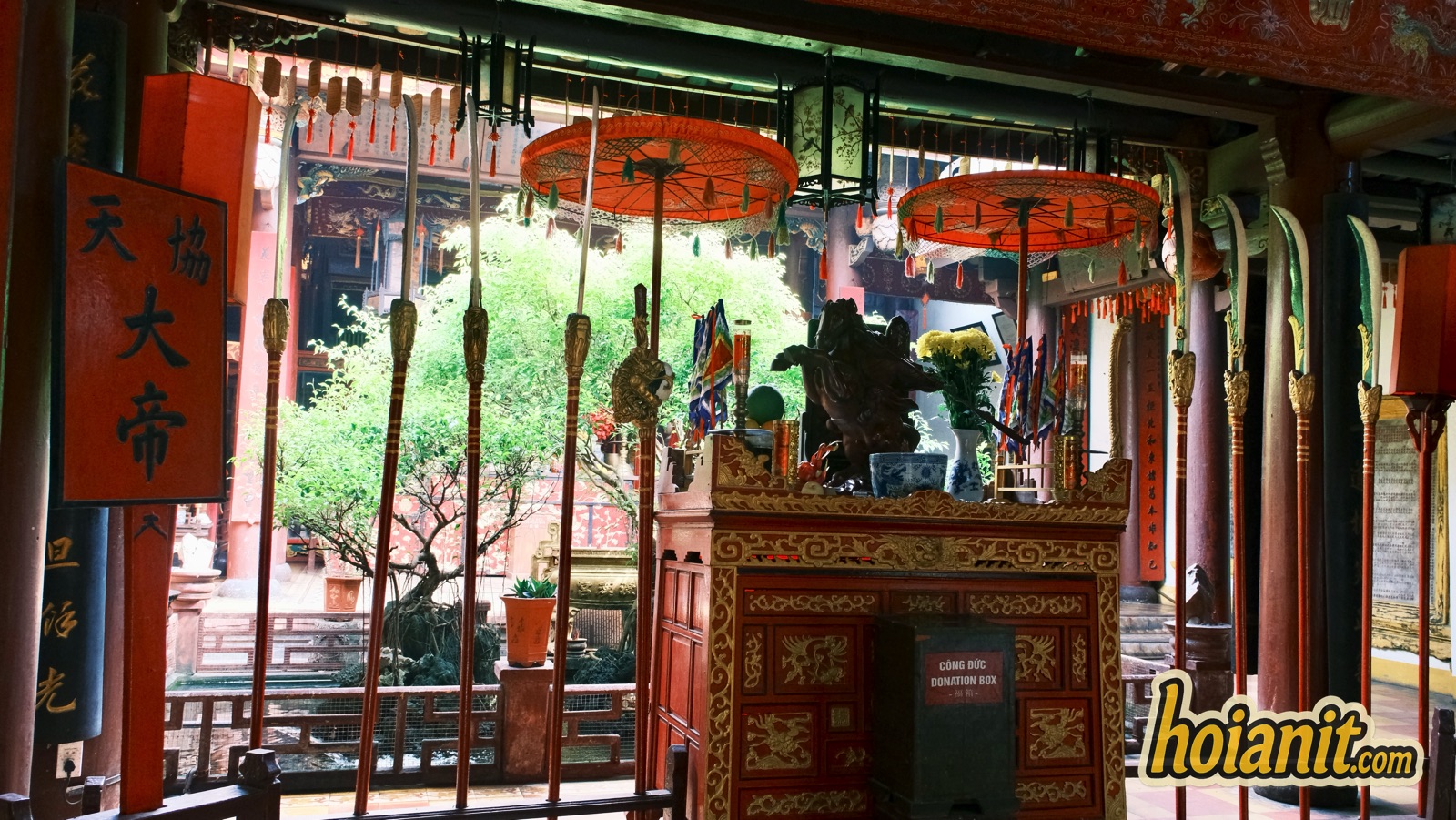
The figure the temple exists for is Quan Cong — Guan Yu, a general of the Three Kingdoms period in China, who died in 220 CE and was progressively deified over the following fifteen centuries until he held the title Quan Thanh De Quan, Saintly Emperor Guan. He stands for loyalty and for keeping your word, which is exactly why a trading port adopted him.
He is not alone. Flanking him are the two figures who accompany him in every depiction:
| Figure | Who | How to tell them apart |
|---|---|---|
| Quan Cong | Guan Yu himself, the deified general | centre, seated, red face, long beard |
| Quan Binh | Guan Ping, his son | younger, standing, civil bearing |
| Chau Xuong | Zhou Cang, his sworn retainer | dark-faced, fierce, holds the great blade |
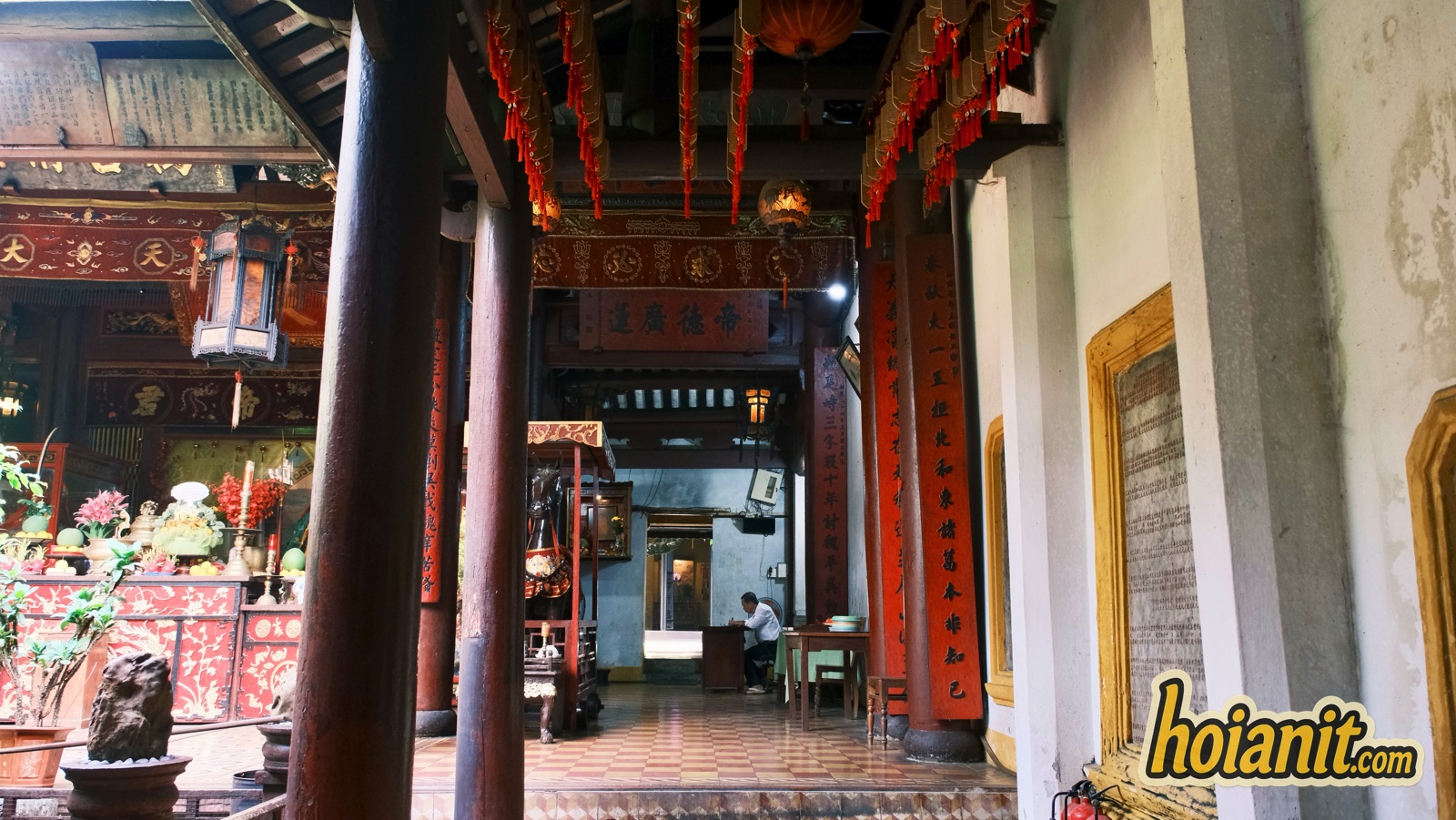
Then the two horses, life-size, one in each side wing. Xich Tho is the red horse — the legendary mount, the fastest horse of the age, given to Guan Yu and, in the story, refusing to eat after his death. Bach Tho is the white one. Visitors regularly photograph one and miss the other entirely, because they are in opposite wings and you only see the second if you walk the full rectangle.
They are objects of veneration, not exhibits. People touch them for luck and leave offerings at their feet. Photograph them if you like; do not climb on, sit beside, or pose with an arm around them.
Thirty boards and ten couplets: a merchants’ temple
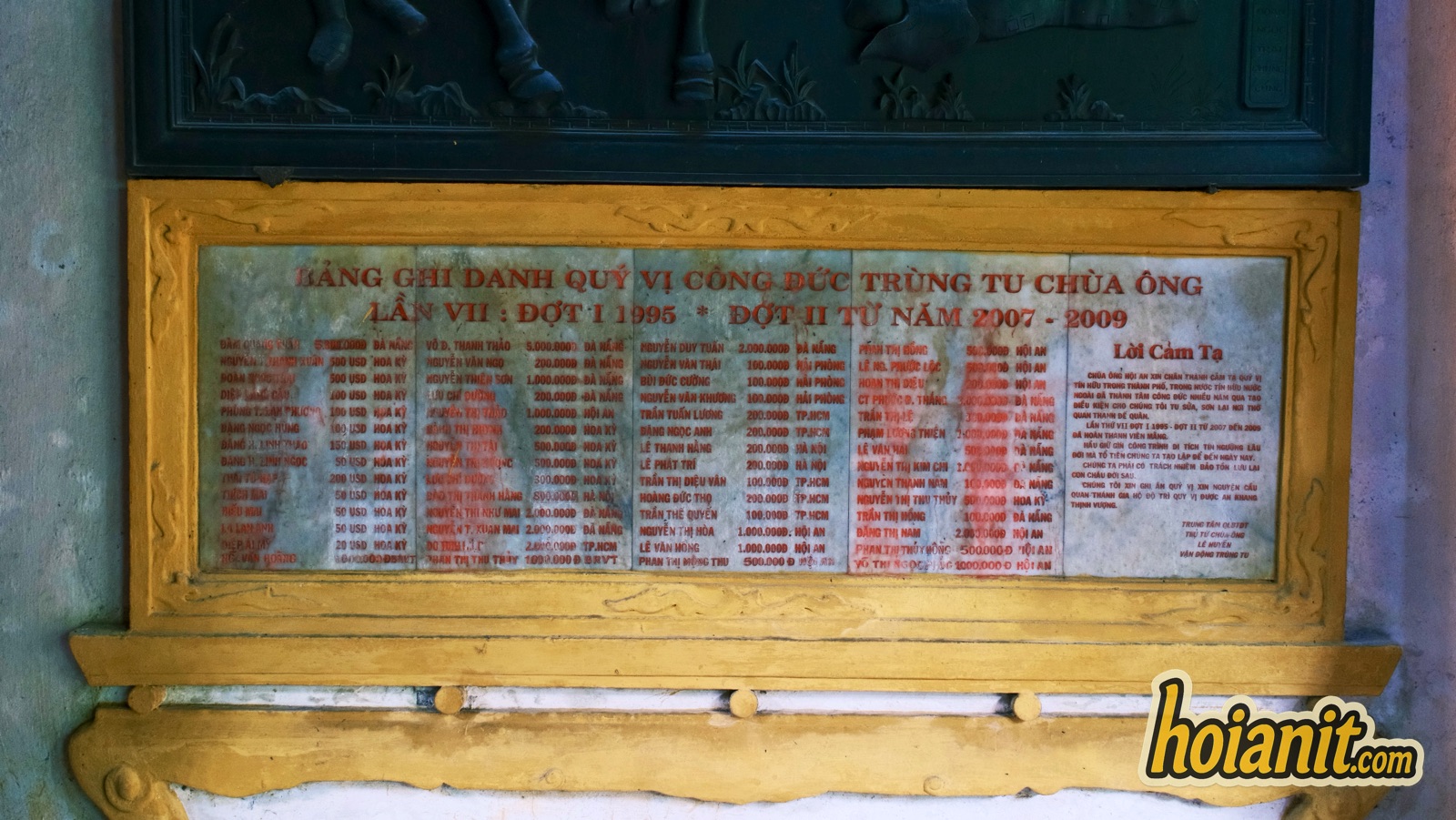
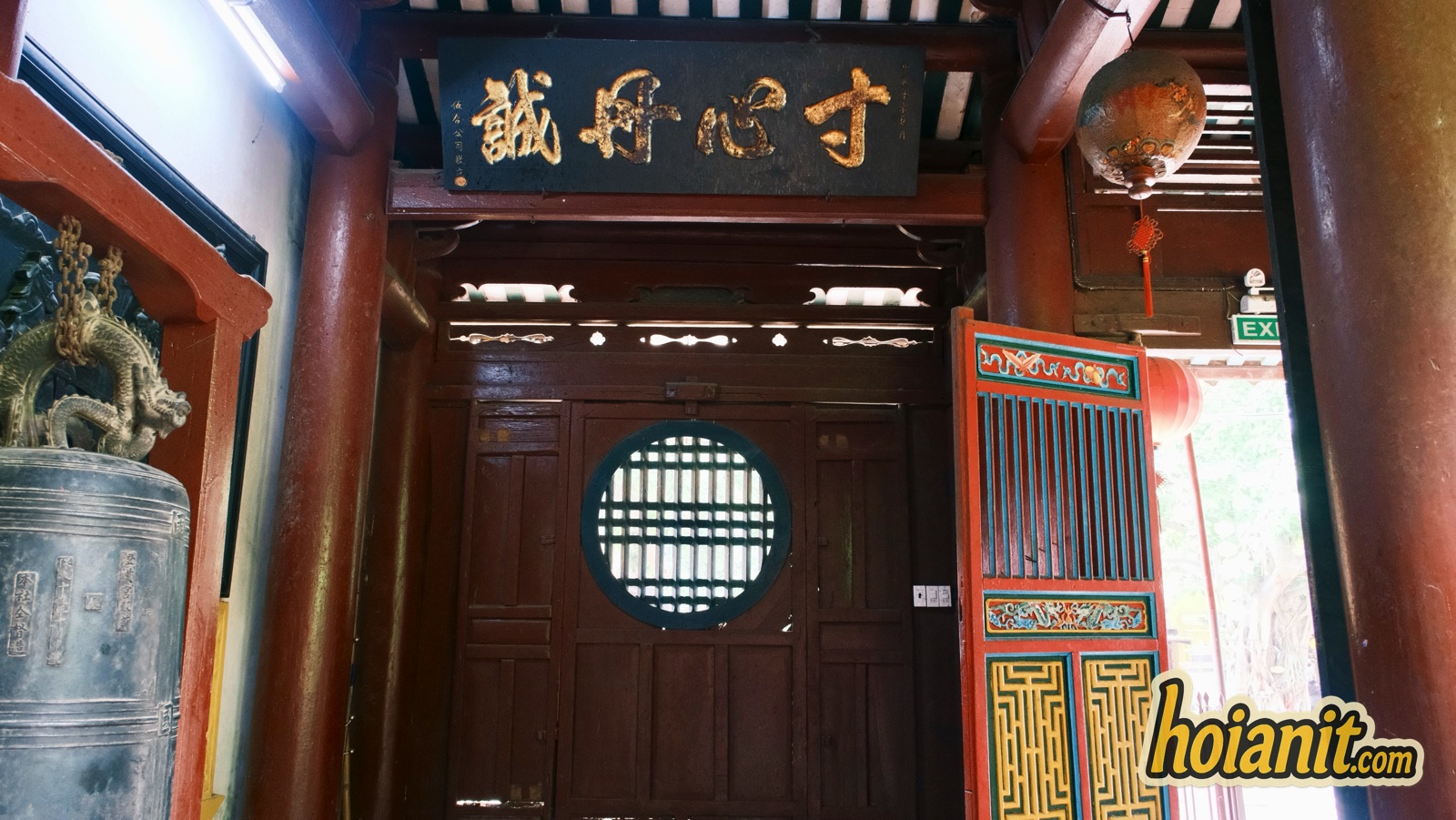
Look up, and then look at the columns. Chua Ong Pagoda holds more than thirty horizontal lacquered boards (hoanh phi) and ten pairs of vertical couplets (cau doi). This is a large number for a building of this size, and it is the clearest evidence of what Chua Ong Pagoda was for.

Boards and couplets like these were not decoration bought by the temple. They were donated — by merchant houses, guilds, and individual traders, each one a public record that a particular family had given money and wanted it known. A wall of thirty of them is three centuries of the port’s commercial community signing its name.
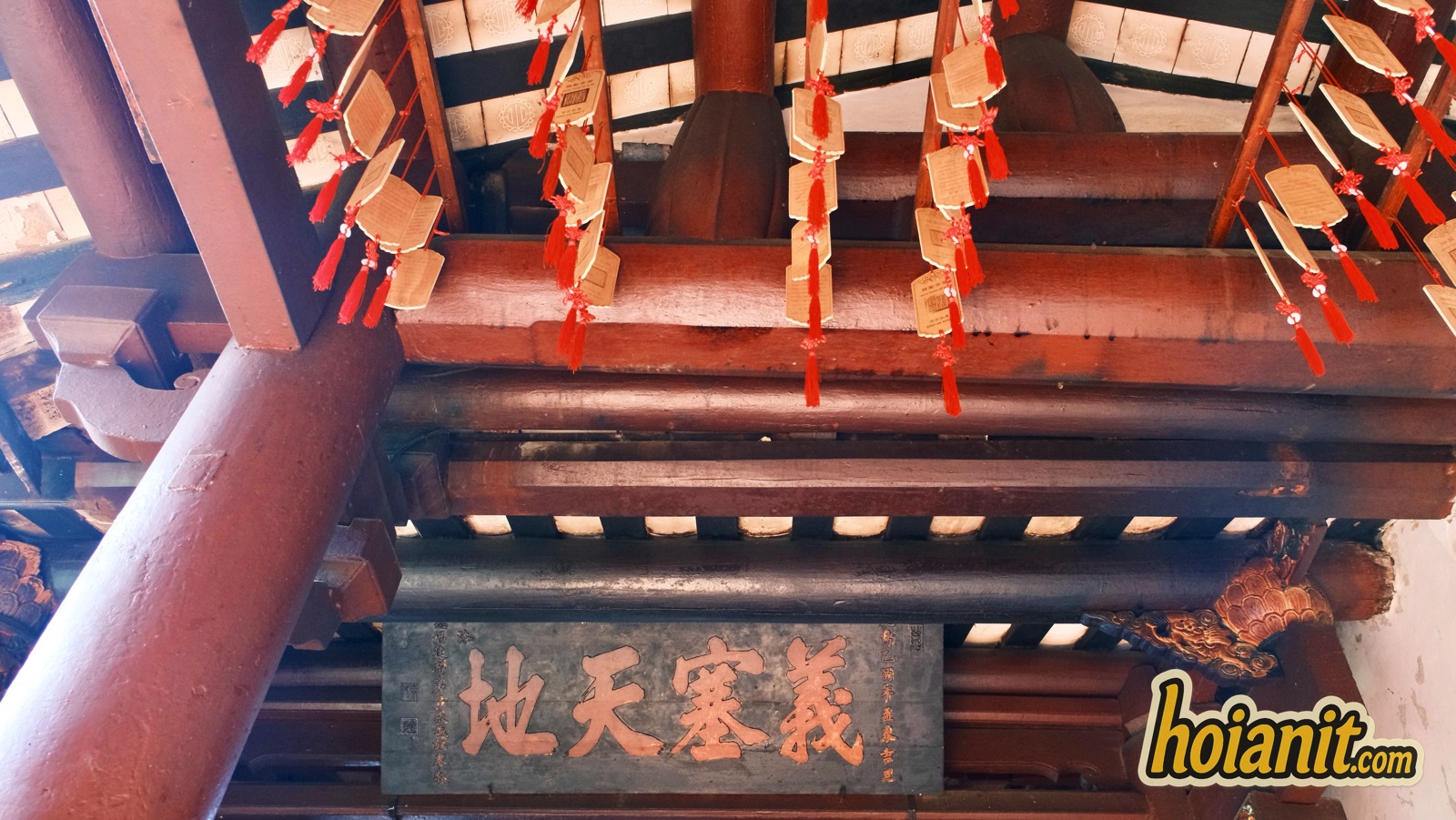
You do not need to read classical Chinese to get value from this. Stand in the main hall and count how many separate donors are represented above your head. That number is the story: a temple to the god of loyal dealing, paid for over and over by the people whose living depended on being trusted.
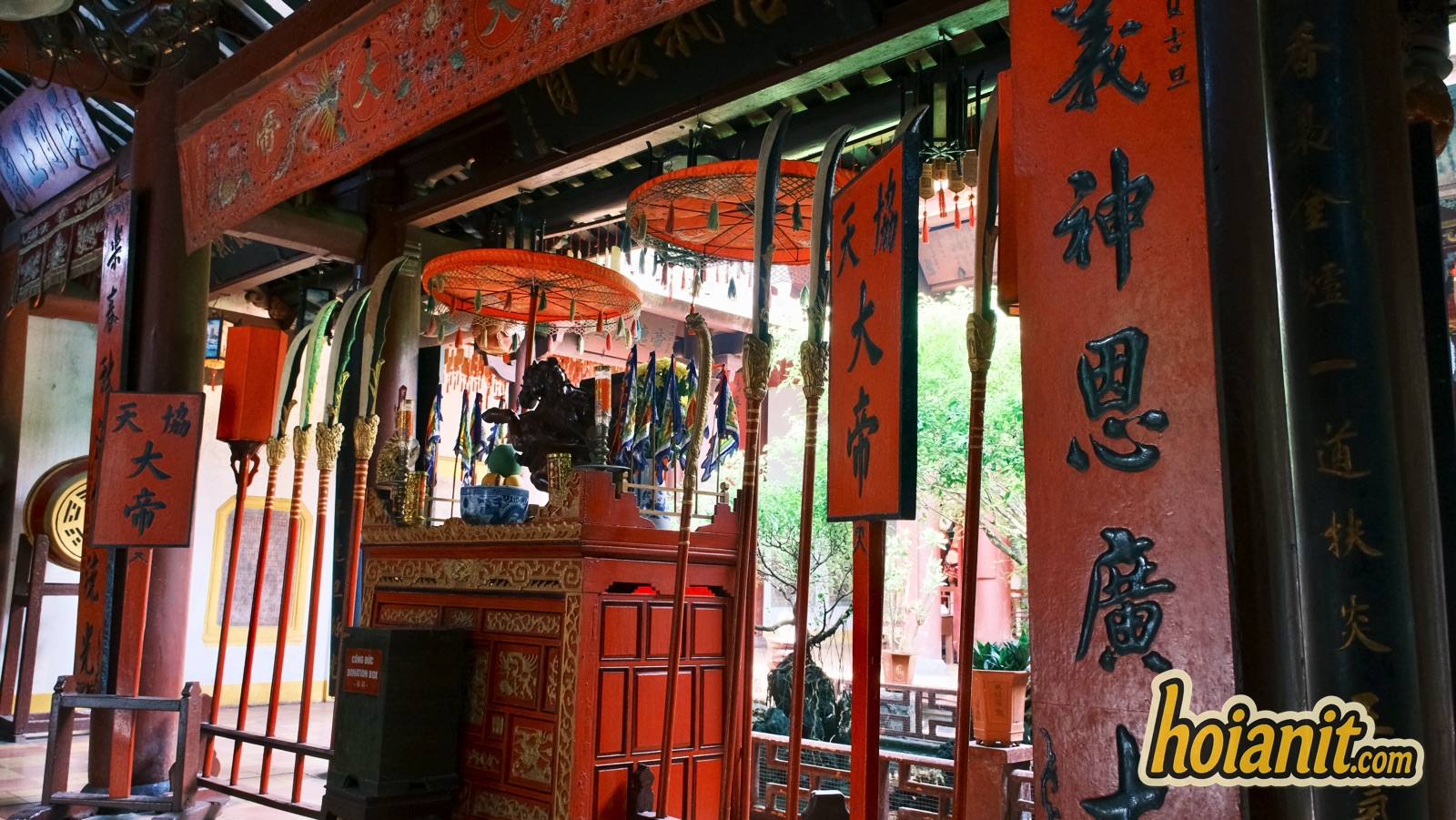
Traders came here to swear agreements in front of Quan Cong. In a port where contracts crossed languages and legal systems, an oath sworn before a god both sides feared was worth more than a document.
The two festival days that change the place
On two dates in the lunar year, Chua Ong Pagoda stops being a quiet monument and becomes the loudest place in the Old Town.
| Day | Lunar date | What happens |
|---|---|---|
| Via Ong | 16th of the 1st lunar month | the main community celebration, falling within Hoi An’s Nguyen Tieu period; lion and dragon dance troupes, offerings, crowds from across the region |
| Via Quan Hien Thanh | 24th of the 6th lunar month | the second observance: morning ritual with music and incense, roast pig, sticky rice and fruit, texts read in classical Chinese, votive papers burned, lion dance |
The first-lunar-month celebration is part of Tet Nguyen Tieu in Hoi An, which is itself listed as national intangible cultural heritage — you will see the emblem saying so displayed at the temple during the festival. Worshippers come from Da Nang, Tam Ky and Quang Ngai, and the street outside fills with lion troupes working from door to door.
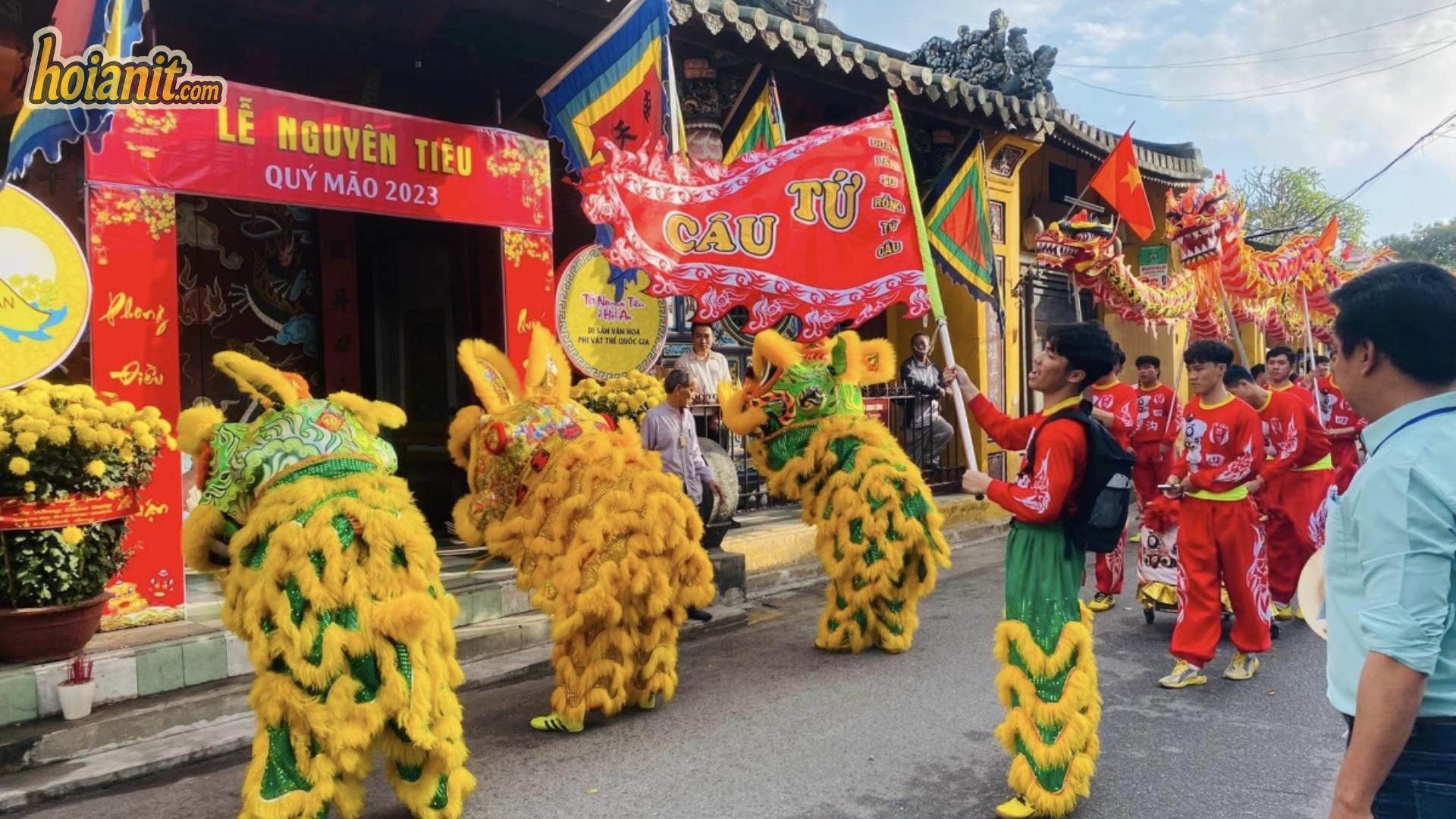
Both dates move against the Gregorian calendar every year. If you want to be there, check the lunar date for your travel year rather than assuming a month — the 16th of the 1st lunar month can land anywhere from early February to early March.
Inside in 25 minutes, in order
A route that gets you everything without doubling back:
- Stop outside first (2 min). Stand across Tran Phu, by the market side, and look at the whole facade — the ridge figures, the glazed tiles, the painted doors. You cannot see the roof properly from inside the courtyard.
- The front hall (3 min). Through the doors, look up immediately: the roof frame and the first of the lacquered boards.
- The courtyard (5 min). Stand in the middle. This is your only wide view of the enclosed plan and the four rooflines.
- Right wing, then left wing (6 min). One horse in each. Walk both; almost everyone walks one.
- The main hall (7 min). Quan Cong seated in the centre, Quan Binh and Chau Xuong flanking. Then look above and behind you at the boards and columns.
- Back through the courtyard (2 min). Different light on the way out, especially in the late afternoon.
Twenty-five minutes covers it. Forty if you read the boards or the place is busy. On a festival day, budget an hour and expect not to move freely.
Etiquette, photography and the best hours
This is a working temple with people praying in it, not a museum with a rope line. The rules are short and locals notice when they are ignored.
- Cover shoulders and knees. Not enforced at the door, but it is the difference between being a guest and being a nuisance. Carry a light scarf in hot weather.
- Take your hat off in the halls, and keep your voice down. Sound carries badly in an enclosed courtyard.
- Do not walk in front of someone who is praying, and do not stand between a worshipper and an altar to get a photograph.
- No flash, ever, near the altars or the lacquered boards.
- Do not touch the statues, the horses, the boards or the offerings.
- If you light incense, take it from where it is offered and follow what the person in front of you does. It is not compulsory and nobody expects it of you.
Best hours. Aim for 07:30–09:00 or 15:30 to closing. Early morning gives you the temple almost to yourself and low sun on the front of the building; late afternoon gives warm light down into the courtyard. The middle of the day is the worst of both worlds — hard overhead light in the courtyard, near-black interiors, and the largest crowds.

Stand inside a hall and shoot outwards towards the courtyard rather than the reverse: the doorway frames the shot and the exposure difference works for you instead of against you. For the altar, brace the phone against a column and tap the darkest part of the frame to expose for it. And take the facade shot from across Tran Phu — from the pavement directly in front you will only get roof and sky.
Flood season. From roughly October to December the Thu Bon can put water into these streets. When Tran Phu floods, Old Town monuments close without notice. If you are here in those months, ask at your hotel in the morning before making the walk.
What to combine it with
Chua Ong Pagoda sits in the densest part of the Old Town, which makes it an easy anchor for a half-day on foot.
- Hoi An Market — directly across Tran Phu. Thirty seconds. Go for breakfast before the temple, or for cao lau after.
- Quan Thang Ancient House (77 Tran Phu) — about a minute along the same street. Small, quiet, the densest wood carving of any house in town.
- Duc An Ancient House (129 Tran Phu) — a few minutes west, a former bookshop with a genuine political history.
- Fukien Assembly Hall (46 Tran Phu) — two minutes. The grandest of the Chinese halls, and a useful contrast: an assembly hall built by one community, versus a temple used by all of them.
- Japanese Covered Bridge — 600 m, 8 minutes west along Tran Phu. Free to look at and photograph from outside at any hour; the 20,000₫ entry is only for walking through it.
- An Hoi Bridge — for the end of the day, when the lanterns come on across the river.
A sensible order: market at 07:30, Chua Ong at 08:00 while it is empty, Quan Thang and Fukien through the late morning, lunch, then the riverside in the afternoon. If you want to get out of the Old Town afterwards — the beaches, Tra Que, the Marble Mountains — that is the point at which a bike stops being optional; the routes are in our Hoi An motorbike rental guide.
Chua Ong Pagoda: frequently asked questions
Where is Chua Ong Pagoda in Hoi An?
At 24 Tran Phu, on the north side of the street directly opposite Hoi An Market. From 84 Phan Chau Trinh it is 700 m, about a 10-minute walk; from the Japanese Covered Bridge it is 600 m, about 8 minutes.
Do you need a ticket for Chua Ong Pagoda?
Yes. It is one of the ticketed Old Town monuments. Since 10 August 2026 entry is 20,000₫ per person, the same for Vietnamese and foreign visitors, and children under 16 go free. Ticket booths sell from 07:30 to 21:30.
Is it true you have to choose between Chua Ong and the Japanese Bridge?
Yes. Since 10 August 2026 each site is paid separately at 20,000₫ per person, so the Japanese Covered Bridge and Quan Cong Temple together cost 40,000₫. The old rule that made you choose one of the two no longer applies.
What time does Chua Ong Pagoda open and close?
Daytime only. Published sources give an early-morning opening and Google lists closing at 17:30; there is no evening opening, unlike some Old Town sites. Treat late afternoon as the cut-off and do not plan a visit after dinner.
How old is Chua Ong Pagoda?
It existed by 1653 at the latest, the date on a stele held in the temple. It may be older — the stele sets the lower bound. It was restored in 1753, 1783, 1827, 1864, 1904 and 1966, and classified as a national historical and cultural monument in 1991.
Is Chua Ong Pagoda a Buddhist temple?
No. Despite the English name, it is a mieu — a shrine to a deified figure, not a Buddhist chua with monks. The principal figure is Quan Cong (Guan Yu), a Chinese general of the Three Kingdoms period venerated as a god of loyalty and honest dealing, especially by merchants.
How long does a visit take?
25 minutes covers the front hall, the courtyard, both side wings with their horses, and the main altar. Allow 40 minutes to read the lacquered boards or if it is busy, and an hour on a festival day.
When are the festivals at Chua Ong Pagoda?
Two dates: Via Ong on the 16th of the 1st lunar month, part of Hoi An’s Tet Nguyen Tieu, with lion and dragon dances and crowds from across the region; and Via Quan Hien Thanh on the 24th of the 6th lunar month, with a morning ritual, offerings and lion dance. Both shift against the Gregorian calendar each year.








Pick your ride in Hoi AnChọn xe cho chuyến đi Hội An
Scooters, electric bikes and bicycles from one shop in the Old Town — delivered to your hotel, helmets and roadside help included.Xe máy, xe điện và xe đạp — giao tận khách sạn, kèm hai nón bảo hiểm và hỗ trợ dọc đường.
Not sure which one fits? Message us on WhatsApp and we’ll recommend a bike for your plans.
Chưa biết chọn xe nào? Nhắn Zalo 0935 439 306, tụi mình tư vấn theo lịch trình của bạn.