
Routes & Day Trips
Cam Dong Bamboo Bridge: 80 Metres of Bamboo Rebuilt Every Year, 11,5 km from Hoi An
Cam Dong Bamboo Bridge: 80 Metres of Bamboo Rebuilt Every Year, 11,5 km from Hoi An
The Cam Dong bamboo bridge is 11,5 km from Hoi An Old Town and almost nobody on a tour bus has heard of it. It is not a tourist attraction.
The Cam Dong bamboo bridge is 11,5 km from Hoi An Old Town and almost nobody on a tour bus has heard of it. It is not a tourist attraction. It is 80 metres of bamboo that around forty farming households build by hand every year after Tet so they can carry vegetables across a branch of the Thu Bon river – and every year the flood takes it away again. This guide has the real numbers, the ride, and how to visit the Cam Dong bamboo bridge without getting in the way of the people who need it.
- What the Cam Dong bamboo bridge actually is
- The part that makes it remarkable: it is temporary on purpose
- When to see the Cam Dong bamboo bridge, and when there is nothing there
- How to ride to the Cam Dong bamboo bridge from Hoi An
- Crossing it: what it feels like and whether you should
- What else is near the Cam Dong bamboo bridge
- The address problem, and why your map may be wrong
- Cam Dong bamboo bridge vs the other bridges near Hoi An
- Frequently asked questions
What the Cam Dong bamboo bridge actually is
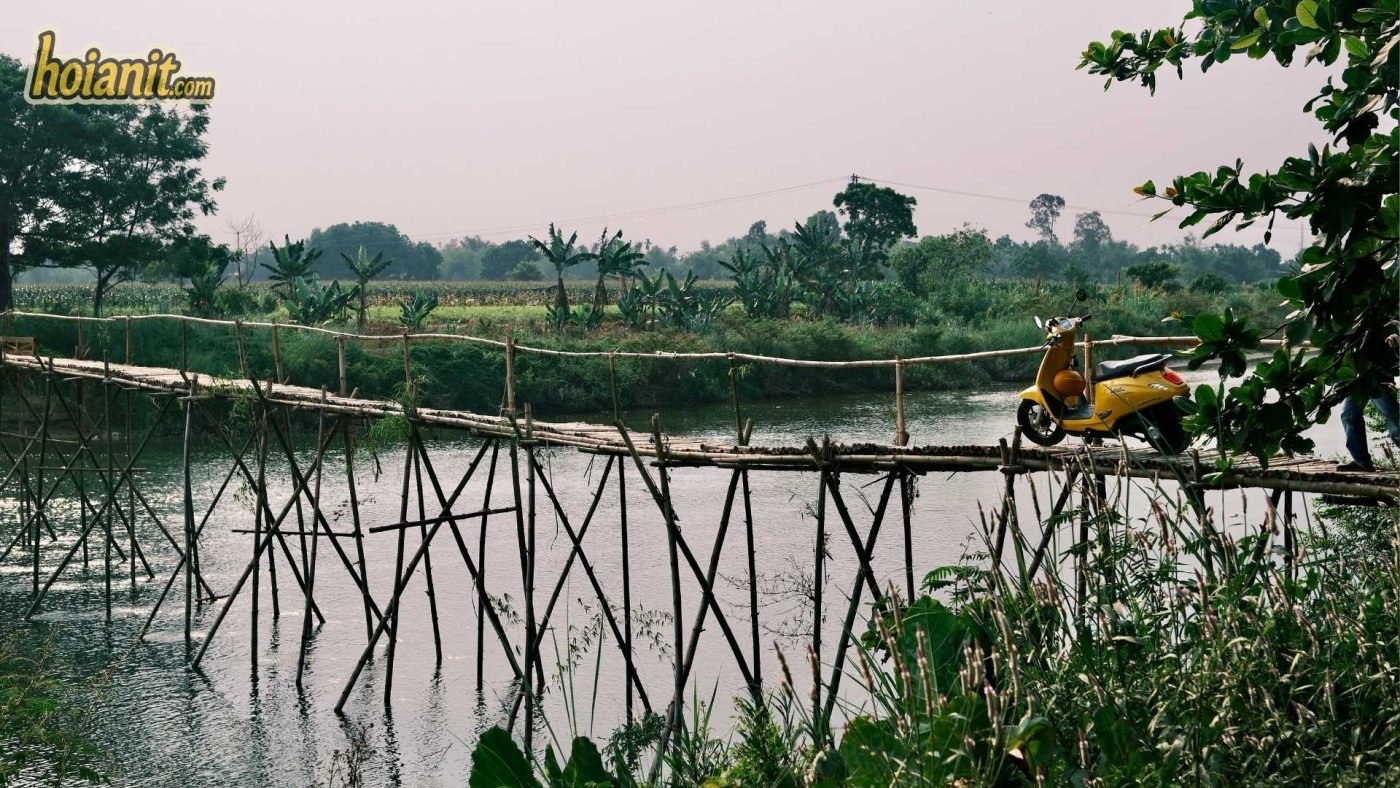
Cam Dong is a hamlet in Go Noi, the flat river island country west of Hoi An. A branch of the Thu Bon river cuts the village off from around 50 hectares of its own farmland – the good soil, the fields the whole hamlet lives on. There is no road bridge. There has never been a road bridge.
So every year the farmers build the Cam Dong bamboo bridge out of bamboo themselves.
The numbers
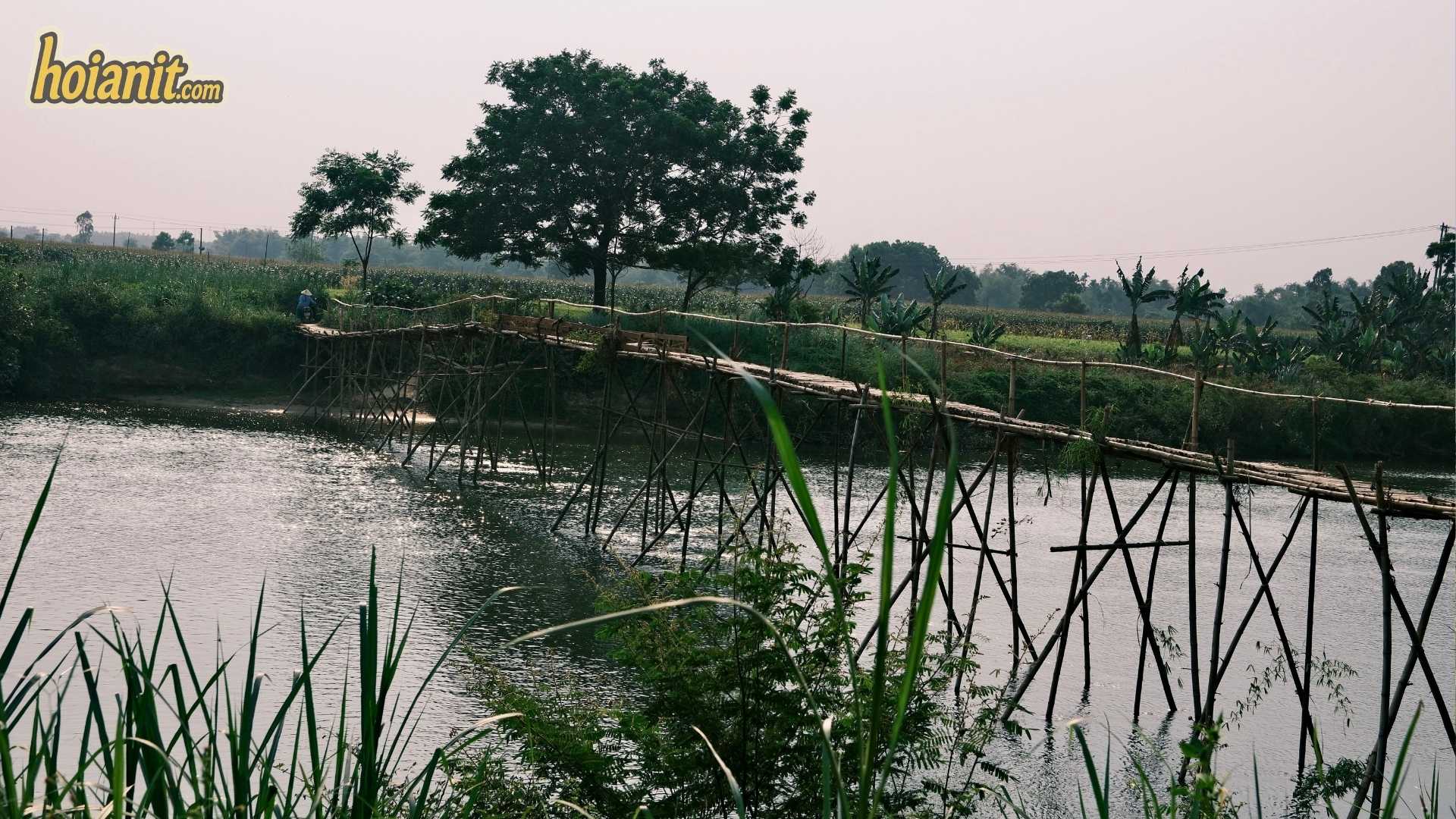
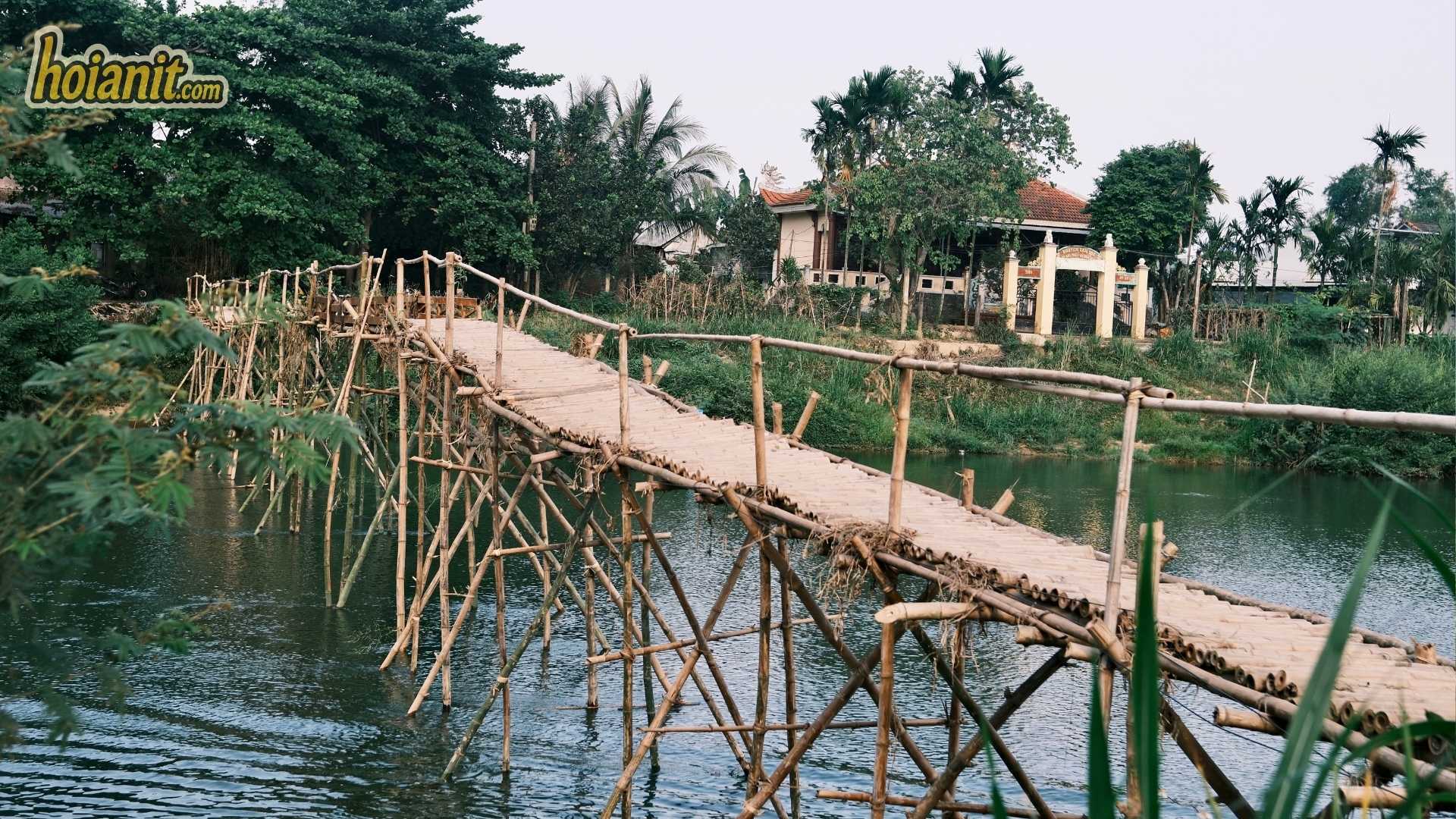
The 2024 rebuild is the best-documented one and gives you the scale. Around forty households on the far bank contributed bamboo, money and labour. Dozens of small boats were used to drive the piles. The finished Cam Dong bamboo bridge was 80 metres long and one metre wide, built from 400 bamboo poles, standing on 27 bamboo piers over six metres tall and spaced three metres apart, all lashed with wire. Sections were left with a five-metre clearance so boats could still pass underneath. It took ten days.
The man who organises it
Mr Nguyen Lo, who was 77 at the time of that rebuild, called the meeting and directed the work. That detail is worth holding onto when you stand on it: this is not a heritage project or a tourism initiative. It is a village committee run by a man in his late seventies, financed by farmers putting in 500.000₫ and five bamboo poles each.
The part that makes it remarkable: it is temporary on purpose
The Cam Dong bamboo bridge is not built to last. It is built to be lost.
Every wet season the Thu Bon floods and takes it. Some years that happens once, in October or November. In years with a big lu tieu man – the early-summer flood that arrives around May – it happens twice, and the village builds it twice. When the bridge is gone the farmers cross by boat, which is slower, harder and considerably more dangerous with a hundred kilos of vegetables.
So the rhythm of the year in Cam Dong goes: flood takes the bridge, winter passes, after Tet the village cuts bamboo and rebuilds, farming resumes, the flood comes back. This has been the pattern for generations.
Why there is no permanent bridge
There is a plan to replace the Cam Dong bamboo bridge. Cam Dong hamlet has close to 370 households, roughly 300 of whom farm nearly 100 hectares across the water, and the local authority approved a steel bridge project worth more than two billion dong at the second bamboo crossing about a kilometre west. As of the last reporting, the funding had not been allocated. Until it is, the bamboo goes back up every spring.
When to see the Cam Dong bamboo bridge, and when there is nothing there
This is the single thing to get right. The Cam Dong bamboo bridge does not exist for part of every year.
| Months | Is the bridge there? | Notes |
|---|---|---|
| March – May | Yes, newly built | Best window. Bamboo still pale, fields green, everything working. |
| June – August | Usually yes | Weathered and darker. May have been rebuilt once already after an early-summer flood. |
| September | Probably | Check before riding out. First floods can arrive. |
| October – December | Often gone | Flood season. The river takes it. You will find piles or nothing. |
| January – February | Usually gone | Rebuilt after Tet, so late February is the changeover. |
Time of day
Early morning is the reason to come to the Cam Dong bamboo bridge. Farmers cross with hand carts of vegetables between about 05:30 and 08:00, traders wait on the near bank, and the light along the river is soft. By ten it is an empty bamboo bridge in flat sun. Late afternoon works too, with the return crossing and better colour, but the morning traffic is the picture.
How to ride to the Cam Dong bamboo bridge from Hoi An
The Cam Dong bamboo bridge is 11,5 km away, around 28 minutes, and one of the more pleasant short rides out of town because almost none of it is on a main road.
The route
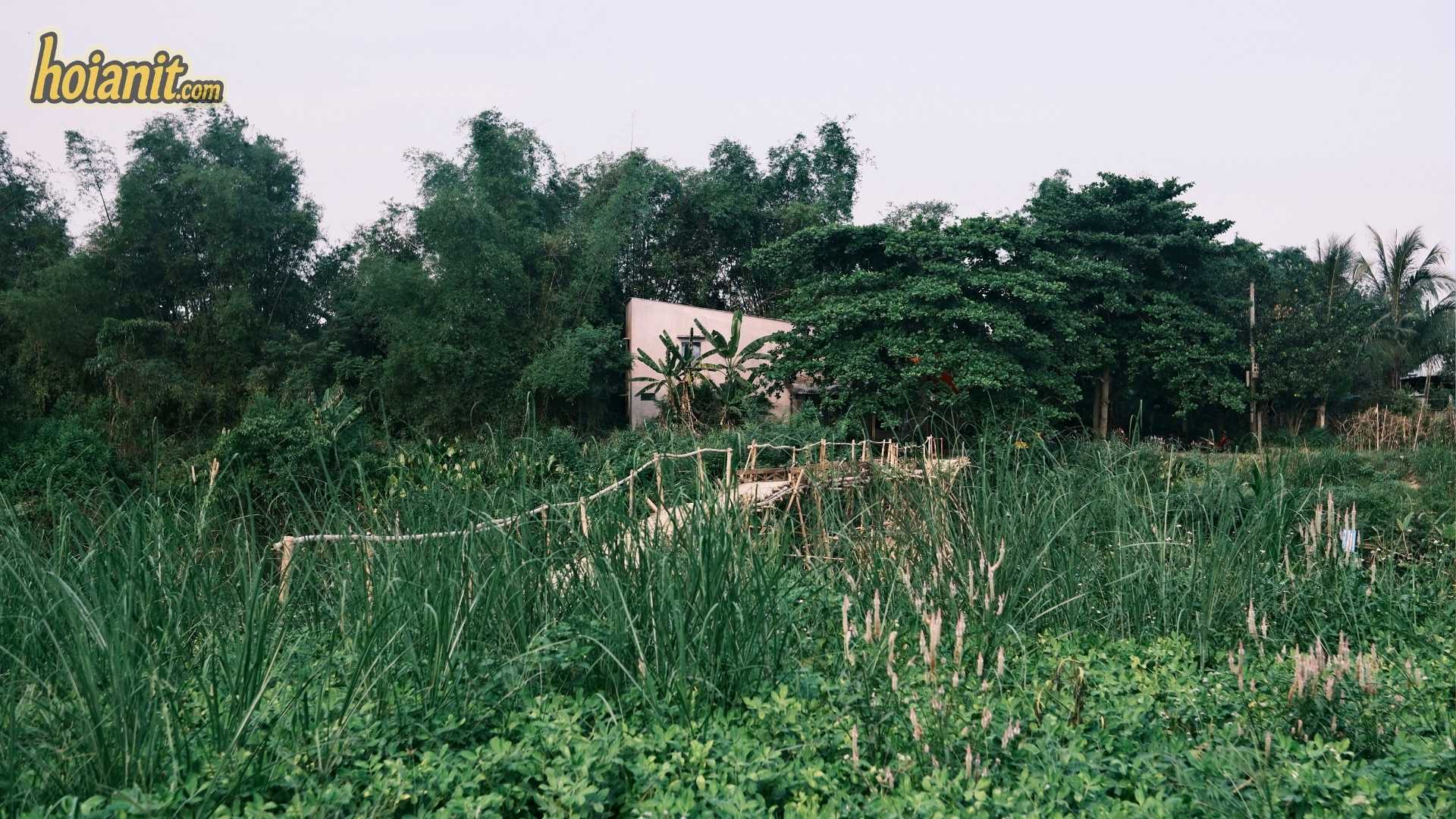
From the Old Town head west on Hung Vuong, pick up DT608 towards Vinh Dien, then turn south onto the Go Noi back roads towards Dien Phong. The last two kilometres are village lanes and field tracks between maize and vegetable plots. Set 15.8756, 108.2368 as your destination rather than searching the name – Maps has more than one bamboo bridge in this area, and the second one at doi 8 is about a kilometre west.
What bike
Anything. It is flat and paved most of the way, with a short stretch of hard-packed dirt at the end. This is one of the few day trips out of Hoi An where an electric scooter has plenty of range – 23 km round trip is well inside a single charge. A bicycle also works if you leave early; the Canadian couple in one news report cycled out from Hoi An.
Crossing it: what it feels like and whether you should
The Cam Dong bamboo bridge is one metre wide, bamboo slats lashed with wire, no handrail worth the name on some sections, three metres of moving water underneath. It flexes. It creaks. Locals walk it pushing loaded carts without looking down.
Can you walk across?
Yes, and people do. Go one at a time, step where the slats are supported rather than mid-span, and get off if a farmer is coming through with a cart – they are working and you are not. If you are nervous about heights or unsteady on your feet, the view from the bank is honestly the better photograph anyway.
Do not ride across
Motorbikes stay off the Cam Dong bamboo bridge and on the bank. The deck takes hand carts and bicycles walked across, not a scooter, and dropping one through the slats would be an expensive and very public morning.
The etiquette that matters
Around forty households paid for the bamboo you are standing on. Nobody will ask you for money and nobody will stop you – but a few things go a long way. Yield to anyone carrying anything. Ask before photographing faces. If somebody is selling drinks or vegetables at the bank, buy something. And do not fly a drone low over people who are working.
What else is near the Cam Dong bamboo bridge
Go Noi is one of the least visited pieces of countryside within 15 km of Hoi An, and the Cam Dong bamboo bridge is the excuse to be in it rather than the whole point.
The second bamboo bridge
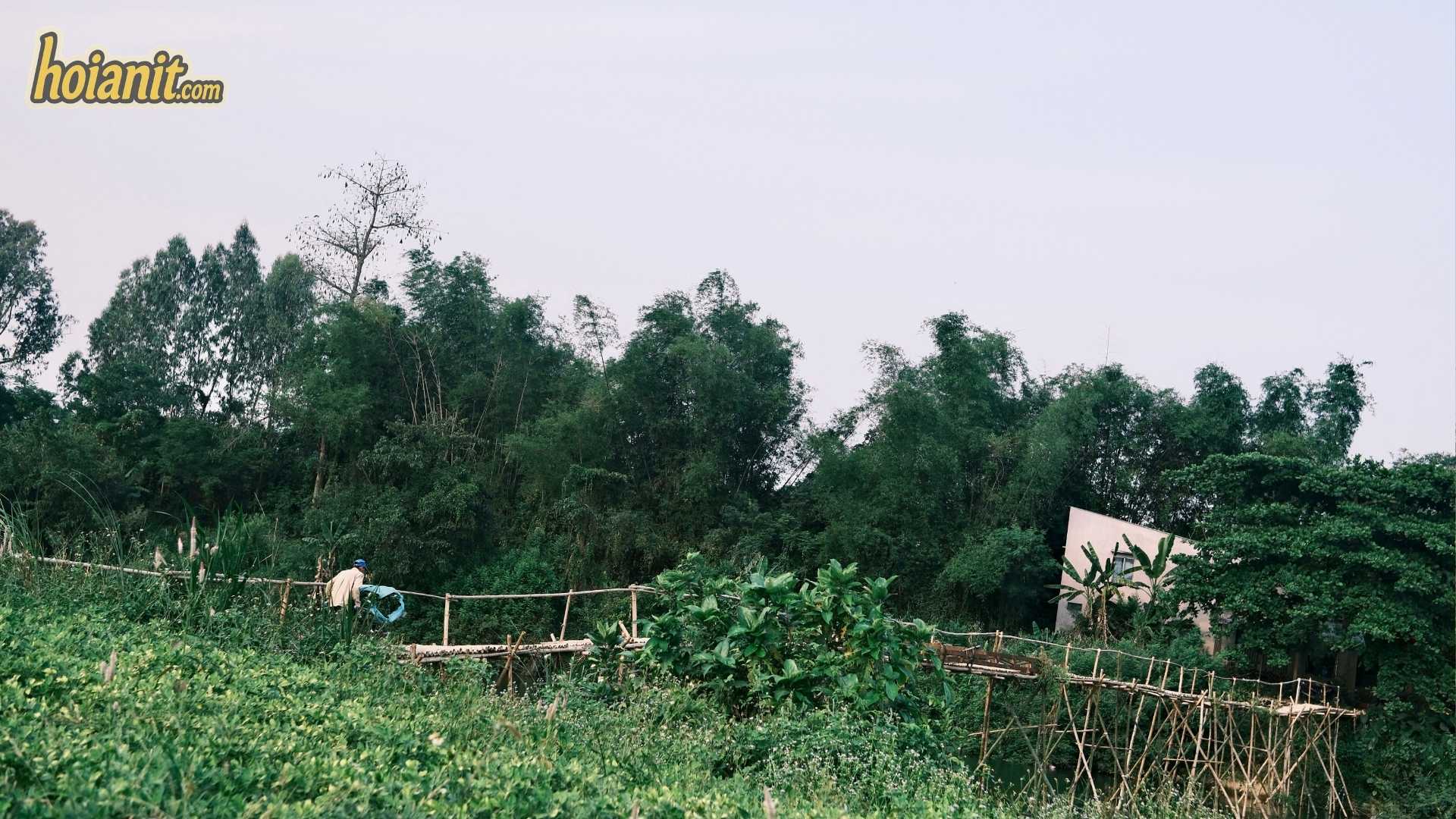
About a kilometre west, the doi 8 group maintains their own crossing. It is the one earmarked for the steel replacement. Worth riding to for the comparison.
The vegetable fields
The 100 hectares across the water grow maize, greens, chillies and herbs, much of which ends up in Hoi An restaurants a few hours later. Early morning you will meet the whole chain: cutting, carting, crossing, trader, truck.
Riverside and rural lanes
The lanes between Dien Phong and the river are shaded, empty and almost entirely free of traffic – genuinely one of the better places near Hoi An to just ride slowly with no destination.
Ten minutes back towards Vinh Dien on the same side of the river is Bang An Tower, the only octagonal Cham tower still standing — free, shaded and usually deserted. Pairing it with the bamboo bridge makes a neat half-day on the Dien Ban plain.
The address problem, and why your map may be wrong
Almost every article about the Cam Dong bamboo bridge, including ours until this rewrite, gives the address as Cam Dong hamlet, Dien Phong commune, Dien Ban town, Quang Nam province. Three of those four are now obsolete.
The 2025 administrative reorganisation merged Quang Nam into Da Nang and abolished the district tier. Google Maps now files the bridge under Cam Dong hamlet, Go Noi, Da Nang. The village has not moved. If a taxi driver looks blank at “Dien Ban, Quang Nam”, show them the coordinates instead: 15.8756, 108.2368.
Cam Dong bamboo bridge vs the other bridges near Hoi An
Hoi An has several bridges people put on lists. They are not the same kind of thing at all, and it helps to know which one you are actually asking about.
| Bridge | What it is | Worth the trip if |
|---|---|---|
| Japanese Covered Bridge | 400-year-old roofed bridge in the Old Town, on the 20.000₫ note | You are in Hoi An at all. Unmissable, and always busy. |
| An Hoi footbridge | Lantern-lit pedestrian bridge over the Hoai river | You want the postcard night shot. Two minutes from the market. |
| Cam Kim bridge | Modern road bridge to Kim Bong carpentry village | You are riding to Cam Kim island – it is transport, not a sight. |
| Cam Dong bamboo bridge | 80 m of hand-built bamboo, rebuilt yearly by farmers | You want the countryside version of Hoi An with nobody else in the photo. |
| Dragon Bridge, Da Nang | 666 m steel dragon that breathes fire on weekend nights | You are going to Da Nang anyway and it is a Friday, Saturday or Sunday. |
Put simply: the Japanese Covered Bridge is the history, the An Hoi bridge is the photograph, and the Cam Dong bamboo bridge is the one where you are the only foreigner there. See our guides to the Japanese Covered Bridge and the Dragon Bridge for the other two.
What to bring
Nothing complicated. Water, because there is no cafe at the Cam Dong bamboo bridge at the bridge itself. Cash in small notes for a drink at a village stall. Shoes with some grip if you plan to cross. And your rubbish comes home with you – there is no bin and no collection out here.
Need a bike for this?
Anh Khoa delivers motorbikes, electric bikes and bicycles free to your hotel in Hoi An, with helmets, raincoats and 24/7 support.
84 Phan Chau Trinh, Hoi An · hotel delivery from 30,000₫ · 24/7 supportFrequently asked questions
Where is the Cam Dong bamboo bridge?
Cam Dong hamlet in Go Noi, about 11,5 km west of Hoi An Old Town. Coordinates 15.8756, 108.2368. Older sources give the address as Dien Phong commune, Dien Ban, Quang Nam – that changed with the 2025 administrative merger into Da Nang.
How do I get to the Cam Dong bamboo bridge from Hoi An?
By motorbike or bicycle, roughly 28 minutes on flat back roads via Hung Vuong and DT608 towards Dien Phong. Set the coordinates rather than the name, because there is a second bamboo crossing about a kilometre away.
Is there an entrance fee?
No. It is a working farm crossing built by the village, not a tourist site. There is no ticket, no gate and no guide. Buying a drink from a stall on the bank is the polite way to leave something behind.
Is the bridge there all year round?
No. The Thu Bon flood destroys it in most wet seasons and the village rebuilds it after Tet, so it is usually absent from around October to February. March to August is the reliable window. Ask locally before riding out in the wet season.
How long is the Cam Dong bamboo bridge?
About 80 metres long and one metre wide in its 2024 build, made from 400 bamboo poles standing on 27 piers over six metres tall. The exact dimensions vary a little each time it is rebuilt.
Is it safe to walk across?
Locals cross it daily with loaded hand carts, but there are no railings, no supervision and over three metres of moving water below. Cross one at a time, yield to anyone working, and hold small children rather than letting them run.
Can I ride a motorbike over the bridge?
No. The deck is built for people, hand carts and walked bicycles. Park on the bank.
What is the best time of day to visit?
Between about 05:30 and 08:00, when farmers are carrying vegetables across to the traders waiting on the near bank. That is when the Cam Dong bamboo bridge is doing the job it exists for, and the light along the river is at its best.
Bridge dimensions and the account of the annual rebuild are drawn from VnExpress reporting on the 2024 build; details change with each rebuild. Distance measured on Google Maps from Hoi An Old Town with expressways excluded. Anh Khoa Hoi An Motorbike Rental, 84 Phan Chau Trinh, Hoi An · Zalo 0935 439 306 · WhatsApp +84 935 206 306.








Pick your ride in Hoi AnChọn xe cho chuyến đi Hội An
Scooters, electric bikes and bicycles from one shop in the Old Town — delivered to your hotel, helmets and roadside help included.Xe máy, xe điện và xe đạp — giao tận khách sạn, kèm hai nón bảo hiểm và hỗ trợ dọc đường.
Not sure which one fits? Message us on WhatsApp and we’ll recommend a bike for your plans.
Chưa biết chọn xe nào? Nhắn Zalo 0935 439 306, tụi mình tư vấn theo lịch trình của bạn.