

Events & Festivals
Cold Food Festival in Hoi An: 2027 Date, Banh Troi and What Really Happens
Cold Food Festival in Hoi An: 2027 Date, Banh Troi and What Really Happens
The Cold Food Festival falls on the 3rd day of the 3rd lunar month: 9 April in 2027. In Hoi An it is a quiet family rite, not a street party. Here is what to expect.
Most guides describe the Cold Food Festival (Tết Hàn Thực) as if Hoi An throws a party for it. It does not. The day is a small, private offering made at the family altar on the 3rd day of the 3rd lunar month, and in Central Vietnam it is quieter still than in the north, where the custom is strongest. What you can do as a visitor is eat the two dishes that define it, banh troi and banh chay, understand what you are looking at when you see them on an altar, and plan the week around it well, because a public holiday and a lantern night both land within eleven days.
This guide uses Vietnamese press reporting for the customs and a lunar calendar conversion for the dates, checked against Vietnamese calendar sources for 2026 and 2027. Where historians disagree, and on this festival they do, we show both sides rather than pick one.
- What the Cold Food Festival is, in one minute
- Cold Food Festival dates, 2025 to 2029
- Where it came from, and the Vietnamese twist
- Banh troi and banh chay: the two dishes
- How the day looks in Hoi An (honestly)
- Plan the week: a holiday and a lantern night follow
- Etiquette if you are invited in
- Getting around Hoi An that week
- Cold Food Festival FAQ
What the Cold Food Festival is, in one minute
Hàn thực means “cold food”. The name comes from an old Chinese observance on which people did not light fires and ate only food prepared in advance. Vietnam kept the name and the date, the 3rd day of the 3rd lunar month, and quietly dropped the rule: Vietnamese families cook as normal that day. What survives is an offering to the ancestors of two kinds of sticky-rice dumplings, after which the family eats them together.
Three things are worth knowing before you go looking for it:
- It is not a public holiday. Banks, shops, museums and the Old Town ticket booths keep their normal hours.
- It happens at home. There is no parade, stage or official programme in Hoi An. The “festival” is a tray on a family altar.
- It is regional. Vietnamese food writers describe it as a northern custom first. In the centre it is simpler, and in the south many families skip it.
If that sounds underwhelming, it is not. Tet Han Thuc is one of the few Vietnamese occasions where the whole ritual can be understood, tasted and even cooked by a visitor in an afternoon.
Cold Food Festival dates, 2025 to 2029
Because the festival follows the lunar calendar, its Western date moves by up to three weeks from year to year. The table below converts the 3rd day of the 3rd lunar month for five years and adds the two dates that matter for planning: Hung Kings Day, a national day off one week later, and the Hoi An lantern night on the 14th of the same lunar month.
| Year | Cold Food Festival (3/3) | Hung Kings Day (10/3) | Hoi An lantern night (14/3) |
|---|---|---|---|
| 2025 | Monday 31 March | Monday 7 April | passed |
| 2026 | Sunday 19 April | Sunday 26 April | passed |
| 2027 | Friday 9 April | Friday 16 April | Tuesday 20 April |
| 2028 | Tuesday 28 March | Tuesday 4 April | Saturday 8 April |
| 2029 | Monday 16 April | Monday 23 April | Friday 27 April |
The 2026 and 2027 dates match Vietnamese calendar listings. For 2028 and 2029 we converted the lunar dates ourselves; Vietnam’s lunar calendar is calculated for its own time zone and very occasionally differs by a day from the Chinese one, so check a Vietnamese calendar (lịch âm) nearer the time.
Where it came from, and the Vietnamese twist
The Chinese story behind it is about Jie Zitui (Giới Tử Thôi), a loyal follower of Duke Wen of Jin in the Spring and Autumn period. When the duke came to power and forgot to reward him, Jie retreated to the mountains with his mother. In the legend, the duke set the forest alight to smoke him out, and Jie died in the fire rather than come down. People in Jin then refused to light fires on the anniversary and ate only cold food.
In Vietnam the story is told, but nobody really commemorates Jie Zitui. As one food writer put it to Tuoi Tre, families offer the dumplings to their own ancestors, and cooking carries on as usual. Some Vietnamese retellings add a home-grown meaning: the round white dumplings recall the hundred eggs of Mother Au Co, the mythical mother of the Vietnamese people. That link is folklore, not history, but you will hear it.
When did Vietnamese families start eating banh troi on this day?
Here the sources genuinely disagree, which is the most interesting thing about this festival:
- Researcher Tran Quang Duc, quoted by VOV, dates the custom of eating banh troi and banh chay at the festival to the Restored Le dynasty (1533–1789). The same article quotes the 18th-century scholar Le Quy Don saying the 3rd of the 3rd month was the day his country made its most prized dish, “floating” rice cakes.
- Art historian Phan Cam Thuong, in his book on Vietnamese material culture, reads Le Quy Don differently: according to Tuoi Tre, he concludes that the festival cake of that era was a fried cake (bánh rán), and that nobody knows exactly why banh troi and banh chay took its place.
We have not seen Le Quy Don’s original text, so we leave the question open. What is not in dispute is the result: for every Vietnamese family that marks the day now, it is the dumplings.
The Chinese festival banned the fire. The Vietnamese one kept the stove on and changed the menu.
Banh troi and banh chay: the two dishes
Both are made from glutinous rice flour, both are boiled, and both are served on the same tray. That is where the similarity ends.

| Dish | What it is | Filling | How it is served |
|---|---|---|---|
| Banh troi (bánh trôi) | Small, marble-sized balls; the name means “floating”, because they bob up when cooked | Usually a nugget of brown sugar | Dry on a plate, often sprinkled with toasted sesame |
| Banh chay (bánh chay) | Larger, flatter dumplings | Sweet mung bean paste | In a light syrup, often scented with ginger, topped with mung beans or sesame |
If the name banh troi rings a bell, it may be from school: Bánh trôi nước is the title of a famous short poem by Ho Xuan Huong, the poet of the late 18th and early 19th century, who used the little floating cake as a bold metaphor for a woman’s life. Many Vietnamese can recite it, and saying you know it is a good way to start a conversation over a bowl.

In recent years some bakeries have started to shape the same dough into flowers. They look nothing like grandmother’s version, but they appear on social media every spring and on a few modern altars too.

Where to taste them in Hoi An
Honestly, banh troi and banh chay are not everyday Hoi An street food, and stalls selling them are not easy to find outside the festival. The closest everyday cousin in the centre and the south is chè trôi nước, a sweet soup of mung-bean dumplings, which you can find at dessert stalls. Around the 3rd of the 3rd month, ask at your homestay: families who keep the custom often make a big batch and are happy to share. Better still, a cooking class host may be willing to show you how to roll them.
How the day looks in Hoi An (honestly)
Here is the part most festival round-ups skip. According to a Vietnamese culinary artisan interviewed by Tuoi Tre, the custom is clearest in the north; Central Vietnamese families keep it more simply, usually with an offering of fruit; and in the south many families do not mark it at all, except households with northern roots.
So on Tet Han Thuc in Hoi An you should expect:
- An ordinary-looking town. Streets, markets and the Old Town run as usual. There is no lantern release, no performance and no event on the Hoai River for this festival.
- Small altars. In some homes and shophouses you may glimpse incense, fruit and, in families who follow the northern custom, bowls of dumplings on the ancestral altar. Offerings are usually made in the morning.
- Pagodas and temples as usual. Some locals visit, but the day does not bring special ceremonies the way the 1st and 15th of each lunar month do.

That is not a reason to skip it. It is a reason to adjust what you look for. If you want a big public spectacle, the Hoi An lantern night eleven days later is the one; if you want to understand how families here relate to their ancestors, this festival is a quiet window into it.
Plan the week: a holiday and a lantern night follow
The best reason to know the festival date is what comes after it. In 2027 the sequence looks like this:
- Friday 9 April — Tet Han Thuc. Normal working day. Look for dumplings at homestays and family-run cafés.
- Friday 16 April — Hung Kings Commemoration Day. The 10th day of the 3rd lunar month honours the legendary founders of Vietnam and is an official day off under the Labour Code. In 2027 it gives Vietnamese workers a three-day weekend, so expect more domestic visitors in Hoi An and on the roads from Da Nang from the Friday to the Sunday. Banh troi and banh chay also appear again as offerings at the Hung Kings temple in Phu Tho.
- Tuesday 20 April — Hoi An lantern night. The 14th of the lunar month, when the Old Town dims its electric lights and the lanterns take over. Full details and every date to December 2027 are in our lantern festival guide.
- 30 April and 1 May — Reunification Day and Labour Day. The year’s biggest domestic travel peak. Book rooms and bikes well ahead.
A week in Hoi An from about 14 to 21 April 2027 would catch the Hung Kings weekend and the lantern night, with Tet Han Thuc a few days before. In 2028 the order is the same but earlier: Tet Han Thuc on 28 March, Hung Kings Day on 4 April and the lantern night on 8 April.
Etiquette if you are invited in
If a host invites you to watch or join their Tet Han Thuc offering, a few small things go a long way:
- Wait for the offering to finish. Dumplings go on the altar first and are eaten afterwards. Do not take one from the tray.
- Ask before photographing the altar. It holds photographs of the family’s dead. Most hosts say yes; asking is what matters.
- Dress as you would for a pagoda. Shoulders and knees covered is respectful, especially if you are invited to light incense.
- Bring something simple. Fruit is a safe, welcome gift and fits the central Vietnamese way of marking the day.
- Try both. Refusing food is awkward; one of each is plenty.
Getting around Hoi An that week
None of that week needs a long ride: homestays, cafés and the Old Town are all within a few kilometres of each other. A bike is still the easiest way to fit it all in, especially on the Hung Kings weekend when ride-hailing gets busy.
- Old Town hours. Parts of the Old Town are closed to motorbikes at set times; check the Old Town vehicle restriction hours and park at the edge on lantern night.
- Book ahead for the holidays. Hung Kings weekend and 30 April are the busy dates.
- Delivery. Collecting from our shop at 84 Phan Chau Trinh is free; hotel delivery starts from 30,000₫, 07:00–21:00.
In Hoi An for the festival week?
Rent a scooter, electric bike or bicycle from Anh Khoa and ride it at your own pace. Deposit 2,000,000₫ or a copy of your passport (we never keep the original), and free roadside help within 10 km of our shop, any hour.
84 Phan Chau Trinh, Hoi An Old Town · KakaoTalk: anhkhoa.hoianCold Food Festival FAQ
When is the Cold Food Festival in 2027?
On Friday 9 April 2027, the 3rd day of the 3rd lunar month. In 2028 it falls on Tuesday 28 March.
Is the Cold Food Festival a public holiday in Vietnam?
No. It is a family custom, and shops, offices and sights stay open. The public holiday is Hung Kings Day, one week later, on the 10th day of the same lunar month (Friday 16 April in 2027).
Is there a public festival event in Hoi An?
No public event is held for it. Families who keep the custom make an offering at home, and in Central Vietnam it is often simpler than in the north, usually with fruit.
What do people eat on Tet Han Thuc?
Banh troi, small glutinous rice balls usually filled with brown sugar, and banh chay, larger dumplings filled with mung bean paste and served in syrup. They are offered to the ancestors first, then eaten by the family.
Do Vietnamese people really eat cold food that day?
No. The no-fire rule belongs to the original Chinese festival. In Vietnam families cook as normal; only the name and the date were kept.
Can tourists join in?
Yes, if a host invites you. Homestays and cooking class hosts are the most likely to offer. Wait until the offering is finished before eating, and ask before photographing the altar.
Is the Cold Food Festival the same as the lantern festival?
No. Hoi An’s lantern night is held on the 14th of every lunar month. In 2027 the one after Tet Han Thuc is on Tuesday 20 April.
Updated November 2026. Customs, regional differences and the historians’ debate are based on reporting by VOV (31 March 2025) and Tuoi Tre (11 April 2024). Festival, Hung Kings Day and lantern night dates are lunar-to-solar conversions; the 2026 and 2027 festival dates were checked against Vietnamese calendar listings. Confirm with a Vietnamese lunar calendar before you plan around them.
Keep reading Events & Festivals
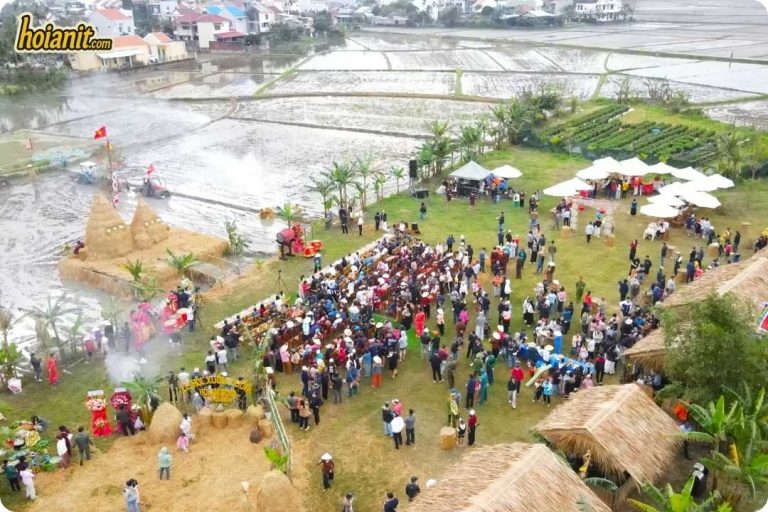 Hoi An Dong Rice Farming Festival: Dates, Programme and How to Get There










Pick your ride in Hoi AnChọn xe cho chuyến đi Hội An
Scooters, electric bikes and bicycles from one shop in the Old Town — delivered to your hotel with helmets, plus free roadside help within 10 km of Hoi An.Xe máy, xe điện và xe đạp — giao tận khách sạn, kèm hai nón bảo hiểm, cứu hộ miễn phí trong bán kính 10 km.
Not sure which one fits? Message us on WhatsApp and we’ll recommend a bike for your plans.
Chưa biết chọn xe nào? Nhắn Zalo 0935 439 306, tụi mình tư vấn theo lịch trình của bạn.