

Events & Festivals
Hoi An Dong Rice Farming Festival: Dates, Programme and How to Get There
Hoi An Dong Rice Farming Festival: Dates, Programme and How to Get There
The Hoi An Dong rice farming festival opens the planting season with buffalo ploughing, a rice-planting contest and a country market. Past dates, 2027 news and the ride there.
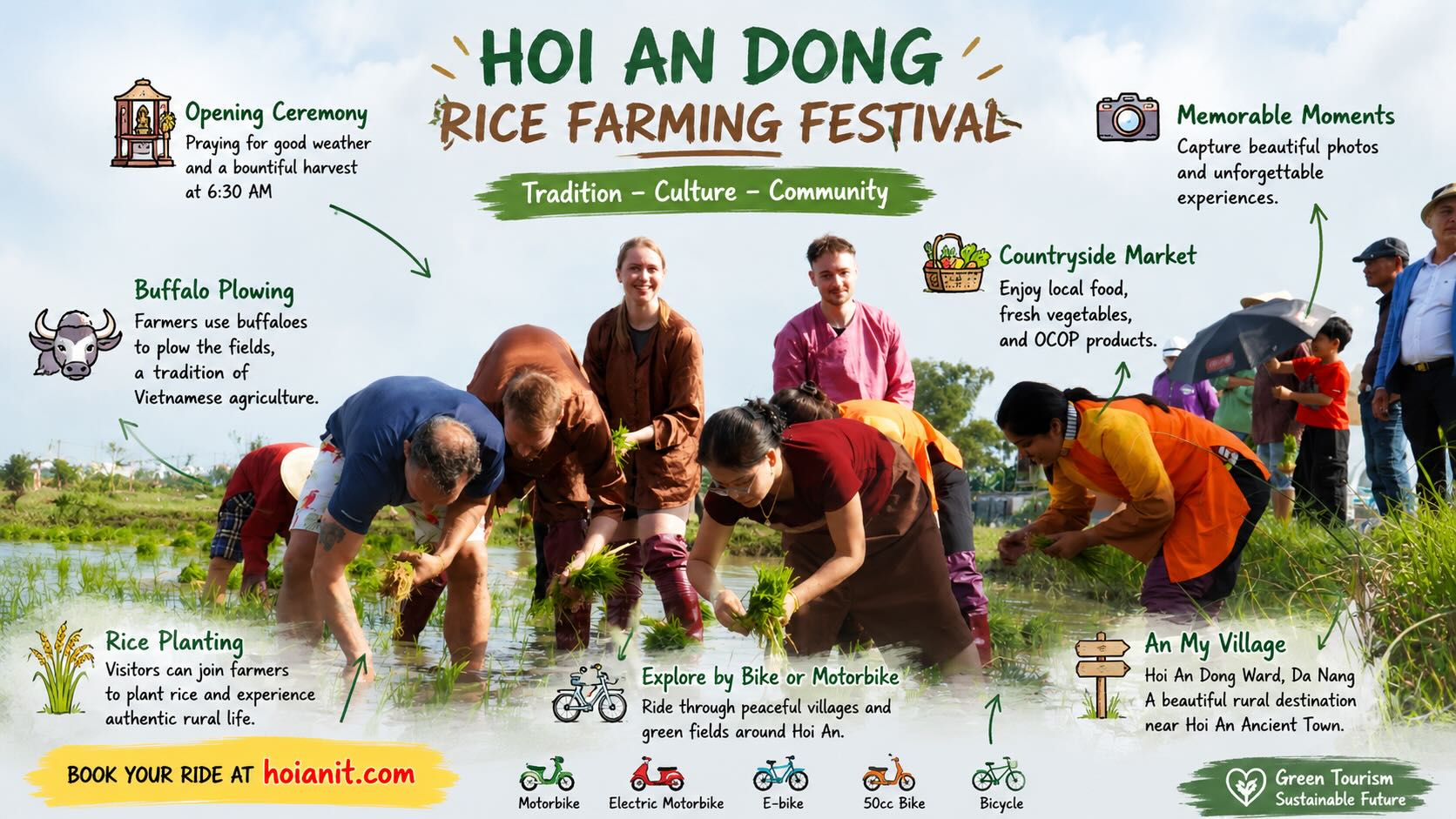
Most festivals in Hoi An happen after dark, under lanterns. This one happens at sunrise, in mud. The rice farming festival (in Vietnamese, Lễ hội xuống đồng, literally “going down to the fields”) marks the first ploughing of the winter–spring rice crop at An My, a farming neighbourhood on the eastern edge of town. Elders make offerings at 6:30 in the morning, farmers lead buffalo into the paddy, ward teams race each other planting seedlings, and visitors are invited to wade in and try it themselves. It is small, local and very early, which is exactly why it is worth getting out of bed for.
This guide is built from the ward’s own announcement, Da Nang city reporting and our own rides out to An My. Dates are only ever written here once they have been published; where something is not known yet (the 2027 date, for one), we say so.
- What the rice farming festival is, and why its name changed
- Dates: every edition so far, and what we know about 2027
- The programme, hour by hour
- Where it is: An My, not Tra Que
- Getting there from the Old Town
- What to wear and bring into the paddy
- Etiquette and photography
- Missed it? Rice fields the rest of the year
- Rice farming festival FAQ
What the rice farming festival is, and why its name changed
“Going down to the fields” is an old custom across Vietnam’s rice-growing villages: before the first furrow of a new crop, the village thanks heaven and earth, asks the God of Agriculture (Thần Nông) and the village guardian spirit (Thần Hoàng) for good rain and a good harvest, and then everyone gets to work together. Hoi An’s version grew out of the vegetable and rice fields of An My, where families still farm a patchwork of paddies and vegetable beds between the Old Town and the Cua Dai coast.
The city turned it into an organised event in 2024. Reporting on the January 2024 edition, Hoi An’s vice-chairman said the city had added it to its list of annual festivals under the name Cam Chau Rice Farming Festival, after the ward that An My belonged to at the time.
Then the map changed. On 1 July 2025, Vietnam’s local government reform merged the former Cam Chau ward, Cua Dai ward and Cam Thanh commune into a single new ward, Hoi An Dong (East Hoi An), now part of Da Nang city. The festival followed the ward: the January 2026 edition was the first held under the name Hoi An Dong Rice Farming Festival, organised by the Hoi An Dong ward People’s Committee. Same village, same fields, new name. If you see older articles about a “Cam Chau” festival, they are describing the same event.
The ward pitches the rice farming festival as a “green tourism” product, and that is fair: there is no stage show to speak of, no ticket booth we have ever seen mentioned, and the main attraction is a field of mud. What you get is a rare morning where farming, not tourism, sets the schedule.
Dates: every edition so far, and what we know about 2027
The festival is tied to the start of the winter–spring (Đông – Xuân) crop, not to a fixed calendar date, so it moves around the turn of the year. Here is every edition we could confirm:
| Edition | Date | Name used | How sure we are |
|---|---|---|---|
| 2024 | Tuesday 2 January 2024 | Lễ hội xuống đồng Cẩm Châu | Two press reports from the day |
| 2025 | Saturday 28 December 2024 | Lễ hội xuống đồng Cẩm Châu 2025 | One press report; the article has since been taken down |
| 2026 | Sunday 4 January 2026, from 6:30 AM | Lễ hội xuống đồng Hội An Đông | Ward announcement plus city and national press |
| 2027 | Not announced yet (as of 4 November 2026) | — | Watch for the ward’s announcement in December |
Two patterns are useful if you are planning a trip. First, every edition so far has landed between late December and the first week of January. Second, the date is announced only a few weeks ahead: the 2026 programme was published by the ward on 11 December 2025, 24 days before the event. So if you are in Hoi An over the New Year holiday, keep an eye out; if you are booking flights in October, there is nothing official to book around yet.
The programme, hour by hour
The official programme for 2026, as announced by the ward, listed: the offerings to the God of Agriculture and the village spirit; a demonstration of buffalo ploughing alongside motorised ploughs; a rice-planting contest; blindfolded duck-catching; bài chòi folk singing; a chance for visitors to try farm work; a countryside market with OCOP products (Vietnam’s “One Commune One Product” local specialities); and a farm-food corner. Reports from the morning itself line up with that list, with a lion dance and a drum roll to open proceedings. Expect roughly this order:
6:30 AM — the rites
Village elders lay out offerings and pray for good weather and a good harvest. This is the quiet, serious part of the day and the reason to arrive early: by the time the drums start, the ground around the altar is packed.
After the rites — drums, lion dance and the first furrow
Ward leaders beat the festival drum, a lion dance opens the field, and farmers lead buffalo into the paddy to cut the first furrows of the new season. In 2026 the buffalo shared the field with motorised ploughs: the festival is about tradition, but nobody here pretends the village still farms only with animals.
Mid-morning — the rice-planting contest
Teams from the ward’s residential groups race to plant their strip of paddy with seedlings. In the 2024 edition there was also a demonstration of scooping water into the paddy with gàu sòng, the traditional hand scoop, using two scoops and four farmers.
All morning — try it yourself
This is the part most visitors remember. Reports from 2026 describe visitors wading in to plough, plant seedlings, scoop water, catch fish along the field edges and pick vegetables, then lighting a straw fire to cook a pot of rice or boil sweet potatoes. None of the announcements mentioned booking: the try-it-yourself plots are part of the programme.
Market and food corner
Stalls sell vegetables from An My itself, OCOP products and farm food. In 2026 the press listed cao lau, mi Quang, banh xeo, banh beo, banh dap, tofu and sweet soup. Bring small notes; this is not a card-machine kind of market.
Be there for the rites at 6:30. The first furrow of the season is cut once, early, and everything after that is the village celebrating it.

Where it is: An My, not Tra Que
The festival is held in the fields of An My vegetable village (Làng rau An Mỹ, residential group An My), Hoi An Dong ward, Da Nang. On Google Maps the place is listed as “Làng rau An Mỹ” at plus code V8WV+9CR, coordinates 15.8960, 108.3435.
Visitors often mix it up with Tra Que vegetable village, which is the famous one and sits on the other side of town, to the north, in the new Hoi An Tay ward. Both grow herbs and vegetables and both offer farming experiences, but the rice farming festival is at An My. If you type “vegetable village Hoi An” into a ride-hailing app on the morning of the festival, you will probably end up at Tra Que.
Because the old Cua Dai and Cam Thanh areas are now part of the same ward, the festival is also handy for a morning loop: the fields, then breakfast, then the Bay Mau coconut forest in Cam Thanh or the beach at Cua Dai.
Getting there from the Old Town
We measured the route with Google Maps directions from our shop at 84 Phan Chau Trinh to the An My vegetable village pin: 4.5 km and about 12 minutes by motorbike, heading east via Cua Dai road and Le Thanh Tong street. Google’s alternatives were 4.8 km via Nguyen Duy Hieu and Le Thanh Tong (13 minutes) and a third route via Hai Ba Trung (18 minutes in usual traffic). On foot, Maps gives about 42 minutes.
| Option | Good for | Watch out for |
|---|---|---|
| Motorbike or scooter | Arriving before 6:30 and carrying on to the coast afterwards | Park on the road, not on the field paths, which are narrow and muddy |
| Bicycle or e-bike | A flat, easy ride on quiet roads in the cool of the morning | Leaving in the dark: use lights; check the e-bike battery the night before |
| Walking | Hotels on the eastern side of the Old Town | About 42 minutes from Phan Chau Trinh, much of it along a main road |
| Ride-hailing car or bike | No licence, no bike | Type “Làng rau An Mỹ”, not “vegetable village”, or you may be taken to Tra Que |
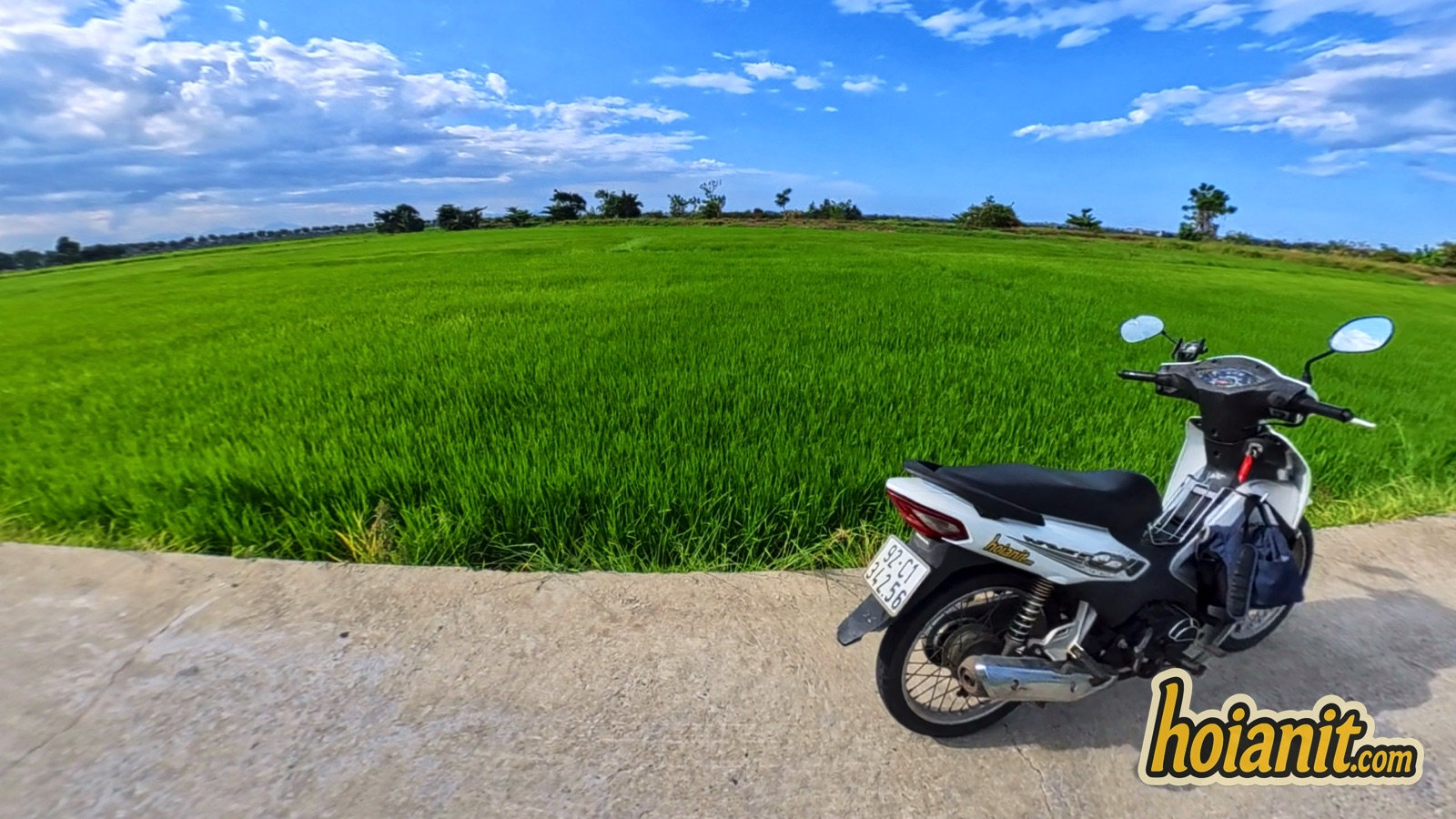
Our honest recommendation is two wheels. The festival is spread across open fields, everything interesting happens before mid-morning, and the best part of the day is often the ride home along the coast. You can rent a motorbike in Hoi An from us, or a bicycle or e-bike if you would rather pedal; our guide to exploring Hoi An by bicycle covers the flat back roads out this way.
What to wear and bring into the paddy
If you plan to step into the field, assume you will be muddy to the knee, at least. Plan for that before you leave the hotel.
- Clothes you can write off for the day. Shorts or trousers you can roll up, a light top. White is a brave choice.
- Footwear you can take off. Most people go barefoot in the paddy; wear sandals or old shoes to get there and leave them on the bank.
- A change of clothes and a plastic bag for the wet set, especially if you are riding home.
- A hat and sunscreen. Once the sun is up there is no shade in a rice field.
- A light jacket for the ride. Early mornings around the turn of the year can feel cool on a bike.
- Small cash for the market and food stalls.
- A dry bag or a zip bag for your phone. Phones and paddies do not mix.
Etiquette and photography
The festival is a working village celebrating its own harvest, and visitors are guests. A few things that make a difference:
- Keep a respectful distance during the rites. Stand back from the altar, do not walk between the elders and the offerings, and hold the drone until the ceremony is over.
- Ask before close-up portraits. A smile and a raised camera is enough; most people will nod.
- Stay on the bunds unless invited in. The contest strips belong to the teams. Wait to be waved into the visitors’ plot.
- Buy something at the market. The produce on the tables comes from the fields you are standing next to.
- Take your rubbish back with you. The festival is promoted as green tourism; it is a small thing to help it stay that way.
Missed it? Rice fields the rest of the year
The festival is one morning a year. The fields are there all year, and so is most of what makes the morning special, minus the crowd and the contest.
- Ride out to An My anyway. The same 12-minute ride gets you into the paddies at sunrise on any morning. Be polite, stay on the paths and do not walk into planted fields.
- Tra Que vegetable village runs farming experiences year-round, with herb and vegetable beds you can visit outside festival season. See our Tra Que guide.
- Buffalo rides through the paddies are offered around Hoi An; see our guide to buffalo riding in Hoi An.
- A countryside loop by bike. Our Hoi An countryside guide strings together villages, fields and river roads.
- Other festivals. If your dates do not fit, see our top Hoi An festivals for what is on in other months.

Riding to the fields at sunrise?
Book the bike the day before and we will deliver it to your hotel that evening, so you can leave at six. An My is 4.5 km from our shop, well inside our free roadside help zone (10 km, any hour).
84 Phan Chau Trinh, Hoi An Old Town · KakaoTalk: anhkhoa.hoianRice farming festival FAQ
When is the Hoi An Dong rice farming festival in 2027?
The 2027 date has not been announced as of 4 November 2026. Past editions were held on 2 January 2024, 28 December 2024 and 4 January 2026, and the 2026 date was announced only 24 days ahead, so expect news in December.
Where exactly is the festival held?
In the fields of An My vegetable village, Hoi An Dong ward, Da Nang (Google Maps: Làng rau An Mỹ, 15.8960, 108.3435). It is 4.5 km from 84 Phan Chau Trinh in the Old Town, about 12 minutes by motorbike.
What time should I arrive?
The rites start at 6:30 AM, so aim to be there by about 6:15. The buffalo ploughing, contest and hands-on activities follow through the morning.
Can tourists join the rice planting?
Yes. Visitors are invited to try ploughing, planting seedlings, scooping water and catching fish at the field edges. The rice-planting contest itself is between teams from the ward.
Is there an entry fee?
The ward’s announcement and the press reports we read do not mention a ticket. Bring small cash for the market and food stalls.
Is it the same as Tra Que vegetable village?
No. Tra Que is a different village north of the Old Town, in Hoi An Tay ward. The rice farming festival is at An My, east of the Old Town, in Hoi An Dong ward.
Can I have a bike delivered for a 6:30 AM start?
Our hotel delivery runs from 07:00 to 21:00 and costs from 30.000₫, so book it for the evening before. Collecting from 84 Phan Chau Trinh is free.
Updated November 2026. Festival dates, programme and organiser checked against the Hoi An Dong ward announcement in Da Nang Newspaper, the Da Nang city portal and national press; the 2024 edition against two press reports from the day. Distance and riding time measured with Google Maps directions from 84 Phan Chau Trinh to Làng rau An Mỹ (15.8960, 108.3435) on 4 November 2026. Festival details are set by the ward each year — confirm the date before you plan around it.
Keep reading Events & Festivals
 Cold Food Festival in Hoi An: 2027 Date, Banh Troi and What Really Happens










Pick your ride in Hoi AnChọn xe cho chuyến đi Hội An
Scooters, electric bikes and bicycles from one shop in the Old Town — delivered to your hotel with helmets, plus free roadside help within 10 km of Hoi An.Xe máy, xe điện và xe đạp — giao tận khách sạn, kèm hai nón bảo hiểm, cứu hộ miễn phí trong bán kính 10 km.
Not sure which one fits? Message us on WhatsApp and we’ll recommend a bike for your plans.
Chưa biết chọn xe nào? Nhắn Zalo 0935 439 306, tụi mình tư vấn theo lịch trình của bạn.