
Routes & Day Trips
Tam Tien Fish Market and Tam Hai Island by Motorbike from Hoi An: The Dawn Run South (2026)
Tam Tien Fish Market and Tam Hai Island by Motorbike from Hoi An: The Dawn Run South (2026)
Tam Tien fish market happens on a beach at 4 a.m., 50 km south of Hoi An, and is over by sunrise. Twenty kilometres on, a ferry crosses to Tam Hai and the 400-million-year-old rocks of Ban Than. Here is how to ride both.
- Why ride south for a fish market
- The 4 a.m. problem, and the two-day answer
- The road: Cua Dai bridge and the Vo Chi Cong coast road
- Tam Tien fish market: what happens, hour by hour
- Buying, eating and photographing without being a nuisance
- On to Tam Hai: the two ferries
- Ban Than, Hon Mang and Hon Dua: the black rocks
- The rest of the island, honestly
- Season, bike, fuel and the ride home
- FAQ
№ 01Why ride 50 km south for a fish market that closes at dawn
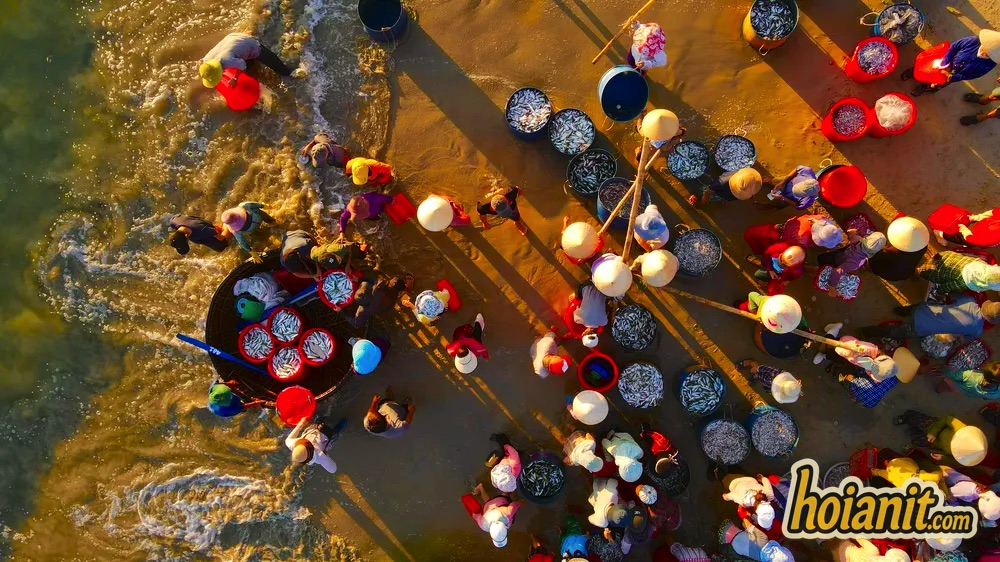
Because nothing else near Hoi An looks like it. Tam Tien fish market is not a building. It is a kilometre of beach in a fishing village south of Tam Ky where, on summer mornings, two hundred and more boats anchor just offshore in the dark and send their catch in through the surf by basket boat, and where three or four hundred traders wade out to meet them with baskets, scales and headtorches. By the time the sun clears the horizon the deals are done, the trucks are loading anchovies for the steaming ovens up the road, and the beach is a beach again. It has been featured in Vietnam Airlines’ Heritage magazine and sits in every photographer’s portfolio in central Vietnam, and it is still, in 2026, almost entirely a working market with a few dozen visitors on a busy day.
Twenty kilometres further south the coast road ends at a sandbar, a small ferry carries you and your bike across the mouth of the Truong Giang, and you are on Tam Hai, an island commune of coconut lanes and fishing hamlets whose northern tip is Ban Than: two kilometres of tilted black schist, four hundred million years old, standing forty metres out of a sea with ninety hectares of coral in it. Together they make the best two-day motorbike trip on the south coast, and one that almost no visitor to Hoi An has heard of.
| You are… | Do this | Time |
|---|---|---|
| A photographer who will get up at 3 a.m. | Ride down in the dark, market at 04:30, breakfast, home by 09:00 | 1 morning, ~100 km |
| Sensible | Ride down in the afternoon, sleep at Tam Thanh, market at dawn, Tam Hai after breakfast, home by sunset | 2 days, ~150 km |
| Here for the rocks, not the fish | Leave at 07:00, Tam Quang ferry by 09:00, Ban Than at low tide, back by 16:00 | 1 day, ~140 km |
| Doing the whole south coast | Tam Thanh murals → Tam Tien → Tam Hai → Ly Son ferry from Sa Ky | 3–4 days |
№ 02The 4 a.m. problem at Tam Tien fish market, and the two-day answer
The market runs from about 04:00 until the light comes, which in the fishing season means it is finished by 06:00 at the latest. From Hoi An that is an 03:00 alarm and 49 km of riding in the dark; the coast road is good, but you will be doing it on no sleep, and you will arrive as the best of it is ending. It is doable, and some riders do it; most of those who have say they would stay the night down there next time.
So stay the night. Tam Thanh, the painted fishing village 8 km north of the market, has a row of beach homestays and a couple of small resorts at roughly 400.000₫–900.000₫ a night, a beach that empties after the day-trippers leave, and seafood restaurants along the sand. Ride down in the afternoon, walk the murals in the low light, eat, sleep, and set the alarm for 04:15: you are on the market beach in fifteen minutes, awake, with the whole of it in front of you. After breakfast the island is an hour away. This is the plan the rest of this guide assumes.
Leave at 03:00 sharp, ride the Vo Chi Cong coast road (wide and empty at that hour, but the lighting is patchy, so you want a good headlight), keep to 50 km/h, and expect to be on the beach at 04:20. Fuel up the night before: there is nothing open on the coast road at that hour. Ride back after breakfast when you are tired but the road is quiet, not in the midday heat.
№ 03The road: Cua Dai bridge and the Vo Chi Cong coast road
This is one of the easiest long rides from Hoi An, because one road does almost all of it. Leave the Old Town east on Cua Dai street, cross the Cua Dai bridge over the Thu Bon, and you are on Vo Chi Cong, the coastal expressway that runs straight south along the dunes for 60 km to Chu Lai. It is wide, has almost no junctions and no trucks worth mentioning, and the sea is a dune’s width away on your left the whole time. Posted limits change by section, so ride to the signs; police do check speed on the long straights.
| Leg | Road | Distance | Riding time |
|---|---|---|---|
| Hoi An → Tam Thanh mural village | Cua Dai bridge → Vo Chi Cong | 41 km | 50 min |
| Tam Thanh → Tam Tien fish market | Vo Chi Cong → beach lane at Ha Loc | 8 km | 15 min |
| Tam Tien → north sandbar ferry (Tam Hai) | coast road south to its end | ~14 km | 25 min |
| Tam Tien → Tam Quang ferry (Tam Hai, south) | inland via Nui Thanh | 18.7 km | 35 min |
| Tam Hai → Hoi An | ferry → Vo Chi Cong north | ~70 km | 1 h 30 |
The market beach is in Ha Loc hamlet, on the seaward side of the coast road about 8 km south of the Tam Thanh turn. Search Google Maps for “Cho ca Tam Tien” and it drops a pin on the right stretch of sand; the lane down to it is unsigned but at 04:30 you simply follow the motorbikes and the light. Park on the hard sand above the tideline with everyone else, or by the breakfast stalls at the top of the lane; nobody charges; take your helmet with you.
A note on names. Since 1 July 2025 the district of Nui Thanh no longer exists: Tam Tien commune has been merged into a new Tam Xuan commune, the Tam Quang ferry town is now part of Nui Thanh commune, and all of it belongs to Da Nang City rather than Quang Nam province. Tam Hai, being an island, was left alone and is still Tam Hai commune. Old signs, old maps and old guidebooks use the old names; they mean the same beach.
№ 04Tam Tien fish market: what happens, hour by hour
The market began in 1995, when the boats of Tam Tien started selling straight off the beach rather than hauling to Tam Ky, and it grew without anyone planning it into the largest landing point on the south Quang Nam coast. Its rhythm is the fishing boats’: they go out in the late afternoon for the night’s fishing on the near grounds, and they come back on the dawn.
- 03:30–04:00 — the boats arriveLights appear offshore, dozens of them, and anchor a few hundred metres out; the water is too shallow for the boats to beach. Traders gather on the sand with baskets, plastic crates and battery lamps. A line of women set up breakfast stalls at the top of the beach.
- 04:00–05:00 — the basket boatsThis is the part you came for. Round bamboo thung chai ferry the catch from boat to beach in relays, one man paddling, each basket loaded to the rim with anchovy, mackerel, scad, squid or whatever the night gave. Porters — about 150 of them on a good morning, many of them women — carry the crates up the sand on shoulder poles. Prices are shouted, not posted.
- 05:00–05:45 — the sunIn June the sun is up by 05:15 and the whole scene turns orange for twenty minutes: boats on a copper sea, silhouettes in the surf, wet fish flashing. This is the photograph everyone has seen, and you will get it too if you are standing in the surf with your feet wet and your back to the land.
- 05:45–06:30 — the trucksMotorbikes and small trucks load the crates and leave for the anchovy-steaming sheds and the markets of Tam Ky and Da Nang. The traders count money, the porters eat, the boats go back out to moor. By 07:00 the beach belongs to the gulls.
Two things are worth knowing before you plan around it. First, it is a summer market: it runs from roughly April to September, the vu ca nam or southern fishing season, when the sea is calm enough for the small boats; in the north-east monsoon from October to March there may be a handful of boats or none, and the beach is empty. Second, the biggest mornings tend to follow the dark of the moon, when the light-fishing boats do best. If you can choose your date, choose a new moon in May, June or July.
№ 05Buying, eating and photographing without being a nuisance
Buying. Everything on the sand is for sale by the kilo, and you will pay roughly half what the same fish costs in Hoi An market by the time it has been on ice for a day: squid around 150.000₫–200.000₫ a kilo, mackerel 80.000₫–120.000₫, a kilo of anchovy for 30.000₫. Bring small notes; nobody has change for a 500.000₫ at 4 a.m. and nobody takes QR on the beach. If you buy, the restaurants back at Tam Thanh will cook it for a small fee, which is the best lunch of the trip.
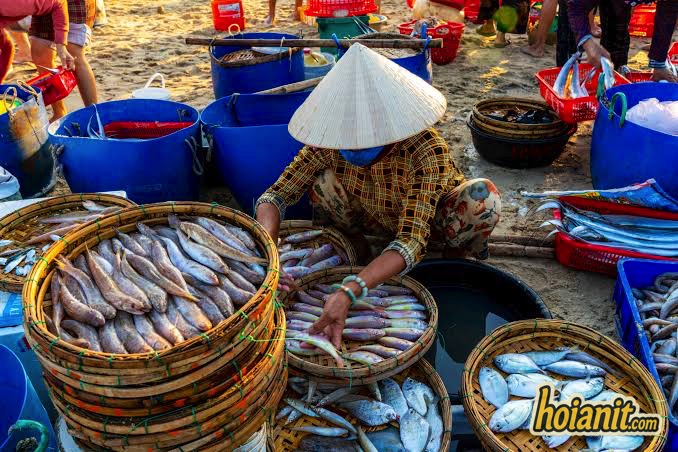
Eating. The stalls at the top of the beach do mi Quang, bun, sticky rice and strong coffee from about 04:00 for the traders, and will feed you for 20.000₫–35.000₫; sit on a plastic stool with the porters and you will hear more about the night’s fishing than any tour guide could tell you. There is no restaurant on the beach itself. For a proper seafood breakfast, ride back to the Tam Thanh strip.
Photographing. This is a workplace, and the people in it are carrying 30 kg on a pole through surf in the dark. The rules are simple: stay out of the line between the basket boats and the trucks, do not stand in the water where the baskets land, do not use flash in anyone’s face, and if you are shooting a particular porter or trader for more than a frame or two, buy something from her or hand her 20.000₫ and say thank you. A telephoto and a high ISO get you everything you need without stepping in the way; the good frames are from knee height, looking up at the baskets against the sky.
The whole market is over before most of Hoi An has had its first coffee. That is exactly why it is still a market and not a show.
№ 06On to Tam Hai: the two ferries
Tam Hai is an island in the mouth of the Truong Giang river, 15 square kilometres, about 8,500 people, and reachable only by ferry. There are two crossings, and which you use depends on where you are coming from.
| Ferry | From | Boat | Fare | Runs |
|---|---|---|---|---|
| North crossing (sandbar) | End of the coast road south of Tam Tien, at the river mouth | Small open ferry, bikes and people | 10.000₫ per bike and rider | Daylight, every 10–20 min, siesta ~12:00–13:30 |
| South crossing (Tam Quang) | Tam Quang pier, off QL1A near Nui Thanh / Chu Lai | New steel ferries since April 2026, 80 passengers plus bikes and small cars | 5.000₫ per person, 10.000₫ with a bike | Daylight, roughly every 20–30 min, 5-minute crossing |
Coming from the fish market, the north crossing is the natural one: keep south on the coast road until it runs out of land, and the ferry is there. It is a wooden-decked open boat with a rail, the kind that takes a dozen bikes and whoever is standing between them, and it is not for the nervous when the river mouth is choppy. If you would rather have a proper ferry, ride inland to QL1A, south to the Tam Quang turn and out to the pier, where the commune’s two new 30-metre steel ferries — built for about 25 billion dong and launched on 29 April 2026 to end years of overloaded crossings on a single ageing boat — cross in five minutes. Either way, you ride your bike straight on and straight off; there is no need to leave it on the mainland.
Both crossings pause around midday and both stop when the sea is up, which in the monsoon can mean days. Do not arrive at a pier at 12:15 expecting to cross, and do not plan an island day between October and January without asking at the pier first. The coast road ferry in particular is a family operation with a phone number chalked on a board; the Tam Quang ferry is run by the commune and keeps to its timetable.
№ 07Ban Than, Hon Mang and Hon Dua: the black rocks
Ban Than is at the island’s north-eastern tip, a ten-minute ride from either ferry along coconut lanes, and you will know it when you see it: a headland of black rock two kilometres long and up to forty metres high, tilted, layered and fractured like a giant’s stacked slates, with the sea working at its foot and two small islands, Hon Mang (2 hectares) and Hon Dua (11 hectares), sitting just offshore. Geologists date the rock — amphibole schist of the Kham Duc–Nui Vu complex, shot through with quartz veins — at 400 to 500 million years, which makes it among the oldest exposed rock on the Vietnamese coast. It is not volcanic, as the tourist boards like to say; it is ancient basement rock heaved above the sea by a tectonic event and then carved by four hundred million years of waves.
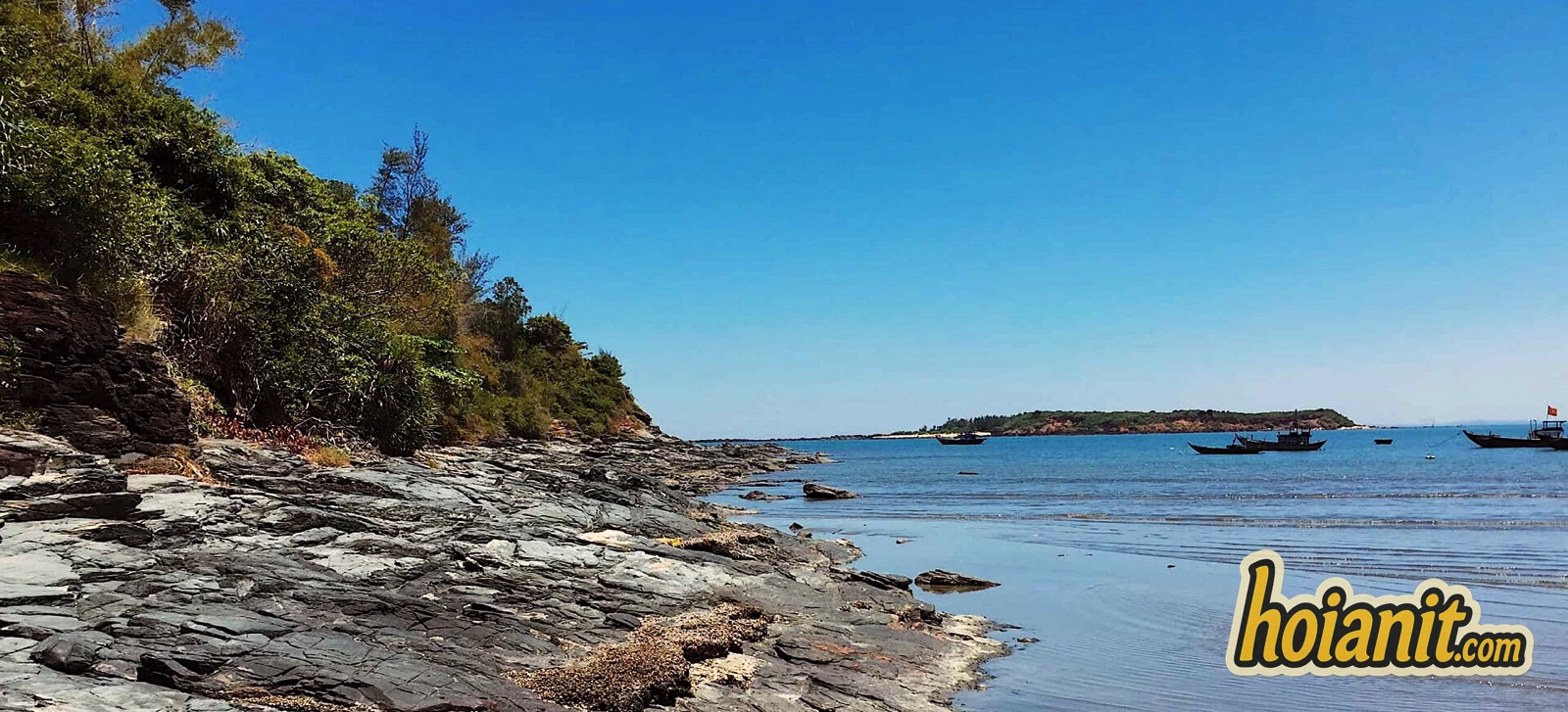
The province ranked Ban Than–Hon Mang–Hon Dua a scenic monument in September 2017, and in February 2024 the Ministry of Culture raised it to national status. There is no ticket and no gate; you park at the end of the lane and walk out onto the rock. Wear shoes with grip — the surfaces are sharp, wet and tilted — and time it for low tide, when the shelves and rock pools are exposed and the water is clear enough to see the coral. The reef around the headland covers more than 90 hectares, with around a hundred coral species and 168 species of fish counted; snorkelling from the rocks on a calm morning is good, and local boats will take you round Hon Dua if the sea is flat — ask in the hamlet and expect a few hundred thousand dong for the boat.
Two seasons transform the place. From Tet until about the third lunar month (roughly February–April) the lower rocks turn green with moss and seaweed, and the whole headland looks like it has been upholstered; this is when the Vietnamese photographers come, at low tide, at sunrise. And on any low tide in summer the women of the island are out on the shelves harvesting seaweed into baskets, which is the other picture people carry home. Sunrise is the light for the rocks; sunset works from the western beach.
№ 08The rest of the island, honestly
Tam Hai is not Cu Lao Cham. It is a farming and fishing commune with paved lanes under coconut palms, a hamlet of painted houses in the north, a whale temple and a whale cemetery where the village has buried stranded whales for generations, an ancient freshwater well still in use, and two long beaches that are, in the words of one honest guide, more attractive from afar. The sea is clean; the sand is not. Currents bring plastic in from the river mouth and the island has no real way to clear it, so the beaches on the ocean side are often littered. Go for the rocks, the lanes and the lunch, not for a beach day.
Lunch is easy: the hamlet nearest Ban Than has half a dozen family seafood places that will cook what came in that morning — grilled squid, clams with lemongrass, a fish steamed with ginger — for 150.000₫–300.000₫ for two, and there are rice-and-noodle shops in the southern village. Most kitchens close for a rest from noon to about 14:00. If you want to stay, the island has one resort, Le Domaine de Tam Hai, eleven river-view villas with a pool from around $100 a night, and a couple of homestays in the villages; otherwise sleep at Tam Thanh or Tam Ky.
Allow two to three hours on the island: forty minutes at Ban Than, a slow lap of the lanes, lunch, and the ferry queue. Ride the lanes gently — they are the village’s streets, full of children, chickens and drying fish.
№ 09Season, bike, fuel and the ride home
Season. The fish market needs the summer fishing season, April to September; Ban Than’s green moss needs February to April; the ferries need calm sea. The overlap is April, and the safe bet is any new-moon week from April to August. Avoid October to January entirely: the market is closed, the ferries are unreliable and the coast road floods at the Truong Giang crossings.
Bike. This is a 150 km round trip with a night in between, on a fast, open road with a headwind on the way back. Take a 110–125 cc automatic or a Honda semi-automatic from our fleet; a 50 cc will get there but will be miserable on Vo Chi Cong, and an electric scooter is out — there is nowhere to charge on the coast road or the island. Our fleet page lists what is available; tell us it is for Tam Hai and ask about a luggage rack.
Fuel. Fill up in Hoi An. There are petrol stations at the Tam Thanh turn and in Nui Thanh town, none on the island and none open at 3 a.m. Our guide to the E10 RON 95 switch explains what to ask for at the pump.
Home. Ride back up the coast road in the afternoon light, with a stop at Tam Thanh for the seafood you bought at dawn, and you are over the Cua Dai bridge by sunset. If you are heading further south instead, Sa Ky port and the Ly Son ferry are another 50 km down QL1A.
Ride the south coast this week
110–125 cc automatics and Honda semi-autos with luggage racks, delivered free to your hotel in Hoi An with two helmets, a phone holder and a rain poncho. No passport deposit, roadside help on the coast road 24/7.
84 Phan Chau Trinh, Hoi An · Zalo 0935 439 306 · roadside line +84 766 766 087 (24/7)Tam Ky is also the gateway to the Tien Phuoc hills: from the fish market it is under an hour on DT616 to Loc Yen ancient village, which pairs well with a dawn at Tam Tien for a full inland-and-coast day.
№ 10FAQ
What time does Tam Tien fish market open?
Tam Tien fish market runs from about 04:00 until sunrise, roughly 06:00, on the beach at Ha Loc hamlet. The basket boats bring the catch ashore between 04:00 and 05:00 and the best light is 05:00 to 05:45. It operates only in the summer fishing season, from about April to September; in the monsoon months there is little or nothing to see.
How far is Tam Tien fish market from Hoi An by motorbike?
Tam Tien fish market is about 49 km south of Hoi An by the Cua Dai bridge and the Vo Chi Cong coast road, roughly one hour on a scooter. Tam Thanh mural village is 8 km before it, and the Tam Hai island ferries are 14 to 19 km beyond it.
Is it worth going to Tam Tien fish market in one morning from Hoi An?
It can be done: leave at 03:00 and you are on the beach by 04:20. But most riders enjoy it far more by sleeping at Tam Thanh, 8 km north, and riding to Tam Tien fish market at 04:15 rested, then continuing to Tam Hai island after breakfast.
How do I get to Tam Hai island with a motorbike?
By ferry, with the bike on board. The north crossing is a small open ferry at the end of the coast road south of Tam Tien, 10.000₫ per bike and rider; the south crossing from Tam Quang pier near Nui Thanh uses two new steel ferries launched in April 2026, 5.000₫ per person and 10.000₫ with a bike, five minutes across. Both run in daylight only, pause around midday and stop in rough sea.
What is Ban Than?
Ban Than is a two-kilometre headland of black schist up to 40 m high at the north-eastern tip of Tam Hai island, dated at 400 to 500 million years old, with the islets of Hon Mang and Hon Dua offshore and more than 90 hectares of coral reef around it. It was ranked a provincial scenic monument in 2017 and a national one in February 2024. Entry is free.
When is the best time to visit Tam Hai and Ban Than?
April to August, at low tide and at sunrise. The rocks are greenest with moss from Tet to about the third lunar month, roughly February to April, and the fish market at Tam Tien only runs from April to September, so April is the month that gives you both. Avoid October to January, when the ferries stop for weather.
Can I do Tam Tien fish market and Tam Hai on a 50 cc or electric scooter?
Not comfortably. The round trip is about 150 km on the fast Vo Chi Cong coast road with a headwind on the return, there is no charging on the coast road or the island, and the ferries are easier with a bike you can push. Take a 110–125 cc automatic or a Honda semi-automatic.
Distances were measured on the road from 84 Phan Chau Trinh, Hoi An, to the market beach at Ha Loc and to the Tam Quang pier; the coast-road ferry distance is approximate because the landing moves with the sandbar. Market hours, boat and trader numbers are from Nhan Dan and Thanh Nien reporting in 2024–25; Ban Than geology and heritage rankings from the Tam Hai commune relic file and VnExpress and Tuoi Tre features of 2024–26; the new Tam Quang ferries from Thanh Nien, 29 April 2026. Ferry fares and seafood prices are what we and our guests have paid and will drift. Administrative names follow the 1 July 2025 merger of Quang Nam into Da Nang City.








Motorbike Rental
Bicycle Rental
One-way to Hue
Electric Bicycle
Electric Scooter
Dirt Bike Rental
No License