
Hoi An Travel Tips
An Hoi Bridge Hoi An 2026: The Crossing Everyone Uses and Nobody Reads About
An Hoi Bridge Hoi An 2026: The Crossing Everyone Uses and Nobody Reads About
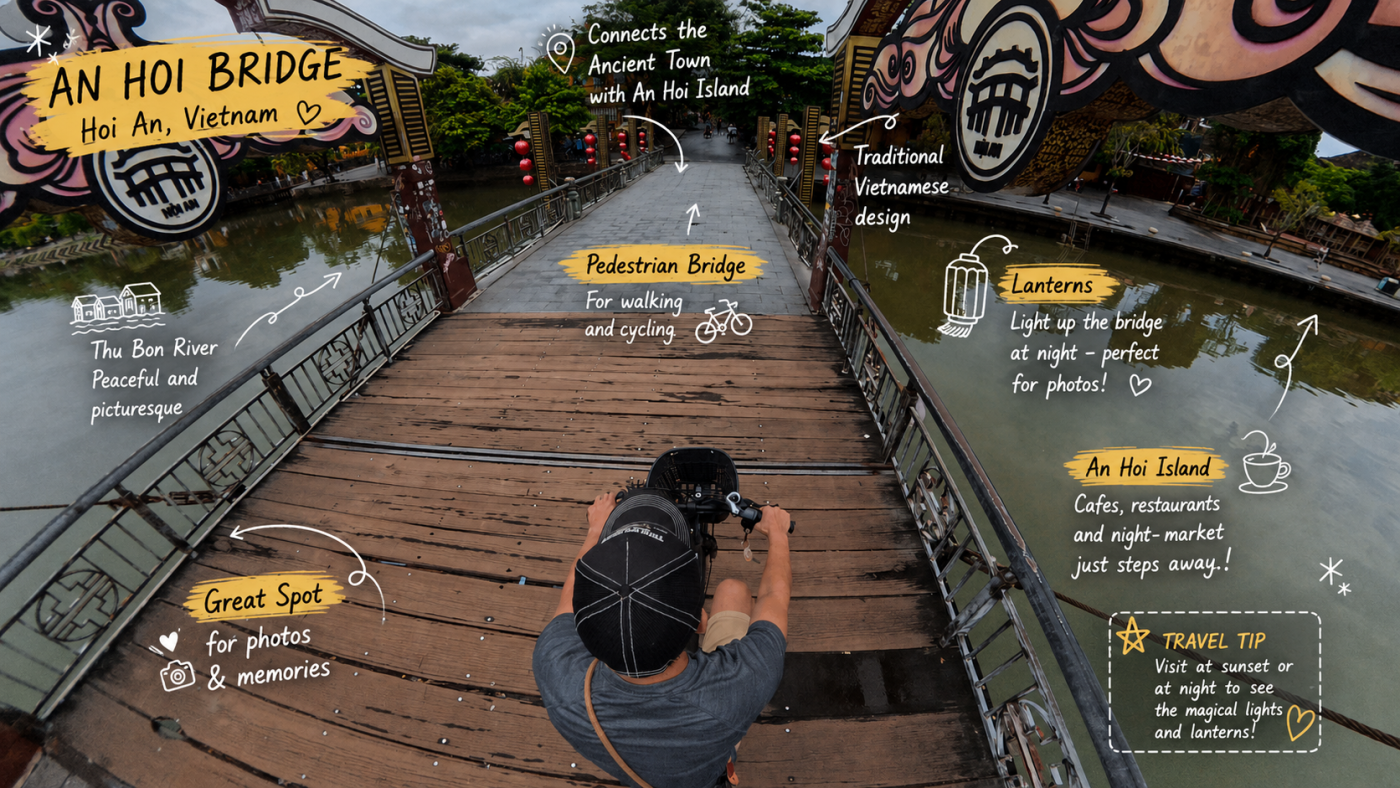
An Hoi Bridge is the busiest fifty metres in Hoi An — the way to the night market, the lantern boats and the far bank. Free, open always, 140 m from the Japanese Covered Bridge.
Almost nobody comes to Hoi An to see An Hoi Bridge. They come to cross it — on the way to the night market, on the way back from dinner, at the moment the lanterns come on. It is the single most walked-over piece of the Old Town and the least written about, which is a shame, because where you stand on it and when you stand there decides whether you get the photograph everybody has, or the one they do not.
- What An Hoi Bridge actually is
- Where it is and how to reach it
- Free, always open, and the vehicle rules
- The blue hour: the only twenty minutes that matter
- Where to stand on An Hoi Bridge
- The lantern boats, honestly
- What is on the An Hoi side
- Crowds, pickpockets and the 20:00 crush
- Where to leave a bike
- Ride out from the bridge
- An Hoi Bridge: frequently asked questions
What An Hoi Bridge actually is
Set expectations first, because a lot of guides oversell this. An Hoi Bridge is a modern concrete footbridge. It is not a heritage monument, it is not on the Old Town ticket, and by daylight it is a plain grey deck with steel railings and a row of dark lamp posts hung with red lanterns. Walk across it at eleven in the morning and you will wonder what the fuss is.
The fuss is about what it does, not what it is. The bridge is the hinge of the Old Town: the point where the heritage streets on the north bank meet the An Hoi peninsula on the south, where the boat women wait, where the night market begins, and where — for about twenty minutes each evening — several thousand people all want to stand in the same place at once.
So this guide treats it the way locals do: as a platform and a route, not a monument. Where to stand, when, what you can actually photograph from it, and what is worth crossing for.

Where it is and how to reach it
An Hoi Bridge carries Chau Thuong Van street across the Hoai River, from the Old Town bank near Bach Dang over to Nguyen Phuc Chu on the An Hoi side. Step off the southern end and the night market street is directly in front of you.
- From our shop at 84 Phan Chau Trinh: 300 m, about 4 minutes on foot, measured on Google Maps — south on Tran Phu, then down Chau Thuong Van.
- From the Japanese Covered Bridge: 140 m, about 2 minutes. They are close enough that most people photograph both in the same ten minutes without realising how near they are.
- From Hoi An Market: about eight minutes west along Bach Dang, with the river on your left the whole way.
- From An Bang or Cua Dai beach: ride in, park on the north bank, walk the last stretch.
It is worth knowing that there is more than one crossing to An Hoi. The bridge described here is the pedestrian one at the heart of the Old Town, beside the night market. If a driver or a map takes you to a wider road bridge with traffic on it, you are at a different crossing further downstream.
Free, always open, and the vehicle rules
| Item | Detail |
|---|---|
| Entry fee | Free. It is a public bridge, not a ticketed site |
| Old Town ticket | Not one of the 21 ticketed sites — no stub is used |
| Opening hours | None. Open day and night |
| Lighting | Lanterns and lamp posts lit from dusk |
| Time to cross | Under a minute walking |
The one rule that catches people out is vehicles. The bridge sits inside the Old Town pedestrian zone, so whether you can ride across it depends entirely on the hour: during the vehicle-free windows it is walking and bicycles only, and outside them motorbikes cross normally. The windows change from time to time, so rather than repeat a schedule that may age badly, check our page on the Old Town vehicle-free hours, which we keep current.
In practice, the evening you actually want to be here — from about half past five onwards — is inside the closure. So plan to arrive on foot or leave the bike on the north bank. Trying to ride to the bridge at seven in the evening is the single most common mistake visitors make with a rental in this town.
The blue hour: the only twenty minutes that matter
If you take one thing from this page, take this. The photograph everyone wants of the Hoai River — lanterns lit, sky still holding colour, boats moving — is possible for roughly twenty minutes a day, and most visitors miss it by arriving an hour late.
| Time | What it looks like | Verdict |
|---|---|---|
| Before 7:00 | Empty deck, mist on the water, boat women setting up, no crowd at all | Best for the bridge itself |
| 9:00–16:00 | Flat harsh light, grey concrete, no lanterns lit | Cross it, do not shoot it |
| 17:30–18:30 | Lanterns on, sky still blue, boats out, crowd building but not solid | The photograph. Be here |
| 19:00–21:00 | Black sky, full crowd, shoulder-to-shoulder on the deck | Atmosphere, but hard to shoot |
| After 22:00 | Market winding down, deck clearing, lanterns still lit | Quiet second chance |
The mistake is waiting for full darkness. Once the sky goes black you lose the colour behind the lanterns and every phone photograph turns into orange dots on nothing. Get there while there is still blue in the sky and the same scene has depth.
Everyone photographs the river from An Hoi Bridge. Almost everyone does it forty minutes too late.
Where to stand on An Hoi Bridge
- Upstream rail, north half. Looking back at the Old Town bank with the boats and the yellow houses. This is the classic frame and the busiest metre of railing in Hoi An.
- Downstream rail, middle. Fewer people, and you get the moored boats, the palms and the open river — a calmer photograph than the postcard one.
- The north abutment, looking along the deck. Lantern posts receding in a line with people walking through them. Best at blue hour with a slow hand.
- Off the bridge entirely, from the Bach Dang bank. Shoot the bridge itself with its reflection. You cannot photograph the bridge while standing on it, and this is where the side-on picture comes from.
- From a boat. The oarswomen will take you under and back for a few minutes on the water; the bridge from below with lanterns above is a photograph very few visitors have.

The lantern boats, honestly
From the bridge you will see the wooden rowing boats with paper lanterns going up and down. Here is what to expect, told straight, because this is where visitors most often feel they were taken advantage of.
- Agree the price and the time before you get in. Say the number out loud, say how many minutes, and say how many people. Almost every complaint comes from skipping this.
- Prices are negotiable and move with the season and the hour. They rise sharply on the full-moon lantern night and around big holidays. We are not going to print a figure that will be wrong next month; ask two boats and you will know the going rate in a minute.
- Floating candle lanterns are sold separately, usually by children on the steps. If you do not want them, a smile and a no is fine and nothing bad happens.
- Life jackets. Ask for one for children. Some boats have them stowed under the seats.
- It is short. A typical ride is ten to twenty minutes and a loop under the bridge. That is the right length; it is a photograph, not an excursion.
The full-moon evening, the fourteenth day of each lunar month, is when the electric lights along the riverfront are switched off and the whole stretch runs on lanterns. It is beautiful and it is extremely crowded. If you want the bridge quiet, that is the one night to avoid; if you want the spectacle, that is the one night to be here.
What is on the An Hoi side
Crossing the bridge is the point of it. What you get on the far bank:
- The night market. Immediately in front of the southern end — a few hundred metres of lantern stalls, souvenirs, grilled skewers, banh mi, fruit and clothing. Busiest from 19:00.
- The lantern shops. The silk-and-bamboo lanterns sold here collapse flat for a suitcase; ask the seller to fold one before you buy so you know it will travel.
- Riverfront restaurants and bars along Nguyen Phuc Chu, most with tables facing back across the water at the Old Town.
- Street food away from the market. Walk two streets in from the river and prices drop noticeably for the same food.
- A quieter walk. Head west along the An Hoi bank away from the market and within five minutes it is residential, dark and calm, with the best view back at the lit Old Town.
Crowds, pickpockets and the 20:00 crush
Between roughly 19:00 and 21:00 the deck of An Hoi Bridge is packed solid in both directions, and it is the one place in Hoi An where you should be paying attention to your pockets rather than the view.
- Phone in a zipped pocket or a front pocket you can feel. Not a back pocket, not loose in an open bag, and not in your hand at chest height while you look at lanterns.
- Bags to the front in the crush, especially with a camera in one.
- Keep left and you will move; the middle of the deck is where everyone stops to photograph and where the jam forms.
- With small children, cross before 18:30 or after 21:30. Between those hours the deck is genuinely difficult with a pushchair.
- Flood season, October to December, the river rises and the riverfront streets on both banks can go under. The bridge itself stays open, but the approaches may not — ask at your hotel before walking down.

Where to leave a bike
This is the practical problem nobody warns you about: you rent a scooter, you ride towards the river at seven in the evening, and the streets are shut. Three workable answers.
- Leave it with us. Our shop is 300 m from the bridge at 84 Phan Chau Trinh and parking with us is free while you walk the Old Town, whether or not you rented the bike from us that day.
- Paid lots on the edge of the core. There are guarded parking yards on the streets ringing the pedestrian zone, charging a small flat fee. Take the ticket and note the yard’s closing time — some shut before midnight.
- Your hotel. If you are staying within a kilometre, walking in from the hotel and skipping the parking question altogether is usually faster than riding.
What does not work is parking on a pavement inside the core. It is prohibited, it is enforced, and the fine plus the walk to collect the bike costs more than a night’s parking many times over.
Ride out from the bridge
An Hoi Bridge is where most visitors’ Hoi An begins and ends. It does not have to be. Everything below is measured on Google Maps from the north end of the bridge, and all of it is easy on a scooter or an electric bike.
| Where | Distance | Ride |
|---|---|---|
| Tra Que vegetable village | 3 km | 9 minutes north |
| An Bang beach | 5 km | 13 minutes north-east |
| Thanh Ha pottery village | 4 km | 10 minutes west |
| Bay Mau coconut forest | 5 km | 12 minutes east |
| My Son Sanctuary | 45 km | about 1 hour 15 west |
The best use of a rental in this town is the hour after sunrise and the hour before sunset, when the light is worth having and the roads are empty. Cross the bridge at six in the morning, ride out to Tra Que, be back for breakfast — that is a better day than any tour will give you.
Four minutes from the bridge
We are at 84 Phan Chau Trinh, 300 m from An Hoi Bridge. Scooters, semi-automatics, electric bikes and bicycles, with helmets, raincoats and a map marked with the vehicle-free hours. Free parking with us while you walk the Old Town — you do not have to solve the parking problem yourself.
An Hoi Bridge: frequently asked questions
Where is An Hoi Bridge in Hoi An?
It carries Chau Thuong Van street across the Hoai River from the Old Town bank to Nguyen Phuc Chu on the An Hoi side, with the night market immediately beyond the southern end. From our shop at 84 Phan Chau Trinh it is 300 m, about 4 minutes on foot.
Do I need a ticket to cross An Hoi Bridge?
No. It is a public bridge, free at any hour, and it is not one of the 21 sites on the Old Town ticket, so no stub is used.
How far is it from the Japanese Covered Bridge?
About 140 m, roughly two minutes on foot. They are much closer together than most visitors realise, and you can photograph both in the same short walk.
Can I ride a motorbike across An Hoi Bridge?
Only outside the Old Town vehicle-free windows. The bridge sits inside the pedestrian zone, so during the closures it is walking and bicycles only. Our page on the Old Town vehicle-free hours has the current schedule.
What is the best time to visit?
Between about 17:30 and 18:30, when the lanterns are lit and there is still blue in the sky. Before 7:00 the deck is empty and the river is misty, which is the best time for the bridge itself rather than the lanterns.
How much is a lantern boat ride?
Prices are negotiated and change with the season, the hour and the festival calendar, so agree the price, the number of people and the number of minutes before you get in. A typical ride is ten to twenty minutes and a loop under the bridge. We do not operate boats and take no commission from them.
Is An Hoi Bridge safe at night?
Yes, it is busy and well lit. The one real risk is pickpocketing in the crush between 19:00 and 21:00 — keep your phone in a zipped or front pocket and your bag in front of you, and keep left so you keep moving.
What is on the other side of the bridge?
The An Hoi night market starts right at the southern end, with lantern and souvenir stalls, street food and riverfront restaurants along Nguyen Phuc Chu. Walk five minutes west along the bank and it turns quiet and residential, with the best view back at the lit Old Town.








Motorbike Rental
Bicycle Rental
One-way to Hue
Electric Bicycle
Electric Scooter
Dirt Bike Rental
No License