

Routes & Day Trips
Ha Giang Loop vs Hai Van Pass: Which Vietnam Motorbike Ride Is Right for You? (2026)
Ha Giang Loop vs Hai Van Pass: Which Vietnam Motorbike Ride Is Right for You? (2026)
One is 350 km over four days on the Chinese border. The other is 21 km that starts at your hotel door. We rent bikes for one of them — so here is the honest version.
Ha Giang Loop vs Hai Van Pass is not a question of which road is better. They are different rides for different trips, different skill levels and very different amounts of time. This guide covers both honestly — including the travel days to Ha Giang that most comparisons quietly leave out, and the seasons where each one falls apart.
Some links in this article are affiliate links — if you book through them, we earn a small commission at no extra cost to you. It helps keep this local guide free and updated.
- 2026 update: Ha Giang is now Tuyen Quang province
- The quick comparison
- The Ha Giang Loop — what you are signing up for
- The Ha Giang Loop, stop by stop
- Renting a bike for the Ha Giang Loop
- Getting to Ha Giang from Hoi An — the hidden cost
- The Hai Van Pass — what you are signing up for
- The Hai Van route, stop by stop
- Renting a bike for the Hai Van Pass
- Season: when each ride is at its best
- So which one should you do?
- Can you do both?
If you’re planning a motorbike trip through Vietnam, two routes come up in every conversation: the Ha Giang Loop in the far north, and the Hai Van Pass in the centre. Deciding between the Ha Giang Loop vs Hai Van Pass isn’t really about which road is “better” — they’re different rides for different trips, different skill levels, and different amounts of time.
We’re Anh Khoa, a family-run motorbike rental shop in Hoi An, so we’ll be upfront: we rent bikes for the Hai Van Pass, not for Ha Giang. This guide tells you honestly when Ha Giang is the right call and when it isn’t — including the parts most guides leave out.
2026 update: Ha Giang is now part of Tuyen Quang province
This trips up a lot of travellers, and almost every English guide still gets it wrong.
On 1 July 2025, Vietnam reduced its 63 provinces to 34. Ha Giang province was merged into Tuyen Quang province — the new province keeps the name Tuyen Quang and covers 13,795 km² with about 1.87 million people. The district level was abolished entirely; the province now has 7 wards and 117 communes.
What this means for you:
- The road, the scenery, the Ma Pi Leng Pass, the homestays — nothing has changed on the ground. The Ha Giang Loop is exactly the same ride.
- Everyone still calls it “the Ha Giang Loop,” and Ha Giang city (now Ha Giang 1 and Ha Giang 2 wards) is still where you start.
- Older blog posts list addresses using districts and “Tuyen Quang City” — those administrative units no longer exist. If a guide still lists them, its information predates mid-2025 and its prices are probably stale too.
- On official paperwork, insurance documents and newer maps, you may see “Tuyen Quang province” where you expected “Ha Giang.”
The quick comparison
| Ha Giang Loop | Hai Van Pass | |
|---|---|---|
| Where | Far north, Tuyen Quang province (former Ha Giang), near the China border | Central Vietnam, between Da Nang and Hue |
| Length | ~350 km loop | 21 km pass (~220 km Hoi An → Hue with stops) |
| Time needed | 3–4 days minimum | One day |
| Difficulty | Hard — steep, remote, unforgiving | Moderate — well-paved, wide lanes, busy |
| Skill required | Confident rider, real mountain experience | Anyone who has ridden a scooter before |
| Scenery | Karst mountains, ethnic villages, Ma Pi Leng | Ocean, jungle, Da Nang Bay, Lang Co |
| Self-drive rental | ~180,000–600,000₫/day, local shops | 750,000₫ one-way Hoi An → Hue, all in |
| Guided option | Easy rider ~$70–120 for 3–4 days | Easy rider from ~1,500,000₫ |
| Fits a short trip? | No — needs 5 days with travel | Yes — slots into any itinerary |
| Best for | Experienced riders with time | Everyone else, and anyone heading to Hue |
The Ha Giang Loop — what you’re signing up for
The Ha Giang Loop is, without much argument, Vietnam’s best multi-day motorbike route. Roughly 350 km through limestone karst mountains along the Chinese border, past terraced rice fields and villages of Hmong, Tay and Dao communities, over the Ma Pi Leng Pass — a road cut into a cliff face above the Nho Que river. Most riders take 3 or 4 days and stay in homestays along the way.
The honest part: this is not a beginner’s road. Steep gradients, blind switchbacks, loose gravel after rain, fog, and trucks that will not move over for you. Industry estimates put minor falls at roughly 5–10% of visitors, and the serious accidents overwhelmingly involve people who had never really ridden before renting a bike. If your riding experience is “a scooter around Hoi An for an afternoon,” Ha Giang is not where you level up.
Two ways to do it:
- Self-drive — cheapest, most freedom. Needs a real licence, an IDP, and genuine mountain confidence. Rentals from local Ha Giang shops run about 180,000₫/day for a semi-auto, 250,000₫+ for manual, and 450,000–600,000₫ for a Honda XR or Winner.
- Easy rider — you ride pillion, a local driver handles the bike. Around $70–120 for 3–4 days including bike, fuel and guide. This is the right answer for most people, and there’s no shame in it — your guide doubles as a cultural interpreter, and you get to actually look at the view.
Where to rent: locally, in Ha Giang. We don’t operate there and won’t pretend otherwise — book with an established Ha Giang shop or through your hostel, and check the bike’s brakes and tyres yourself before you leave.
Getting there: Ha Giang is about 300 km north of Hanoi — a 6–7 hour sleeper bus. Budget 5 days minimum for the whole thing: travel up, 3–4 days riding, travel back.
The Ha Giang Loop, stop by stop
The classic route runs counter-clockwise: Ha Giang → Yen Minh → Dong Van → Meo Vac → Du Gia → Ha Giang. Roughly 320–400 km depending on your detours. Here’s what you actually stop for:
| Stop | Where it falls | Why it matters |
|---|---|---|
| Bac Sum Pass | Day 1, out of Ha Giang | First real climb — switchbacks up out of the valley. Your warm-up for what’s coming. |
| Quan Ba Twin Mountains | Day 1, ~45 km | The “Heaven’s Gate” viewpoint over Tam Son. Standard lunch stop. |
| Yen Minh | Day 1 end, ~80 km | Pine-forest valley town. Quiet overnight before the plateau proper. |
| Sung La Valley | Day 2 | Flower-filled valley, Hmong villages. The postcard section. |
| H’Mong King’s Palace (Sa Phin) | Day 2 | Early-1900s residence of the Vuong family — worth the 30 minutes. |
| Lung Cu Flag Tower | Day 2 detour | Symbolic northernmost point of Vietnam. ~800 stone steps to the top; on a clear day you see into China. |
| Dong Van Old Quarter | Day 2 end | Cobbled mountain town. Aim to arrive before sunset. |
| Ma Pi Leng Pass | Day 3, ~20 km past Dong Van | The reason you came. Road cut into a cliff above Tu San Canyon, Nho Que River 800 m below. |
| Nho Que River | Day 3, below Ma Pi Leng | Emerald-green river through the canyon. Boat trips run from the valley floor. |
| Meo Vac | Day 3, 24 km from Dong Van | Small town at the far end of the pass. Sunday market if you time it right. |
| Du Gia | Day 4 (only on the 4-day version) | Quiet Tay valley, waterfall, homestays. This is what the extra day buys you. |
The 3-day version skips Du Gia and compresses the plateau. The 4-day version (~80 km / ~100 km / ~70 km / ~60 km) is the one most people wish they’d booked — the riding days are short enough to actually stop and look.
Renting a bike for the Ha Giang Loop
We rent in Hoi An, not Ha Giang — so treat this as advice, not a recommendation. We have not put a single kilometre on any of these shops’ bikes, and we are not taking a commission to name them.
Names that come up again and again in rider reviews: QT Motorbikes, Style Motorbikes, Jasmine Hostel, Loop Trails, Tuan Motorbike. Most Ha Giang hostels also rent, or will arrange it. But shops change hands, standards slip, and any list of phone numbers and prices — including this page — starts going out of date the moment it is published. Check current Google and TripAdvisor reviews the week you go.
What actually matters when you pick one:
- Do they make you test the brakes before you leave? The good ones insist. It is the single best signal you are at a serious shop.
- Is there a real rescue service? Ask what happens if you break down 60 km out on Ma Pi Leng. “We will figure it out” is the wrong answer. You want a number and a van.
- Do they ask about your experience — or just take the money? A shop that hands a manual 150cc to someone who has never ridden is telling you what it thinks of your safety.
- Will they show you the route on a real map and mention current landslide damage? Road conditions up there change every wet season.
- Semi-auto vs manual vs automatic: semi-auto (~180,000₫/day) suits most riders. Manual (250,000₫+) and Honda XR/Winner (450,000–600,000₫) are for people who already ride. A fully automatic scooter is the wrong tool for this route — engine braking matters on those descents.
- Photograph the bike before you leave. Every scratch. This is where deposit disputes are won.
Getting to Ha Giang from Hoi An — the cost nobody budgets for
Every comparison of these two rides quietly ignores the biggest practical difference: the Hai Van Pass starts at your hotel door in Hoi An. Ha Giang is 1,000 km away and takes most of two days to reach.
There is no direct route. You go to Hanoi first, then north.
| Leg | Options | Time | Typical cost |
|---|---|---|---|
| Hoi An → Da Nang | Taxi, Grab or scooter | ~45 min | from ~350,000₫ by car |
| Da Nang → Hanoi | Flightfastest by far | ~1h20 in the air | varies by season |
| Sleeper bus or train | 15–18 hours | cheaper, costs you a day | |
| Hanoi → Ha Giang | Standard sleeper bus | 6–7 hoursdeparts 20:00–23:00, arrives 04:00–07:00 | 180,000–250,000₫ |
| VIP sleeper | 250,000–350,000₫ | ||
| Cabin sleeper | 300,000–400,000₫ | ||
| Limousine | 400,000–600,000₫ |
Realistically: a day to get to Hanoi, a night bus north, 3–4 days riding, and the same journey back. That is where the “you need at least 5 spare days” figure comes from — and five is tight. Seven is comfortable.
The night bus arriving between 4 and 7 in the morning is not an accident of scheduling. It is designed so you can start riding the same day. It also means you begin a difficult mountain road having slept badly on a bus, which is worth planning around — most riders take the first morning slowly, or sleep in Ha Giang city first.

The Hai Van Pass — what you’re signing up for
The Hai Van Pass is 21 km of switchbacks over a headland between Da Nang and Hue, climbing through jungle to a summit with old French and American bunkers and views over Da Nang Bay in one direction and Lang Co lagoon in the other. Top Gear made it famous. It earns the reputation.
It’s a fundamentally different proposition: one day, not four. Most people ride it as part of the ~220 km Hoi An → Hue journey, stopping at the Marble Mountains, the summit, and Lang Co Beach for lunch. Riding time is 4.5–5 hours; with stops it’s a full, unhurried day.
The honest part: it’s busy, and you won’t get solitude. It’s a famous road and you’ll share it. What you get instead is a genuinely beautiful ride that almost any rider can handle, that doesn’t cost you four days, and that ends somewhere you were going anyway.
How we do it: the Anh Khoa Hoi An ⇄ Hue one-way rental is 750,000₫ (about $30) and includes free bags transfer — we collect your luggage from your Hoi An hotel and it’s waiting at your Hue accommodation when you arrive. Riding a mountain pass with a backpack strapped to your spine is miserable; this removes it. Hotel delivery in Hoi An is 30,000₫, or collect free from our office at 84 Phan Chau Trinh.
Ride a 125cc automatic or larger — underpowered scooters struggle on the climb with two people. Fill up in Da Nang; there’s no petrol between there and Lang Co.
The Hai Van route, stop by stop
The Hai Van Pass itself is 21 km, but nobody rides only the pass. The real day is Hoi An → Hue, ~220 km, and the stops are what make it. Every one of these is a page on our site with directions from Hoi An:
| Stop | From Hoi An | Worth |
|---|---|---|
| Marble Mountains | ~30 km | 45–60 min. Cave temples, pagodas, view over Da Nang. |
| My Khe Beach | ~35 km | 20–30 min. Coffee stop on one of Asia’s best beaches. |
| Son Tra Peninsula | ~42 km | Optional 30 min detour. Lady Buddha and coastal views. |
| Hai Van Pass summit | ~65 km | 30–45 min. Old French and American bunkers, cloud and ocean. |
| Lang Co Beach | ~90 km | 45–60 min. Lagoon-side seafood lunch. Non-negotiable. |
| Lap An Lagoon | ~120 km | 15 min. Mirror-flat water, stilted fishing frames. |
| Thanh Toan Tile-Roofed Bridge | ~165 km | Optional 20 min. 17th-century covered bridge near Hue. |
| Hue | ~220 km | Arrive mid-afternoon. Bags already at your hotel. |
Riding time is 4.5–5.5 hours. Leave Hoi An by 7:00–7:30 and you hit the summit in the best light with the whole day still ahead of you.
Not going to Hue? The same bike opens up the rest of central Vietnam from Hoi An: My Son Sanctuary (40 km), Ba Na Hills and the Golden Bridge (50 km), An Bang Beach (4 km), Tra Que Vegetable Village (4 km), Bay Mau Coconut Forest (8 km), the Cham Islands (18 km), or Deo Le cool springs (35 km).
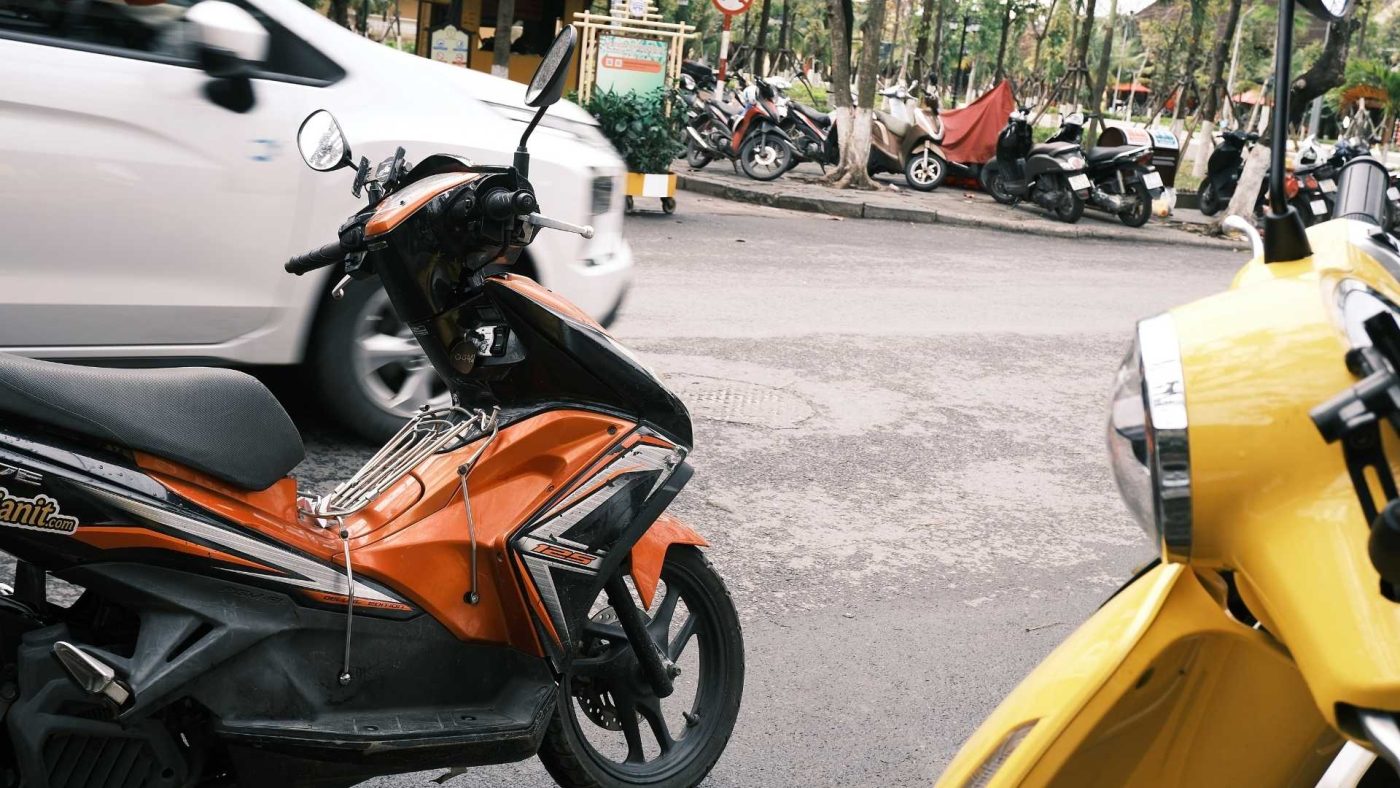
Renting a bike for the Hai Van Pass — our locations
This half we can speak to directly. Anh Khoa has been renting in Hoi An since 2015 (ANH KHOA HOI AN CO., LTD, business registration 4001210046). Three of our own shops, plus partner drop-off points at each end of the Hai Van route:
| Location | Address | What it is for |
|---|---|---|
| Head Office | 84 Phan Chau Trinh, Hoi An | Main fleet. Free pickup here — walk in and ride out. |
| Branch II | 08 Cau Hoi Muong, Hoi An Dong | Closer if you are staying east of the Old Town. |
| Branch III | Cam Thanh Hamlet | For the An Bang / Cam Thanh side. |
| Hue (partner) | 201 Tran Phu St. | One-way drop-off at the north end of the Hai Van ride. |
| Da Nang (partner) | 136 Hoang Bich Son St. | Drop-off if you are flying out of Da Nang. |
Open 7:00 AM – 9:00 PM daily, including holidays. Hotel delivery anywhere in central Hoi An is 30,000₫; pickup at the Head Office is free. Booking is fastest on WhatsApp: +84 935 206 306. Roadside assistance runs 24/7 on +84 766 766 087 — a real number with a real person, which is exactly what we just told you to demand of a Ha Giang shop.
For the ride itself: the one-way Hoi An ⇄ Hue rental is 750,000₫ with free bags transfer. Staying local instead? Automatic scooters start at 120,000₫/day, and 50cc bikes and e-bikes need no licence at all.
Season: when each ride is at its best
These two rides do not share a weather calendar. Central Vietnam and the far north are different climates, and the months that ruin one are often fine for the other.
| Period | Ha Giang Loop | Hai Van Pass |
|---|---|---|
| Mar – May | Good — 18–25°C, clear visibility, smooth riding | Excellent — dry, clear, warm |
| Jun – Aug | Worst — rainy season, slippery roads, fog, landslides. July–August especially | Good but hot — dry, 24–35°C, start early |
| Sep – Oct | Best of the year — harvest scenery, clear skies | Mixed — rainy season begins, storms possible |
| Nov – Feb | Cold — 5–15°C at altitude, heavy fog on the passes | Cool and often wet — the pass can sit inside cloud |
September and October are peak Ha Giang and awkward Hai Van. March to May is excellent for both. If you are trying to fit both rides into one Vietnam trip, spring is the only window where neither is compromised — and it is also when the Hai Van Pass is at its clearest, which matters because the whole point of that road is the view.
So which one should you do?
Do the Ha Giang Loop if:
- You have at least 5 spare days
- You’re a confident rider with real experience on mountain roads — or you’re happy to take an easy rider
- Remote landscape and ethnic culture is what you came to Vietnam for
- You’re travelling north anyway (it’s usually the first or last leg of a Vietnam trip)
Do the Hai Van Pass if:
- You have one day, not four
- Your riding experience is limited but not zero
- You’re travelling between Hoi An, Da Nang and Hue — which most itineraries do
- You want a great ride without restructuring your whole trip around it
Do neither on a bike if you’ve genuinely never ridden. Take an easy rider on Ha Giang, or a car over Hai Van. Vietnam’s mountain roads are not a good classroom.
Can you do both?
Yes — and on the standard backpacker route they fit naturally, because they’re at opposite ends of the country.
The common north-to-south trail runs Hanoi → Ha Giang Loop → Ninh Binh → Phong Nha → Hue → Hai Van Pass → Hoi An → Da Lat → HCMC. Reverse it if you’re going south-to-north. Ha Giang tends to be the first or last big thing you do; Hai Van sits right in the middle, on the leg between Hue and Hoi An.
That’s the neat part: you don’t have to choose. Ha Giang is the multi-day expedition. Hai Van is the day you were already spending getting from Hue to Hoi An — you just spend it on a better road.
If you’re riding Hue → Hoi An rather than the other way, we run the route in both directions — pick up in one city, drop in the other.
Booking the loop — or keeping it simple
Most riders do the loop over three days with an easy rider, so you can watch the canyon instead of the road — compare small-group loop tours on GetYourGuide’s Ha Giang page. If Hai Van Pass wins instead, you need none of that: grab one of our bikes at 84 Phan Chau Trinh and we’ll mark the route on your map for free.
Prefer to ride the loop yourself?
Rent a bike right in Ha Giang town — semi-automatic and manual bikes built for the passes, luggage straps included, and you keep it for the whole loop. Book before you get on the night bus; the good bikes go first in October and November.
✓ Free cancellation · ✓ Instant confirmation · ✓ Pay at pickup on most optionsRiding the Hai Van Pass this week?
One-way Hoi An to Hue is 750,000₫ with your bags moved for free. Staying local instead? Automatic scooters from 120,000₫/day, and 50cc bikes need no licence at all. Delivery from 30,000₫ across central Hoi An.
Roadside assistance 24/7 · 84 Phan Chau Trinh, Hoi AnFrequently asked questions
Is the Ha Giang Loop still called that after the province merger?
Yes. Travellers, guides and rental shops all still call it the Ha Giang Loop, and Ha Giang city remains the starting point. Only the administrative name changed: since 1 July 2025 the area sits inside Tuyen Quang province. The road and route are unchanged.
Which is harder, Ha Giang Loop or Hai Van Pass?
Ha Giang, by a wide margin. Hai Van is 21 km of well-paved, well-marked mountain road that thousands of ordinary travellers ride every year. Ha Giang is 350 km of remote, steep, sometimes broken road over 3–4 days, far from help. They’re not in the same category.
Can I rent a motorbike in Hoi An and ride to Ha Giang?
You could, but you shouldn’t. It’s roughly 1,200 km each way — Hoi An to Hanoi alone is about 900 km by road, then another 300 km north to Ha Giang. That’s most of a week just in transit, on a scooter never intended for it. Fly or take the train to Hanoi, bus to Ha Giang, rent locally. Our bikes are for central Vietnam.
How much does the Hai Van Pass ride cost?
Our one-way Hoi An → Hue rental is 750,000₫ (~$30) including free bags transfer to your Hue hotel, helmet, raincoat, phone holder and 24/7 roadside support. Optional add-ons: motorbike bodywork insurance +50,000₫/day (bodywork only; no rider injury or medical cover), full tank +200,000₫, top box +50,000₫/day.
Do I need an International Driving Permit to ride in Vietnam?
Yes. Vietnamese law requires a valid IDP (with the motorbike category endorsed) to legally ride anything above 50cc, and your travel insurance will very likely refuse a claim without one. If you don’t have an IDP, ride a 50cc scooter or e-bike — no licence needed — or take a guided tour.
When is the best time to ride the Hai Van Pass?
February to August is dry and clear. September–October brings showers — start early. November–January is the central Vietnam rain season; the pass is often fogged in and wet.
Updated August 2026. Distances, prices, bus fares and seasonal conditions are approximate and recorded at the time of writing — rental rates in Ha Giang in particular move constantly, and road conditions there change every wet season. Ha Giang province was merged into Tuyen Quang province on 1 July 2025; the route and the name riders use are unchanged. Always check current conditions and reviews the week you travel. Spotted something out of date? Message us and we will correct it.








Pick your ride in Hoi AnChọn xe cho chuyến đi Hội An
Scooters, electric bikes and bicycles from one shop in the Old Town — delivered to your hotel, helmets and roadside help included.Xe máy, xe điện và xe đạp — giao tận khách sạn, kèm hai nón bảo hiểm và hỗ trợ dọc đường.
Not sure which one fits? Message us on WhatsApp and we’ll recommend a bike for your plans.
Chưa biết chọn xe nào? Nhắn Zalo 0935 439 306, tụi mình tư vấn theo lịch trình của bạn.